 |
| Pix credit here |
The war between rival factions of the Sudanese Arab elite has provided evidence, again, that the techniques and modalities of violent aspects of warfare have neither ideology nor limits--they are instruments the utility of which is a function of desire and objectives by those who use them. In the case of Sudan it appears to be used to eliminate non-Arab Black Africans from contested parts of Sudan. Racial and ethnic cleansing has become the stuff of the ordinary in the wars that have emerged below the triggering points of international (and certainly U.N.) organized outrage. That was again illustrated in the context of the all of the Sudanese city of el-Fasher to the Rapid Support Forces (RSF).
The Wall Street Journal reported that "Sudan’s civil war is taking a jarring turn in Darfur, where an Arab-led militia is now using state-of-the-art drones and execution squads to dominate the region’s Black population. . . . The group behind the violence, the Rapid Support Forces, led by Lt. Gen. Mohamed Hamdan Dagalo, has previously been accused by the U.S. of pursuing a genocide of Darfur’s Black population. Two decades ago, its predecessor was involved in the killing of more than 200,000 people in Darfur." (Nicholas Bariyo, "Sudan Militia, Armed With Drones, Hunts Down Black Population of Darfur," Wall Street Journal 31 October 2025). Of particular interest was the way in which dual purpose technologies have been used in the conflict.
The Yale Humanitarian Research Lab (HRL, HUMAN SECURITY EMERGENCY: El-Fasher Falls to RSF: Evidence of Mass Killing, 27 October 2025) was a bit more circumspect: "“El-Fasher appears to be in a systematic and intentional process of ethnic cleansing of Fur, Zaghawa, and Berti indigenous non-Arab communities through forced displacement and summary execution,” the HRL said." (Yale report finds evidence of RSF mass killings in Sudan’s el-Fasher). Al Jazeera noted "The RSF, which has been fighting Sudan’s military for control of the country, killed at least 1,500 people over the past three days as civilians tried to flee the besieged city, the Sudan Doctors Network said on Wednesday. The group, which tracks the country’s civil war, described the situation as “a true genocide”. (here; "Saudi Arabia, Egypt, Qatar, Turkiye and Jordan have condemned the abuses committed by the RSF in Sudan."). Goobal mass mobilizations, however, do not appear to have emerged either in the first phase years ago nor now.
 |
| Pix credit here |
The U.N, reporting follows below.
‘Blood on the sand. Blood on the hands’: UN decries world’s failure as Sudan’s El Fasher falls
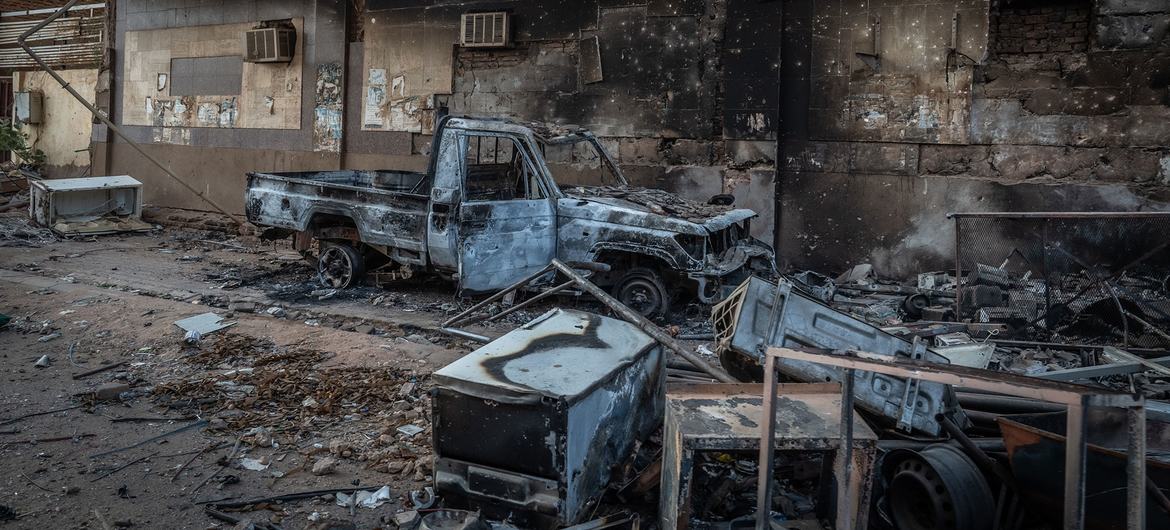
El Fasher has “descended into an even darker hell,” senior UN officials warned on Thursday, as the Rapid Support Forces (RSF) militia seized control of the North Darfur capital after a 500-day siege, forcing tens of thousands to flee on foot amid reports of mass executions, rape and starvation.
Briefing ambassadors in the Security Council, the UN’s top relief official Tom Fletcher said “women and girls are being raped, people being mutilated and killed – with utter impunity,” adding: “We cannot hear the screams, but – as we sit here today – the horror is continuing.”
After overrunning the Sudanese Armed Forces’ (SAF) last major stronghold in Darfur which had held out for over 500 days, RSF fighters moved house to house, he said, with “credible reports of widespread executions” as civilians attempted to escape.
Nearly 500 patients and their companions were reportedly killed in the Saudi Maternity Hospital, one of numerous health facilities targeted in the fighting.
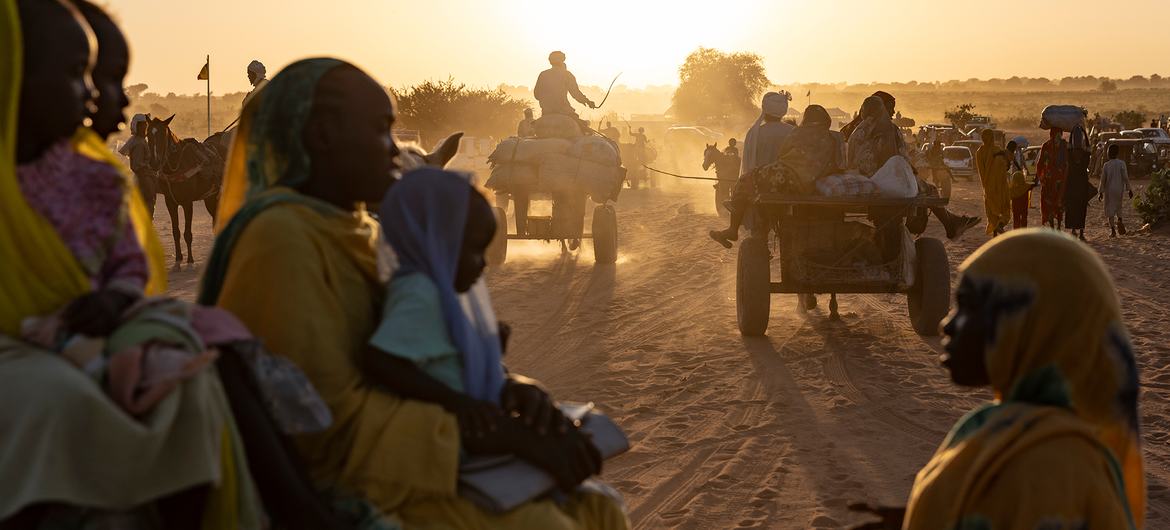
“Tens of thousands of terrified, starving civilians have fled or are on the move,” Mr. Fletcher said. “Those able to flee – the vast majority women, children, and the elderly – face extortion, rape and violence on the perilous journey.”
Horror spreads
Assistant Secretary-General for Africa Martha Pobee called the fall of El Fasher “a significant shift in the security dynamics,” warning that the implications for Sudan and the wider region are “profound.”
Fighting has already intensified in the Kordofan region, where the RSF captured the strategic town of Bara last week.
Drone strikes by both RSF and SAF, she said, are now hitting new targets across Blue Nile, South Kordofan, West Darfur and Khartoum. “The territorial scope of the conflict is broadening,” she cautioned.
“The risk of mass atrocities, ethnically targeted violence and further violations of international humanitarian law, including sexual violence, remains alarmingly high,” Ms. Pobee told the Council.
“Despite commitments to protect civilians, the reality is that no one is safe in El Fasher. There is no safe passage for civilians to leave the city.”
The UN human rights office, OHCHR, has documented mass killings, summary executions, and ethnically motivated reprisals both in El Fasher and Bara. In the latter, at least 50 civilians were killed in recent days, including five Sudanese Red Crescent volunteers, Ms. Pobee said.
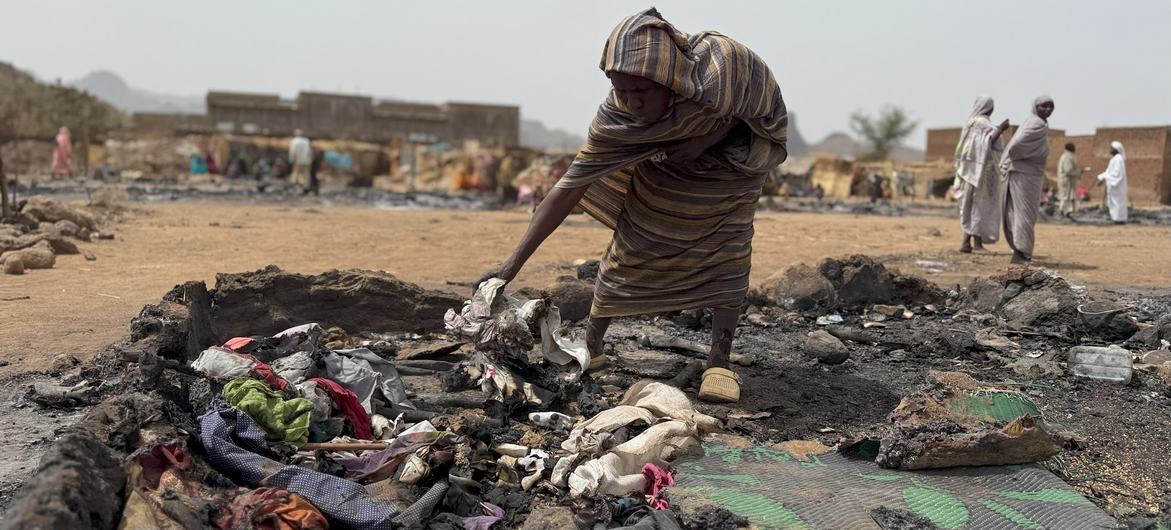
History of atrocity in Darfur
“What is unfolding in El Fasher recalls the horrors Darfur was subjected to twenty years ago,” Mr. Fletcher said, referring to the atrocities of the early 2000s that shocked the world and eventually led to International Criminal Court indictments.
“But somehow today we are seeing a very different global reaction – one of resignation,” he continued. “This is also a crisis of apathy.”
“The Sudan crisis is, at its core, a failure of protection, and our responsibility to uphold international law,” Mr. Fletcher said. “Atrocities are committed with unashamed expectation of impunity…the world has failed an entire generation.”
Descent into all-out war
The conflict in Sudan began in April 2023, when a long-simmering power struggle between the SAF and RSF erupted into open war.
The RSF traces its roots to the Janjaweed militias accused of atrocities in Darfur 20 years ago, while the SAF represents the remnants of long-standing military rule from Khartoum.
Both forces once shared power after the 2019 ouster of former president Omar al-Bashir, but a dispute over integrating the RSF into the national army triggered a nationwide collapse.
What began as a contest for control of the State has since devolved into a brutal struggle marked by ethnic killings, urban siege warfare, mass displacement, and famine conditions across large parts of the country.
Regional spillover and humanitarian collapse
More than four million people have already fled into neighbouring Chad, South Sudan and the Central African Republic, straining humanitarian operations and heightening instability in already fragile border regions.
Inside Sudan, more than 24 million people – over 40 per cent of the population – are food insecure. Tawila, the main destination some 50kms away for those fleeing El Fasher, is already hosting hundreds of thousands displaced by earlier attacks.
“Our teams in Tawila are seeing traumatized people arriving showing shocking signs of malnutrition,” Mr. Fletcher said.
‘Blood on the sand. Blood on the hands’
Mr. Fletcher said the Council must act “with immediate and robust action” to stop atrocities, ensure safe humanitarian access, and halt flows of weapons fuelling the war.
“I urge colleagues to study the latest satellite imagery of El Fasher; blood on the sand,” he told ambassadors. “And I urge colleagues to study the world’s continued failure to stop this. Blood on the hands.”
No comments:
Post a Comment