 |
| Pix Credit here |
Secretary Hegseth recently attended the International Institute for Strategic Studies Shangri-La Dialogue, where he gave what he hoped was an important speech. The event describes itself this way:
Held annually in Singapore, the Dialogue is Asia’s premier defence summit. It enables decision-makers from across the Asia-Pacific, North America, Europe and the Middle East to gather together to discuss the most pressing regional security issues and to share policy responses. It features plenary debates led by government ministers, as well as important opportunities for bilateral discussions among delegations. (here)
 |
| Pix credit here |
China will not send its defense minister to this year’s Shangri-La Dialogue, shunning a chance for a high-level meeting with US and Asian counterparts as tensions simmer with Washington. China announced Thursday it will instead be represented by a delegation from the People’s Liberation Army National Defense University, marking the first time in five years a high-level delegation from Beijing will miss Asia’s largest defense and security forum. The United States will be represented by Defense Secretary Pete Hegseth at the event, which often provides opportunities on the sidelines for rare face-to-face meetings between top generals and defense officials from the US and China. (here)And, as expected, the Chinese rejected, in the usual colorful way, whatever it was the Secretary of Defense had to say.
China’s top official at a global defence dialogue on Saturday (May 31) rejected “accusations” made against the country as unfounded and politically motivated, and asserted its commitment to protecting and improving regional security. “We do not accept groundless accusations against China. Some of these claims are completely fabricated, some distort the truth, and some are outright cases of ‘the thief crying thief’,” said Rear Admiral Hu Gangfeng, who is leading a delegation from the National Defense University of the People’s Liberation Army at the Shangri-La Dialogue in Singapore. (Here)
Well, then, what was it that the Defense Secretary had to say as an official of the United States that produced the expected and necessary public reaction from the Chinese? On balance, there was little in the speech that has not been said by officials of every administration since the Obama Administration. And there is little about the longevity of U.S. interests in the Pacific that has not been established tentatively since the 1850s and more robustly (in contextually and historically acceptable ways) since the end of the 19th century. That, though is important. There is now a longer term (measured as these things are measured in the United States) and consistent emphasis on the Asian sector in terms of the interest of the United States in its contemporary form. The differences are of style of of the manifestation of that interest in the form of the variations in the politics and ideologies of the various administrations that have populated the White House since the first decade of this century. But the interest remains--whether in the form of the Trans Pacific Partnership, sanctions regimes against the Chinese, the development of mutual defense pacts among states, or, if this administration actually has the stomach for it (the jury is still out on that) through an aggressive transactions oriented tariff and migration based strategy to re-orient relations among the leading powers in the Pacific.
Still, this version of the American vision for the Indo-Pacific (or whatever it is that the region must now be called--any name suits as long as it has the desired effect of constructing from it an acceptably shaped geographical reality that can then be used appropriately to everyone's benefit) reflects another step in shaping the content of the American New Era under the core of leadership of the President. That vision, like everything else in this Administration is transactional:
And under President Trump's leadership, the United States is committed to achieving peace through strength. That starts with deterring aggression around the world and here in the Indo-Pacific, here in our priority theater, here with you — our allies and our partners. The United States stands ready to work with any country that is willing to step up and preserve the global and regional peace that we all hold dear. (Secretary's speech)
One could expect nothing else from our merchant president; but it is also likely to be incomprehensible to the official and warrior castes that populate some of the leadership cultures of allies and opponents. Merchants make deals with the willing and oppose competitors by any means at least with respect to those interests (the wealth augmenting transactions and perhaps relationships) that drive the way they view the world. For officials who prefer to see the world as something that is managed to enhance their objectives or for warriors who view things in terms of crude power relations for which merchants and officials ought to be made to contribute (and for whose greater glory merchants and official exist in the first place) deal making will have to be "translated" into their own reality affirming language in order to be useful and usefully responded.
For merchants, on the other hand, warriors and officials exist merely to enhance the ability fo the merchant to operate. The warrior is "muscle" and protection. The official services accounts and translates transaction into systems for exploiting productive forces (including labor, warriors and officials), and enhancing their ability to operate within platforms of transactions in which they can act as both producers and consumers of wealth through transactional activity.
And to that end from day one, President Trump gave me a clear mission at the Defense Department: achieve peace through strength. To accomplish this mission, our overriding objectives have been equally clear: restore the warrior ethos, rebuild our military, and reestablish deterrence. And it starts with the warrior ethos. All of us in this profession of arms understand that humans are far more important than hardware. So, we're focused on lethality, meritocracy, accountability, standards, readiness, and warfighting. (Secretary's speech)

And every merchant, warrior, and official needs an adversary. For the United States, having done without a Great Adversary since the 1990s, now finds itself with a quite interesting adversary--a frenemy that has become the incarnation of the bete noir for the American elites--at once seduced by the possibility of transposing some of the techniques and sensibilities of Chinese Leninism into American liberal democracy, and at the same time leery of actually doing what it takes to become a Marxist-Leninist state with liberal democratic characteristics.
Thus, on the one hand, the Secretary sounds like a Chinese official speaking to the Shanghai Cooperation Organization when he says :
As President Trump also said in Riyadh, the United States is not interested in the moralistic and preachy approach to foreign policy of the past. We are not here to pressure other countries to embrace or adopt policies or ideologies. We are not here to preach to you about climate change or cultural issues. We're not here to impose our will on you. We're all sovereign nations. We should be able to choose the future we want to build. We respect you, your traditions, and your militaries. And we want to work with you where our shared interests align for peace and prosperity. On this sure foundation of mutual interests and common sense, we will build and strengthen our defense partnerships to preserve peace and increase prosperity.(Secretary's speech)
But in the next breath sounds like a merchant who is threatened by an adversary that chooses not to play by the rules but rather seeks not top compete but to dominate in the classical sense as a merchant might understand this:
we do not seek conflict with Communist China. We will not instigate nor seek to subjugate or humiliate. President Trump and the American people have an immense respect for the Chinese people and their civilization. But we will not be pushed out of this critical region. And we will not let our allies and partners be subordinated and intimidated. China seeks to become a hegemonic power in Asia. No doubt. It hopes to dominate and control too many parts of this vibrant and vital region. Through its massive military build-up and growing willingness to use military force to achieve its goals, including grey zone tactics and hybrid warfare, China has demonstrated that it wants to fundamentally alter the region's status quo. * * * China uses its vast and sophisticated cyber capabilities to steal technology and attack critical infrastructure— in your countries and in the United States, as well. These actions not only compromise our countries, but endanger the lives of our citizens. (Secretary's speech)
 |
| Pix credit here |
But perhaps it was what was not said that might have been the most important element of the speech--for those leaders in other parts of the world of interest to the United States--and especially Latin America, Europe, and MENA, the same pattern and expectations will likely dominate the relationships with the United States. I expect that Brazil will resist, but that Mexico will be a far more effective player. That means that trade deals with added defense elements might prove to be more important in the near future, not just in Asia but elsewhere.
The text of the Secretary's speech follows below along with the perhaps more important official summary prepared by officials well versed in these sorts of tasks at the Department of Defense.
Remarks by Secretary of Defense Pete Hegseth at the 2025 Shangri-La Dialogue in Singapore (As Delivered)
Well, good morning. It is great to be in Singapore.
And Bastian, thank you very much for your warm welcome. The Shangri-La Dialogue is an important forum for bringing together defense leaders from across the Indo-Pacific and the world. And I want to thank IISS for hosting us this morning.
As was mentioned, I'm certainly proud to be back into the Indo-Pacific for the second time as the Secretary of Defense. And I'm going to keep coming back, and back, and back again. You're stuck with me.
But it's not just me. America is proud to be back in the Indo-Pacific — and we're here to stay. The United States is an Indo-Pacific nation. We have been since the earliest days of our Republic. We will continue to be an Indo-Pacific nation — with Indo-Pacific interests — for generations to come.
And under President Trump's leadership, the United States is committed to achieving peace through strength. That starts with deterring aggression around the world and here in the Indo-Pacific, here in our priority theater, here with you — our allies and our partners. The United States stands ready to work with any country that is willing to step up and preserve the global and regional peace that we all hold dear.
Your presence here today sends a strong message about our shared purpose, our shared commitment to peace, our shared dedication to a free and open Indo-Pacific.
So, this morning, I'd like to share the U.S. Defense Department's vision for the Indo-Pacific.
You see, my job is to create and maintain decision space for President Trump, not to purport to make decisions on his behalf. And in doing that I'm joined today by two great military leaders from the United States military.
Our Chairman of the Joint Chiefs, Dan "Raisin" Cane, is here with me, a great partner, who understand how to take a global look, globally integrate American interests and American power, regionally and internationally.
And of course we're joined by our Indo-Pacific Commander, Admiral Sam Paparo, America's fighting general in the Pacific. Admiral, thanks for being here.
It is our job, the three of us and the entire Defense Department, to keep our military strong and create options.
President Trump was elected to apply America first on the world stage. You know, getting a chance to watch him first hand in the Oval Office and around the world, the world is incredibly fortunate to have an American president with the combination of being a peace seeker and a strong leader. President Trump has the unique ability to make possible things that seem impossible, moving the Overton window. He is the ultimate deal maker.
And to that end from day one, President Trump gave me a clear mission at the Defense Department: achieve peace through strength. To accomplish this mission, our overriding objectives have been equally clear: restore the warrior ethos, rebuild our military, and reestablish deterrence.
And it starts with the warrior ethos. All of us in this profession of arms understand that humans are far more important than hardware.
So, we're focused on lethality, meritocracy, accountability, standards, readiness, and warfighting. We respect human nature, hard training, and the lessons of history. Our combat formations will be trained and skilled. Our standards will be high and unwavering. If you can do the job, you'll be in our formation. If you can't, you are not. Color blind. Gender neutral. Merit-based. It's as simple as that.
That is restoring the warrior ethos, and our troops, in America, are responding to it. Morale, recruiting, retention, readiness, training, capabilities, all rapidly increasing thanks to President Trump's back-to-basics approach.
Our second priority is rebuilding the military. We're equipping American warfighters with the most advanced capabilities so that we remain the strongest and most lethal fighting force in the world.
President Trump is spending — for the first time ever — over $1 trillion next year to do this. A 13 percent increase in American defense spending. The Golden Dome for America, our new sixth generation fighter — the F-47, our new stealth bomber —the B-21, new submarines, destroyers, hypersonics, drones, you name it. It's all part of it. The best military equipment in the world.
We're reviving our defense industrial base and investing in our shipyards. We're rapidly fielding emerging technologies that will help us remain the world leader for generations to come. We are stronger — yet more agile — than ever before.
When our opponents know that our military is armed with the most capable weapons systems, wielded by skilled warriors with the will to prevail, they are less likely to challenge us on the battlefield — which is the point.
This leads to the third objective which is reestablishing deterrence. Across four years of deferred maintenance under the Biden administration, the world saw, unfortunately, a feckless and weak America. An invasion of 21 million illegals on our southern border, Russian aggression in Ukraine after what had happened under the previous Democratic administration in 2014 in Crimea. Islamist terror on October 7th in Israel. A humiliating and deadly retreat in Afghanistan. An enriched and emboldened Iran. A Chinese spy balloon flying over our country. And a Secretary of Defense that was AWOL for a week. That ends now. Not anymore.
We are re-establishing deterrence around the world, but credible deterrence starts at home, like our historic Golden Dome for America. And it starts at our borders. Border security for us, and for all of you, is national security. So we have surged troops to our Southern border and we'll have 100% operational control of there soon enough. We spent two decades patrolling other borders. It's time to prioritize the defense of our own.
We're also increasing security in the Western Hemisphere and taking back the Panama Canal from malign Chinese influence. It is key terrain, after all. China did not build that canal. We did. And we will not allow China to weaponize it or control it. Deterrence starts in our own backyard.
But beyond our borders, and beyond our neighborhood, we are reorienting toward deterring aggression by Communist China. We'll talk a little bit more about that in a minute.
But elsewhere — and around the world — we are engaging with, enabling, and empowering our allies. Sometimes with tough love, but love nonetheless. We're pushing our allies in Europe to own more of their own security — to invest in their defense, things that are long overdue.
We still believe that the "N" in NATO stands for North Atlantic and that our European allies should maximize their comparative advantage on the continent. And thanks to President Trump, they are stepping up. An alliance cannot be ironclad if in reality or perception it is seen as one-sided.
That is changing and that is very important. And as our allies share the burden, we can increase our focus on the Indo-Pacific, our priority theater.
You see, here in the Indo-Pacific, our futures are bound together. The prosperity and security of the American people are linked to those of your people. We share your vision of peace and stability, of prosperity and security.
And we are here to stay.
And as a matter of fact, we are here this morning, and somebody else isn't.
But for a generation, the United States ignored this region. We became distracted by open-ended wars, regime change, and nation building. I had a front row seat as a soldier in Iraq and Afghanistan. These costly diversions lacked clearly defined goals and were not tied to vital and core American interests.
President Trump is changing that. We are not making the same mistakes. Not this generation and not now. We are done with that approach. We're focused on delivering for the American people, on safeguarding their security, on protecting their economic interests, and on using common sense to preserve peace in the Indo-Pacific.
You know, standing here in Singapore, I think this approach aligns quite well with the pragmatic style of Singapore's legendary Prime Minister, Lee Kwan Yew. Across three decades, he built this country into one of the world's most important hubs of finance and innovation.
Like the late-Prime Minister, President Trump's approach is grounded in common sense and national interests, built on a willingness to work with others while respecting mutual self-interest, and informed by an understanding of military strength but shaped by a preference for engaging on the basis of commerce and sovereignty — not war.
These two historic men share a willingness to challenge old ways of doing things that no longer make sense. We refuse to accept any paradigm that makes conflict inevitable.
As President Trump said in Riyadh, in an historic speech in Saudi Arabia, America does not have or seek permanent enemies. Under President Trump's leadership, we are applying this common sense approach to defense here in the Indo-Pacific and throughout the world.
And we believe the results speak for themselves. President Trump is leading European allies to step up in their own defense, as I mentioned. He is striking new, fairer trade deals that protect Americans while providing a lasting and secure basis for commerce. Not to mention resilient, anti-fragile, and reliable supply chains for our and your defense needs. He's also rebalancing security and defense arrangements with key allies in the region.
This enables all of us to benefit from the peace and stability that comes with a lasting and strong American presence here in the Indo-Pacific. These benefits, they only multiply when our allies and partners are also strong.
As President Trump also said in Riyadh, the United States is not interested in the moralistic and preachy approach to foreign policy of the past.
We are not here to pressure other countries to embrace or adopt policies or ideologies. We are not here to preach to you about climate change or cultural issues. We're not here to impose our will on you. We're all sovereign nations. We should be able to choose the future we want to build. We respect you, your traditions, and your militaries. And we want to work with you where our shared interests align for peace and prosperity.
On this sure foundation of mutual interests and common sense, we will build and strengthen our defense partnerships to preserve peace and increase prosperity.
But a threat gathers. As we all know, strength and security underpin peace and enable prosperity. And our common sense approach to achieving security — achieving peace through strength — requires seeing things crystal clearly. It requires confronting obvious truth about the threats we face in the Indo-Pacific. And requires meeting those threats with a very real sense of urgency.
So, before we get to those hard truths, and to make sure for our friends in the press our words are not misconstrued as they so often are, let me begin by saying, we do not seek conflict with Communist China. We will not instigate nor seek to subjugate or humiliate. President Trump and the American people have an immense respect for the Chinese people and their civilization. But we will not be pushed out of this critical region. And we will not let our allies and partners be subordinated and intimidated.
China seeks to become a hegemonic power in Asia. No doubt. It hopes to dominate and control too many parts of this vibrant and vital region. Through its massive military build-up and growing willingness to use military force to achieve its goals, including grey zone tactics and hybrid warfare, China has demonstrated that it wants to fundamentally alter the region's status quo.
We cannot look away, and we cannot ignore it. China's behavior towards its neighbors and the world is a wake-up call. And an urgent one.
China uses its vast and sophisticated cyber capabilities to steal technology and attack critical infrastructure— in your countries and in the United States, as well. These actions not only compromise our countries, but endanger the lives of our citizens.
In the South China Sea, China harasses its neighbors – many of which are here in the room today. China seeks to intimidate you in your own waters. We've all seen the videos and pictures of water cannons, and ship-to-ship collisions, and illegal boardings at sea. We're also seeing the illegal seizing and militarizing of lands in the South China Sea.
These actions reveal a lack of respect for neighbors and they challenge sovereignty, freedom of navigation, and overflight. We are watching very closely China's destabilizing actions. And any unilateral attempt to change the status quo in the South China Sea and the First Island Chain by force or coercion is unacceptable.
Every day you see it. China's military harasses Taiwan. These activities have been paired with China's rapid military modernization and buildup – including huge investments in nuclear weapons, hypersonics, and amphibious assault capabilities.
It has to be clear to all that Beijing is credibly preparing to potentially use military force to alter the balance of power in the Indo-Pacific. We know. It's public that Xi has ordered his military to be capable of invading Taiwan by 2027. The PLA is building the military needed to do it. Training for it every day. And rehearsing for the real deal. Admiral Paparo has spoken very clearly about this on multiple occasions.
Again, to be clear: any attempt by Communist China to conquer Taiwan by force would result in devastating consequences for the Indo-Pacific and the world. There's no reason to sugarcoat it. The threat China poses is real.
And it could be imminent. We hope not. But it certainly could be.
Facing these threats, we know that many countries are tempted by the idea of seeking both economic cooperation with China and defense cooperation with the United States. Now that is a geographic necessity for many. But beware the leverage that the CCP seeks with that entanglement. Economic dependence on China only deepens their malign influence and complicates our defense decision space during times of tension.
Nobody knows what China will ultimately do, but they are preparing. And therefore we must be ready as well.
Urgency and vigilance is our only option at the Department of Defense with our allies, because the United States, especially under President Trump, does not seek war. We do not seek to dominate or strangle China. To encircle or provoke. We do not seek regime change, nor will we instigate or disrespect a proud and historic culture. We will be ready, but we will not be reckless. Instead, we seek peace. But we must ensure that China cannot dominate us — or our allies and partners. Maintaining the status quo requires strength. That's just a rational, common sense goal that all should be able to live with.
President Trump has also said that Communist China will not invade Taiwan on his watch. So, our goal is to prevent war, to make the costs too high, and peace the only option. And we will do this with a strong shield of deterrence, forged together with you – America's great allies and defense partners. Together, we will show what it means to execute peace through strength. In many ways seen and unseen. Overt and covert.
But if deterrence fails, and if called upon by my Commander in Chief, we are prepared to do what the Department of Defense does best – fight and win — decisively.
And as I've said many times before, and it's important for this room to hear today, and all the world — America First certainly does not mean America alone. Especially alongside so many of our allies, model allies like Poland, Israel, and the Gulf States, the Baltic States. And it does not mean ignoring the world.
As you have all seen President Trump is committed to a lasting and durable peace in Ukraine. And with an unwavering commitment to ensure Iran never has nuclear weapons. He seeks a strong and verifiable negotiated deal. The other option is regional war, or worse.
As we shift our focus to this region, and as Europe steps up and takes greater ownership for its own security, President Trump and I will be counting on you, on this room – our allies and partners – to be force multipliers for peace alongside the United States.
We ask — and indeed, we insist — that our allies and partners do their part on defense. Sometimes, that means having uncomfortable and tough conversations. Partners owe to it to each other to be honest and to be realistic. As many of you have been with me in the past few days and I with you. This is the essence of a pragmatic, common sense defense policy.
But you will also see that we are — and will remain — loyal to our allies and partners. The military-to-military relationship between many of our countries goes back decades, and in some cases, centuries. In fact, the only way to ensure lasting alliances and partnerships is to make sure that each side does its part and sees the benefit.
We will stand with you and work alongside you to deter Chinese aggression. Each day, together, creating more and more dilemmas and complications should China want to act. Should they decide to overturn the status quo. More dilemmas, more complications, more questions, more concerns, more variables, more reasons to say, "it's not worth it."
No one should doubt America's commitment to our Indo-Pacific allies and partners. We will continue to wrap our arms around our friends and find new ways to work together — not only our treaty allies here, but also our key defense partners in ASEAN and across the Indo-Pacific.
For example, look no further than to our growing defense relationship with India, where we pass new milestones by the day—from shared ventures of our defense industries to the increased operational coordination and interoperability between our two militaries.
I urge all our allies and partners to seize this moment with us. Our defense spending must reflect the dangers and threats that we face today. Because deterrence doesn't come on the cheap, just ask the American taxpayer.
Time is of the essence. We must step up and move out with urgency.
And it's hard to believe, a little bit, after some trips to Europe that I'm saying this this – but thanks to President Trump Asian allies should look to countries in Europe as a new-found example. NATO members are pledging to spend 5% of their GDP on defense, even Germany. So it doesn't make sense for countries in Europe to do that while key allies in Asia spend less on defense in the face of an even more formidable threat, not to mention North Korea.
Ultimately, a strong, resolute, and capable network of allies and partners is our key strategic advantage. China envies what we have together. And it sees what we can collectively bring to bear on defense. But it's up to all of us to ensure that we live up to that potential by investing. U.S. allies in the Indo-Pacific can, and should, quickly upgrade their own defenses.
President Trump said it himself last month in Riyadh – and will never hesitate to wield American power swiftly and decisively if necessary.
That is re-establishing deterrence.
So, we're doing this here in the Indo-Pacific in three distinct ways, and forgive me as I go into a little bit of detail: First, by improving our forward force posture, second, by helping allies and partners strengthen their defense capabilities, and third by rebuilding defense industrial bases.
So first, the Department of Defense is prioritizing forward-postured, combat credible forces in the Western Pacific to deter by denial along the first and second island chains. In my first trip to the Indo-Pacific in March, I traveled to the Philippines to meet with President Marcos and Secretary of National Defense Teodoro. While there we announced our commitment to deploy more advanced U.S. military capabilities to the Philippines.
We announced the inaugural overseas deployment of NMESIS, a U.S. Marine Corps mobile anti-ship missile system, to the Philippines. The 3rd Marine Littoral Regiment – one of the U.S. military's most capable and lethal formations – exercised NMESIS along with our Philippine allies. Together we deployed the system to the Batanes Islands on the Luzon Strait between the Philippines and Taiwan. This enhanced our interoperability and improved our readiness on cutting-edge platforms where we need them, and when we need them.
We also announced that U.S. Special Operations Forces and Philippine Marines are training together on complex landing scenarios in the Batanes Islands. This demonstrates that our forces can conduct high-end operations in the most challenging of environments.
I also had a chance to visit Tokyo and meet with Prime Minister Ishiba and Defense Minister Nakatani. We announced that we're upgrading U.S. Forces Japan headquarters. This is about warfighting and deterrence – as well as common sense. Upgrading USFJ demonstrates the significant work of the U.S.-Japan Alliance as it evolves to emerging threats. It also reflects the progress the Alliance has made towards improving interoperability and strengthening Japan's capabilities.
And, this summer, the U.S. Army has plans to conduct its first live-fire test of its Mid-Range Capability system in Australia. This will be the first time that system is fired west of the International Date Line, the first time it's been tested on foreign soil. Deployments like this represent a commitment to the region, and there are many more planned.
On the home front, Golden Dome for America will protect the U.S. homeland against a catastrophic missile attack by adversaries. It will strengthen missile defenses for the U.S. homeland as we look for ways to improve regional missile defenses right here in the Indo-Pacific.
We're also using regional integrated air and missile defense. And we're deploying several key missile defense technologies and data-sharing partnerships with Japan and Australia. Leveraging America's best-in-class technologies to strengthen regional air and missile defense architectures.
Second, we're supporting allies and partners as they strengthen their own defense capabilities and capacity. We want to empower you – as partners, not dependents – to work more capably with the United States.
We're working to rapidly deliver the kinds of off-the-shelf, innovative, autonomous systems for which the American defense industry is renowned. It's why the Department partnered with U.S. industry to launch the Maritime Security Consortium. This consortium will build and sustain maritime domain awareness to deliver real operational effects by employing unmanned aircrafts and vessels. These capabilities, delivered quickly and at a lower cost, give a cutting edge advantage into the hands of our warfighters and of our defense partners in Southeast Asia.
A critical part of working with our partners is increasing interoperability – learning how to sail, fly, and fight as one. This year's BALIKATAN exercise in the Philippines was the largest-ever. In the South China Sea, we continue to conduct regular maritime activities alongside Australia, Japan, and the Philippines. We're also expanding our security partnership with India through robust military exercises like TIGER TRIUMPH. And we're also amplifying cooperation within the Quad and other multilateral frameworks. Within the Quad we are also leading an initiative called the Indo-Pacific Logistics Network, enabling Quad partners to leverage shared logistics capabilities in the Indo-Pacific. You know, they say, rookies talk strategy, pros talk logistics.
And we're grateful for the opportunity to train with all our allies in the region in other exercises like TALISMAN SABRE with Australia and COBRA GOLD in Thailand. These exercises enhance our lethality while improving our readiness to respond at a moment's notice. And that was certainly put into practice last March with the Thai military in response to the earthquake there.
Flying, and sailing, and operating together in peacetime ensures we are prepared for the unexpected.
And third, we are revitalizing our defense industrial bases and reallocating resources toward the most lethal and effective capabilities. We are doing this because success of the warfighters requires it.
It's one thing for an adversary to see multinational forces operating together in exercises. It's another thing entirely for that same country to see an integrated defense industrial base supporting those forces and standing ready to keep them in the fight.
That's why we're pleased to endorse the Partnership for Indo-Pacific Industrial Resilience, also known as PIPIR — a U.S.-initiated multilateral forum of 14 allies and partners working with industry, capital providers, and key non-governmental stakeholders, to strengthen industrial resilience, expand our capacity, and accelerate deliveries.
So today, I'm proud to announce the first PIPIR projects.
The first project plans to establish repair capability and capacity for P-8 radar systems in Australia. It will also enable Indo-Pacific allies and partners operating the aircraft, including New Zealand and the Republic of Korea, to repair aircraft within the region rather than relying on single repair sources in the continental United States.
The second is a project that will develop standards for small unmanned aerial systems across the Indo-Pacific, identifying secure sources of production for their critical components, and increasing global supply chain resilience for these essential systems.
Similarly, we are working through our Regional Sustainment Framework to do things like expand existing contracts for U.S Army Watercraft repair. The goal of this initiative is to bring in more providers and expand existing repair capability more broadly across the Indo-Pacific.
We'll also use our allies' world-class ship repair capabilities to enhance the U.S. Navy's operational effectiveness to save taxpayers money.
These moves will strengthen regional resiliency by increasing access to repair capabilities in theater and reducing dependency on far away supply chains.
We're deepening our cooperation with Australia's Guided Weapons and Explosive Ordnance enterprise with historic momentum and purpose. This work secures our technological edge and makes our munitions supply chains resilient.
In the last two months, we've reached an agreement for Australia to produce 155 millimeter ammunition and to assemble Guided Multiple Launch Rocket Systems, or GMLRS. These steps enhance our readiness and facilitate upgrades to our collective defense industrial base.
And we're working with India to co-produce equipment needed to deter aggression. And this includes negotiating an agreement to bring our industrial bases ever closer. Last month, we held our first-ever U.S.-India industry-government experts exchange to produce and field state-of-the-art autonomous systems as part of the U.S.-India Autonomous Systems Industry Alliance.
So, across the board, the United States, our allies, and our partners have made great progress in these — and many other — areas towards achieving peace through strength. But we have to move quickly and we have no time to waste.
So, as I conclude, it is with sage leadership, and strategic vision, and a sense of urgency that Lee Kwan Yew turned Singapore into one of the world's great success stories. Many call it the "Singapore Miracle." That's what common sense policies can achieve. And that's precisely what President Trump's vision is all about.
President Trump is a leader of peace, a man of peace, a force for peace. And together, we will achieve that peace through strength. Reestablishing deterrence. Sharing our burdens. Multiplying our strengths. Reinforcing our great alliances. Respecting our cultures. Not starting wars, but preventing them. And building a better future for our nations, for our mutual benefit.
During my last visit to the Indo-Pacific, I watched oil seep out from the wreckage of USS ARIZONA at Pearl Harbor. I saw the rows of crosses marking the graves of over 17,000 American soldiers at the Manila American Cemetery in the Philippines. And I had the chance to walk the black sandy beaches of Iwo Jima.
In these hallowed places you can't help but immediately feel
connected to the past — to the warriors who went before us. They gave
their all for me, for men and women they never knew, for freedom and for
peace. So, as we mark 80 years since the end of World War II, we owe
it to today's warriors, to our citizens — as we put our citizens first
and you put your citizens first. We owe it to them, to our children and
our grandchildren, to preserve this peace.
The motto of my first platoon, first one I led, was: "Those who long for
peace, must prepare for war." And that's exactly what we're doing. We
are preparing for war in order to deter war — to achieve peace through
strength. And we look out in this room and we look to you — to our
allies and to our partners — to join us in this important work.
Our time is now. The threats we face will not wait. And nor can we.
Thank you and Godspeed.
.
Hegseth Outlines U.S. Vision for Indo-Pacific, Addresses China Threat
While delivering plenary remarks at a Singaporean security summit today, Defense Secretary Pete Hegseth outlined to numerous Asian ally countries DOD's vision for the Indo-Pacific region, while also addressing the strategic threat posed by China.
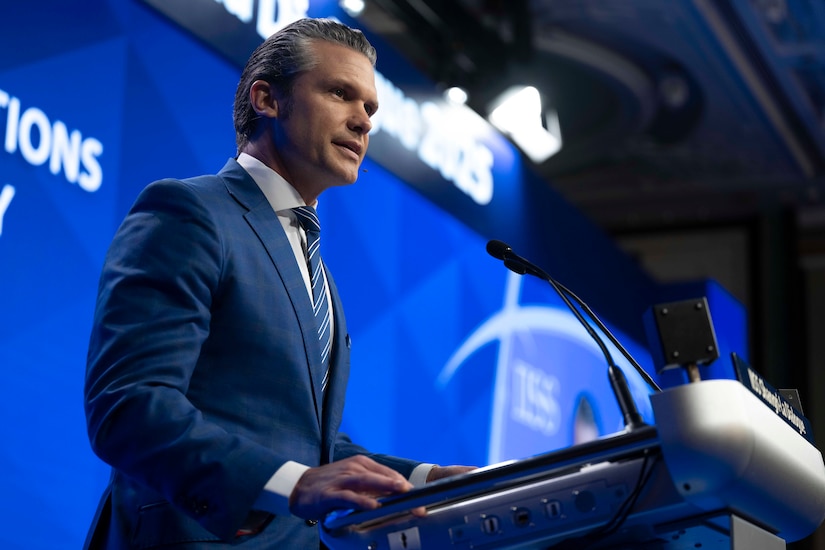
Speaking at the International Institute for Strategic Studies Shangri-La Dialogue, Hegseth began his remarks by underscoring the Defense Department's priorities of achieving peace through strength by focusing on restoring the warrior ethos, rebuilding the military and reestablishing deterrence.
The secretary then used the topic of deterrence — noting, specifically, that our allies around the world are beginning to invest more in their self-defense — to segue into speaking about the Indo-Pacific region.
"As our allies share the burden, we can increase our focus on the Indo-Pacific: our priority theater," Hegseth said.
Stating the futures of the U.S. and its Indo-Pacific allies are "bound together," Hegseth said the security and prosperity of Americans are linked to the security and prosperity of U.S. ally countries' citizens.
"We share your vision of peace and stability, of prosperity and security and we are here to stay," he said.
The future vision for the Indo-Pacific is one "grounded in common sense and national interests," Hegseth said, where the U.S. and its allies work together while respecting their mutual self-interests and engaging on the basis of sovereignty and commerce, as opposed to war.
The secretary pointed out, as President Donald J. Trump continues to lead European allies to step up in their self-defense, the U.S. can then focus more resources on the Indo-Pacific region.
"This enables all of us to benefit from the peace and stability that comes with a lasting and strong American presence here in the Indo-Pacific," Hegseth said.
"These benefits, they only multiply when our allies and partners are also strong," he added.
Regarding American influence in the region, Hegseth said the U.S. isn't interested in the approach to foreign policy of the past.
"We are not here to pressure other countries to embrace and adopt our politics or ideology; we are not here to preach to you about climate change or cultural issues; [and] we are not here to impose our will on you. We are all sovereign nations," Hegseth said, adding the U.S. seeks to work with its allies in areas where mutual interests align for peace and prosperity.
"On this sure foundation of mutual interests and common sense, we will build and strengthen our defense partnerships to preserve peace and increase prosperity," he said.
Pivoting to the threat China poses to the region, Hegseth made clear the U.S. is not actively seeking conflict.
"We do not seek conflict with communist China. … But we will not be pushed out of this critical region and we will not let our allies and partners be subordinated and intimidated" he said.
Noting China is "credibly preparing to use military force to alter the balance of power in the Indo-Pacific," Hegseth said any attempt by China to conquer neighboring Taiwan would result in "devastating consequences" not just for the Indo-Pacific, but the entire world.
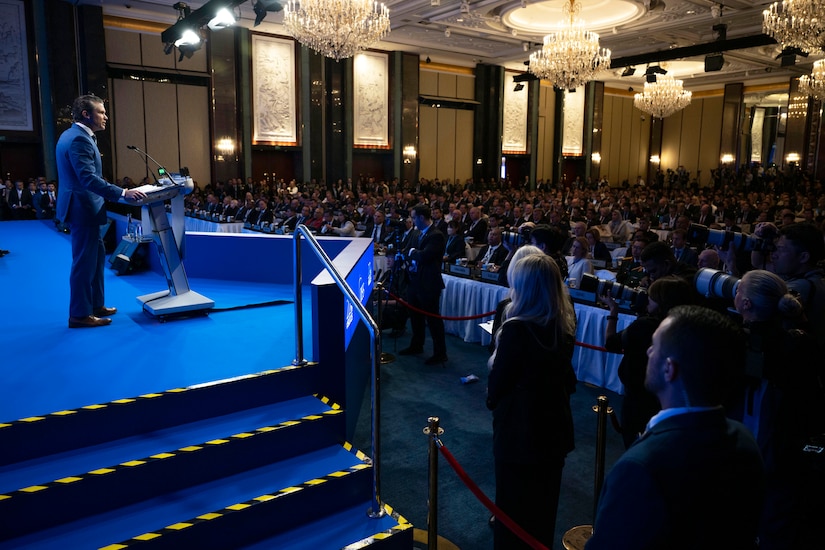
"There's no reason to sugarcoat it: the threat China poses is real, and it could be imminent," Hegseth said, adding while nobody truly knows what China might ultimately do, the U.S. and its allies must nonetheless be ready with "urgency and vigilance."
While once again reiterating the U.S. seeks peace as opposed to war, Hegseth said the U.S. must also be prepared for armed conflict.
"If deterrence fails — and if called upon by [the] commander in chief — we are prepared to do what the Department of Defense does best: to fight and win, decisively," he said.
Hegseth then revisited the topic of reestablishing deterrence in the region.
The U.S. is working that line of effort in three ways, he said: improving DOD's forward force posture, helping allies and partners strengthen their defense capabilities and rebuilding U.S. and ally countries' defense industrial bases.
"Across the board, the United States, our allies and our partners have made great progress in these — and many other — areas toward achieving peace through strength," Hegseth said.
"But we have to do this quickly, and we have no time to waste," he added.
Hegseth wound down his remarks by emphasizing those who long for peace must prepare for war, and the U.S. is looking to its partners and allies in the Indo-Pacific to do just that.
"Our time is now," Hegseth said, adding the threats the U.S. and its allies are facing will not wait.
"And nor can we," he concluded.


No comments:
Post a Comment