Showing posts with label CubaConstitution. Show all posts

Tuesday, April 07, 2026

Just Posted: "Legal-Institutional Foundations for Reconstruction in a Post-Revolutionary Cuba: A Conceptual Exercise"


Pix credit here


I am delighted to share a recently posted essay: Legal-Institutional Foundations for Reconstruction in a Post-Revolutionary Cuba: A Conceptual Exercise (March 2026), which will appear in the Cuba in Transition, 2025 Proceedings of the Annual Conference of the Association for the Study of the Cuban economy. It may be accessed HERE.

Here is the abstract:

Cuba is certainly in transition. But that means very different things to groups competing to drive transition. The resulting dissonance, guided by sometimes incompatible formative premises, complicates the challenge of transition, its forms, where that transition leads, and what may be necessary. Whatever the form and trajectories of transition, it is clear that transition will require substantial attention to the construction of aligned institutional-legal foundations. The purpose of these remarks is to consider the form and challenges of developing robust institutional-legal foundations in the Cuban context. It is organized in five parts. After the introduction the remarks first considers conceptual starting points-the importance of the development and choice of political-economic models as a predicate for the construction of robust institutional-legal foundations. It is divided into two parts, the first focusing on normative political orders, and the second examining institutional-legal orders. The remarks then considers two starting points of analysis. The first situates the Cuban political-economic model as a conceptual baseline. The second the current state of institutional-legal foundations in Cuba. The remarks then articulates the context in which the challenge of transition appears in contemporary Cuba-the end of the long arc of the Cuba revolutionary regime. That brings the remarks to the heart of the matter: what the future can bring. This is divided into several organizing-normative questions: (a) Who is to make decisions about transitioning?; (b) What ideological political economic model is to serve as the basis of post-revolutionary institutional-law building?; (c) Through which institutional actors ought this ideological politicaleconomic model be realized?; (d) What timeline is to be chosen to develop and implement this transition?; and (e) The Marie Kondo moment-what of the present system is to be kept and what is to be discarded or repurposed?

 The Introduction follows below

Wednesday, October 22, 2025

"Legal-Institutional Foundations for Reconstruction in a Post-Revolutionary Cuba: A Conceptual Exercise," Remarks prepared for delivery at the 2025 Annual Conference of the Association for the Study of the Cuban Economy, Miami, Florida, 25 October 2025

Pix credit here (Genet, "The Balcony" 1963 film version

 I was delighted to have been asked to contribute to a fascinating panel, Long-Term Reconstruction Investment and Recovery Funding, organized for the 2025 Annual Conference of the Association for the Study of the Cuban Economy, the theme of which is "Recovering Cuba."

I was asked to speak to legal and institutional foundations for reconstruction in a post-revolutionary Cuba. To those ends I prepared remarks for delivery, framing them as a conceptual exercise. The abstract of which nicely summarizes the main points of the remarks:

ABSTRACT: Cuba is certainly in transition. But that means very different things to groups competing to drive transition. The resulting dissonance, guided by sometimes incompatible formative premises, complicates the challenge of transition, its forms, where that transition leads, and what may be necessary. Whatever the form and trajectories of transition, it is clear that transition will require substantial attention to the construction of aligned institutional-legal foundations. The purpose of these remarks is to consider the form and challenges of developing robust institutional-legal foundations in the Cuban context. It is organized in five parts. After the introduction the remarks first considers conceptual starting points--the importance of the development and choice of political-economic models as a predicate for the construction of robust institutional-legal foundations. It is divided into two parts, the first focusing on normative political orders, and the second examining institutional-legal orders. The remarks then considers two starting points of analysis. The first situates the Cuban political-economic model as a conceptual baseline. The second the current state of institutional-legal foundations in Cuba. The remarks then articulates the context in which the challenge of transition appears in contemporary Cuba—the end of the long arc of the Cuba revolutionary regime. That brings the remarks to the heart of the matter: what the future can bring. This is divided into several organizing-normative questions: (a) Who is to make decisions about transitioning?; (b) What ideological political economic model is to serve as the basis of post-revolutionary institutional-law building?; (c) Through which institutional actors is this ideological political-economic model to be realized?; (d) What time line is to be chosen to develop and implement this transition?; and (e) The Marie Kondo moment—what of the present system is to be kept and what is to be discarded or repurposed?

Cuba has been worked on for well over a century by a shifting host of well meaning people all of whom know in their hearts what is best for the Cuban people. It may, perhaps be time to create a fairly stable environment in which, organically, people in Cuba may, by their actions and behaviors, by their discourse and desires, produce a community of behaviors and aggregated arrangements which, then, might be given a name and a narrative to suit the times and interests of the troubadours of ideology.  The view from Jean Genet's The Balcony (Le Balcon 19656), in this sense, is quite instructive. 

 The full text of the Remarks, "Legal-Institutional Foundations for Reconstruction in a Post-Revolutionary Cuba: A Conceptual Exercise,"follows below and may also be accessed here.

Pix credit here


Monday, July 24, 2023

Cuba's Central Contradiction--A rejection of markets and the contradiction between the productive forces and the relations of production


Pix Credit here

 Cuba remains caught in a web of its own making.  

Cuba's economic growth is less than 2% this year and remains 8 percentage points below pre-pandemic levels, while production in sectors such as agriculture, mining and manufacturing was further behind, Economy Minister Alejandro Gil said on Saturday.

Speaking before the country's parliament, Gil said the primary sector, which includes agriculture, mining and other basic production, was down 34.9% compared with 2019, while manufacturing was off 20%. A third sector that includes services such as tourism, communications and education was down 4.9%. . . The minister said inflation was raging at a 45% clip this year, on top of last year's 39% jump, a figure many economists say underestimates the rate as it does not adequately account for a growing informal market driven by scarcity. (Cuban economy minister says no quick fix to devastating crisis)

Yet the Cuban aversion to the market, as the incarnation of the power of the evil of its great adversary, the United States as the vanguard of markets driven liberal democracy (essay here), has created a great irony--its inability to price itself to market as it sells its territory, allegiances, and services to its newer patrons.  

Among its more interesting transactions of this kind has been the selling of its territory for the convenience of the spying of its friends and perhaps its patrons (Cuba Gains a Not-So-New Listening Post, Courtesy of China). Its value, of course, is a function of its utility in advancing Chinese interests and thwarting those of the United States in an area of significant strategic and ideological interest to the U.S. And yet what the Chinese are purchasing may be repurposed Soviet real estate already well known to virtually anyone with an internet connection. 

Anyone who’s followed intelligence history will recall that the Soviets had a listening station in Lourdes, Cuba, for almost five decades. So it’s not surprising given the long-standing relationship between China and Cuba that China would also be seeking to find another platform on which to conduct intelligence operations against the U.S. China’s interest in a Cuban intelligence platform reflects two trends. One is that across a spectrum of intelligence collection operations, China’s activity is expanding greatly. . . you have to look at Cuba as just one small data point in a vast apparatus of Chinese intelligence activities directed against the U.S. Second, Cuba reflects Chinese geopolitical goals of expansion and assiduous cultivation of governments in Latin America, Mexico, Argentina, Bolivia, Ecuador, Cuba, the Caribbean. (Chinese spies in Cuba? The problem runs deeper than that)

And thus the general contradiction of Cuba in its current stage of development.  This recalls Mao Zedong's discussion of contradiction and production.

Some people think that this is not true of certain contradictions. For instance, in the contradiction between the productive forces and the relations of production, the productive forces are the principal aspect; in the contradiction between theory and practice, practice is the principal aspect; in the contradiction between the economic base and the superstructure, the economic base is the principal aspect; and there is no change in their respective positions. This is the mechanical materialist conception, not the dialectical materialist conception. True, the productive forces, practice and the economic base generally play the principal and decisive role; whoever denies this is not a materialist. But it must also be admitted that in certain conditions, such aspects as the relations of production, theory and the superstructure in turn manifest themselves in the principal and decisive role. When it is impossible for the productive forces to develop without a change in the relations of production, then the change in the relations of production plays the principal and decisive role.(Mao Zedong, On Contradiction (1937).

Pix Credit here
On the one hand Cuba's internal political-economic model is built on the basis of a fundamental rejection of the market, not just as an ideological basis for ordering but also as a tool for meeting state directed objectives.  As a matter of theory it might work, though both internal and external factors have proven to have overwhelmed theory for three quarters of a century. On the other hand, the furious cultivation of markets rejection has made it impossible for Cuba to act in its own best interests in a global order that is essentially grounded on the core principles of markets of willing consumers and producers operating under conditions of imperfect information  but perfected desire. Its own efforts to create a regional markets rejectionist system ended in ideological victories and effective operational failures (Cuba and the Construction of Alternative Global Trade Systems: Alba and Free Trade in the Americas). It is left to play the fool in international markets where it must play the role of apex capitalist. At first blush one might be tempted to see Cuba in this as the incarnation of the symbolism of the Fool in a Tarot deck.

Pix Credit here
But ideological purity is of cold comfort to an empty belly, and it provides no pathway out of despair.  And it is when the masses are hungry and they despair, that all the ideological purity in the world will nt prevent the likely instability that follows. . . even on an island. The Cuban leadership, in this sense, and in the face of a contradiction it fails to resolve, resembles for the Hanged Man of Tarot, than the Fool. Cuba continues to avoid its central contradiction--the contradiction between the productive forces and the relations of production. Cuban theorists, much less its vanguard apparatus, has failed to grasp the nature of Cuba's productive forces under its ruling ideology--as distinctly constituted within the state and as the state in the global marketplace. That is, it has failed to grasp that the relations of production, in this case of the utilization of Cuba's productive forces by other states, do not constitute relations of production. In the case of Cuba's outward activities, the relations of production prevail and the instrumentalization of the market is paramount. Internally, the inverse is possible.  Between them a permeable membrane is required. The failure to grasp this contradiction produces  what can be seen as the state of the Cuban political economy. That, for the moment does not appear to be susceptible to change.  The insistence on selling itself short remains the principal tragedy of current vanguard thinking; one which even the most efficient protection of the current status quo cannot put off indefinitely. Or better put--Cuba will remain in stais as long as it suits those who make use of it.  And in the process Cuba has effectively lost what it has claimed is one of the few things it has managed to preserve since 1959--its sovereign autonomy.  Irony.


Wednesday, October 26, 2022

"From 11 July 2021 to Hurricaine Ian in 2022: The Transformation of Mass Protests in Cuba and its Consequences"; Remarks Delivered Penn State Journal of Law & International Affairs Speaker Series 25 October 2022


I was grateful when the student editors of the Penn State Journal of Law & International Affairs extended an invitation to speak as part of their Fall Speaker Series. For my remarks I chose the topic of law, lawfulness, and direct mass participation in political orders, focusing on the example of Cuba, which I titled From 11 July 2021 to Hurricane Ian in 2022: The Transformation of Mass Protests in Cuba and its Consequences.

The topic is worthy of sustained examination beyond the usual discourse that is often seduced by the interests of great powers to use these as an instrument for the projection of power abroad, or as a discourse of insurrection, lies, hooliganism, and disorder when manifested internally. Cuba provides an excellent example in two respects. First it suggests the way that states can institutionalize and to some extent naturalize even a spontaneous explosion of popular expression. Second, it also suggests the ways in which such explosions, when ignored or suppressed, can produce instability, not for the nation, but for the operation of an inattentive state apparatus. There are lessons here for all states, including the great powers.

The abstract adds a little detail:

Abstract: On 11 July 2021 mass protests erupted across the country in ways that had not been seen since the success of what became the Marxist-Leninist revolution of 1 January 1959. The protests represented an important challenge to the inertia that had characterized Cuban Marxist Leninism since the start of the 21st century. It was forcefully suppressed. At the end of September 2022 Hurricane Ian plunged much of Cuba into darkness as the national electrical supply was compromised. Days later, without power restoration, mass protests erupted all over Cuba. This time the police and security services did not respond in the same way. While internet services were cut for a while, Luis Antonio Torres, the head of the Communist Party in Cuba was widely quoted as saying ""I believe that protesting is a right, but only when those responsible are not doing their jobs,” though he noted these protests might not rise to that level. This presentation considers the ramifications of potentially radical transformation protest Cuba. It weaves together a number of critical stands that now produce an effort to accept and internalize at least a limited role for popular protests, while suppressing the rest. To that end the presentation will consider interlinkages between the move to popular consultation and referendum in Cuba, the 11 July protests, and the reshaping of the cultures of protests in 2022. The implications of these changes remain contested—for the United States and the Cuban diaspora the changes point to the eventual triumph of some form of liberal democracy in Cuba; for the Cuban establishment, the changes point to a much needed reform of the political system.
The PowerPoint that accompanied the remarks follow and may also be accessed here.


Monday, August 01, 2022

Thirty Second Annual Meeting of ASCE: “Cuba: What is Happening and Cuba and the Environment” --Tentative Program


The Thirty Second Annual Meeting of ASCE:  “Cuba:  What is Happening and Cuba and the Environment” will be held in person at Florida International University in Miami, Florida, September 15-17, 2022. 


Please go to ascecuba.org to register for the conference (click in the membership tab).  Rooms has been reserved at the Nuvo Suites Hotel at the discount rate of $119 until 30 days before the start of the conference.  The Nuvo Suites are close to FIU.  Instructions to reserve the hotel are also in ascecuba.org.


The preliminary program for the Conference follows:


Tuesday, September 14, 2021

Domingo Amuchastegui Commentario (Commentary): "El Eslabon perdido de la Crisis en Cuba" [The Missing Link of the Crisis in Cuba] and the Central Contradiciton of Democratic Organization in its Leninist and Liberal Democratic Forms


There continues to be a lot of discussion about the ramifications of the 11 of July popular protests in Cuba and their aftermath.  Much of it, of course, is more about the feelings and perspectives of those who write.  That is a pity because in the process--a process that has its origins in the infatuation of the pre 1959 revolutionary movement and its charismatic leaders as a sort of metaphor for the cultural revolutions about to begin  among the Western intelligentsia and which continues to the present time--the reality of Cuba and its need for dispassionate analysis is lost  in its use as a sort of political-intellectual fetish. 

It is thus refreshing to come across the analysis of Domingo Amuchastegui who for many years served the post revolutionary Cuban state.  His essay, "El Eslabon perdido de la Crisis en Cuba" [The Missing Link of the Crisis in Cuba], nicely captures an insider's perspectives of the challenges and capabilities limitations of the Cuban establishment, as well as its opponents, to move beyond the societal explosions of 11 July 2021, to plausible movement  within the current historical context of Cuba. That forward movement, for  Amuchastegui, requires the creation of a uniquely Cuban expression of what for Chinese Leninism would be understood as mass line politics--of the creation of robust spaces within which societal segments could engage collectively with the issues facing the nation.  For that to happen, Amuchastegui suggests, the Cuban vanguard will have to change substantially. 

Amuchastegui, however, highlights something far more basic and far more important: the central contradictions of systems organized around collectives.  That central contradiction is this:  Collective organizations embed systems of collective tyranny; it is in the nature of collectives that its integrity is grounded in the need to discipline its members; but that discipline itself undermines the democratic character on which the legitimacy of the collective is organized.  For Leninist states that contradiction is focused on a tyranny of a minority--the leading social forces organized as a superior political force. For liberal democratic systems it is the tyranny of the majority--the incarnation of popular will expressed periodically (through elections) which invariably discriminate against "discrete and insular minorities" (Carolene Products, n. 4). Both systems seek to confront their central contradictions but necessarily in very different ways.  Contemporary Leninist systems respond through the structural devices of engagement--implementing principles of "mass line ("from the people to the people"), democratic centralism, and now structures of consultative democracy. Liberal democratic systems work from the other direction, developing increasingly elaborate structures of managerialism to tame and harness the principle of mass democracy now within systemic cages of regulation and oversight by courts, legislatures, and accountability systems that analyze behaviors against a democratic ideal. Each is imperfect, and each struggles against am moving target--time passes, people die and others grow to take their place, social conditions change, as do tastes and the way interpretive communities see the world around them.  What separates Leninism from liberal democracy, in this context, what differentiates minority and majority tyranny, is expressed in the differences between the emphasis on consultation (contemporary Leninism) and accountability (contemporary liberal democracy). It is the inability to confront these central contradictions successfully in each historical era that proves fatal to these systems, or that produces profound transformation.

Cuba sits uncomfortably between the two--a Leninist system committed to the principles of guided majoritarianism. The central contradiction is both compounded and made doubly difficult to overcome--at least conceptually and in ways that preserve the system's legitimacy. Moving back and forth between one pole and the other, if only within tightly and narrowly conceived boundaries has proven successful at putting off  the moment when contradiction can no longer be avoided.  That moment appears to be arriving. But Cuba's leadership collective, like that of the United States, are all prisoners of the logic of the institutions whose trajectories now augment the profundity of contradiction. The question for both is whether they might confront contradiction in ways that preserve the fundamental forms of their political organization. That remains to be seen.

The essay in the original Spanish is republished here with permission, along with my translation, along with my brief comment (in English and Spanish). 
 
Domingo Amuchastegui has had a long and distinguished career. He has served as Cuba's Chargé d'Affaires in Guatemala, was Department Head of Socialist Countries at the Ministry of Foreign Affairs, Department Head of the Organization Department at the Tricontinental Organization (1960s-70s), Chief Analyst in the Intelligence Directorate and "Liberación", and a Professor of Contemporary History and Regional Conflicts at the Universidad Pedagógica and the Instituto Superior de Relaciones Internacionales (Cuba). He is the author of Historia Contemporánea de Asia y Africa (4 volumes), Palestina: Dimensiones de un Conflicto, Angola in the XX Century (1988)and the co-author of Intelligence and the Cuban Missile Crisis. In addition he has written hundred of articles and essays for Cuba News, Cuba Standard, and various Cuban publications. He participated in fact-finding missions throughout Africa, Asia and Chile, served as Chief analyst during Fidel Castro's visit to Chile and adviser to the Angolan Government (1986-1988). He has resided in the United States since 1994.


Saturday, August 14, 2021

Jorge I. Domínguez, "The Triumphs and Failures of Bureaucratic Socialism in Cuba in 2018-2021," Presentation at the 31st Annual Conference of the Association for the Study of the Cuban Economy


The 31st Annual Conference of the Association for the Study of the Cuban Economy (ASCE), with the support of the Coalition for Peace & Ethics for its virtual format, was held 12-14 August. The theme this year was COVID and the VIII Party Congress: Reforming the Cuban Economy (more on the Conference HERE).  The opening sessionon the contemporary economic and political context brought together three eminent scholars of Cuban political economy, economics, and politics. Carmelo Mesa-Lago, Professor Emeritus, University of Pittsburgh, presented a paper on “Key Economic and Social Factors That Provoked the Worst Cuban Economic Crisis since the 1990s and Subsequent Street Protests.”  Omar Everleny Pérez Villanueva, Havana presented on the state of cuban economic reform in a presentation entitled “La economía cubana: La Tarea Ordenamiento y su repercusión social.”  I will return to  Omar Everleny's presentaiotn in a latter post.

Here I wanted to highlight the fascinating presentation of one of the most eminent students of Cuban politics, Jorge I. Domínguez.  That presentation, The Triumphs and Failures of Bureaucratic Socialism in Cuba in 2018-2021, focused on the critical importance of the Cuban 8th Communist Party Congress on reshaping the institutions of the Party, and to some extent, perhaps not just its working style but also structuring.  He provides a critical analysis of the product of that inward turning of the PCC that I considered  in the context of its Leninist and ideological implications (here). His analysis of the changes in the composition of Party leadership, as well a the moves toward institutionalizing the trajectories of those changes are critical for understanding the way in which the Party nomenklatura is changing, and its consequential effects on the Part's ability to meet and respond to challenges. At the same time, Dominguez astutely examines the way that those changes were insufficient to either anticipate or meet the challenges of the eruptions of popular anger from 11 July 2021. The presentation is worth careful consideration, and its insights will have substantial application for any study of Caribbean Leninism, for the sociology of vanguardism, and for the relationship of leadership theory to political economy.

Now retired, Jorge Dominguez was a Harvard professor for 46 years and Harvard’s vice provost for international affairs for nine years, among other senior posts. He has been publishing books and articles about Cuba for about a half century. In 1989, Abraham F. Lowenthal described him in Foreign Affairs as the dean of U.S. Cubanologists. Dominguez' books touching on Cuba (without mentioning his excellent work on Mexico and other Latin American states) include: The Construction of Democracy: Lessons from Practice and Research; Between Compliance and Conflict: East Asia, Latin America and the New Pax Americana; The Cuban Economy at the Start of the Twenty-First Century;  and Democratic Politics in Latin America and the Caribbean.  Dominguez's germinal work,  Cuba: Order and Revolution (1978) whose look at the way in which changing elites made clams to legitimate rule in Cuba and its consequences, remains a foundational work for those studying Cuba, and its insights now appears to have increasing resonance in the conflicts among political elites in the contemporary US. 

The Power Points of the presentation, including some very interesting data, follow.  This and other materials frm the 31st Annual Conference may be found at the Coalition for Peace and Ethics website as well.


Tuesday, July 20, 2021

2021 Virtual Annual Meeting of the Association for the Study of the Cuban Economy: Theme and Program


The theme of this year’s conference is Cuba’s economic reforms, the impact of COVID and the VIII Congress of the Cuban Communist Party. Cuba is in a tremendous state of flux, one that is likely to affect all aspects of the society. No one can be sure how this will turn out, but ASCE’s members old and new have for more than 30 years brought understanding and analysis to the Cuban puzzle. That experience and familiarity with Cuba is needed more than ever as we note that our work is being widely read and watched by more people in government and on the Island. This year we will also focus on the Cuban diaspora. FIU’s Cuban Research Institute will take the lead in developing that part of the program. 

This year's program has been intensified by the protest movement that erupted in Cuba in early July, when "[t]housands of Cubans took to the streets on Sunday to protest a lack of food and medicine as the country undergoes a grave economic crisis aggravated by the Covid-19 pandemic and US sanctions. Demonstrators complained about a lack of freedom and the worsening economic situation during the rare protests, according to people who spoke to CNN and videos from multiple cities, including capital Havana.
Many chanted for "freedom" and called for President Miguel Díaz-Canel to step down." (Cubans take to streets in rare protests over lack of freedoms and worsening economy).

The program follows. The program consists of six sessions spread over three days (12-14 August 2021) plus two Special Opne Microphone sessions to discuss the current situation in Cuba (on 12-13 August).

Registration information follows.  Registration is available for members of ASCE and those who pay the registration fee. More information forthcoming.  

Saturday, April 24, 2021

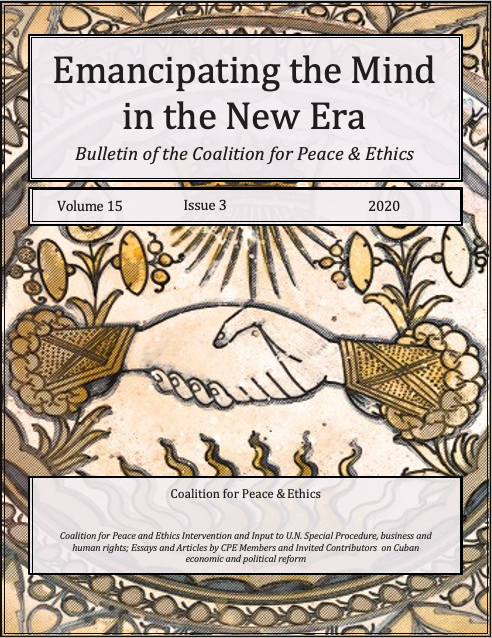
Just Published: Volume 15 Issue 3: "Emancipating the Mind in the New Era: Bulletin of the Coalition for Peace & Ethics" (Winter 2020)


Cover Volume 15 No. 3


I am delighted to announce the publication of the Winter 2020 issue of the Coalition for Peace & Ethics' Bulletin--Emancipating the Mind in the New EraVolume 15 No. 3 may be accessed free by clicking on the links provided below. All available on line issues of the Bulletin may be accessed HERE.

This last issue of 2020 is divided into two parts.  Part I includes delivered inputs in response to a call for input by the UN Working Group for Business and Human Rights on its preparations for the celebration of the 10th Anniversary of the endorsement of the UN Guiding Principles for Business and Human Rights by the Human Rights Council. Part II includes three essays in issues of Cuban economic and political reform efforts in the shadow of the transition of authority within Cuban ruling circles and its larger implications. These include consideration of the right to political resistance built into the 2019 Constitution and implications of the economic reforms of mid 2020. It also includes a consideration of comparative patterns of reform cycles in Cuba, China, and the United States.

The Table of Contents with links to individual articles and contributions, along with the short introduction to the volume follow below. A link to the entire issue also follow. 


Friday, April 09, 2021

The End of the Official Castro Era--The 8th Congress of the Cuban Communist Party Announcement and Theme (The Party is the Soul of the Revolution)


This post begins is the first of a short series considering the 8th Congress of the Cuban Communist Party (VIII Congreso del Partido Comunista Cubano). This Congress is particularly interesting, and potentially important, as a result of the convergence of several factors.


1. Raul Castro appears ready to retire from his role in the all important post of first secretary of the PPC. "Raúl Castro is to stand down as the party’s first secretary, the true source of power on the island, and armed forces commander after serving two five-year terms. He succeeded his brother Fidel, who handed power to him several years before his death in 2016." (Exit of Cuba’s last Castro brings curtain down on revolutionary era). That is a momentous event--from the perspective of history (people love to mark historical events, it is perhaps the way that societies tell time). But is is also important from the perspective of politics as a relatively untested and unknown generation will be given freer (but not free rein) to move the state apparatus forward under considerably stressful times.


2. This marks the first Congress immediately after the roll out of what might be potentially the most significant set of changes to the economic model of the state. The changes include grudging liberalization of the conditions for non state economic activity, a more robust engagement with the contemporary flows of global trade, and the unification of Cuba's currency. That it was done as a technocratic rather than an ideological exercise is also significant. That produces a tension that the 8th Congress may seek to resolve--the development of some sort fo ideologically sound imprimatur, grounded in traditional Cuban Caribbean Marxist ideology--to support the profound changes.

3. The COVID-19 pandemic has produced a series of challenges and opportunities that the Cuban state has sought to exploit (in the one case) and overcome (in the other). This is the moment for the triumph of Cuban medical diplomacy now augmented by a strong tech sector. The success of its COVID-19 vaccine, if handled correctly, will produce a substantial amount of political capital abroad that Cuba might be able to exploit, even if Cuban authorities receive very little by way of financial compensation for the effort. One might expect this sector of the 2030 Economic Plan to be an important element of the pageantry if not the work of the Congress. 

4. This set of political and economic changes are occurring at a time of social unrest. While Cuba had been relatively successful in managing its intellectuals since 1961, that efficient management (as brutal as it was some time to time) appears to be breaking down. The Movimiento San Isidro, a collection of artists and others that have captured the imagination of the liberal democratic camp and its intellectuals) is likely the tip of the iceberg. And yet the traditional mechanisms of suppression are likely to be less available than they were. The PCC's ability to meet this challenge in ways that preserve stability will be among the first real tests of the new leadership. Indeed, the incoming leadership's pointed reference to Fidel Castro's 1961 speech and the construction of a propaganda campaign around it suggests the nature of the battles that lie ahead (Cuba President Recalls Fidel Castro’s Historic Speech to Intellectuals :That speech became the founding platform of cultural policy of the Cuban Revolution). An English translation of that speech, well worth reading for its overtones to much of the global conversation about speech today, may be accessed HERE.

5. The theme of the VIII Congress suggests its discursive challenges. "El Partido es el alma de la Revolución"--The Party is the Soul of the Revolution--is a semiotic meadow (perhaps a minefield as well. There is a sense built into the proceedings of both promise and danger. Like elites in the rest of the world, it has become clear that a control of the way in which the masses are led to the understanding of the world is essential for the project of both managing mass behavior and of directing it toward preferred objectives. Guiding ideology remains a powerful weapon and its contestation around the world has posed problems for vanguards from the United States and China to those of Cuba. Each, of course, utilizes quite distinct tools for the construction and maintenance, and for the naturalization of its guiding ideology within their respective political cultures. But especially in periods of transition, control of the guiding ideology (its construction, elaboration, contestation, rejection or replacement) is the key to power among those who seek to assert it, guide it or use it. Here there are two great objects at stake. The first is control of the meaning of the term "Revolution" which had been carefully curated since the 1959 establishment of the current political-economic model. The second is the legitimacy of the naturalization of the product of that control deeply within the way that the masses approach and understand the world. The "soul of the revolution" then suggests both a normative perspective and the legitimization of the mechanics of its development and deliverance. All o this may be up for grabs now.

6. The United States continues to dominate this Congress as it has virtually every other one. It is a pity but hardly to be avoided that even as the PCC declares its autonomy, it does so only by reference to and in the shadow of the United States. That has proven to be in some respects its greatest protection. But increasingly it may become the greatest weakness of this Party and its ideological apparatus. A state cannot control its people on the basis of negatives (e.g., we are not the United States). That effectively gives the other party control over your own destiny, a result that is becoming increasingly apparent int he case of Cuba. Cuba can no longer afford to build its ideologies as a function of its contests with the US). This is a lesson that is hardly ever learned, certainly it remains unlearned in politics that sees in the construction of difference (internally or externally) a quick, dirty, and expedient way to elaborate administrative power in the hands of a controlling group--whatever their political inclinations).  Intellectuals, especially, are good are seeking to deride the construction of otherness in power relations but then use it precisely to rearrange the allocation of power among the categories of otherness constructed. A great pity but perhaps the fate of society as currently understood by those with the power to control. 
 
7. For all that, the United States does remain a wild card.  The Biden administraiton does not yet appear to have developed anything like a robust coherence to policy going forward--it is still working against the shadow of the Trump Administraiton. This also poses dangers and opportunities for the Cubans. This is especially so now in connection with relations to Iran.
 
8. Yet the VIII Congress does little by way of confronting the real threat to Leninist parties: exclusivity that ultimately provides the greatest contradiction between Marxism and Leninism. The establishment of a communist society (whatever its conceptual gymnastics about the ownership and allocation of capital and the role of planning or markets) ultimately requires that the vanguard and the masses become indistinguishable.  That is the success of the establishment of a communist society requires that everyone be a member of the vanguard.  But the vanguard as a Leninist revolutionary party  (and then a party in power)  is grounded in the notion that the masses are not ready, and later that external threats require a Leninist organization to serve as a techno-bureaucratic force to lead the masses toward whatever is defined as victory in any particular era of historical development. But a Leninist party that fails to expand and to embrace an ever growing  number of mass elements runs the risk that it will become corrupted.  So corrupted it runs the danger of becoming a ruling clique mired in either left or right error.  The failures of the PCC to more actively address this issue of working style may in the end pose the greatest threat to its long term survival.

These are the themes that the the object, in the usual discursive tropes of the PCC, that are meant to give meaning to the words elaborated by the Central Committee pf the PCC in its Announcement of the Holding of the VIII Congress (Convocatoria al VIII Congreso del Partido Comunista de Cuba), the text of which in the original Spanish and with my own crude translation, follows below. 


Tuesday, March 02, 2021

Lu Yu and Björn Ahl: "The financial credit information system and China's evolving data protection law" (European Chinese Law Research Hub)


The folks over at the European Chinese Law Research Hub (with thanks to Marianne von Blomberg, Editor ECLR Hub, Research Associate, Chair for Chinese Legal Culture, University of Cologne) have posted Lu Yu and Björn Ahl (both of Cologne University): "The financial credit information system and China's evolving data protection law"  Xin He's (Law Faculty at the University of Hong Kong)  marvelous summary essay around his recent book.

Marianne von Bloomberg explains:

The financial credit information system is but one of the many arms of China's evolving social credit system- and arguably the most advanced. As it is evolving rapidly, so is data protection law, limiting its scope and outreach. What are the restraints current data protection laws impose on the financial credit information system- and are they meaningful and feasible in court practice? Lu Yu and ECLS member Björn Ahl investigate the state of the art and find a considerable gap between what is laid down in law and what is adjudicated in courts. Lu Yu is a research assistant with the research project "The Social Credit System as a Challenge for Law and Courts in China" led by Björn Ahl at Cologne University. Enjoy the read and as always, we would love to hear your comments, criticism and ideas.

I am cross posting the essay below. The original ECLRH post may be accessed HERE. And as a plug for the marvelous work at the European Chinese Law Research Hub: iIf you have observations, analyses or pieces of research that are not publishable as a paper but should get out there, or want to spread event information, calls for papers or job openings, or have a paper forthcoming- do not hesitate to contact Marianne von Bloomberg.


Wednesday, January 06, 2021

Video Recording of Panel 5 (Book Discussion: La Cuba que quisimos. Essays on the New Cuban Constitution) Now Available--ASCE 2021 Conference (4-6 January 2021)--"Caught in a Perfect 'Storm': Are Havana's Responses Sufficient?


I am delighted to be able to share with you the video recording of the Fifth Panel ((Book Discussion: La Cuba que quisimos. Essays on the New Cuban Constitution) (along with the marvelous discussion that followed).

ACCESS VIDEO HERE


Wednesday, January 6, 2021

10:00 am-12:00 noon

5.     Book Discussion: La Cuba que quisimos. Essays on the New Cuban Constitution 

The book selects and publishes articles that first appeared on the Cuba Posible website, as well as never-published material, regarding Cuba’s new Constitution.

ACCESS BOOK HERE; download link (open access): https://www.programacuba.com/libro-la-cuba-que-quisimos-la-nueva


Moderator and panelist:

--Claudia González Marrero, Justus-Liebig University (Gießen, Germany) and Universidad Sergio Arboleda


Panelists:

--Elaine Acosta, visiting researcher, Cuban Research Institute, Florida International University

--Jorge I. Domínguez, retired, former Professor of Government, Harvard University 

--Lenier González Mederos, former Assistant Director, Cuba Posible, and co-editor, Espacio Laical

--Roberto Veiga González, former Director, Cuba Posible, and co-editor, Espacio Laical; member,  Inter American Dialogue

--Mauricio de Miranda,  Director Centro de Estudios sobre la Cuenca del Pacífico en Pontificia Universidad Javeriana Cali


Conference PPTs and other materials may be accessed HERE.

All video recordings of the Conference ASCE 2021 may be found on the YouTube Channel of the Coalition for Peace & Ethics HERE: 

There is still time to register (free) and participate in the remaining panels which will be held  through 6 January.

 Reminder-- registration is now open for the 2021 ASCE Conference--Caught in a Perfect Storm: Are Havana's Responses Sufficient?, which is scheduled to take place 4-6 January 2021.

Conference Website may be accessed here: With information about participants, registration, and useful inks.

Pre-Conference Interview Series These may be accessed via CPE YouTube Channel. Follow the link above for the listing of all interviews and links to your favorites.
Concept Note: The theme of ASCE’s January conference will focus on Cuba’s current economic problems and the Cuban governments announced responses (reforms). The focus will be on analysis of policies and suggested policies that improve those reforms. Indeed, the issue of Reform, yet again, as it has so many times over the long arc of the history of post “revolutionary” Cuba, has been one of developing elegant statements of idealized objectives and then offering what in retrospect might be characterized second or third best solutions; and that might be the only thing on offer now. Yet even these second best solutions can be used to bring significant improvements to the Cuban economy.
The Conference Program may be accessed HERE. The Conference extends over three days and offers six exciting events. They include five panels: They include (1) Cuba's Economic Situation and Strategy; (2) Cuba's External Relations; (3) US-Cuba Economic Relations; (4) Cuban Agricultural Challenges; an (5) the Cuba-Venezuela Crisis. In addition Jorge Dominguez has organized a marvelous discussion around the book La Cuba que quisimos: Essays on the New Cuban Constitution.

Registration is required but free; space is limited. Registration permits the user to attend any combination of the six Conference events. Those wishing to attend all events, for example, must register for all six. Those wishing to attend fewer events may register for those panels of interest to them. Please contact us with questions. Attendance for each event requires a separate registration. Registration links for each of the Panels follows below. Or access via this QR Code

Tuesday, July 14, 2020

Just Published: "Popular Participation in the Constitution of the Illiberal State: An Empirical Study of Popular Engagement and Constitutional Reform in Cuba and the Contours of Cuban Socialist Democracy 2.0," Emory International Law Review 34(1):183-276 (2020).


For those of you interested in comparative constitutionalism in general, and Latin American Marxist-Leninist Constitutional development more specifically, on behalf of my co-authors Flora Sapio (Naples) and  James Korman (Penn State), I am delighted to announce the publication of our article: "Popular Participation in the Constitution of the Illiberal State: An Empirical Study of Popular Engagement and Constitutional Reform in Cuba and the Contours of Cuban Socialist Democracy 2.0," which appears in the Emory International Law Review 34(1):183-276 (2020). 

The article may be downloaded HERE

 The article theorizes the possibility of democratic participation in constitutional reform in the context of non-liberal democratic political systems--Marxist-Leninist systems in particular.  We understood that realizing this theoretical possibility required a somewhat difficult process of setting aside the deeply ingrained premises and practices of liberal democracy as it has been normalized in the traditional academic and political discourse. Thus we started with the question: is it possible to conceive of a democratic impulse within a Marxist Leninist constitutional context.  

To get the the answer required us first to put aside the usual narcissism at the heart of much of the academic literature; that is to put aside what we" thought was "right" and to delve (as a matter of theory--like most systems the gap between theory and practice can be wide) into the system an its own aspirations/conceits wholly on its own terms. That is, of course, what theorists of liberal democracy do without a second thought (but so do Marxist-Leninists as well as theocratic constitutionalists).  From a comparative perspective that is never helpful except as an affection to shine the light more brightly on the value of the system embraced. . 

With that in mind we arrived at a tentative answer: yes--but that "yes" requires a re conception of democratic practice in ways alien to liberal democracies that center notions of "representation" and "election" in the construction of their own democratic universe.  Instead of this almost invisible political decision to center democratic principles on its exogenous practices, we posited that democratic principles are possible in Marxist Leninist systems if one focuses instead on its endogenous practices--that is not on the purity of representative elections, but on the vigor of democratic engagement.

It was with that in mind that we then considered the development of practices of endogenous democracy in Cuba since 1959--its origins, practices, successes and failures.  More importantly we considered its self-conscious development.  That is, we wondered whether the practices emerging, and especially most self consciously after 2008 and the start of the leadership of Raul Castro,  were an expression of theoretical development, or whether theoretical development awaited the accumulation and development of practices that could be aggregated into theory.

The "laboratory" for this consideration was the process of development first of the revised expression of the political-economic model of Cuban Marxist-Leninism in the 7th Cuban Communist Party Congress through its expression in the constitution adopted in 2019 by plebiscite. We measured the sources and content of both formal engagement in the process (a relatively complex and imperfect endeavor) and then held that up to what was the most surprising element of engagement--the toleration (and perhaps co-opting) of a vigorous private engagement with constitutional reform both within Cuba and among Cubans living abroad.

Make no mistake, the article was not created as an apology to any political system.  Indeed its core purpose was the inverse of apology--a mild and loving j'accuse  directed to the comparative constitutional establishment to recognize their own prejudices when engaging with systems the core premises of which are incompatible with those that are personally appealing.  This is a reminder that orthodoxy--no matter how appealing and necessary within a system (and some of us strongly believe that)--is an impediment to the rigorous study between normatively incompatible systems. In the end the last thing one ought to care about when one is studying systems is whether or not one "believes" in the system, one ought to be able to suspend disbelief in the impossibility of normative systems quite incompatible with their own values, and to consider whether or to what extent these also can serve to meet objectives, broadly understood, that are, at their bottom, meant to provide positive value for the collectives within which they operate. If the answer might be yes, then one can advance to the equally interesting question--just how great a gap exists between a system as conceived and the system as practiced, and how might leaders be held accountable for that gap.  Beyond that, of course, one enters the realm (and quite an important one to be sure) of the great contests of values based systems to win the hearts and minds of political communities.  But that, too, is likely a fnction of the ability of a system t show that it can narrow the gap between theory and practice that they can, within the logic of ther systems, advance accountability, and that, in the end, there is a value system against which such efforts can be measured. 

The Introduction and Part A (the Cuban Context) of the article follows. We would welcome  considered engagement by those interested in this conversation.


Friday, February 07, 2020

Just Published: Larry Catá Backer and Flora Sapio, "Popular Consultation and Referendum in the Making of Contemporary Cuban Socialist Democracy Practice and Constitutional Theory," University of Miami International and Comparative Law Review 27(1):37-130


I am delighted to announce the publication of Larry Catá Backer and Flora Sapio, "Popular Consultation and Referendum in the Making of Contemporary Cuban Socialist Democracy Practice and Constitutional Theory," University of Miami  International and Comparative Law Review 27(1):37-130.

The article may be of interest to those examining issues of comparative constitutionalism, or the emergence of alternative  conceptualizations of democratic expression that may be gaining traction in developing states, or more generally on Latin American studies issues. The article sketches the development of participatory constitutional practices  in Cuba, tracing their origins to the very beginnings of the current post-Revolutionary government in 1959. It suggests the possibility of constructing democratic governance from the baseline of non-Western models and notes both the difficulties of current theorizing of this emerging model, and the great distance that separates conceptualization from any sort of deeply embedded institutionalized practice.

The article is available for download (pdf) HERE. Flora and I tale this opportunity to thank Maia Dumbey, Editor in Chief, and the staff of the University of Miami International and Comparative Law Review for their excellent work, and especially for their care and attention, to this draft as it proceeded to publication.  It was our great pleasure to work with them. 

The Abstract and Table of Contents follow below.


Sunday, May 26, 2019

Remarks: "The Fundamental Contradiction of Cuban Socialism in the “New Era”: Economic Reintegration Preserving the Revolutionary Moment" Delivered at the Latin American Studies Association Annual Conference for the Panel on Cuba in Comparative Perspective


I was delighted to have been asked to deliver remarks as part of the panel organized by Silvia Pedraza (University of Michigan) for a panel on Cuba in Comparative Analysis organized by the Association for the Study of the Cuba Economy for the Latin American Studies Association Annual Meeting held in Boston, MA 27 May 2019.

The text of my remarks,  The Fundamental Contradiction of Cuban Socialism in the “New Era”: Economic Reintegration Preserving the Revolutionary Moment, along with the associated PowerPoint Slides, follows.It may be downloaded (CPE Working Paper 5/1 (May 2019) from the Coalition for Peace & Ethics Website HERE.


Sunday, May 05, 2019

Just Posted: Discussion Draft--"Popular Participation in the Constitution of the Illiberal State—An Empirical Study of Popular Engagement and Constitutional Reform in Cuba and the Contours of Cuban Socialist Democracy 2.0"

(Pix © Larry Catñá Backer 2017)


Is it possible to speak of democracy in illiberal states? Is it possible to develop a space for popular participation in a Party-State political system? Can such civic spaces exist beyond the direct control and management of the Party-State apparatus? Might it have some effect especially where a society is asked to reform its constitutional order?

These are the questions that Flora Sapio, James Korman and I undertake in an empirical study of the contours of popular participation in the recently concluded Cuban Constitutional Reform Project. Popular participation in the 2019 Cuban constitutional reform efforts actually takes three forms. Two of them are formal and Party-State driven. These consisted of the formal system to deliver comments and reactions to the drafts of the revised constitution circulated to the general population after review and revision by PCC and State.

The third of them, the object of our study, was both informal and popularly driven. Perhaps the most important element of popular participation in the 2019 Cuban constitutional reform debate, the quite vigorous popular debates about Cuban constitutional reform occurred outside the structures of the Party and State organs. These debates took place in cyber space and among an active and politically engaged segment of the population, one with strong connections to the Cuban diaspora community. More importantly, it represented an engagement that took place within the established structures of Party-State organs of mass communication—its on-line news and information portals, as well as tolerated mass communication sites, notably Facebook. We use data from government web sites, the official reports, and social media sites to examine the contours of participation, its constitution, and its limitations. We intend to develop from the analysis of four distinct data sets a clearer understanding of the nature of popular participation. We then considers consequences and applications both within Cuba and beyond.


We post here the discussion draft of that study, Popular Participation in the Constitution of the Illiberal State—An Empirical Study of Popular Engagement and Constitutional Reform in Cuba and the Contours of Cuban Socialist Democracy 2.0. A more elegant final version with footnotes will follow.  At this point we are interested in comments, suggestions, and engagement from those interested.  The Abstract follows below.