 |
| Pix credit here |
Abstract/Summary: For nearly 125 years, American jurisprudence has struggled with a tension the West has never resolved — the collision between collective social order and individual conscience in matters of religion, a conflict as old as Antigone's defiance of Creon and refracted in the United States through the somewhat distorting prism of the Religion Clauses, where Free Exercise and Anti-Establishment pull in opposing directions. Reynolds v. United States (1878) attempted to manage that tension by cleaving belief from conduct, and every major religion-clause case since has orbited that distinction, producing a jurisprudence that is contradictory, resourceful, and never at rest. Tim Rosenberger's "Benedict at Haytor Vale" uses the murder of Ann Widdecombe to build a sweeping argument about religious liberty, institutional loyalty, and the meaning of old age. It is eloquent, historically ambitious, and deeply felt. It is also, on its own terms, incomplete — and the incompleteness is most visible in its reading of the Supreme Court cases that form the spine of its legal argument. Rosenberger constructs a narrative of progressive enclosure: Reynolds v. United States (1878) planted a defective belief-conduct distinction; Employment Division v. Smith (1990) restated it; Fulton and Mahmoud destabilized it without replacing it; and the Mormon experience — exile, pursuit, dissolution, surrender — proved that no American religious community has ever achieved genuine exit from state authority. The only unconquered ground, he concludes, is prayer. The response that follows takes Rosenberger seriously enough to disagree at the foundations. The belief-conduct distinction he condemns as rotten is not, on this reading, an error to be corrected but a technology of governance — a mechanism by which the state defines what counts as "religion" in order to protect it without surrendering regulatory authority. The religious communities Rosenberger frames as besieged from outside are, in fact, partly constituted by law: the LDS Church that Congress dissolved was a corporation; the Amish community that won Yoder became legally cognizable through litigation; the religious school in Espinoza exists within a tax and accreditation framework that makes it visible as an institution. Law does not merely constrain these communities. It builds the temples within the icon. Most strikingly, Rosenberger's own refuge — prayer as unconquered ground — reproduces the very distinction he denounces. Locating sovereignty in interiority is precisely the move Reynolds made in 1878. He has not escaped the framework. He has miniaturized it. The exchange illuminates something rare: a disagreement where the chasm between positions reveals the first principles that make convergence unlikely — and where following the argument is worth the vertigo.
Sometimes the best things worth reading are those with which one disagrees, and in some places fundamentally. Sometimes the disagreement is grounded in error. The best type of disagreement is where the chasm between reader and author illuminates the nature of the core premises and staring points of analysis that make any sort of convergence or agreement unlikely. Disagreements that expose the structures and operation of our Aristotelian "first principles"--and what semiotics suggests are the interpretations derived from the signification of objects. That was my reaction to a wonderful essay by Tim Rosenberger for Telos Insights entitled Benedict at Haytor Vale,
This essay by Tim Rosenberger, published on August 12, 2026, uses the murder of Ann Widdecombe — the former Conservative MP who was killed on July 8, 2026, at her home in Haytor Vale, Dartmoor, by a man who drove two hundred miles and struck her with a hammer — as the occasion for a wide-ranging meditation on institutional loyalty, religious liberty, the ethics of exit versus endurance, and the purpose of old age.
Rosenberger opens with an admiring portrait. He highlights Widdecombe's willingness to damage her own side — her 1997 denunciation of Michael Howard as having "something of the night about him" — as evidence of a rare, costly candor. He notes her long tenure holding Maidstone, her care for her mother, her novel-writing, and her appearance on Strictly Come Dancing as signs of a person who was unserious about herself but never about her convictions. He acknowledges the obvious criticism — that she kept leaving institutions (the Church of England in 1993, the Conservative Party in 2019) — and answers it by arguing that her departures were principled rather than temperamental: she moved toward the one institution (the Roman Catholic Church) whose self-understanding holds that certain questions are settled, not subject to revision by vote.
The essay's longest section traces the history of religious "exit" in England and America. Rosenberger contrasts Widdecombe's departure from the Church of England with John Wesley's refusal to leave it, noting that Wesley's internal community survived only one founder's lifetime before separating anyway. He draws an analogy to contemporary "classical academies and intentional communities" in the American South and West, warning that they run on the same perishable fuel of personal authority.
Turning to America, Rosenberger argues that American religious pluralism was historically underwritten by open land — Roger Williams, William Penn, the Mormons — and that the closing of the frontier in 1893 ended that option. He critiques the legal framework that replaced it, tracing a line from Reynolds v. United States (1878) through Employment Division v. Smith (1990) to more recent cases like Fulton and Mahmoud, arguing that the belief-conduct distinction at the heart of American free-exercise law rests on reasoning he considers discredited. His conclusion is that American law permits a partial exit but never sovereignty, with Espinoza (2020) marking the available room and Bob Jones (1983) marking the ceiling.
The essay reinterprets the "Benedict Option" as fundamentally about prayer rather than geographic withdrawal. Rosenberger points to Pope Benedict XVI's own retirement in 2013 — laying down authority but continuing to write and pray inside the Vatican walls — as proof that withdrawal can function as redeployment rather than retreat. He places Widdecombe's daily Mass attendance in the same frame: a form of persistence in a culture that had made her convictions, in his view, a punchline. He insists that prayer must not be instrumentalized as fuel for activism but understood as an end in itself.
Rosenberger invokes the English recusant tradition — Catholics who remained in England, refused conformity, and paid statutory fines — as the model Widdecombe embodied. He argues that by converting to Catholicism, keeping her name on the door, and remaining publicly accessible, she practiced a form of endurance rather than escape. He then makes the essay's most provocative claim: that a culture which treats certain convictions as unspeakable rather than merely wrong effectively teaches that those who hold them are "not quite persons," and that violence against such people "requires no organization." He frames her murder as a consequence of her refusal to hide.
The essay's final movement asks what old age is for. Rosenberger criticizes a culture that courts the elderly as consumers — pharmaceutical advertising, cruise brochures, continuing-care communities — while dismissing their convictions as embarrassing. He draws on Simone de Beauvoir, Hannah Arendt's concept of "superfluity," Aristotle's distinction between leisure (scholē) and mere amusement, and Cicero's De Senectute to argue that the last stage of life should be understood as an office, not a reward. He contrasts the elderly martyrdom of Polycarp of Smyrna at eighty-six with the young martyrdoms of Perpetua and Felicity, arguing that the old are uniquely positioned for moral courage because they are past the obligations — mortgages, children, careers — that make boldness costly to others.
Rosenberger closes with three imperatives directed at the old: serve in unglamorous public offices (school boards, zoning commissions, parish councils) with nothing left to gain; give wealth away during life rather than deferring it to inheritance; and stay visible, saying "the true thing under your own name" in one's own community. He identifies the last of these as the least dramatic and the one that cost Widdecombe her life.
The essay is written from an explicitly Christian and socially conservative standpoint, sympathetic to Widdecombe and to the tradition she represented. Its legal and historical arguments are presented with considerable detail but in service of a thesis — that modern liberal democracies have narrowed the space for religious dissent and devalued old age — that many readers would contest. Rosenberger does not claim neutrality; he states plainly that he admired Widdecombe and shares her general orientation. The essay's strength lies in its historical range and its willingness to engage counterarguments (Wesley, Perpetua and Felicity) on their own terms.
This is all well worth considering. Much more interesting to me are the argument's foundations grounded in a quite specific reading of a long line of US Supreme Court cases with which Rosenberger takes issue and in which lies the description of the space that separates his view from mine.
Rosenberger's Legal Argument: The Supreme Court Cases. Rosenberger constructs a legal narrative in which American religious liberty has been progressively enclosed, mirroring the physical closing of the frontier. The cases form a chain, and his reading of each one matters.Reynolds v. United States (1878) is his foundation stone, and he calls it rotten. The case upheld a federal anti-bigamy statute against a Free Exercise Clause challenge by a Mormon defendant. The Court drew a sharp line: the First Amendment protects religious belief absolutely but leaves religious conduct subject to regulation. Rosenberger insists this distinction was wrongly decided, and he goes further — he argues the opinion's own logic rested on a racialized premise, that the practice at issue (polygamy) "was confined to Asiatic and African peoples." For Rosenberger, this is not incidental rhetoric but the holding's operative reasoning, the mechanism by which the Court justified treating conduct as categorically regulable. He presents Reynolds not merely as dated but as structurally defective at inception.
Employment Division v. Smith (1990) is cast as Reynolds's direct descendant. In Smith, the Court held that neutral, generally applicable laws do not require a Free Exercise exemption even when they substantially burden religious practice. Rosenberger treats Smith as a restatement of the belief-conduct rule, updated but carrying the same original defect forward. He does not dwell on the facts of Smith (denial of unemployment benefits to members of the Native American Church for sacramental peyote use), which is notable — the racial dimension of that case would have reinforced his argument about Reynolds, but he leaves it implicit.
Fulton v. City of Philadelphia (2021) appears as evidence that the Court itself has recognized Smith's weakness. Rosenberger notes that Justices Alito, Thomas, and Gorsuch called for Smith to be overruled, and that Justice Barrett "found the textual case against it compelling." The Court decided Fulton on narrower grounds — that Philadelphia's foster-care non-discrimination policy was not truly "generally applicable" because it contained a discretionary exemption mechanism — and so Smith survived technically intact. Rosenberger reads Fulton as the moment four justices openly declared the framework unsound.
Mahmoud is described as reaching strict scrutiny "by way of Yoder, around Smith rather than through it," leaving the rule "intact in name only." This appears to refer to Mahmoud v. McKnight or a related case in which the Court applied heightened scrutiny to a religious liberty claim by routing through the Yoder precedent rather than confronting Smith directly. Rosenberger's point is structural: the Court has effectively hollowed out Smith without the doctrinal honesty of overruling it, creating a regime in which the formal rule and the operative rule have diverged.
Wisconsin v. Yoder (1972) occupies a paradoxical place in the argument. Rosenberger calls it "the most complete withdrawal our law permits" — the Amish won the right to remove their children from public schooling after eighth grade. But the victory itself proves his thesis about enclosure: the withdrawal "required the permission of the sovereign it sought to escape." Yoder is freedom-by-judicial-grace, not sovereignty, and the permission can be revisited.
The Mormon sequence is Rosenberger's most extended illustration of exit's failure. The Mormons left the United States entirely in 1847, crossing to Mexican territory. The border followed them after the Treaty of Guadalupe Hidalgo in 1848. Congress then dissolved the LDS Church as a corporation (the Late Corporation of the Church of Jesus Christ of Latter-day Saints v. United States, 1890), seized its property, and imprisoned its leaders. The Manifesto of 1890 abandoned plural marriage. Statehood came in 1896 with conditions written into the Utah Constitution itself. Rosenberger's summary is blunt: "The jurisdiction followed them across a desert and beat them. Exit did not merely cost them something. It failed."
Espinoza v. Montana Department of Revenue (2020) and Bob Jones University v. United States (1983) are the final markers. Espinoza held that a state cannot exclude religious schools from a publicly available scholarship program solely because they are religious, which Rosenberger reads as defining the room a partial religious exit currently enjoys. Bob Jones held that the IRS could revoke the tax-exempt status of a religious university that practiced racial discrimination, which he reads as the ceiling — the point at which the state's interest overrides religious institutional autonomy. Between the two lies the available space: real but bounded, and "never sovereignty."
The overall architecture of the legal argument is that Reynolds planted a defective principle; Smith restated it; Fulton and Mahmoud have destabilized it without replacing it; and meanwhile the historical record — the Mormons, the Amish, Bob Jones, Espinoza — demonstrates that no American religious community has ever achieved genuine exit. Every withdrawal operates by permission. The one exception Rosenberger will grant is prayer, which "requires no charter, no Royal Assent, no favorable judgment from any court."
And yet it may be possible to consider whether Rosenberger has written an essay that is rhetorically accomplished and analytically incomplete, and one might be forgiven for observing that the incompleteness is not accidental — it is structural, built into the very framework he has chosen. He tells a story about sovereignty lost. The more interesting story, the one he cannot tell from inside his commitments, is about sovereignty's constitution, about how the state and the religious community produce each other and always have.
Begin with Reynolds, since he does. Rosenberger calls the decision "wrongly decided" and locates its defect in the racialized reasoning of the opinion. He is not wrong about the racism — the opinion's language is repellent and its anthropology is colonial, at least by contemporary standards (though one ought to be cautious about timer traveling contemporary sensibilities backwards to another time and space). But it is possible to consider that it isn't that Rosenberger doesn't go far enough, it is that his critique goes in the wrong direction. The problem with Reynolds is not that it drew the belief-conduct line badly. The problem is that it drew the line at all, as though belief and conduct were naturally separable categories that the Court merely recognized rather than produced. The belief-conduct distinction is not a discovery about the nature of religion. It is a technology of governance. It defines what counts as "religion" for constitutional purposes — interior conviction, private conscience, the things that do not disrupt public order — and it defines religion that way because the state needs a category it can protect without constraining its own regulatory authority. Rosenberger treats this as an error to be corrected. It is better understood as a function to be analyzed.
This matters because Rosenberger's entire chain of cases presupposes a religious community that exists prior to and independent of the legal order, a community that the state then constrains, permits, dissolves, or accommodates. That is true; yet the community of the faithful in the world tends to constitute itself within structures of rules and expectations that align with those of the political and special communities in which they must exist. Religious communities, then, work in two registers, that of belief and that of manifestation, and the manifestation of beliefs can go to faith and it can infuse the all too human structures of communal organizations that may be infused with a holy spirit but are not inseparably of the body of the faithful. The LDS Church that Congress dissolved in 1890 was a corporation — a legal creature of the state whose existence depended on the very jurisdiction Rosenberger says "followed them across a desert and beat them." The Amish community that won Yoder was constituted as a legally cognizable group precisely through the litigation that defined its practices as religious rather than cultural, traditional rather than merely preferential. The religious school in Espinoza exists within a tax and accreditation framework that makes it legible as an institution. Law does not merely regulate these communities from outside. It constitutes them as the kinds of entities that can claim rights, hold property, educate children, and be recognized as "religious" in the first place. The visible community of believers is an Ikon — a human, embodied reality that serves as a collective portal to faith, recognized by the world as a human institution and experienced by the faithful as something more. But the institutional structures through which that community acts in the world — the corporation, the school, the diocese, the property trust — are temples that law builds within the Ikon. They are juridical constructs, and they depend for their existence on the legal order Rosenberger frames as an external constraint. The Ikon may transcend the state; the temple within it does not (eg here, here). Rosenberger's narrative of enclosure — open ground, then closed ground, then law — misses this. There was never a moment before law. The frontier itself was a legal construct, opened by treaty, conquest, and federal survey, and the communities that settled it were organized under charters, territorial statutes, and land-grant regimes from the beginning.
The essay's treatment of the Mormon experience is revealing. Rosenberger tells it as tragedy: a people who sought exit, were caught by the border, and were beaten by jurisdiction. The story is real and the suffering was real--and remembered. But the framing occludes something important. LDS did surrender plural marriage under duress. But it also reconstituted itself from out of that experience — its theology, its institutional structure, its relationship to the American constitutional order — and emerged as one of the most successful religious organizations in the modern world, one whose governance structure now operates transnationally with a sophistication that most nation-states cannot match (Proverbs 25:4: "Remove the dross from the silver, and a vessel for a silversmith will come forth."Isaiah 1:25: "I will turn my hand against you; I will thoroughly purge your dross and remove all your impurities."). The Manifesto of 1890 was not merely a defeat. It was a transformation, and the transformed institution is arguably more powerful, more durable, and more globally consequential than the one that crossed the plains. Rosenberger cannot see this because his framework has only two categories: sovereignty and submission. A community that adapts to legal constraint while building institutional capacity within and across legal orders is doing something his binary cannot capture.
That fundamental choice of orienting premise then makes inevitable the approach to what must, in his views, be the corruption that comes form the abomination of Reynolds, especially in his reading of Smith and its aftermath. He is correct that Fulton and Mahmoud have destabilized the Smith framework, and his observation that Mahmoud routes "around Smith rather than through it" is precise. But he reads this as incoherence — the Court lacking the honesty to overrule a discredited precedent. There is another reading. The Court is managing a polycentric governance problem in which religious institutions, state agencies, federal civil-rights frameworks, and international human-rights norms all make competing claims, and the doctrinal untidiness is not a failure of nerve but a reflection of the actual complexity of the regulatory environment. The fantasy that overruling Smith would restore something — sovereignty, autonomy, the open ground — is just that, a fantasy. The post-Smith landscape is cluttered and negotiated and unprincipled in the way that all functioning governance systems are unprincipled when they must accommodate genuinely incompatible commitments.
Rosenberger's single exception — prayer as "the one unconquered ground" — is the essay's most striking claim and its most symptomatic evasion. He is right that interior prayer is practically unreachable by state power. But calling it "unconquered ground" smuggles the spatial metaphor back in at the moment he claims to have transcended it. Prayer is not ground. It is not territory. It is not a jurisdiction. By analogizing it to the frontier, Rosenberger reveals that he has never actually left the sovereignty framework — he has only miniaturized it, relocated sovereignty from the visible institution to the interior self, which is precisely the move Reynolds made in 1878. The belief-conduct line he denounces as rotten is the same line he redraws when he locates the "one unconquered ground" in an activity defined by its interiority. He has not escaped the framework. He has reproduced it.
And yet the irony cuts both ways. The interiorization that Rosenberger reproduces is precisely the accommodation that Reynolds itself was trying to provide. The Court in 1878 was not engaged in pure domination; it was attempting to give the mainline religions of the period room to operate within a constitutional order that could not exempt conduct from law without dissolving itself. The belief-conduct line was a pragmatic joint in the machinery, not a theological assertion. That it was supported by repellent racial reasoning does not change the structural function it served, and that function — carving out an interior space the state agrees not to enter — is the same function Rosenberger claims for prayer. His quarrel with Reynolds is not that the framework failed. It is that the framework succeeded on terms he cannot accept, because accepting them would mean acknowledging that the "unconquered ground" of prayer exists by the same logic as the belief-conduct distinction: the state's recognition that some territory is not worth the cost of conquest.
The essay's treatment of old age and the recusant tradition is its most humane section and also the one most vulnerable to the critique that Rosenberger romanticizes powerlessness while ignoring the structures that produce it. He invokes Arendt's concept of superfluity to describe the condition of the elderly, and the invocation is apt — but Arendt's point was that superfluity is manufactured by political systems for political purposes, not that it is an ambient cultural failing to be corrected by individual moral effort. Rosenberger's three imperatives — serve, give, stay — are addressed to individuals. They presuppose that the problem is one of will rather than structure, that the elderly are superfluous because they have chosen comfort rather than office. The structural analysis — the pension systems, the zoning regimes, the liability frameworks, the healthcare financing models that together produce the isolation he describes — shifts both perspective and the orienting taxonomies of analysis. That shift suggests what is necessarily absent in Rosenberger's view, the structures within which free will is exercised and valued, because engaging it would require engaging the state as a constitutive actor rather than as an external constraint on pre-political communities, and that is the one move his framework cannot make. One thinks here of Nietzsche's Four Great Errors, and especially the error of the freedom of free will. Institutions that claim moral authority on the basis of persistence are the same institutions whose structures enabled abuse, and the individualist framework that attributes virtue to personal will cannot account for systemic failure
That last insight leads one to the essay's most provocative claim — that a culture rendering certain convictions "unspeakable" teaches that their holders are "not quite persons," making violence against them require "no organization" — demands scrutiny. Rosenberger is careful: he says "whatever the Crown proves about the man in custody." But the rhetorical structure does the work regardless of the caveat. He has constructed a causal chain running from cultural disapproval through dehumanization to murder, and he has done so without evidence about the attacker's motives, ideology, or mental state. This is not analysis. It is appropriation of a death for a thesis that preceded it. The essay's own epigraph from Benedict XVI — "the heart must be stretched" — could be turned against this move. A heart stretched to the dimensions of the event would wait for evidence before converting a woman's murder into proof of a civilizational indictment. The structural point extends beyond the state. If the error of free will means that individual moral effort cannot be evaluated apart from the systems within which it operates, the same must hold for the institutions Rosenberger commends. Persistence is not self-validating. An institution's endurance tells us that it survived; it does not tell us what it did to the people inside it while surviving, or what it failed to do. And here the essay's deepest silence becomes audible.
What is missing from the essay, finally, is any reckoning with the possibility that the institutions Rosenberger valorizes — the Roman Catholic Church, the conservative political tradition, the recusant inheritance — are themselves governance systems that constitute, constrain, and sometimes destroy the persons within them. The abuse crisis he mentions in a parenthetical ("his 2019 essay on the abuse crisis") is not a parenthetical fact. It is the central counterexample to every claim the essay makes about the moral authority of institutional persistence. An institution that persisted for centuries while systematically enabling the abuse of children is not self-evidently a model for the endurance Rosenberger commends. That he mentions it only to praise Benedict's essay about it, without engaging the structural conditions that produced the crisis, is the essay's deepest evasion, and the one most characteristic of the tradition from which it speaks.
Benedict at Haytor Vale
by Tim Rosenberger
12 August 2026
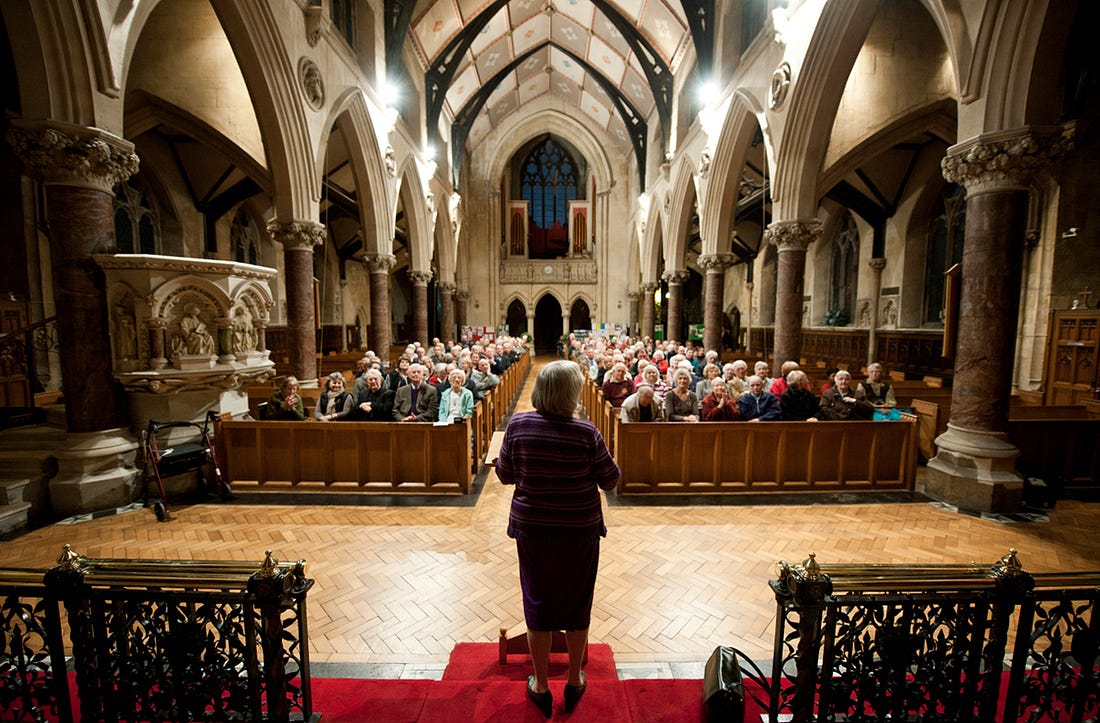
Ann Widdecombe delivers “One Year On” lecture at St. John the Evangelist Roman Catholic Church in Bath, 2011. Photo: Mazur/catholicchurch.org.uk via Flickr. CC BY-NC-ND 2.0.
Man was created for greatness, for God himself; he was created to be filled by God. But his heart is too small for the greatness to which it is destined. It must be stretched. —Benedict XVI, Spe Salvi
I’d be a liar if I didn’t say that an exclusion that pointed didn’t stab just a little bit. But I am a great one for saying it’s no good looking back. —Ann Widdecombe
He was inside the house for two minutes. On the eighth of July, a man who had driven two hundred miles walked into a cottage in Haytor Vale, on the edge of Dartmoor, carrying a hammer. Ann Widdecombe was in her kitchen, eating lunch. The provisional cause of death, read out at Westminster Magistrates’ Court, was blunt force injury to the head. She was seventy-eight. She was found the next morning, after missing a television interview, which was the only appointment anyone expected her to keep.
The coverage has gone where coverage goes, to security reviews and the question of how a former parliamentarian could be so reachable. The larger question is why she was there to be reached at all.
Start with the woman, who deserves better than to become a premise. In May 1997 she stood in the Commons and said of Michael Howard, her own former boss, that there was something of the night about him, because she believed he had misled the House. It ended his leadership hopes for years. Costly candor aimed inward is the rarest kind, and she spent it on a point of truthfulness that profited her nothing. She held Maidstone for twenty-three years. She cared for her mother at home until she died. She wrote novels because she wanted to make things. In 2010 she let herself be hauled around the Strictly Come Dancing floor by Anton Du Beke while the nation laughed, a humility grave people never manage. She was unserious about herself and never once about her convictions. When David Cameron passed her over for a peerage, reportedly for being too traditional, she said it stabbed a little, and then that it was no good looking back. She was good, and I admired her.
The obvious objection is that she kept leaving. She left the Church of England in 1993 and the Conservative Party in 2019, after forty-three years. A woman who exits whenever she loses has not found a principle. She has dressed an incapacity as one.
The answer is the destination. She went to Rome, the one body in Christendom that purports to be incapable of redefining itself by vote, and one does not escape argument by moving to the institution whose theory is that certain arguments are closed. Her judgment was that the change had been constitutive rather than incidental, and that staying would have required her to call something by a name it had stopped deserving. Most of her countrymen think she was wrong, and it is not a question this essay must settle. What it needs is the thing underneath, an unusually old view of what makes an institution the thing it is, held by someone willing to be ruined by it.
Upgrade to paid
What she fled was no synodal resolution. The Priests (Ordination of Women) Measure 1993 was approved by Parliament and given Royal Assent, and Parliament then compensated the clergy who resigned in conscience. There could be no faithful remnant parish for her, because an established church’s identity is fixed by statute rather than by conscience. The state defined the church and then funded the exit.
There is an English counterexample, instructive because he failed. John Wesley had every reason to leave and refused for fifty years; he published his Reasons Against a Separation in 1758 and died a priest of that church. What he built inside it is the most successful parallel community in Protestant history, and when the pulpits closed he preached in the fields and called the world his parish. That is expansion under exclusion rather than withdrawal, and the better answer to her problem. Yet four years after his death, the Plan of Pacification permitted the sacraments in Methodist chapels and the separation he had refused for half a century came anyway. A community nested inside an institution it will not leave runs on personal authority rather than jurisdiction, and lasts one founder’s lifetime. Every classical academy and intentional community now rising in Idaho and Tennessee runs on the same fuel: a founder’s authority, a founder’s energy, a founder’s remaining years. They should read the Plan of Pacification and count.
America solved heresy with land. Roger Williams did not reform Massachusetts Bay; he walked to Narragansett Bay. Penn took a charter. The Mormons walked out of the country entirely. American religious liberty is downstream of open ground as much as of argument, and the ground closed in 1893.
What remained was law, and its foundation stone is rotten. Reynolds v. United States, handed down in 1878, fifteen years before the ground closed, was wrongly decided, and the practice at issue is beside the point. What it established was the rule that religious liberty protects belief while conduct belongs to the state, a rule the opinion supported by observing that the practice was confined to Asiatic and African peoples. That is the holding’s logic, and the direct ancestor of the rule Employment Division v. Smithrestated in 1990. In Fulton, three decades later, Alito, Thomas, and Gorsuch called for Smith to be overruled, and Barrett found the textual case against it compelling. Four years later, Mahmoud reached strict scrutiny by way of Yoder, around Smith rather than through it, and left the rule intact in name only.
Until then every American exit is exit by leave. In 1972 Wisconsin v. Yoderwon the Amish the most complete withdrawal our law permits, and required the permission of the sovereign it sought to escape. Utah is the abject case. The Mormons left the United States altogether, crossing thirteen hundred miles to a Mexican basin in 1847; the border caught them the next year. Within fifty years Congress had dissolved their church as a corporation, seized its property, and jailed its leaders; the Manifesto of 1890 surrendered the doctrine they had crossed a continent to practice; and statehood came in 1896 on terms written into their own constitution. The jurisdiction followed them across a desert and beat them. Exit did not merely cost them something. It failed. Espinoza (2020) marks the room the partial exit enjoys, and Bob Jones (1983) marks the ceiling. There is room, but never sovereignty.
Except one. Prayer requires no charter, no Royal Assent, no favorable judgment from any court. Parliament altered a church’s doctrine by statute and could not touch it; Congress dissolved a church and seized its property and could not touch it. It is the one unconquered ground in a story whose burden is that the ground ran out, and why the Benedict Option was never about real estate. The man who proved it shares the name. In 2013 Benedict XVI laid down an office he no longer had the strength to hold, moved into a monastery inside the Vatican walls, and gave the rest of his life to prayer. He wrote until he died at ninety-five, and his 2019 essay on the abuse crisis caused as much trouble as anything he wrote while wearing the ring. Withdrawal, in his hands, was redeployment. Ann Widdecombe at daily Mass, in a country that had made her convictions a punchline, is the same fact in a smaller frame. The temptation to justify this instrumentally, prayer as fuel for activism, must be refused. Prayer is not first because it powers the rest. It is first because it is the end, and the rest follow.
England, which never had a frontier, has an old name for what a people do when exit is closed. They become recusants. You stay. You refuse conformity. You pay the fine, twenty pounds a month under Elizabeth, ruinous by design. You keep going to the wrong Mass. The Act of Settlement of 1701 stands today, so that the sovereign may marry a Catholic but may not be one, and in 1993 Ann Widdecombe converted into the one church her country’s constitution still bars from the throne. Then she stayed in that country, on Dartmoor, name on the door, taking the invitations. A polity that has made certain convictions unspeakable rather than merely wrong has taught everyone that those holding them are not quite persons, and violence against unpersons requires no organization. Whatever the Crown proves about the man in custody, the fact that matters is fixed. She stayed, and staying made her reachable.
Which brings us to the question her death forces and our culture cannot answer. What is old age for? An entire economy is trained on the old, the pharmaceutical advertising and the cruise brochures and the continuing-care campuses with their pages of golf. No group is courted more diligently as a source of revenue, and none told more plainly that its opinions are an embarrassment. The same culture that will sell a woman of eighty a stairlift will not sit still for thirty seconds of what she believes about marriage or country or God, and has coined a two-word phrase for ending the conversation. De Beauvoir held that a society’s treatment of its old exposes whatever its professed humanism is worth. Ours has resolved that they may purchase and may not speak, and the result is visible in every parish and subdivision, in men and women solvent, medicated, entertained, superfluous, whose telephones never ring. Superfluity was Arendt’s word for what totalitarian systems accomplished by design; it describes with precision a condition nobody here designed at all. They have been given everything except a reason to be here.
Upgrade to paid
We have made the last third of life a reward rather than an office. That is not what leisure ever meant. Aristotle’s scholē was the condition of the activities that constitute a life, contemplation and the affairs of the city, and it stood opposed not to work but to amusement. Leisure filled with diversion is only labor working a second shift. Cicero put the political version in Cato’s mouth, that great affairs are carried not by strength or speed but by counsel, authority, and judgment, faculties age does not remove and often supplies. The old republic had an office for the old. Ours has a market segment.
The tradition knows better. Polycarp of Smyrna was eighty-six when the proconsul offered him the recantation, and his answer, that he had served Christ these many years, is remembered because of them. The strongest objection comes from inside that tradition, whose two most celebrated martyrs are young mothers. Perpetua was twenty-two with a nursing infant, and Felicity gave birth in prison days before the arena. If courage were the special province of the old, the Passio would make nonsense of the claim. But the claim is prudential rather than vocational, and Perpetua is its proof, since her greatness is measured by what made her boldness expensive, that the price fell in a currency never hers alone. The young are bound by obligations that make courage costly to people who never chose it. The old are past the mortgage, past the school fees, past the years when a child needs a living parent more than a brave one. That freedom is not a discharge but an assignment. Benedict’s word for the mechanism is exact. The heart is too small for its destiny, and must be stretched. The world sells the last decades as the contraction into comfort. They are the last chance to be enlarged.
Three things follow, and only after the praying. Stand. Widdecombe took a party spokesmanship at seventy-six with nothing left to gain, and the school board, the zoning commission, and the parish council are offices nobody wants and everybody needs, belonging to those with no career to protect. Give, while you can still be blamed for where it went. The generation holding most of the nation’s wealth means to move nearly all of it by death rather than decision, which is the parable of the rich fool. Found the school rather than endow a chair at one, and buy the building and hand the congregation the deed. And stay put. Keep the name on the door, keep taking the invitations, say the true thing under your own name in a town where everyone knows it. That is the least dramatic of the three, and the one that got her killed.
Return, then, to the table. A woman with no husband, no children, no constituency, and no obligation to be anywhere at all, at home in her own country, at lunch, still in the fight at seventy-eight. She had nothing left that the culture wanted, and she had not surrendered the one thing it could not reach. They found her because she had never once made herself hard to find.
Thanks for reading Telos Insights! Share this article with others and invite them to subscribe.
Tim Rosenberger is a pastor and attorney and cofounder of Excelsior Action.


No comments:
Post a Comment