 |
| Pix credit here (1954) |
Everyone has something to say about AI and AI governance (see my eight lectures on commemorate comparative approaches to AI governance , June 2026). That, at least says something as bout the importance of the topic to those who are in a position to govern, and to manage the expectations and conceptual universe of the masses. But it says far less about the conceptual cages from out of which all of this "conversation" emerges, and which they reflect within the confines of the topic of AI governance.
 |
| Pix credit here (1982) |
 |
| Pix credit here |
The "Closing Synthesis" of the essay weaves the analytic strands into something that may approach coherence but not conclusion. Read together, the four parts of this analysis converge on a single finding, approached from four directions. The matrix shows that Xue's speech is deeply embedded in New Era doctrinal content beneath an STS-inflected surface vocabulary. The two-line critique shows, first, that the saturation is faithful almost to the point of orthodoxy, elaborated chiefly through a choice of borrowed vocabulary whose home discourse sits in mild tension with the recentered political project it has been recruited to serve; and second, that Xue's oracular position is structurally unlike every other voice in the comparative corpus, because he speaks from inside, rather than in supplication to, the sovereign authority the other oracles are all still negotiating with — his true request is addressed not downward to a domestic regulator but outward to the international order, for recognition as its rule-maker. The comparative-regulatory analysis shows that this same custodial, civilizational ambition is not confined to rhetoric: it is already instantiated in an operating apparatus whose closest functional analogue, the EU's AI Act, shares its structural comprehensiveness but not its legitimating grammar. And Part V shows that beneath even these three findings lies a still deeper structure common to every framework this analysis has examined — Chinese, American, and European alike — in which the only live question is who or what should occupy the apex position directing AI's development, never whether such a position should exist at all.
What remains most exposed, across all four readings, is the wager the speech stakes everything on: that AI's power is entirely a function of the adequacy of the body built to house it, and that the Party-state's capacity to build a more comprehensive body than any market-fragmented rival constitutes China's decisive advantage. It is a wager made with unusual theoretical sophistication, and one that finds unexpected company — in a Brussels regulator's risk-tiered technocracy, in a Left-Leninist senator's call for expert-negotiated redlines, in a market oracle's founder-controlled safety board — among interlocutors who share almost nothing else with Xue Lan except the conviction that some apex must hold the reins. It is also, on the terms of the corpus this analysis has now placed Xue within, the wager most vulnerable to the one question none of the seven oracles — Chinese, American, Left-Leninist, or Right-Leninist — has yet allowed itself to ask.
 |
| Pix credit here |
The text of Xue Lan's remarks in Chinese and an English translation follows below along with the Introduction to my essay. The FULL TEXT of the essay, Xue Lan's (薛澜) "Social Application of Artificial Intelligence" Read Within Its Own Cognitive Cage: A New Era Signification Matrix, a Two-Line Critique, and a Comparative-Regulatory Analysis; MAY BE ACCESSED HERE and on SSRN HERE.
薛澜:《人工智能技术的社会应用——治理挑战》——在2026中国数字经济发展和治理学术年会上的主旨演讲
编者按
7月3日,2026中国数字经济发展和治理学术年会(以下简称“年会”)在清华大学举行。本届年会以“数智经济发展中的全球机遇与治理挑战”为主题,紧扣2026全球数字经济大会核心议题。近40位顶尖专家学者、智库和业界代表参会并进行研讨交流。近20所高校的研究人员、数字经济产业相关的科研机构及企业代表共400余人线下参加会议,超10万人次观看了大会直播。
薛澜教授发表主旨演讲
一、引言
非常高兴参加今天的会议。今天我要讲的是人工智能如何能够更好地在社会当中应用。人工智能近年来发展的非常快,语言大模型之后又有了具身智能,很多判断说今年是具身智能元年。从人工智能的技术层面看,过去两年的发展是日新月异。与此相比,社会技术系统的构建更加迟缓。现在可以说人工智能发展进入到下半场了,构建人工智能技术在社会中应用的社会技术系统就变得非常急迫了。下面我就针对这个问题展开讨论。
二、人工智能发展:技术决定一切?
目前很多关于人工智能的讨论都聚焦于大模型。大模型的能力提升特别快,从ChatGPT,到Gemini,到Mythos,一代更比一代强。这种变化有意无意地形成了一个观念,算法不断优化,模型持续迭代,算力大大增强,这样的循环就会推动产业升级、组织变革、社会进步。现在有人预测,今后两三年可能会实现通用人工智能,万亿级的经济增长就成为必然。这些讨论背后隐含的前提就是技术决定一切——大模型只要往前推进了,后面社会价值同步增长是必然的。但如果我们真正去分析人工智能对各行各业的实际影响,除了少数行业之外,更多的情况是“只听楼梯响,不见人下来,”很多行业真正大规模应用成功的是特例,不是大多数。一些咨询公司做的分析,也发现很多公司在AI应用方面都面临投入很多,但收益远远不如预期。
这个现象背后的原因很复杂。如医疗领域,几年以前就有报道说人工智能系统做影像判断比医生准确率高,但人命关天,最终责任归属是难题。自动驾驶是另外一个例子。前些年我们去美国调研人工智能治理,跟加州公用事业委员会访谈,他们说自动驾驶从技术上看应该是可以应用到实际当中去了,而且比较合适的场景是高速公路的长途运输,大卡车在高速公路的行驶路线和路况比较简单,而且长途运输中的疲劳驾驶也比较普遍,使用自动驾驶技术对减少交通事故收益很大。但他们接着就说,尽管这样,我们没有指望自动驾驶很快实现,因为卡车司机的工会坚决反对,不会让自动驾驶进入长途运输行业。
这些例子让我们看到,技术发展的预期的和实际社会的应用之间有巨大的差别,这个差别使得技术决定论本身面临巨大挑战。如果讲人工智能上半场的主要任务是技术发展,现在下半场面临怎么应用的新问题,技术发展已经不是唯一的核心问题了。
要让社会更有效来使用人工智能技术,关键的任务是要形成一个新的技术社会系统—一个技术和社会水乳交融的生态。从技术决定论的眼光来看,技术进步有其相对独立的发展逻辑,社会组织、制度安排和文化观念需要被动地来配合来适应技术的发展。技术走到哪里,社会就会跟到哪里。技术的逻辑是根本的决定因素。虽然这种观点在科技社会学里仍然是一个非常重要的流派,但更多的人看到,技术创新跟社会变迁并不是这么一种简单的线性因果关系。尤其是像人工智能这样影响面很宽的技术,我们必须把它放在更广阔的社会背景中来看技术发展怎么跟组织、制度、文化等各种社会要素结合。
三、科技社会学的相关研究及汽车社会的经典案例
科技社会学对技术决定论一直有不同反思,看到了技术对社会单向影响观点的局限性。一些新的理论在不断发展,技术的社会构建论、大型技术系统理论、行动者网络理论等,特别强调技术是嵌入在复杂社会关系中的社会技术存在。最近又提出来共同演化,认为技术跟社会发展实际上是相互影响的,是双向奔赴,技术和社会相互适应,从微观、中观、宏观层面有很多研究。
例如,在微观层面,可以去分析技术是怎样改变组织,重塑组织结构的。而组织的改变反过决定了技术能否真正发挥作用,组织反向塑造技术。例如,人工智能在垂直应用领域应用时,不同领域的公司就会引导技术向不同方向发展,如谷歌可能对信息检索之类应用非常关注,金融机构特别强调风险管控等等。每一类公司都有其各自领域原来的烙印,包括特定组织的需求,从而对技术发展方向产生选择性压力。
在宏观层面,制度与文化对技术边界外部重构也是非常重要的。欧盟的《数据保护法规》对数据可得性和数据应用的边界提供了严格的外部边界。而这个法规背后又跟欧盟特定的文化社会环境相关。
综合来看,技术与社会互动最好的综合例子是汽车在人类社会的演化史。汽车从机械发明,最后成为影响整个社会发展的推动力,背后是有一段曲折起伏的故事的。
第一阶段是从卡尔·本茨的内燃机汽车原型出现后的一二十年,这个阶段其实是技术孤立发展的阶段,而非社会意义上的交通系统。汽车只是少数有钱人身份的展示,有钱人开一辆车觉得很新鲜很好玩,但它也没有在大众中去应用,当时马车是主要的交通工具。这个阶段与汽车技术配套的社会体系没有跟上来。
第二个阶段大概是1910-1945年期间,是汽车的技术社会系统形成的阶段,汽车真正进入到社会。这个过程有很多要素,首先是福特公司在1913年推出T型汽车(model),把每辆车的售价从850美元下降到300美元,使得很多普通中产阶级家庭可以买得起汽车了,一下子就把汽车的可及性大大提高了。其次就是与汽车相关的配套社会制度开始形成。首先就是道路系统。原来马路是马车用的,开汽车不行。为了让汽车能够更好地发挥作用,政府开始系统性建设道路系统。从1916年开始,美国开始建设高速公路,形成公路交通体系。这样汽车可以跑得很远了,由此产生了长途旅程加油的需求。汽车加油站系统和相关服务体系应运而生。这些社会配套系统的完善刺激了更多的买车需求。很多家庭不是一下子就能拿得买车需要的钱,需要贷款买车。相关的金融与保险服务也随之跟上。当然,如果开车的人技术不行,整天出交通事故,这样的汽车交通系统也无法持续。应运而生的是交通治理体系,包括驾驶执照、红绿灯、交通规则等相关制度安排。这个阶段的汽车技术与社会体系的互动促进了汽车的应用及扩散,也推动了与汽车相关的软硬基础设施的完善。
第三个阶段是社会重构阶段,汽车对整个社会空间形态的改变产生了巨大的影响。美国仍然是比较典型的。二战之后,汽车在美国家庭扩散迅速,城市发展的郊区化由于汽车的存在成为可能。美国大量的家庭开始搬到郊区居住,开车通勤到城市中心上下班。与此同时,很多商业形态开始重构,在郊区形成综合性购物商场,巨大的超市连锁店等等。这种城市-郊区的社会空间结构很大程度上是被汽车在家庭中深度扩散应用而形塑的。由于汽车消耗大量汽油,很多国家必须从全球汽油资源丰富的国家进口,形成了以石油的生产、运输、及应用为核心的国际地缘政治体系。换句话说,在第三阶段时,汽车已经对社会空间形态和国际政治格局产生了巨大影响。
从以上分析可以看出,汽车的发展不是简单的技术进步驱动社会变化,而是汽车与社会文化、产业网络、国家空间形态、国际政治格局紧密相连与深度互动,并进而形成了一个以汽车为核心的社会技术系统。
四、如何构建人工智能为核心的社会技术系统
相比之下,我们今天面临的情况是,如何构建一个以人工智能技术为核心的新型社会技术系统。当然,跟汽车时代相比,人工智能还是处于早期发展阶段,今天看大模型可能也就相当于当年汽车时代的发动机。现在AI发展面临的问题不光是技术成熟与否,更重要的是与之配套的社会技术系统是否完整,就像是汽车时代的道路系统、交通规则、驾驶文化等相应的软硬基础设施是否建立起来了。
综合各方面的观点,构建支撑人工智能发展的社会技术系统需要发展相互嵌套的三方面的软硬件基础设施,包括硬件基础设施、制度与治理结构、及组织与文化体系。有学者将这种新型系统称为“智能社会技术系统”(intelligent sociotechnical systems, iSTS),用以区别于传统的社会技术系统:在智能时代,智能机器代理不再是简单的辅助工具,而是人机团队中的合作成员,系统需要应对的是动态变化的技术环境和内外生态系统的不确定性,设计目标也从“对变化的控制”转向了“应对变化的敏捷性和自适应能力”。
人工智能时代的硬基础设施相当于是汽车时代的公路交通系统。目前各国关注最多的是算力基础设施。不管是美国还是中国,大家都在这方面大量投资,建设智算中心。从产业层面看,AI基础设施已形成一个涵盖芯片、服务器、数据中心等多层次的市场体系,这一“技术栈”的底层是半导体芯片——GPU、CPU、NPU、TPU等加速器构成了AI的计算引擎,英特尔、AMD、英伟达以及中国的华为、寒武纪等厂商在这一层面展开竞争。芯片之上是AI服务器和数据中心,超大规模数据中心已成为训练大模型的核心场所,它们需要支持高密度机架配置、先进冷却系统和超高速互联网络。另外一个就是数据存储中心。今天的数据存储中心早已不再是简单的“数据仓库”,而是驱动AI进化的核心引擎和“数据枢纽”。AI系统训练和推理的质量在很大程度上取决于所依赖数据的质量、代表性和可靠性,数据来源涵盖开放网络、企业专有数据库、授权内容库、科学数据集、公共记录乃至人工生成的合成数据。此外,网络运行的基础设施也是人工智能发展所必需的硬基础设施,AI工作负载依赖高速网络架构连接计算与存储资源,低延迟、高吞吐量的光纤网络和移动通信网络是实时AI应用落地的关键支撑。能源供给同样不可忽视——数据中心的选址越来越依赖可靠的电力接入,部分超大规模厂商已开始直接投资新的发电能力来保障算力基础设施的运转。
软的基础设施包括AI发展和应用的各类制度体系。如数据的流通和数据所有权的问题、系统出错后的责任制度(如医疗,无人驾驶等应用场景)、系统的安全制度,如AI审计与认证制度、监管沙盒与动态治理机制等等。这些制度体系构成了一个社会责任治理集,将社会责任理念分层嵌入到从设计约束、运行时监控到机构监督的全生命周期中,使公平性、透明度、可解释性等价值成为可监测、可执行的技术约束而非仅停留在原则层面的口号。在政策实践层面,中国已在新修订的《网络安全法》中以法律形式将人工智能纳入国家网络安全法律体系,针对深度合成、生成式人工智能等特定风险出台了专项规章,并发布了相关标准划定AI伦理安全边界。同时,国际社会也在探索“分类分级管理”“风险导向、敏捷治理”等新思路。还有一些基础设施是软硬结合的,如AI模型调用标准,相当于交通规则信号系统,最后能保证不同模型之间的协调。这个“技术栈”的中间层——模型开发与运维平台(MLOps)、模型服务(MaaS)、API管理等——正是软硬结合的关键环节,它承载着不同模型之间的互操作标准和调用规范。
最后是组织体系与社会文化体系。人工智能技术对组织机构的运行带来的冲击是根本的。如果人工智能只是应用在现有的工作流程中,其作用发挥的非常有限。人工智能技术只有嵌入组织结构变化,推动整个工作流程的重构,才能真正发挥其变革性作用。在智能社会技术系统框架下,人与智能系统需要被作为一个全新的工作系统重新设计,根据人与AI之间的优势互补来调整功能和任务分配,保证人类拥有最终决策操控权。人类学家麦克法兰指出,以往的技术变革主要影响体力劳动者,而人工智能可能带来的是对专业性工作的替代,这将在根本上改变职业的定义和结构。有研究预测,组织的运行模式将从传统的金字塔式科层制向更灵活的项目化、团队化形态转变。社会文化体系涉及很多方面,包括社会信任机制、风险认知结构、教育与能力结构等等。人工智能技术在中国推广应用的一个有利条件是,中国社会对现代科技,对人工智能技术总体来讲是持积极拥抱态度的。各种国际调研中比较发现,中国、阿联酋、新加坡等国家都属于对人工智能技术比较积极正面的。如第十四次中国公民科学素质抽样调查数据显示,中国公民整体对AI持积极态度,信任基础良好,但不同群体在认知水平、使用频率、发展信心等方面存在明显分化:受教育程度越高、职业数字化程度越高者,对AI的认知与态度更积极;青年群体认知活跃且态度开放,而老年群体则表现出认知滞后但态度乐观的特征。社会大众对人工智能在交通出行、家居生活、教育培训等领域解决实际问题的期待强烈。如何发挥好这种积极态度的优势,同时正视群体分化带来的挑战,构建面向全民的人工智能素养教育体系,也是整个社会文化体系建设中不可忽视的课题。
五、结语
综上所述,技术与社会的动态演进与交错发展是科技发展的基本规律,人工智能技术也无法例外。回顾历史上任何一次重大技术革命——从蒸汽机到电力、从汽车到互联网——其最终的社会影响力从来不是单纯由技术本身的性能决定的,而是由技术与制度、组织、文化之间能否形成正向的协同共进关系决定的。告别技术决定论,走向共同演化视角,意味着我们不能再把AI发展简单理解为“技术突破-社会适应”的单向过程,而应看到社会结构、价值观念和治理能力同样在塑造着技术的走向与形态。技术很重要,制度、组织、文化同样重要,这些要素之间相互嵌套、互为条件,缺了任何一环都难以形成可持续的竞争力。正如有学者所指出的,下一步人工智能竞争可能不是简单的技术竞争,而是产业生态、社会系统的竞争。谁能在算力基础设施、数据治理制度、组织变革能力、社会信任文化四个维度上率先形成协调高效的整体系统,谁就能在这场漫长的竞赛中赢得真正的先机。因此,构建一个适应人工智能发展的完整社会技术系统,是人工智能发展下半场的关键任务,也是中国从技术追随走向规则制定的战略支点。
供稿 | 清华服务经济与数字治理研究院
编辑 | 卢梦醒
审核 | 靳 景
推荐阅读
2. 黄先海:《人工智能驱动的知识生产:理论与政策》——在2026中国数字经济发展和治理学术年会上的主旨演讲
3. 洪永淼:《Token经济学理论创新初探》——在2026中国数字经济发展和治理学术年会上的主旨演讲
Xue Lan on AI Governance
China's Leading AI governance expert argues that the winners of the AI era will be those that integrate technology with infrastructure, institutions and social trust.
|


| |||||||||||||||


Xue Lan, a Cheung Kong Chair Distinguished Professor, Dean of Schwarzman College, and Dean of the Institute for AI International Governance at Tsinghua University, is one of China’s leading scholars on AI governance. He also serves as Chair of China’s National Expert Committee on AI Governance and as a member of the United Nations Committee of Experts on Public Administration (CEPA). From 2000 to 2018, he served as Associate Dean, Executive Associate Dean, and Dean of the School of Public Policy and Management at Tsinghua University.
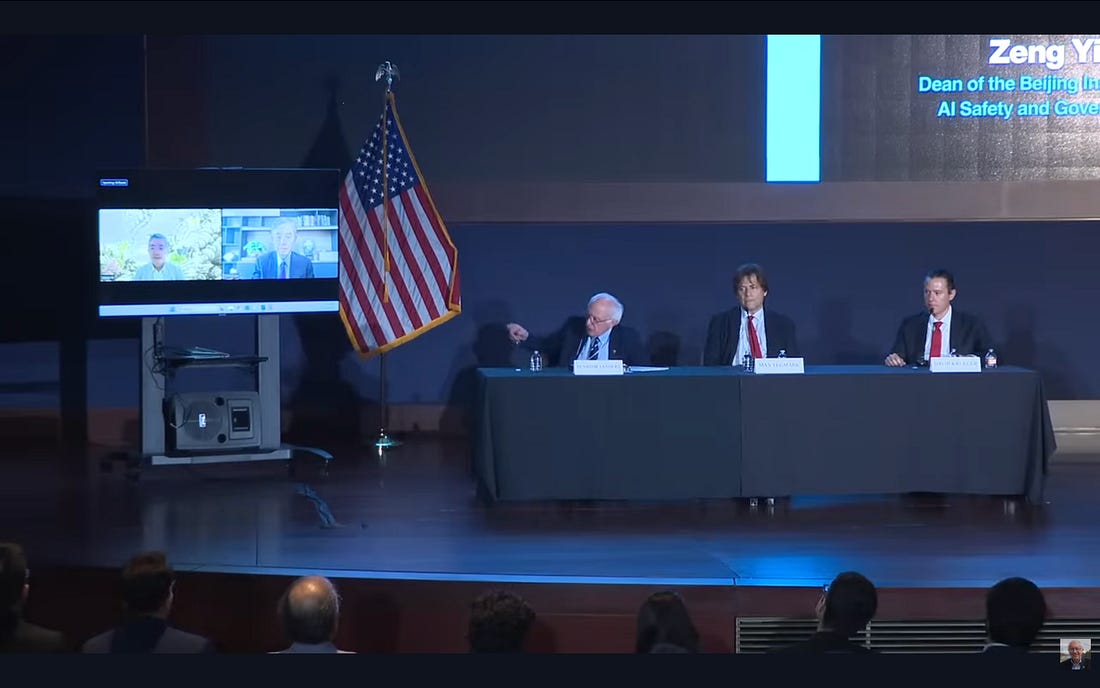
In May 2026, Xue joined a Capitol Hill discussion convened by U.S. Senator Bernie Sanders on the risks and governance of advanced AI.
 |
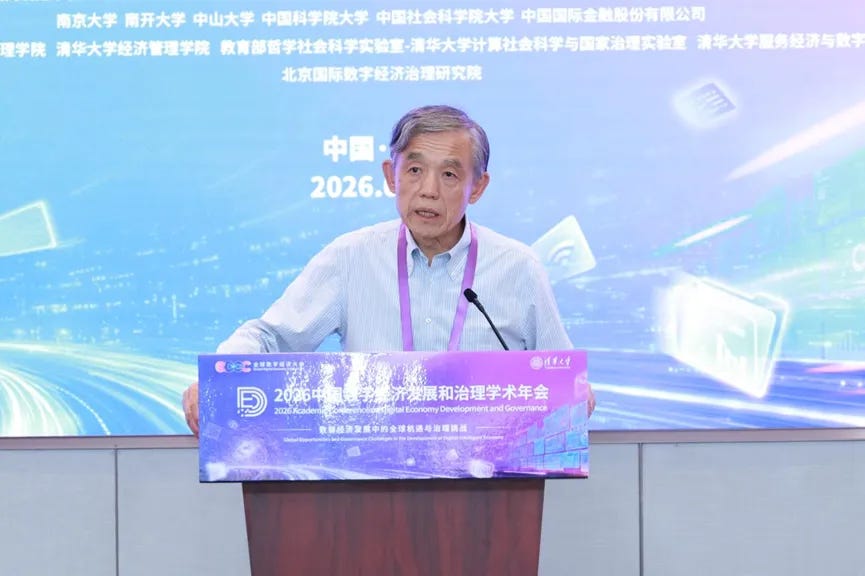
Speaking at Tsinghua University’s 2026 Academic Conference on Digital Economy Development and Governance, Xue argued that AI’s economic and social impact will depend not only on technological capabilities, but also on the sociotechnical systems, institutions, culture, and governance structures built around it. He also highlighted China’s generally positive public attitude toward AI as an advantage in its adoption and development.
Xue’s speech was published on the official WeChat blog of the Institute for Service Economy and Digital Governance, Tsinghua University, on 30 July. He kindly reviewed and revised the following translation.
 |
人工智能技术的社会应用——治理挑战
The Social Application of Artificial Intelligence:
Governance Challenges
I. Introduction
It is a great pleasure to join today’s conference. Today, I would like to discuss how artificial intelligence can be more effectively applied in society. AI has advanced very rapidly in recent years. Following large language models, we have seen the emergence of embodied AI, and many are calling this the inaugural year of embodied intelligence. From a technical perspective, AI has developed at a breathtaking pace over the past two years.
By comparison, the development of the sociotechnical systems has been much slower. It’s fair to say that AI has entered its second half of development, making it increasingly urgent to build the sociotechnical systems required for its application in society. That is the issue I will discuss today.
II. The Development of Artificial Intelligence: Does Technology Determine Everything?
Much of the current discussion about artificial intelligence focuses on large language models. Their capabilities have improved extraordinarily quickly: from ChatGPT to Gemini to Mythos, each generation has been more powerful than the last. Intentionally or otherwise, this trend has fostered the belief that the continuous optimization of algorithms, iteration of models, and expansion of computing power will naturally drive industrial upgrading, organizational transformation, and social progress.
Some now predict that artificial general intelligence (AGI) could be achieved within the next two or three years, making trillions of dollars in economic growth inevitable. The implicit assumption behind these claims is that technology determines everything: as long as frontier models continue to advance, their social value will inevitably grow in tandem.
Yet a closer examination of AI’s actual impact across industries reveals a very different picture. Outside a selected number of sectors, there has been much anticipation but little tangible progress. Successful large-scale adoption remains the exception. Analyses from consulting firms tell the same story: many companies have invested heavily in AI applications, only to see returns fall far short of expectations.
The reasons behind this are complex. Take healthcare for example. Several years ago, reports already suggested that AI systems could interpret medical images more accurately than physicians. But when human lives are at stake, taking ultimate responsibility remains a difficult question.
Autonomous driving is another example. A few years ago, during a research trip to the United States on AI governance, we spoke with the California Public Utilities Commission. Its representatives said that autonomous driving was technically ready for real-world deployment and particularly well suited to long-haul highway trucking, since routes and road conditions are relatively straightforward. Driver fatigue is also common in long-haul transport, so autonomous driving could significantly reduce traffic accidents. Even so, they did not expect the technology to be adopted quickly, because truck drivers’ unions strongly opposed its entry into the long-haul freight industry.
These examples reveal a substantial gap between expectations for technological development and its actual application in society, posing a major challenge to technological determinism. If the main task in the first half of AI development was technological advancement, then the second half is about its application. Technological progress is no longer the only core issue.
For society to use AI more effectively, the key task is to create a new sociotechnical system: an ecosystem in which technology and society are deeply integrated.
From the perspective of technological determinism, technological progress follows a relatively independent path, while social organizations, institutional arrangements, and cultural beliefs have to passively accommodate and adapt to it. Wherever technology goes, society follows; the logic of technology is the fundamental determining force.
Although this remains an important school of thought in the field of Science and Technology Studies (STS), a growing number of scholars recognize that technological innovation and social change do not have such a simple, linear causal relationship. This is especially true of a technology as far-reaching as AI. Its development must be understood within a broader social context and examined in relation to organizations, institutions, culture, and other social factors.
III. Research in the STS and the Classical Case of the Automobile Society
STS has long offered critical reflections on technological determinism, recognizing the limitations of viewing technology’s influence on society as one-directional. Newer theories, including the social construction of technology, large technical systems theory, and actor-network theory, emphasize that technology is a sociotechnical phenomenon embedded in complex social relations. More recently, scholars have advanced the concept of coevolution, arguing that technology and society shape and adapt to each other. This reciprocal relationship has been studied extensively at the micro, meso, and macro levels.
At the micro level, for example, the focus can be placed on how technology transforms organizations and reshapes their structures. In turn, organizational change determines whether technology can truly fulfil its potential; organizations also shape technology. When AI is applied in specific sectors, companies in different fields steer its development in different directions. Google, for instance, may focus heavily on information retrieval, while financial institutions place particular emphasis on risk management. Each type of company bears the imprint of its own field, including its specific organizational needs, and therefore exerts selective pressure on the direction of technological development.
At the macro level, institutions and culture are also crucial in redefining the boundaries of technology. The European Union’s General Data Protection Regulation (GDPR) sets strict external limits on data availability and use, and the regulation itself reflects the EU’s particular cultural and social environment.
Taken as a whole, the evolution of the automobile in human society provides perhaps the best comprehensive example of interaction between technology and society. The automobile went from a mechanical invention to a driving force that reshaped society as a whole in the 20th century, but the path between those two points was far from straightforward.
The first phase spanned the first one or two decades following Karl Benz’s development of his prototype internal-combustion automobile. During this period, the technology essentially developed in isolation rather than functioning as a transportation system in any social sense. Cars primarily served as status symbols for a small number of wealthy people, for whom driving was a novel and entertaining experience. They were not yet adopted by the public, and horse-drawn carriages remained the dominant means of transportation. The social systems required to support automotive technology had not yet fully developed.
The second phase, roughly from 1910 to 1945, was when a sociotechnical system for the automobile took shape and cars truly entered society. Many factors contributed to this process. First, Ford introduced the Model T in 1913 and reduced the price of a car from $850 to $300. Cars thus became affordable for many ordinary middle-class families, greatly expanding car ownership.
Second, supporting social institutions began to emerge, starting with the road system. Existing roads had been built for horse-drawn carriages and were unsuitable for automobiles. To support the widespread adoption of automobiles, governments began systematically developing road infrastructure. In 1916, the United States began developing highways and establishing a modern road transportation system. Cars could then travel much farther, creating demand for refueling on long-distance journeys. Networks of gas stations and related services emerged in response.
As these supporting systems improved, they stimulated further demand for cars. Many families could not afford to buy a car outright and needed financing, so financial and insurance services followed. A road transportation system could not be sustained if drivers lacked the necessary skills and accidents occurred constantly. A traffic management system therefore emerged, including driver’s licenses, traffic lights, traffic laws, and other institutional arrangements. During this phase, interaction between automotive technology and the social system promoted the adoption and diffusion of cars while also improving the associated physical and institutional infrastructure.
The third phase marked a period of social restructuring, during which the automobile profoundly reshaped the spatial organization of society. The United States provides a particularly clear example. After World War II, car ownership became widespread among American households, facilitating suburbanization. Large numbers of families moved to the suburbs and commuted by car to jobs in city centers. Commercial patterns were transformed as well, with integrated shopping malls and large supermarket chains emerging in suburban areas. This urban-suburban spatial structure was largely shaped by widespread household car ownership.
Because automobiles require large quantities of fuel, many countries have to import oil from resource-rich nations, giving rise to a global geopolitical order shaped by the production, transportation, and consumption of petroleum. By this third phase, the automobile had profoundly influenced not only the spatial organization of society but also the international political order.
This analysis shows that the automobile’s development was not simply a case of technological progress driving social change. Rather, the automobile became closely connected to, and interacted deeply with, social culture, industrial networks, national spatial patterns, and the international political landscape. Together, these relationships formed a sociotechnical system centered on the automobile.
IV. Building a Sociotechnical System Centered on Artificial Intelligence
By comparison, the key challenge today is how to build a new sociotechnical system centered around AI. Relative to the automobile era, AI is still at an early stage of development. Today’s large language models may be comparable to the engines of the early automobile era. The question facing AI is not only whether the technology itself is mature, but, more importantly, whether a complete supporting sociotechnical system has been established, just as automobiles required roads, traffic rules, a driving culture, and other forms of physical and institutional infrastructure.
Drawing on a range of perspectives, a sociotechnical system capable of supporting AI development requires three interlocking forms of physical and institutional infrastructure: physical infrastructure; institutions and governance structures; and organizational and cultural systems.
Some scholars call this new type of system an “intelligent sociotechnical system” (iSTS), distinguishing it from traditional sociotechnical systems. In the age of intelligence, intelligent machine agents are no longer merely auxiliary tools but collaborative members of human-machine teams. Systems must cope with dynamic technological environments and uncertainty in both their internal and external ecosystems. The design objective has likewise shifted from controlling change to responding to it with agility and resilience.
The physical infrastructure of the AI era is comparable to the highway network of the automobile era. Countries currently place the greatest emphasis on computing infrastructure. Both the United States and China, among others, are investing heavily in this area and building intelligent computing centers. At the industry level, AI infrastructure now comprises a multilayered market encompassing chips, servers, data centers, and more.
At the bottom of this technology stack are semiconductor chips: accelerators such as GPUs, CPUs, NPUs, and TPUs serve as AI’s computational engines. Companies including Intel, AMD, and NVIDIA, as well as Chinese firms such as Huawei and Cambricon, compete at this layer.
Above the chip layer are AI servers and data centers. Hyperscale data centers have become the main sites for training large models and must support high-density rack configurations, advanced cooling systems, and ultra-high-speed interconnection networks.
Data storage centers are another essential component. They are no longer merely data warehouses, but core engines and data hubs that drive AI’s evolution. The quality of AI training and inference depends heavily on the quality, representativeness, and reliability of the underlying data. Sources include the open internet, proprietary corporate databases, licensed content repositories, scientific datasets, public records, and artificially generated synthetic data.
Network infrastructure is also indispensable to AI development. AI workloads rely on high-speed network architectures to connect computing and storage resources, while low-latency, high-throughput fiber-optic and mobile communication networks are critical to deploying real-time AI applications.
Energy supply is equally important. Data center locations increasingly depend on reliable access to electricity, and some hyperscale providers have begun investing directly in new generation capacity to ensure that their computing infrastructure can operate.
Institutional infrastructure includes the various systems needed for AI development and application. These cover data circulation and ownership, liability when systems fail (as in healthcare or autonomous driving), and safety arrangements such as AI auditing and certification, regulatory sandboxes, and dynamic governance mechanisms. Together, these institutions form a framework for governing social responsibility. They embed social responsibility throughout the system’s lifecycle, from design requirements and runtime monitoring to institutional oversight, so that values such as fairness, transparency, and explainability become measurable and enforceable technical requirements rather than slogans that exist only at the level of principle.
In policy practice, China has formally incorporated AI into its national cybersecurity legal framework through the newly revised Cybersecurity Law. It has also introduced dedicated regulations addressing specific risks associated with deep synthesis and generative AI, and issued standards defining ethical and security boundaries for AI. Meanwhile, the international community is exploring new approaches such as classified and tiered management and risk-based, agile governance.
Some infrastructure combines physical and institutional elements. Standards for invoking AI models, for example, are analogous to traffic rules and signaling systems because they can ensure coordination among different models. The middle layer of the technology stack, including machine learning operations (MLOps) platforms, model as a service (MaaS), and API management, is precisely where the physical and institutional dimensions come together. This layer supports interoperability standards and invocation protocols across models.
Finally, there are organizational and sociocultural systems. AI technology has a fundamental impact on how organizations operate. If AI is simply inserted into existing workflows, its effects will be very limited. It can realize its transformative potential only when it is embedded in organizational change and drives the redesign of entire workflows.
Within the framework of intelligent sociotechnical systems, humans and intelligent systems must be redesigned as an entirely new work system. Functions and tasks should be allocated according to the complementary strengths of people and AI, while ensuring that humans retain ultimate decision-making authority and control. Anthropologist Alan McFarlane has observed that earlier technological changes primarily affected manual workers, whereas AI may replace certain forms of professional work, fundamentally altering the definition and structure of occupations. Some studies predict that organizations will move away from traditional pyramid-shaped bureaucracies toward more flexible, project-based, and team-based forms.
Sociocultural systems encompass many areas, including mechanisms of social trust, patterns of risk perception, and systems of education and skills. One favorable condition for the adoption of AI in China is the broadly positive and receptive attitude of Chinese society towards modern technology and AI. Comparative international surveys have found that countries such as China, the United Arab Emirates, and Singapore tend to view AI relatively positively.
Data from the 14th Survey on the Scientific Literacy of Chinese Citizens, for example, show that Chinese citizens are broadly positive about AI and that the foundation of trust is strong. However, clear differences exist among groups in their level of understanding, frequency of use, and confidence in AI’s development. People with higher levels of education and those working in more highly digitalized occupations tend to know more about AI and view it more positively. Younger people are more engaged with the technology and more open to it, while older people tend to have less familiarity with it but remain optimistic. The public has high expectations that AI will solve practical problems in areas such as transportation, health, education, and training.
An important part of building the broader sociocultural system will be to capitalize on this positive attitude while confronting the challenges created by differences among social groups and developing an inclusive system of AI literacy education for the entire population.
V. Conclusion
In summary, the dynamic and intertwined evolution of technology and society is a fundamental pattern of technological development, and AI is no exception. Historical experience from major technological revolutions, from the steam engine and electricity to the automobile and the internet, shows that their ultimate social impacts were never determined solely by technological capabilities alone. Rather, it depended on whether technology, institutions, organizations, and culture could develop a positive and mutually reinforcing relationship.
Moving beyond technological determinism towards a coevolutionary perspective requires abandoning the view of AI development as a linear process in which technological advances precede and drive social adaptation. Instead, social structures, values, and governance capacity must be recognized as forces that shape the trajectory and application of technology.
Technological capabilities are essential, but institutional, organizational, and cultural factors are equally important. These elements are interlocking and mutually dependent; the absence of any one of them would make sustainable competitiveness difficult to achieve.
As some scholars have noted, the next stage of AI competition may not simply be a contest over technological capabilities, but competition among broader industrial ecosystems and sociotechnical systems. Those that succeed in building a coordinated and efficient system across four dimensions — computing infrastructure, data governance institutions, organizational capacity for change, and a culture of social trust — will gain a genuine advantage in this long-term competition. Building a comprehensive sociotechnical system suited to AI development is therefore the central task in the second half of AI’s evolution and a strategic foundation for China’s transition from a technology follower to a shaper of global technological development.
Larry Catá Backer (白轲)[1]
A reflection on Xue Lan's July 3, 2026 Tsinghua keynote, read against my essays, "Modernization (现代化) and Chinese Constitutionalism's Lifeworld," "But Can You Drown a Demon 2?", and "Reflections on Measures on Cyberspace Security Supervision and Inspection by Public Security Organs"
Abstract
This essay reads a July 2026 Tsinghua keynote by Xue Lan (薛澜) — chair of China's National Expert Committee on AI Governance — as a case study in how Chinese AI-governance discourse is produced, exported, and received. It builds a matrix linking Xue's key terms to specific New Era Marxist-Leninist doctrinal referents, then pursues two lines of critique: first, an assessment, grounded in a theory of modernization as the organizing horizon of Chinese constitutionalism (drawing on my essay, "Modernization (现代化) and Chinese Constitutionalism's Lifeworld") the fundamental political line of which Xue's speech is faithful, elaborates, or deploys (finding fidelity nearly everywhere); second, a semiotic reading, using a five-stage interpretive protocol drawn from the Gerasene demoniac narrative (Mark 5), that places Xue among a corpus of AI-governance "oracles" — Palantir, Anthropic, OpenAI, Aschenbrenner, DeepSeek, and Meta — and argues his position is structurally distinct: custodial rather than supplicatory, addressed to the international order rather than a domestic sovereign. A comparative-regulatory section sets the institutional apparatus Xue's speech legitimates against the EU AI Act and the fragmented U.S. landscape. A final section, prompted by Xue's real-world engagement with Senator Bernie Sanders, identifies a deeper structure common to every framework examined — Chinese, American, and European alike — distinguishing "Left" and "Right" variants of a Leninist impulse toward concentrated, expert- or vanguard-directed control of productive and cognitive life, and argues that Xue's framework functions as a bridge between them, which is what gives the Xue-Sanders convergence its logic. The essay concludes that no framework canvassed — Chinese or Western — contemplates AI's development without some apex authority to direct it; the only contested question is who occupies that position.
Executive Summary (for the General Reader and Policymaker)
A senior Chinese AI-policy figure, Xue Lan, gave a speech in July 2026 arguing that AI's usefulness depends less on how smart the models get and more on whether societies build the surrounding infrastructure — physical, legal, and organizational — needed to put AI to work, much as the automobile only reshaped society once roads, traffic law, and gas stations were built around it. This essay treats that speech as a window into how China's AI-governance thinking works, and into what it shares with, and how it differs from, Western approaches.
Three things stand out.
First, nearly every phrase in Xue's speech connects to a specific concept from official Chinese Communist Party doctrine — even when the speech's language sounds like neutral academic sociology of technology. This isn't necessarily insincere; it reflects how thoroughly Communist Party ideology shapes what can be said and how, in an official Chinese venue, even on a technical topic like AI infrastructure.
Second, Xue is not simply asking Beijing for permission to do things — he already speaks from within China's governing apparatus. His real audience is international: he is making a bid for China, and Chinese-style institutions, to be recognized as the model the rest of the world should adopt, rather than a rival regulatory bloc among several. This ambition showed up concretely when Xue appeared alongside American scientists at a Capitol Hill event convened by Senator Bernie Sanders in April 2026 — an event that caused real political controversy in Washington, with critics accusing Sanders of legitimizing Chinese Communist Party officials.
Third, and most broadly: this essay argues that a strain runs through Chinese AI governance, American progressive politics (Sanders' own brand of it), and Western regulatory technocracy (the EU model) alike — a shared assumption that AI's development requires some concentrated authority, whether a Communist Party apparatus, a treaty of negotiating governments and scientists, or an independent regulatory agency, to direct it. Genuinely bottom-up, undirected, or market-driven alternatives are rare in this discourse, on any side. That shared assumption, more than any disagreement over specific rules, is what allowed a Chinese Party-linked scholar and an American democratic-socialist senator to find real common ground in the same room, despite otherwise occupying opposite ends of the political spectrum.
Part I: Introduction: Context and Method
On 3 July 2026 Xue Lan (薛澜), Dean of Schwarzman College and the Institute for AI International Governance at Tsinghua, delivered remarks at Tsinghua's "2026 Academic Conference on Digital Economy Development and Governance," published on the Institute's WeChat account on July 30 and reproduced here with an English translation and framing commentary (apparently from a Substack-style newsletter, bylined Yuxuan Jia and Alex Yang). In addition to his academic appointment, Xue Lan ius described as a Counsellor of the State Council of China, holds the chair of China's National Expert Committee on AI Governance and sits on the UN's Committee of Experts on Public Administration (CEPA), a UN technical advisory body that studies and makes recommendations to improve governance and public administration structures and processes for development. Prior to delivering the remarks, in May 2026, Xue joined a Capitol Hill discussion convened by Senator Bernie Sanders on frontier AI risk where, alongside other international experts, Xue Lan urged global cooperation and safety guardrails to slow down unregulated AI development.
The Remarks are worthy of critical study not merely because of the ideas they generate, but also for the context in which it was delivered and the collectives into which it was meant to be projected. This essay reads a July 2026 Tsinghua keynote by Xue Lan — chair of China's National Expert Committee on AI Governance — as a case study in how Chinese AI-governance discourse is produced, exported, and received. The remarks repay close reading not principally for its account of technology but for what it reveals about the ideological labor that Chinese academic-administrative elites are being asked to perform in the current moment of AI competition. The remarks were delivered at an official university venue, transmitted through the WeChat channel of Tsinghua's Institute for Service Economy and Digital Governance, and then translated into English with Xue's own review and revision. Every stage of that transmission chain is curatorial. One should read the text, therefore, less as an academic argument to be evaluated on its internal merits and more as a document of governance: an artifact produced by, and for, the apparatus that is simultaneously the object and the author of its own theorization.
Part I.A provides a summary of the remarks and my sense of their political context. Part I.B provides a note on method. Critical there is my aim to read Xue Lan’s text in light of my own prior work on Marxist Leninist Lebens welt, and eventually within contemporary currents within elite circles of advancing elaboration of “left” and “right” Leninism theory within both Marxist Leninist (political vanguards) and liberal democratic (techno, expert, administrative vanguards) cognitive cages. Part II embeds Xue Lan’s remarks within Chinese Marxist Leninist frameworks. Part III.A then reads Xue Lan’s remarks within the conceptual universe of my paper, "'Modernization' (现代化) and Chinese Constitutionalism's Lifeworld; Constitutionalism as the Institutionalized Phenomenology of Modernization: A Semiotic-Phenomenological Analysis of Modernization Discourse in Chinese Marxist-Leninist Political-Legal Theory" [hereafter the “modernization paper”]. Part III.B then contextualizes Xue Lan’s remarks within the ongoing “conversations among the leading figures of AI businesses and organs. Part IV attempts an analysis of Xue Lan's iSTS Apparatus Against Its Closest Analogues. Part V then considers the remarks as a function of the deeper ,eta-signifier, the current global conversation about ownership and the control and direction of human activity.
Part I.A: Xue Lan’s Remarks—A Preliminary Pass
Xue Lan rejects technological determinism — the view that model capability gains automatically translate into economic and social value. He argues AI has entered a "second half" in which the binding constraint is no longer algorithmic progress but the absence of a mature sociotechnical system around it. He borrows from STS literature (social construction of technology, large technical systems, actor-network theory, co-evolution theory) to frame technology and society as mutually constitutive rather than technology as an autonomous driver. This matters because the substantive claim of the speech — that AI's social consequences will be determined by the sociotechnical system built around it, not by model capability alone — is not merely descriptive. It is a prescription for administrative action, and the argument's rhetorical structure exists to make that prescription appear to follow ineluctably from disinterested social-scientific observation rather than from a pre-existing commitment to comprehensive state direction of technological development. This is the characteristic move of a great deal of contemporary Chinese Party-state-adjacent scholarship: the importation of Western analytic vocabulary — here, the social construction of technology, large technical systems theory, actor-network theory, co-evolutionary theory — repurposed not to interrogate power but to legitimate its exercise by a specific, named set of institutions.
Central analogy. He develops an extended automobile history in three phases: (1) 1880s–1900s, the car as an isolated technical novelty for the wealthy; (2) 1910–1945, the sociotechnical system forming around it — the Model T's price collapse, federal highway construction from 1916, gas stations, auto financing/insurance, licensing and traffic law; (3) postwar, social restructuring — suburbanization, mall/supermarket retail geography, and the oil-driven geopolitical order. His point: the car's social power came from the infrastructure and institutions built around it, not the engine alone.
Application to AI. He maps this onto three "interlocking" layers AI needs: (a) physical infrastructure — compute, chips (Nvidia/Intel/AMD vs. Huawei/Cambricon), hyperscale data centers, data pipelines, networking, energy; (b) institutional infrastructure — data circulation/ownership rules, liability regimes for AI failures (medicine, autonomous driving), auditing/certification, regulatory sandboxes, and interoperability standards across models (his "traffic signal" analogy); (c) organizational and sociocultural systems — workflow redesign (not bolt-on AI), human-AI task allocation that preserves human final authority, the shift from pyramidal bureaucracy to flexible team structures, and public trust/AI-literacy, citing generational and educational divides in Chinese survey data.
The automobile analogy and what it conceals. The extended automobile analogy is the speech's rhetorical centerpiece, and it is genuinely well constructed as pedagogy. Xue's three-stage periodization — isolated technical novelty (pre-1910), sociotechnical system formation (1910–1945, anchored by the Model T's price collapse and the federal highway program launched in 1916), and social restructuring (postwar suburbanization and the petroleum-geopolitical order) — has real explanatory power, and Xue deploys it competently to make the point that computational capability without institutional and organizational complement produces underwhelming returns, a point amply supported by his own citation of AI-adoption studies showing persistent gaps between capital expenditure and realized value.
But the analogy does specific ideological work that deserves to be named. Every institution Xue lists as constitutive of the automobile's sociotechnical system — highways, licensing regimes, traffic law — was in the American case a product of federal, state, and municipal government action operating within, and substantially constrained by, a private capital structure that financed, manufactured, insured, and distributed the technology with only intermittent and contested state involvement, litigated through courts, legislatures, and eventually a labor movement that Xue elsewhere in the speech treats as an obstacle to efficient deployment (his aside about the truckers' union blocking autonomous long-haul trucking is offered, tellingly, without normative comment — an inconvenient friction rather than a legitimate site of contestation over who bears the costs of automation). The American case, in other words, is a story of negotiated, adversarial, and pluralist institution-building, not administrative design from a single directing center. Xue borrows the analogy's descriptive force while quietly substituting, for its American institutional pluralism, an implicit brief for the kind of unified, state-directed "system-building" that Chinese administrative practice already privileges. The rhetorical trick is to use a historical case whose institutions emerged from contest and bargaining to naturalize a governance model whose institutions are meant to emerge from Party-state planning.
This is worth dwelling on because it recurs as a structural feature of the argument. Xue's third layer of the sociotechnical system — the "institutional infrastructure" comprising data-circulation rules, liability regimes, auditing/certification, and "regulatory sandboxes" — is presented as if it were simply the functional equivalent of traffic law, arising to solve a coordination problem that any rational system-builder would recognize. But he then names the specific instruments: China's newly revised Cybersecurity Law, now formally incorporating AI; dedicated rules on deep synthesis and generative AI; and standards demarcating AI's "ethical and security boundaries." What is presented as sociological description is, at the level of the text's actual referents, a recitation of the current administrative-regulatory apparatus of the Cyberspace Administration of China and its sister bodies. The theoretical apparatus of co-evolution and large technical systems is doing legitimating work for a specific, already-existing, already-operating body of law — it is not a neutral analytic frame from which policy might be derived; it is a post-hoc justification for policy already made.
"Social responsibility governance" and the compliance/ethics distinction. The passage most deserving of sustained attention — and the one closest to my own long-running preoccupation with the divergence between voluntary corporate-social-responsibility regimes and hard compliance architectures — is Xue's description of what he calls the "social responsibility governance cluster" (社会责任治理集): a framework that embeds fairness, transparency, and explainability "throughout the system's lifecycle, from design requirements and runtime monitoring to institutional oversight," so that these values become, in his formulation, "measurable and enforceable technical requirements rather than slogans that exist only at the level of principle."
Read against the background of a decade of Western AI-governance discourse dominated by voluntary principles, ethics boards, and self-assessment frameworks that have manifestly failed to constrain deployment decisions at the major frontier labs, this is a pointed — if unstated — critique. Xue is implicitly positioning the PRC's compliance-driven, statutorily grounded model of embedded technical requirements against the West's characteristic reliance on soft law, aspirational principles, and voluntary disclosure. He is right that there is a real and important distinction between principles that exist as texts and principles that exist as enforceable technical constraints instantiated in system architecture and backed by state audit power. This is a serious point, and one I have made in a different register about the global business-and-human-rights regime's chronic weakness for voluntarism.
But the comparison Xue invites elides the question that actually matters: enforceable by whom, against whom, and reviewable through what process. A compliance regime embedded in Party-state administrative law, where the auditing and certifying authority is itself an organ of the same political apparatus whose developmental priorities the technology is meant to serve, does not resolve the accountability problem that plagues Western voluntarism — it relocates it. The "measurability" Xue prizes is a genuine advance over toothless ethics-washing, but measurability enforced by an unaccountable regulator is not equivalent to measurability enforced by an accountable one. The speech elides this distinction entirely, treating "enforceable" as self-evidently sufficient without asking what independent check exists on the enforcer. This is not a minor omission; it is the entire question that separates a rule-of-law compliance regime from a rule-by-law administrative one, and Xue — who as chair of the National Expert Committee on AI Governance is himself embedded in the enforcement apparatus — has every institutional reason not to raise it.
"Humans retain ultimate decision-making authority": convergence of vocabulary, divergence of institution. Xue's claim that intelligent sociotechnical systems must be redesigned so that "humans retain ultimate decision-making authority and control" tracks almost verbatim the human-oversight language found throughout the EU AI Act, OECD AI principles, and most Western corporate AI-governance frameworks. This vocabulary convergence is itself a datum worth noting: it signals that Chinese AI-governance discourse, at least at the level addressed to international audiences (recall that this text was translated with Xue's active participation, evidently for export), has adopted the lexicon of the international AI-safety and AI-governance conversation almost wholesale.
But the convergence is lexical, not institutional. "Human" retaining "final authority" means something different depending on which human, situated in which institution, is empowered to exercise it. In the EU framework, however imperfectly realized in practice, the referent is meant to be the individual data subject or the operator accountable through administrative and judicial review. In Xue's framework, embedded as it is within a system whose institutional infrastructure is explicitly the Cybersecurity Law and its associated regulatory apparatus, the "human" retaining final authority is most plausibly the organizational hierarchy — ultimately answerable to Party-state oversight bodies — rather than the individual affected by the system's operation. The speech's silence on whose human authority is being preserved, at a moment when it otherwise displays considerable analytic precision about layered infrastructure, is not an oversight. It is the place where the argument's universalizing vocabulary and its particular institutional home come into contact, and the text simply declines to resolve the tension by leaving the referent unspecified.
The Sanders meeting and the "public attitude" data as discourse-power moves. Two further details in the framing material deserve comment because they illuminate the speech's function rather than its content. First, Xue's participation in Senator Sanders' Capitol Hill discussion on frontier-AI risk is presented, in the accompanying commentary, essentially without gloss — as a fact about Xue's biography. But it is better read as part of a broader positioning strategy in which PRC-linked AI-governance figures cultivate visible engagement with the U.S. AI-safety-adjacent political left specifically, a constituency more receptive than either Silicon Valley accelerationism or the U.S. national-security establishment to the vocabulary of risk, precaution, and institutional constraint that Xue's speech itself deploys. This is a discourse-power move in the literal sense China's own policy vocabulary uses (话语权): the cultivation of interlocutors and venues abroad through which a PRC-aligned framing of "responsible," "sociotechnical," compliance-oriented AI governance can be naturalized as the sensible, moderate position against both unregulated market deployment and (implicitly) securitized U.S.-China technological rivalry.
Second, Xue's invocation of Chinese public-opinion survey data — showing broad public trust in AI, tempered by generational and educational stratification — performs a legitimating function for domestic audiences that should not be read naively as sociological reporting. Survey instruments administered and disseminated through state-linked research infrastructure, in a public sphere where AI-critical civil-society organizing has essentially no independent institutional base, cannot straightforwardly be read as evidence of an autonomous public disposition toward AI; they are as plausibly evidence of the success of a sustained state and platform messaging environment favorable to AI adoption. Xue uses the finding to argue for an "inclusive AI-literacy education system" that would, not incidentally, be built and administered by the same institutional apparatus responsible for the "positive attitude" being measured — a closed loop in which the state produces the disposition, measures it, and then proposes itself as the appropriate agent to manage its further cultivation.
Theory in service of system-building. None of this is to say Xue's substantive thesis is wrong. Quite the opposite, within the cognitive cages within which it was necessarily developed, and grounded in the principles of rationalizing the relationship of machine systems to humans and human collectives in which he is deeply embedded, makes sense. Moreover, the claim that AI's social and economic consequences depend on the institutional, organizational, and cultural infrastructure built around the technology, and not on model capability alone, is a defensible and increasingly conventional position in AI-governance scholarship generally, and Xue states it with more historical texture than most Western equivalents manage. The automobile analogy, whatever its concealments, is genuinely illuminating as pedagogy.
The critical point is rather this: the speech is best understood not as an intervention in sociotechnical systems theory but as a piece of governance theology — an authoritative account, delivered by the state's own designated AI-governance theorist, of why the current expansion of PRC administrative control over AI development (the revised Cybersecurity Law, the deep-synthesis and generative-AI rules, the sandbox and certification apparatus) is not merely permissible but sociologically necessary, the inevitable institutional complement without which China's very real computational and industrial capacity in AI cannot translate into "genuine advantage." More importantly, perhaps, the remarks attempts to lay the groundwork for the extension of that argument—that the Chinese model, contextually modified, ought to serve as the global governance template for AI governance. The explicit closing move — casting the construction of this sociotechnical system as the "strategic support point for China's transition from technology follower to rule-maker" — confirms that the speech's ultimate register is not descriptive social science but competitive standard-setting: an argument, addressed as much to an international audience as to a domestic one, that the institutions China is already building are the correct institutions, and that the world's coming competition over AI will be won not at the level of the model but at the level of who successfully exports the governance architecture around it. Read this way, the text is less an analysis of sociotechnical systems than an early exhibit in the sociotechnical system it purports only to describe.
This is neither bad nor good; it is, instead, politics.
Part I.B: Preliminary Note on Method
Neither Xue Lan's speech nor the critique of it offered here can be read outside the ruling ideologies within which each acquires signification, interpretive power, and cognitive routing. For Xue Lan that ideology is Chinese Marxism-Leninism in its most sophisticated New Era form — a form so thoroughly institutionalized, per the modernization paper's argument, that it no longer needs to announce itself as ideology at all. It operates instead as Lebenswelt: the pre-theoretical horizon within which Xue's key terms already carry the century of accumulated meaning the modernization paper's nine sediments describe. Almost every key phrase in Xue's speech can be traced to a critical-word norm of the fundamental political line — not because Xue is quoting doctrine (he almost never cites it directly) but because the doctrine has become the condition of intelligibility within which a sentence about compute infrastructure or algorithmic sandboxes can mean anything at all to its intended audience.
The analysis therefore proceeds in three parts. Part I builds the signification matrix the framing calls for: Xue's own words and expressions, mapped directly against the key goals, initiatives, principles, and cognitive-linguistic structures of the New Era political line. Part II develops the two analytic lines specified: (A) an assessment, grounded in the modernization paper's apparatus (metasignifier, sedimentary ontology, principal contradiction, juridification), of the extent to which Xue remains faithful to, elaborates, or departs from that political line; and (B) a semiotic-phenomenological reading, conducted through the Gerasene protocol developed in "But Can You Drown a Demon 2?", that places Xue among — and, as will become clear, structurally apart from — the corpus of AI oracles already assembled there. Part III offers a comparative-regulatory analysis, in the format of the Measures-on-Cyberspace-Security post, setting the institutional apparatus Xue's speech legitimates against its closest analogues abroad.
My “Modernization Paper” as Analytical Vehicle. Because Part III.A leans on it directly, the apparatus supplied by "'Modernization' (现代化) and Chinese Constitutionalism's Lifeworld" needs to be stated in its own terms before it is put to work.
That paper's central claim is that modernization is not one Chinese policy goal among others but the organizing horizon — the taken-for-granted Lebenswelt, in Husserl's sense — through which the Party and state define problems, justify institutions, and project China's future. Modernization performs this work as a metasignifier: not a word that empties socialism, Party leadership, reform, rule of law, common prosperity, ecological civilization, or national rejuvenation of their distinct content, but a higher-order operation of articulation that supplies the semantic field within which those otherwise heterogeneous terms acquire relational meaning and become intelligible as differentiated moments of one historically continuous project. The paper traces this horizon as a sedimentary ontology of nine historical layers — national vulnerability and revolutionary sovereignty, socialist construction, industrialization and the Four Modernizations, reform and opening, the socialist market economy, governance modernization, Chinese-style modernization, and national rejuvenation — that persist simultaneously rather than replacing one another, each conditioning what the later layers can mean without dictating it.
Two further pieces of that apparatus are critical to the analysis. The first is the principal contradiction (主要矛盾): the Party's periodic, textually documented reformulation of its own diagnosis of society's most pressing problem, which the paper identifies as the recursive mechanism by which the modernizing horizon recalibrates itself to new conditions without ever being abandoned or fundamentally questioned — most recently reformulated at the 19th Congress as the contradiction between "unbalanced and inadequate development" and the people's "ever-growing need for a better life." The second is juridification: the paper's six-section account of how modernization travels from Party doctrine through the Party and State Constitutions into national legislation and finally into local administrative practice, becoming at each stage not merely mentioned but constitutive of what counts as an adequate law, a capable institution, or a correct implementation. The paper's own methodological caution — that its claim is interpretive and immanent rather than empirical or causal, and that accurate reconstruction of the system on its own terms must precede any normative evaluation of it — governs the use made of the apparatus throughout Part II.A below.


No comments:
Post a Comment