
Our friends at Global SWF have announced the distribution of their August 2026 Report. They summarize its contents this way:
Global SWF August 2026 Report
Australian State Investors, Rest Super, Royal Family Offices
Global SWF
Aug 2, 2026
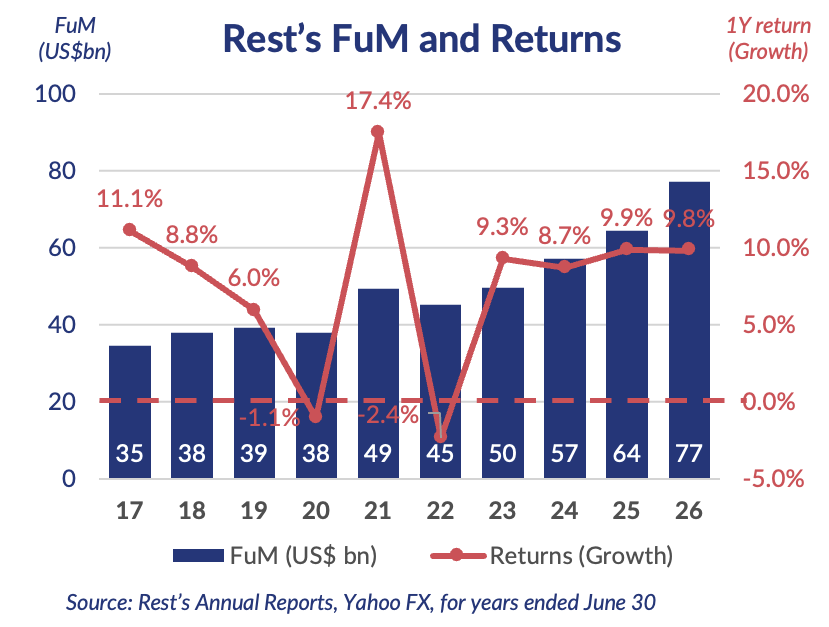
Happy August! Sovereign Investors had a relatively strong month of July, with US$ 23.3 billion in 45 transactions and several funds closed. Read all about the deals, results, and new funds at the Global SWF Times. Australia’s state investors continue to grow as superannuation funds merge and new managers arise. The monthly report looks at the current size the industry, as well as the performance of the largest 10 super funds (“Kangaroo 10”) in the past decade. These are shown with the two infographics of the month. In that context, the fund of the month goes to Retail Employees Superannuation Trust (Rest), the sixth largest fund with a US$ 77 billion portfolio. Do not miss our conversation with its CIO, Mr. Michael Clancy. Lastly, we list the 50 largest royal family offices, which we have started to cover in detail after mapping 100+ of these entities and subsidiaries, mostly in the Middle East, but also in Europe, Africa, and Asia.
The August report can now be accessed at https://globalswf.com/reports/august2026 - if your firm is a subscriber of Global SWF and you forgot your password, you can always reset it with your email at https://globalswf.com/password/reset. And if your firm is not a subscriber yet, feel free to reach out to us. We remain at your disposal should you want to discuss any of the topics in detail.
 |
| Full scorecared available here |
The text of the SWF’s Fund of the month interview with Michael Clancy, CIO of the Australia Superannuation Fund, follows below.
For the past two years, the GSR Scoreboard has recognized Rest as the only Australian superannuation fund with a perfect score (100%). The US$ 77 billion fund has yielded a 7.6% p.a. return for the past decade in the default option for its members. We were delighted to speak with its CIO Mr. Michael Clancy about the fund’s growth, the current strategy to put that capital to work, and the outlook.
[GSWF] Unlike many other Australian superannuation funds, Rest has grown mostly organically – is there any merger with another system in the horizon?
[Rest] Rest has 2+ million members, who are young on average (33-years-old), which means that we have positive net cash flows into our fund, and we can grow organically. As a result, our focus is on retaining the members we have and increasing the number of employers that we work with. However, if a merger option were to present itself, and it was attractive enough and in our members' best financial interests, we would consider it.
[GSWF] In FY26, Rest grew to AU$ 112 bn and had strong returns, despite the volatility. How did you manage to do that?
[Rest] This is the fourth year running of strong investment results, which is fantastic for our members. This year, international equity markets performed well, especially the tech sector in the US. Our Australian equities also delivered positive returns, and we benefitted from the fruit of decisions made several years ago in our private equity and infrastructure programs, e.g., we completed our first co-investment exit, after selling our stake in With Intelligence to S&P Global for a multiple of the original investment.
[GSWF] What percentage of your portfolio is in public markets vs private markets, and how is your portfolio approach?
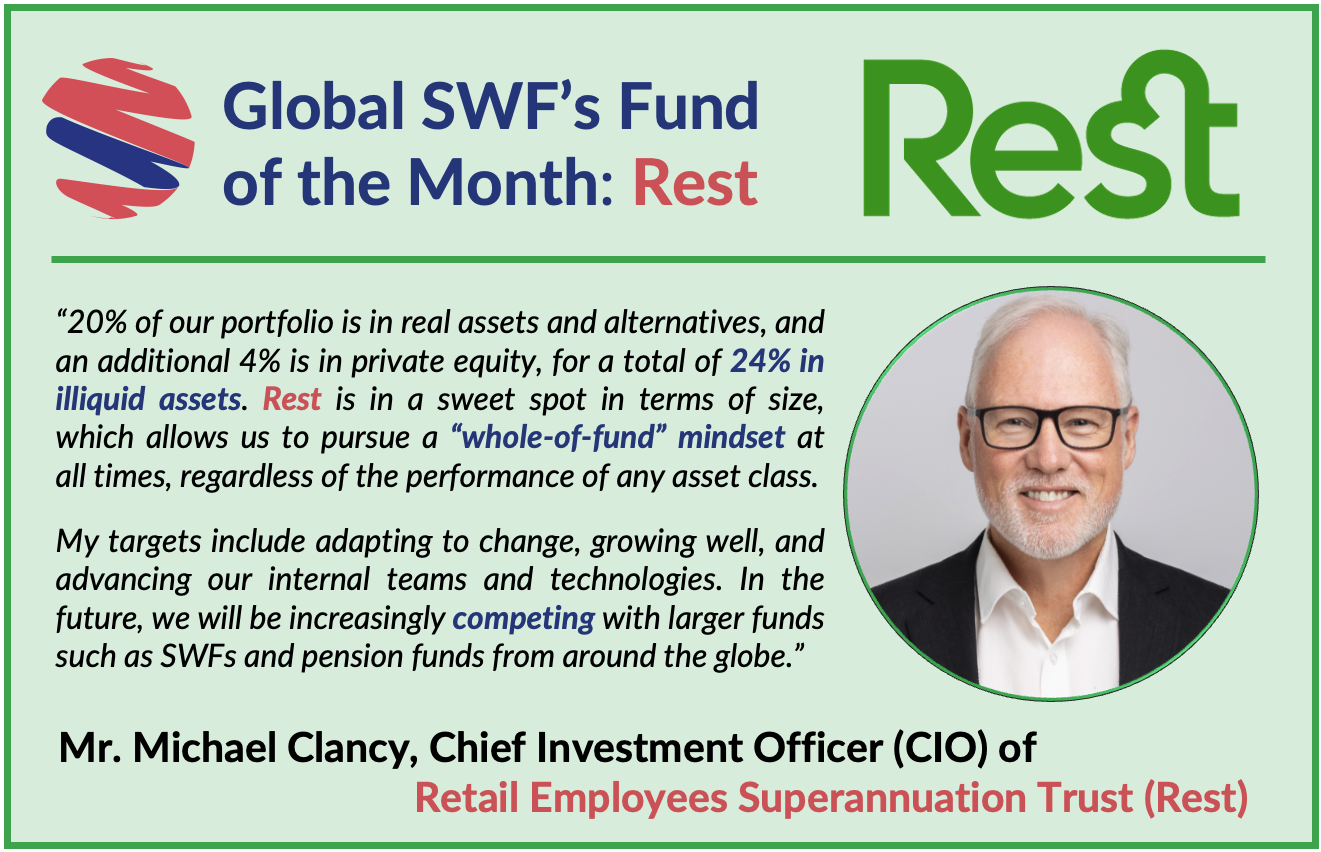
[Rest] Around 20% of our portfolio is in infrastructure, property, and other alternatives, and an additional 4% is in private equity, for a total of 24% in illiquid assets. Rest is in a sweet spot in terms of size, which allows us to pursue a “whole-of-fund” mindset at all times, regardless of the performance of any asset class. Our team is big enough to have scale, but not so big to develop team silos.
[GSWF] How much of your portfolio is domestic? Outside of Australia, is there any region of focus at the moment?
[Rest] About 43% of our portfolio is invested in Australia, with just over half of that in equities. The other 57% is invested offshore. The Australian superannuation industry is about AUD 4.5 trillion (150% of GDP), larger than all bank deposits and larger than the market capitalization of the ASX, so naturally as we grow, we will need to increase our assets offshore and compete with other global asset owners. In terms of regions of focus, our most important market for listed equities is the US, while private markets we tend to be more diversified. We have an office in London, with most of the team focused on getting access to private markets and infrastructure, including fund investments. We don't have any near-term plans to open other offices, but we’ll consider it as we grow.
[GSWF] Rest recently scored a perfect 100% in our GSR Scoreboard. Why are governance and sustainability important?
[Rest] We like to be recognized in that way, and we appreciate the efforts that your organization goes to. Especially given our young membership base, we act as a genuine long-term and responsible investor with a strong focus on governance and sustainability. Our number-one job is to deliver superior performance for our members, so we're very conscious of all the risks and opportunities. When we design our portfolios, we stress test them at least annually, and we deliberately seek diversification across every dimension, including countries, industries and asset classes. In doing so, we aim to make sure our investment options are resilient to shocks.
[GSWF] You have completed your first year at Rest – how do you compare it with your previous role at Qantas Super, and what goals do you have for the next 3-5 years?
[Rest] Qantas Super was a terrific fund to work for, but diametrically opposite in almost every measurable regard to Rest. Rest is a larger fund, cash-flow positive, and growing significantly, so it was an exciting change and opportunity for me personally.
In terms of my targets, I try to differentiate between our current focus, which is delivering the best performance we can given risk constraints; and future goals, which is adapting to change, growing well, and advancing our internal teams and technologies. In the future, we will be increasingly competing with larger funds such as SWFs and pension funds from around the globe.


No comments:
Post a Comment