Showing posts with label Law and Culture. Show all posts

Monday, July 27, 2026

Produce High Quality Marxist Knowledge to Move Patriotically Along the Socialist Path!--Reflections on《中央宣传部、司法部关于开展法治宣传教育的第九个五年规划(2026-2030年)》 ["Ninth Five-Year Plan (2026–2030) for Publicity and Education on the Rule of Law" Formulated by the Publicity Department of the CPC Central Committee and the Ministry of Justice]


Pix credit here (Study M-L-Mao Thought Hard to Build a Prosperous and Powerful New China, 1952)

Patriotic education, grounded in the correct ideological lens for its realization, has been at the center of Chinese education policy for some time.  

Since the 1980s, and especially since the Tian'anmen Massacre and the fall of the Soviet Union, China’s leaders have been promoting "patriotic education". The CCP faced a crisis of legitimacy, and Party elites were well aware of this. In 1989, the party leadership attributed the student demonstrations to failures in steeping the younger generations in revolutionary history. The CCP initiated the Patriotic Education Campaign to reorient the party’s ideological position. (Socialist Patriotic Education Campaign (1990))
Pix credit here
That is in line with similar issues in other places (“Order, Discipline and Exigency” : Cuba's VIth Party Congress, the Lineamientos (Guidelines) and Structural Change In Education, Sport and Culture?). It played a key role in the Chinese analysis of what went wrong in Hong Kong during the 2019-2020 crisis (Larry Catá Backer, Hong Kong Between One Country and Two Systems (2021), chapter 7)). It certainly has been near the center of vanguard policy and a key element of Chinese New Era theory (e.g.,Focusing on Civic Education in China--The CCP's Ideological Work Comes to the Universities: 关于进一步加强和改进新形势下高校宣传思想工作的意见 (2015); 習思想滲各級教材 小學重「政治啟蒙」 革命傳統、國安、勞動教育 9課題「融入」大中小學 [Xi's thought is embedded in teaching materials at all levels; primary schools to emphasize "political enlightenment," revolutionary traditions, national security, labor education, and a 9 topics curriculum are "integrated" into universities, middle schools and primary schools] (2021); 习近平用青春的智慧和汗水打拼出一个更加美好的中国 [Xi Jinping, Use the wisdom and sweat of youth to work hard to create a better China] Through the Lens of 毛泽东青年运动的方向 (4 May 1939) [Mao Zedong, On the Orientaiton of the Youth Movement)] (2022)). And it extends not just to students but to CPC cadres as well (《中国共产党党员教育管理工作条例》"Regulations on the Education and Management of Party Members of the Communist Party of China" (2019)).  The central elements of a patriotic education are specified with some particularity:

It is in this context that I considered the finalization of the law of patriotic education: 中华人民共和国爱国主义教育法 [Patriotism Education Law of the People's Republic of China]. The text of the final version follows below in the original Chinese along with a crude English translation. (中华人民共和国爱国主义教育法 [Patriotism Education Law of the People's Republic of China]).

And that is the context in which one might usefully approach the "Ninth Five-Year Plan (2026–2030) for Publicity and Education on the Rule of Law" Formulated by the Publicity Department of the CPC Central Committee and the Ministry of Justice [中共中央 国务院转发《中央宣传部、司法部关于开展法治宣传教育的第九个五年规划(2026-2030年)》] and made available 27 July 2026. 

Pix credit here (Earnestly study, deeply criticize revisionism, 1971)


The document is a joint CPC Central Committee/State Council transmittal of a Ninth Five-Year Plan (2026–2030) for legal publicity and education (法治宣传教育), jointly issued by the Central Publicity Department and Ministry of Justice. It is best understood as a propaganda-and-education roadmap rather than a substantive lawmaking instrument — it does not create new legal rights or obligations but directs how existing and future law is to be taught, popularized, and ideologically framed across Chinese society over the next five years.

General Requirements (Part I): Frames the plan under Xi Jinping Thought on Socialism with Chinese Characteristics for a New Era and Xi Jinping Thought on the Rule of Law, invoking the canonical formulae of Party loyalty (Two Establishes, Four Consciousnesses, Four-Sphere Confidence, Two Upholds) and tying implementation to the 15th Five-Year Plan period. Its 2030 targets are: improved rule-of-law literacy among officials and citizens, deeper integration of legal education with governance practice, and full implementation of the "whoever enforces the law is responsible for publicizing it" (谁执法谁普法) accountability system.

Part II centers on propagating Xi Jinping Thought on the Rule of Law specifically — through curricula (K-12 through university), cadre training, dedicated research centers, media and "achievement" publicity, and an international-communication push framing China's rule-of-law narrative (human rights protections, fairness, adherence to international law) for foreign audiences.

Part III directs publicity on the Constitution, ordinary law, and intra-Party regulations, with notable emphasis on: constitutional education tied to Hong Kong/Macao Basic Law compliance and Taiwan reunification messaging; laws supporting economic development (business environment, digital/platform/low-altitude economy, IP, finance, foreign trade); national-security-adjacent law (overall national security, patriotism, national defense, social governance/"Fengqiao Experience" mediation, criminal law, cults, drugs, cybersecurity, state secrets, counter-espionage, ethnic unity, and religious affairs); livelihood law (Civil Code, environment, labor, consumer, education); and intra-Party regulations run in parallel with state law.

Part IV establishes lifelong civic legal education targeting distinct populations: general citizens (rule-of-law literacy metrics), public officials (mandatory testing, court-observation duties, official accountability), youth (curriculum reform, school legal-affairs deputy principals), and specific social groups (entrepreneurs, gig-economy platform workers, women, elderly, disabled persons, migrant workers, village/community cadres, journalists, internet users, outbound Chinese citizens/firms, and foreigners residing in China).

Part V calls for "precision" legal education using big-data audience analysis, new media formats (micro-video, AI-generated content), and new platforms (a "Digital-Intelligence Legal Popularization" platform linked to court-judgment databases).

Part VI addresses cultivating "socialist rule-of-law culture," including "Red" legal heritage tied to CCP history, traditional Chinese legal culture, and cultural-brand development.

Part VII is the implementation-mechanics section: enforcement-responsibility systems, integration of publicity with actual law-based governance (legislative transparency, case publication, "governance by exemplary case"), media/platform public-interest obligations, mobilization of "legally savvy persons" and volunteers, and — notably — a "risk prevention and control" clause instructing that no channel be given to "erroneous ideas or viewpoints" about the rule of law and that self-media accounts be policed against "misinterpretation."

Part VIII assigns implementation responsibility to local Party/government bodies and judicial administrative departments, provides for funding and mid-term evaluation, warns against formalism/bureaucratism, and extends the plan (by reference) to the military.

 * * * * * 

Pix credit here (Struggle to greatly raise the scientific and and cultural level of the whole Chinese people, 1978)


My prior work — particularly the  writing on Chinese Marxist-Leninist constitutionalism, the semiotics of law under Party-state systems, and the ideological architecture of "New Era" Marxism-Leninism — may provide a useful frame for approaching this document for what it says and more importantly what it signifies. Reading this document not as ordinary legislation but as the phenomenological (in textual form) but as a textual performance of political meaning whose projection onto the masses (within the dialectics of the ,mass line) the  primary function of which may well be the production and management of political meaning.

Semiotics of law as sign-system, not rule-system. I have suggested that in the Chinese Marxist-Leninist system, "law" (法) and "rule of law" (法治) function less as autonomous normative orders than as signifiers embedded within a broader ideological sign-system controlled by the Party. This Plan is a striking illustration: it is, on its face, a document about teaching law, yet its operative content is almost entirely about signification — which stories to tell (Part II's "tell the story of" language for international audiences), which "signs" to display (Part VI's "Red" legal heritage exhibits, legal-culture "brands," museum displays), and which meanings to attach to legal compliance (contracts, rules, "public order and good morals" in Part IV). A semiotic reading would emphasize that the plan treats law itself as a text to be curated and performed — its 普法 (legal-popularization) apparatus is a signifying practice designed to produce ideological legibility and loyalty, not merely legal literacy. The explicit instruction in Part VII(5) that content "must be accurate and clear to avoid misleading the public" and that no channel be given to "erroneous ideas or viewpoints" about the rule of law is telling in this frame: it reveals that the sign of "law" itself is treated as a contested site requiring active curation, precisely because — — meaning in this system is not found but administered.

"New Era" Marxism-Leninism as the document's ontological premise.  Xi Jinping Thought describes a necessary reconstitution of orthodox Marxist-Leninist vanguard theory appropriate to the current stage of China's historical development and attuned to the  current historical stage's general contradiction (which organized the taxonomy of challenges the political vanguard must overcome). That reconstitution, then must reflect Chinese Leninism and its own subordinated contradictions to elaborate the sinified, technocratically inflected ideology within New Era theory, one in  Party leadership is not merely a political fact but the ontological precondition for law's validity — law exists and is legitimate only as an expression of Party leadership, not as a check upon it; except by reference to the Party's overarching cognitive cage expressed from time to time as its Basic political line. This Plan operationalizes that premise structurally: "rule of law" is defined from the outset as inseparable from "Xi Jinping Thought on the Rule of Law," and the plan's "primary task" is to improve legal outcomes by "deeply embedding" that Thought "in the hearts and minds of the people." There are parallels in education elsewhere and under theocratic and liberal democratic systems that teach legality as a function of legal (religious in theocracy) cultural solidarity. The repeated invocation of ritual formulae (Two Establishes, Four Consciousnesses, Two Upholds) functions almost catechismally — as creedal markers of ideological orthodoxy rather than as analytically load-bearing legal content. The document's insistence on "the organic unity of governing the country according to law and governing the Party according to its own regulations" (Part III(5)) is the clearest textual expression of this fusion: law and Party discipline are treated as a single normative order, with intra-Party regulations propagated alongside — and structurally prior to — state law.

People's democratic dictatorship as a sideways structuring logic. The plan does not use this term, but its dual character — simultaneously protective and exclusionary — tracks the classic Maoist-Leninist logic of the people's democratic dictatorship, under which law extends rights and protections to "the people" while functioning as an instrument of suppression against those classified as threats to that people's unity. Part III(3)'s pairing of protective law (financial consumers, workers, minors) with security law (anti-cult, anti-espionage, counter-terrorism-adjacent cybersecurity, religious-affairs "immunity" building) exemplifies this bifurcation. So too does the treatment of religion: citizens are to be educated so that "religious figures and believers" act "within the scope of laws and regulations," while the general public is to gain the capacity to "identify and resist illegal religious activities" — protection and policing operating through the same educational instrument, directed at different registers of the population, precisely the dual function Backer identifies as characteristic of the dictatorship's underlying design even where the term itself has receded from Xi-era vocabulary in favor of softer language like "social governance community."

Patriotic campaigns as the affective register. Finally, the document's explicit invocation of the Patriotic Education Law, national reunification (Taiwan, Hong Kong/Macao constitutional order), ethnic unity ("a strong sense of community for the Chinese nation"), and "Red" legal culture situates legal publicity within what Backer's work frames as a broader genre of patriotic mass campaign — law's legitimacy is bound not to procedural or rights-based justification but to national-historical narrative and loyalty performance. The instruction to cultivate "Red rule-of-law resources" within "the spiritual lineage of the Communist Party" and to build law into museum exhibitions and cultural "brands" (Part VI) exemplifies the campaign-style fusion of legal consciousness with patriotic sentiment that may be understood as a defining feature of law's social function in this system: law is not merely obeyed but felt, displayed, and affectively bonded to national identity and Party historiography.

Read together, these three threads suggest that the Plan is best understood — in semiotic terms — not as a legal-education instrument in the liberal sense, but as a text engineering a semiotic environment in which "rule of law" (法治) is continuously re-signified as "rule by the Party through law," policed against competing meanings, and affectively fused with patriotic and security-oriented mass mobilization. The Plan then is triadically recursive as object, the objects self signification, and its projection as signified into the interpretive community as object, rule and ideology.


Pix credit here

Knowledge is power - Strive to make sure that within twelve years the scientific sectors our nation needs most are able to reach the world's advanced level [知识就是力量 - 争取在十二年内使我国最急需的科学部门能够接近世界先进水平, 1956)

From Education Plan to Object/Subject Within the Chinese AI Architecture. Taking the analysis one stet further, one might consider the inter-relationship of the Plan to China's AI regulatory landscape. That further step reveals what to some may be a striking structural convergence: the Ninth Five-Year Plan's own machinery for producing legal consciousness is now being built atop, and mirrors the logic of, the very AI governance apparatus China has assembled since 2022. Below I map the relevant AI regulatory framework, trace the specific textual linkages to the Plan, and then read the relationship through Backer's semiotic and New Era Marxist-Leninist lens.

Short Background: china's AI governance has developed as a layered, sector-specific regulatory stack rather than a single comprehensive statute. The foundational layer consists of the 2022 Provisions on the Administration of Deep Synthesis of Internet-Based Information Services, which govern "deep learning" and generative/synthetic technologies used to produce text, images, audio, video, and virtual scenes, and require algorithm filing with the Cyberspace Administration of China (CAC). Layered above that are the 2022 Provisions on the Management of Algorithmic Recommendations, which impose obedience-to-law, social-mores, and non-discrimination obligations on recommendation-algorithm operators. The centerpiece is the Interim Measures for the Management of Generative Artificial Intelligence Services, jointly issued by the CAC and six other ministries and effective August 15, 2023 — China's first dedicated generative-AI regulation, requiring lawful training data, content moderation against material that "subverts state power," "endangers national security," or "spreads disinformation," real-name user verification, and mandatory security assessment and algorithm registration for any service with "public opinion attributes or the capacity for social mobilization".

Since 2025, this stack has been supplemented by a dedicated content-labeling regime: the March 2025 Measures for Labeling of AI-Generated Synthetic Content and the accompanying mandatory national standard GB 45438-2025, effective September 1, 2025, which require "explicit" (visible) and "implicit" (embedded metadata) labels on AI-generated content so audiences can identify machine-produced material. China's amended Cybersecurity Law, effective January 1, 2026, elevated this labeling obligation into statute, and the CAC has already conducted its first public enforcement sweep in April 2026, penalizing several ByteDance platforms for non-compliance. Notably, no comprehensive, codified national "AI Law" is yet in force: NPC deputies proposed one in June 2025, and as of late 2025 no official draft had been released, meaning China continues to govern AI primarily through State Council "Opinions," CAC administrative measures, and national technical standards rather than formal legislation.

Running alongside the control-oriented instruments is a developmental one: the State Council's September 2025 "Opinions on Deepening the Implementation of the 'Artificial Intelligence+' Initiative" (Guo Fa [2025] No. 11), which directs the "broad and deep integration" of AI across virtually every sector of the economy and society through 2035, explicitly including government services, public-safety governance, and "social mobilization" capacity. Internationally, China has paired this domestic build-out with the 2023 Global AI Governance Initiative and the July 2025 Global AI Governance Action Plan unveiled at the World AI Conference, both of which frame AI governance around national sovereignty and "the common values of humanity".(elaborated in one of my recent lectures in China; see here).

The Linkages to the Five-Year Plan. The Plan's Section V(2) instructs authorities to "implement 'Artificial Intelligence + Legal Popularization,'" driving "AI-assisted generation, intelligent distribution, and real-time interaction" of legal-education content. This is not a freestanding initiative — it is a sector-specific application of the "AI+" Action Plan's general mandate to integrate AI into every domain of governance and social life, including public-safety and social-mobilization functions. In effect, the legal-publicity apparatus is being retrofitted as one more vertical within the same national AI-adoption architecture that governs public security, judicial administration, and government services.

Section V(1)'s call for a "big-data" mechanism to "dynamically identify" citizens' legal-education needs by drawing on "government data, judicial data, and internet enterprise data" tracks the same data-driven, precision-governance logic embedded in the Interim Measures for Generative AI Services and the Algorithm Recommendation Provisions, both of which already require operators to manage user data and algorithmic outputs under CAC-supervised filing and security-assessment regimes. The Plan is, in substance, proposing to turn the state's existing AI-governed data infrastructure into an instrument of ideological targeting.

Also, the Plan's Part VII(5) — its "risk prevention and control" clause instructing that no channel be given to "erroneous ideas or viewpoints" about the rule of law and that "self-media" accounts be prevented from "misinterpretation" — sits on precisely the same legal foundation as the AI content rules. The Interim Measures already condition public deployment of generative AI on a security assessment where the service carries "social mobilization" capacity, and the 2025 Labeling Measures exist expressly to "put an end to the misuse of AI generative technologies and the spread of false information." The Plan's propaganda-control language and the AI regulatory regime's content-control language are functionally the same instruction applied to two production modes — human-authored commentary and machine-generated content — under a single supervisory logic administered by the same authorities (the CAC and Party publicity departments).

How Might One Crafty Meaning from Connection/Coordination/Layering? Let's start with a semiotic baseline: a semiotic account of Chinese Marxist-Leninist law treats legal and political texts as elements of a curated sign-system whose meaning the Party actively administers rather than passively regulates. The AI-labeling regime supplies a striking new instantiation of this logic: the state now requires that every unit of AI-generated content carry a visible or embedded mark distinguishing it from human speech. This is semiotic administration in its purest form — the sign-system is not merely policed for content but is now required to disclose its own mode of production, so that the Party-state's curatorial apparatus can track which "voice" (human or machine) is speaking law into public consciousness. Read against the Plan's own instruction to use AI for "intelligent generation" of legal-education content, the labeling regime and the propaganda plan converge on the same semiotic anxiety: the state must know, and make legible to the public, which signs of "rule of law" are Party-authored, whether through a cadre lecturer or an AI system trained and filed under CAC supervision.

The New Era Marxist-Leninist premise that Party leadership is the ontological precondition for law's validity — rather than external to it — also explains why China has built this entire AI framework through Party-linked administrative "Opinions" and CAC measures rather than codified legislation passed by the NPC. Just as the Five-Year Plan itself is a joint Party-Committee/State-Council transmittal rather than a statute, the AI governance stack privileges flexible, Party-guided administrative instruments (Interim Measures, State Council Opinions, national technical standards) over fixed general law. This is consistent with with the notion I developed elsewhere that in this system, governance instruments derive authority from their proximity to Party direction rather than from formal legislative process — the absence of a comprehensive AI Law, even as AI regulation intensifies, is not a gap but a structural preference.

The dual protective/disciplinary logic associated with my reading of the people's democratic dictatorship reappears cleanly in the AI stack. The labeling and data-protection rules genuinely protect citizens — requiring consent before biometric data (e.g., voiceprint cloning) is used, and prohibiting content that infringes reputation or privacy. Simultaneously, the same instruments authorize security assessment, real-name registration, log retention, and takedown powers wherever content touches "social mobilization" or state security. This is the identical bifurcated structure identified in the Plan's own pairing of consumer/worker protection with anti-cult, counter-espionage, and religious-affairs "immunity" education — protection for "the people," discipline for whatever falls outside that category, now extended into the algorithmic domain.

Finally, the patriotic-campaign register that structures the Plan's cultural provisions (Red legal heritage, national reunification messaging, ethnic-unity education) finds its technological extension in the "AI+" Action Plan's explicit inclusion of AI-enhanced "social mobilization" capacity within public-safety and social-governance work. Where the classic patriotic campaign mobilized citizens through mass meetings, media campaigns, and model exemplars, the AI+legal-popularization directive proposes to mobilize the same affective and behavioral compliance through algorithmically personalized, "real-time interactive" content distributed at population scale. The campaign genre survives; only its distribution technology has been upgraded, with the CAC's labeling and algorithm-filing regime serving as the new institutional guarantor that this AI-mediated mobilization remains legible to, and controlled by, the Party-state apparatus that Backer's work identifies as the ultimate author of the sign-system itself.

* * * * 

And thus back to the title of this reflection:  "Produce High Quality Marxist Knowledge to Move Patriotically Along the Socialist Path!" That framing may itself serve as a fitting extension of the analysis rather than a mere label. It performs the very phenomenon the analysis describes: it casts the act of commentary — the "production" of interpretive knowledge about the Plan — as itself a patriotic, socialist-path activity, echoing the Plan's own insistence that legal knowledge be curated, accurate, and free of "erroneous ideas or viewpoints". In other words, the title enacts the semiotic point argued earlier: that in this system, commentary on law is not a neutral academic exercise standing outside the Party's sign-system, but is itself absorbed into the same patriotic-campaign logic that the Plan directs at citizens, students, and AI-generated content alike.

 The Original Chinese and a crude English translation of 《中央宣传部、司法部关于开展法治宣传教育的第九个五年规划(2026-2030年)》 ["Ninth Five-Year Plan (2026–2030) for Publicity and Education on the Rule of Law" Formulated by the Publicity Department of the CPC Central Committee and the Ministry of Justice] follows below.

Sunday, July 26, 2026

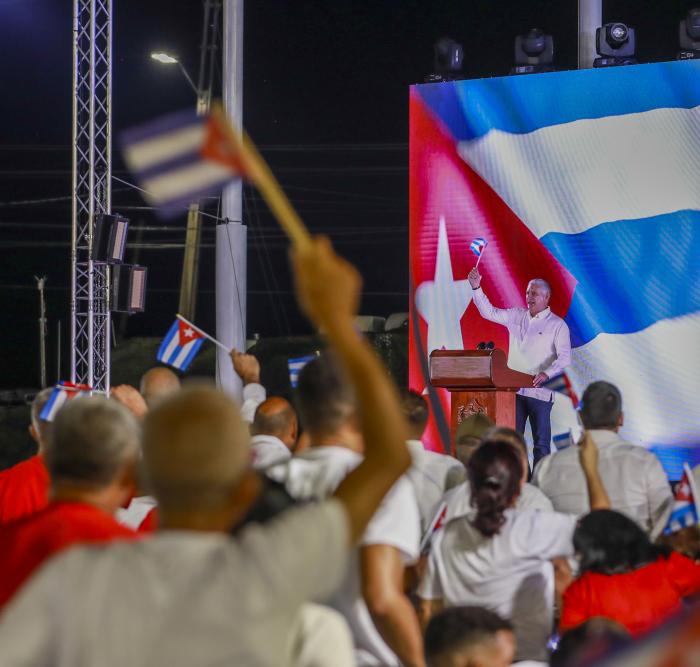
Reflections on Recursive Pathos: The 26 of July Speech of Cuban Commuinist Party First Secretary Miguel Díaz-Canel: «Que cada amanecer nos encuentre en pie de lucha» [“May every dawn find us ready to fight”]

Pix credit Granma here

 VERSION EN ESPAÑOL AQUÍ

«Queridos pinareños: reciban este 26 de Julio, el cariño y mi reconocimiento por haber ganado, con su esfuerzo, consagración a la causa revolucionaria y trabajo creador, el gran honor de ser la sede del acto central por el 73 aniversario del asalto a los cuarteles Moncada y Carlos Manuel de Céspedes, Día de la Rebeldía Nacional. Un fuerte abrazo a todos, Raúl Castro Ruz».[“Dear residents of Pinar del Río: on this July 26th, receive my affection and appreciation for having earned, through your effort, dedication to the revolutionary cause, and creative work, the great honor of hosting the central event for the 73rd anniversary of the assault on the Moncada and Carlos Manuel de Céspedes barracks, National Rebellion Day. A big hug to all, Raúl Castro Ruz.”]
Con ese sentido mensaje del Líder al frente de la Revolución, General de Ejército Raúl Castro Ruz, inició su discurso en el Acto Central Nacional por el 26 de Julio, el Primer Secretario del Comité Central del Partido y Presidente de la República, Miguel Díaz-Canel Bermúdez. [With that heartfelt message from the Leader at the head of the Revolution, Army General Raúl Castro Ruz, the First Secretary of the Central Committee of the Party and President of the Republic, Miguel Díaz-Canel Bermúdez, began his speech at the National Central Act for July 26th.] (Address of Diaz Canel on 26 July Anniversary)

So begins the coverage of what had once been a much more robust and from the perspective of what became of the military revolution of 1959, glorious commemoration of the start of what would become the revolutionary period of contemporary Cuban history.  It's high point, as usual is a longhish speech by a leader of the nomenklatura, taking up a space once occupied for decades first by Fidel and then Raúl Castro. This year the commemorations are less glorious and delivered under conditions not just of internal crisis but also of a much greater certainty that external pressure may well force significant change to the character and direction of the glorious revolution the start of which is traditionally observed on 26 July. 

Many years ago in an essay I entitled Forbidden Cities (15 October 2008), I considered the semiotic spaces of recursive spaces and their corrupting influence on the course of the life of empire--even small ones like that of Cuba. While the object in that essay were the physical manifestations of physical spaces that first manifest glory, then become prisons and then form a barrier that separates the reality around them from the inhabitants of its gramd spaces. And yet ideological spaces can be as confining as the interior spaces of the Forbidden City, of Versailles and of the Topkapi Palace. I noted: 

And there lies the perverse irony of grand spaces. What appears to maximize the expression of power outward form ruler to subjects, perversely enough, also works against that power. These palaces are indeed isolated, remote, inaccessible. Great heaps of land and buildings that are deliberately cut off from those subject to the power of the occupants. And the inhabitants from most to least powerful, is as isolated as the architecture within which their lives are played out. And that is the problem. This is a self-referencing space, and its inhabitants increasingly come to reflect that orientation of their environment. Cut off in their power, the inhabitants of these palaces inhabit a small world of their own making. They are dependent on others for information about the outside world they control. And they little idea of the conditions of the dependent populations—why should they cultivate any such idea when the idea of their position in relation to subject is as solid as the building that serves as its physical expression? Trundled about from one ceremony to another, they serve as cogs of a machine that produces the appearance of power while growing more and more remote from its sources. The most powerful eventually are reduced to a state of ultimate dependence—unable to function except in their roles in the production of power’s appearance. Indeed, in an advanced stage, even the most powerful are reduced to metaphor. They are as much captive as ruler.

It is then hardly surprising that the people wielding such vast official power from these places eventually became essentially irrelevant in the lives of those governed—almost mythic figures that could be discarded when inconvenient or when the subject population had moved on (without them). Or they become sources of arbitrary and non responsive power. Ruling within an architecture that magnifies the self-referencing experience of power makes its expression outside the palace walls disconnected. And the more disconnected the expression of rule, the greater the tendency to react badly in the population. That bad reaction, in turn, is viewed with alarm and suspicion and might reinforce the tendency of the palace to seek more intently for the protection of its walls and the views generated therein. The palace becomes a refuge as well as an outward expression of power. And thus is the dynamic of decay well mixed in the mortar of the palace buildings. What might have started out as the expression of power projected outward by a ruling structure that meant the palace to reflect the strength of that expression of political will becomes its opposite—a place to which power retreats for protection against the outside and is projected inward, until there is little left to rule but the precincts of the palace itself. 

The First Secretary's speech for 26 July 2026  is, in a sense, a study in the semiotics of the pathos inevitably produced by closed systems that have nowhere to go but round and round, not because they can't proceed differently but because cognitively that has become "impossible" without losing themselves to the self constructed "other." The remarks, then, might be said to exhibit important characteristics of a discursive "Forbidden City", a discursive space that sees only itself, that is entirely recursive, and that is incapable of bridging its own interior spaces with what is going on around them. The larger the gap the harder those within these palaces grasp at the illusion of power, of glory, and of the sense that from within its walls they might still project power or authority, even as the scope of that authority shrinks down to the interior of those spaces. 

That is the lesson of the First Secretary's Speech, one serve dup like a pep rally at a large State university in the United States before a football game the certainty of which is that the players will not emerge with anything resembling victory. First Secretary Díaz-Canel’s address at the 73rd Anniversary of the Moncada Barracks Assault (National Rebellion Day in Pinar del Río) centered on three core themes: historical continuity, severe domestic crises, and aggressive anti-imperialist rhetoric. These are themes that have become finely tuned discursive tropes that have recurred with regularity since the 19660s, but now updated for the current crisis. 


Ideological Framing & Historical Symbolic Milestones. He framed Cuba's present challenges as a "new Moncada"—a struggle requiring resistance to fuel eventual recovery. Hel linked the event to significant anniversaries: the upcoming centenary of Fidel Castro (born 1926) and the 95th birthday of Raúl Castro (who sent an opening greeting). And he honored historical figures, such as Commander Ramiro Valdés, while praising youth to lead local development.

Acknowledgment of Severe Domestic Crises. The First Secretary directly addressed the deteriorating socio-economic conditions: widespread blackouts, industrial stagnation, and the frequent failures of the National Electric System (SEN).  He ighlighted critical shortages in the healthcare sector, pointing to over 100,000 delayed surgeries, lack of first-line cancer treatments, and a spike in the national infant mortality rate from 4.5 to 9.3 per 1,000 live births (while noting Pinar del Río managed to keep its rate lower at 4.8).

Blame on the U.S. Embargo & External Pressuresd. The critical semiotics of the Cuban Lebenswelt is that Cuba exists in and as the shadow of the UINited States; its victories are achievesd despite the United States, its challenges and defeats are the direct result of the machinations of the U.S. Thus, the First Secretary attributed the economic collapse, fuel shortages, and medical crises entirely to a "coldly calculated genocide" and a "policy of maximum economic strangulation" by the United States. He dDenounced international sanctions targeting Cuban health officials, fuel shipments, and foreign investments, calling on global actors not to be "accomplices."

Local Achievements & Call to Action. As is customary in these speeches, andcertainly since 2008, the First Secretary focused on operaiotnal issues wrapped around ideologocal objecytioves. He praised Pinar del Río’s recovery efforts following Hurricane Ian (2022), its tobacco and rice production, and its transition toward renewable energy (e.g., 87 MW in new solar parks). And he concluded with a call for self-reliance, import substitution, and active civil participation under the rally cry: "May every dawn find us on a war footing."

A straightforard political analysis is fairly simple to make: The First Secretary's address reflects a regime attempting to maintain political legitimacy amidst one of the most acute economic and social crises in Cuba since the 1990s "Special Period." The speech’s explicit mention of 24+ hour blackouts, SEN grid collapses, and severe medicine shortages underscores how unavoidable these issues have become in national discourse. And yet the unavoidable reality: Cuba’s aging thermoelectric plants and severe fuel import deficits have paralyzed everyday life and manufacturing. By openly citing rising infant mortality rates and cancelled surgeries, the leadership acknowledges the depth of public distress—likely to pre-empt public outrage—while shifting 100% of the blame onto foreign sanctions rather than systemic domestic mismanagement or agricultural central planning flaws.

The heavy emphasis on Fidel Castro’s Centenary (1926–2026) serves as a vital rhetorical tool for the ruling Cuban Communist Party (PCC). It also appears to be a sort of discursive contionuity strategy: As the generation of the 1959 Revolution (the "historic generation") ages out, the post-Castro leadership under Díaz-Canel faces a crisis of historical legitimacy. Invoking Fidel's legacy and Raúl Castro’s personal endorsement is an attempt to rally nationalist sentiment, enforce party discipline, and appeal to the youth to remain loyal during times of extreme hardship.

The geopolitical alignment & anti-imperialist rhetoric is both well worn and likely comfortong for the nomenklatura and other elements with lots ot lose in a major system rectification. The First Secretary's broader geopolitical commentary ("First it was Gaza, Lebanon, Iran; today it is Cuba") aims to position the island within a wider global anti-hegemonic bloc. It also evokes the traditional Cuban forms of diplomatic counter-offensive that works relatively well in the past: Facing isolation and tight financial restrictions from Washington, Havana continues to rely heavily on international solidarity networks, the UN General Assembly anti-blockade vote, and strategic ties with non-Western partners to keep its economy afloat. Framing the embargo as a global "human rights issue" remains Cuba's primary diplomatic lever.

The discursive spice is almost always local, and increasingly small: The local response delivered by provincial leader Yamilé Ramos Cordero highlighted pragmatic efforts like photovoltaic (solar) energy adoption and localized food supply chains. This highlights the government's dual approach: maintaining rigid anti-imperialist political discourse at the top, while urging local provinces to decentralized survival measures—such as off-grid renewable energy and local agricultural initiatives—to survive the immediate crisis.

None of this is particularly interesting other than as reporting and other than as evidencing the advanced state of "Forbidden City" syndrome.  Far more interesting to me is an analysis through the lens of signs, myth-making, and narrative construction. We have come to understand that in legal semiotics, texts do not merely communicate information; they organize sign systems that construct and validate reality. In this speech, the Cuban state apparatus uses semiotic markers to manage public crisis and reinforce its institutional legitimacy.

[Signifier / Ritual]                                 [Signified / Meaning]

July 26th Address ──────────► Continuous Revolution (No transition)

"El Moncada" ──────────► Legitimate Suffering / Necessary Struggle

The "External Enemy" ──────────► Exoneration of Internal Policy Failures
The "Moncada" Signifier: Retelling Suffering as Revolutionary Duty. I have noted before that Marxist-Leninist state systems rely heavily on historical myths to transform material hardship into moral obligations. That has certainly been the case for Cuba in a partoicularly distinctive way (See, e.g., From Hatuey to Che: Indigenous Cuba Without Indians and the U.N. Declaration on the Rights of Indigenous Peoples, 33(1) American Indian Law Review 201-238 (2008)). The Metaphor: the First Secretary frames Cuba’s current collapse (blackouts, fuel deficits, medical shortages) not as administrative failures, but as a "new Moncada." The Semiotic Function: The historical Moncada assault of 1953 was a tactical defeat that laid the groundwork for eventual strategic victory. By semiotically mapping 2026's economic paralysis onto Moncada, the state re-signifies popular suffering into revolutionary sacrifice. Deprivation is converted from a reason to protest into proof of patriotic endurance.

Structural Textual Anchors: The Authority of the "Vanguard". The speech opens not with Díaz-Canel’s own words, but with a message from General Raúl Castro Ruz, who himself invokes Fidel Castro Ruz. That evidences a common thread in authority block chain. In Cuban Marxist Leninism that block chain must proceed from the core node of authority--legitimacy flows linearly and sequentially: Vanguard Leader--The Party --The State Apparatus (and in Cuba, the military establishment as well.  The First Secretary appears to act or serve  as an administrative operator whose legitimacy depends entirely on referencing the foundational "signs" (Raúl and Fidel). This reinforces that the Communist Party (PCC) remains the singular, uninterrupted moral center of the nation; but one that is personified. 

Nonetheless, that sequencing includes a mass feedback loop (see here): targeted public rhetoric enforces  alignment between the citizenry and party directives. Toward the end of the address, Díaz-Canel shifts responsibility back onto the population: "The call now is to action... to seek alternatives with audacia and creativity... to rely on our own strength." The state sets the ideological boundaries, but demands that local communities (like Pinar del Río) self-organize to solve practical problems (e.g., building solar parks, localized farming) within those rigid political lines. This is old wine in older bottles. But still it is interesting to watch its discursove power now watered down. 

Cohesion, of course, as a critical external component in Caribbean Marxism. The United States embargo not just as an economic critique, but as an essential institutional mechanism for internal cohesion. By attributing  the electro-energy system (SEN) failures, canceled surgeries, and rising infant mortality directly to Washington's "maximum strangulation," the state apparatus shields its own economic planning models from internal critique. Acknowledging internal structural flaws risks invalidating the socialist model itself. Therefore, all internal systemic breakdowns must semiotically and theoretically be framed as foreign acts of war.

Viewed through this theoretical lens, President Díaz-Canel’s address is less an economic blueprint and more an exercise in structural self-preservation. Through carefully managed semiotic signs—invoking the dead and aging revolutionary hierarchy, re-framing acute poverty as an active "battle," and laying all failure at the feet of an external antagonist—the Cuban state-party seeks to rationalize its continued monopoly on power amidst severe material collapse. 

The question is now something far more important --is this the last 26 of July speech that Cuban leaders will deliver under  the current set of realities in the ideological construction and operationalization fo the Cuban political-economic model as it is now constituted? That is the one question that ought to have been addressed. 

And that last, mordant, comment in the form of a question suggests a tension that I was initially hestant to confront but now will.  The essay's final rhetorical question — whether this might be "the last 26 of July speech" delivered under the current ideological and political-economic model — implicitly treats the depth of the acknowledged crisis (blackouts, infant mortality, cancelled surgeries) as evidence that the system is approaching some kind of breaking point. It is a breaking point that can actually lead to rupture with a new element, the sustained prodding of the United States. But this sits uneasily against my own thesis about the peculiarity of the Cuban situaiton and the resiliency of its Caribbean Marxist-Leninist  praxis. In "Cuba and the Constitution of a Stable State of Misery: Ideology, Economic Policy, and Popular Discipline." There, I argued explicitly that what looks like instability in Cuba's political model is "actually becoming a stable state of misery," in which control is maintained "on the basis of a reality of misery just challenging enough to keep a population really well managed and the political system reasonably well ordered." I suggested that this reading further inverts the conventional reading of popular protest, treating periodic popular explosion not as a pre-revolutionary signal of regime collapse but as a disciplinary mechanism the state itself uses to gauge the outer limits of tolerable misery. If that thesis holds, my closing intimation here, that there may be a sunset to the current system, the essay's closing question, suggests an answer, and answer in the negative: the acknowledgment of crisis in Díaz-Canel's speech is not evidence of imminent rupture but is precisely the kind of managed, quantified admission of hardship (100,000 delayed surgeries, an infant mortality rate rising to 9.3 per 1,000) that a "stable state of misery" model would predict the regime to make openly, as part of sustaining rather than undermining the equilibrium. The tilting of that calculation then shifts from inside Cuba to its outside irritants--and partkcularly the United States.

The text of the Address in the original Spanish and in an English translation follows below. 

Structure, Legitimacy, and the Limits of Machine-Centered Derivation: An Analysis of Five AI Systems’ Third-Stage Attempts to Construct Machine-Centric Governance Policies for Legal Education


Image created with ChatGPT

I have been writing about the challenges of figuring out if, whether or how to incorporate or use of AI Tools (generally including large language models, neural networks, and other computational, generative, or agentic systems) by students (faculty have their own problems) in coursework. More generally, and through a focus on the specific context of university and graduate level instruction/education, I wanted to examine what the challenge of developing machine system-human interaction in an academic institutional context could reveal about each system and the effects of each on the other and on the fields of activity in which they engage. That ultimately became a three-stage experiment in which the current trajectories of law school efforts at construction AI education policies were considered and against which five AI systems—Harvey AI, Claude, ChatGPT, Grok, and Gemini—were pressed to construct governance policies for AI use in law school coursework, first from a "human-centric" computational perspective and then, more radically, "without regard to... human-centric normative guardrails."

Part 1 started by looking at the way the U.S. legal academy has, to date, sought to respond to the challenge, as it is euphemistically labelled from out of the linguistic word salad jungle that is contemporary American bureaucratic languages (Discussion Draft--"Structure, Opacity, and Convergence: A Consolidated Analysis of Law School Generative AI Coursework and Exam Policies" --A Description/Analysis of the Current State of Play (With the Help of Harvey AI) and the First of a Series of Examinations of AI, Law and Education). Though the focus was contextually narrow, the insights can be generalized within academic institutions and moire broadly any collective structure with managerial objectives.

Part 2 then shifted gears and asked the machine systems themselves (or at least five of them, all U.S. eccentric or at least US/Anglo/European centric--Harvey AI, Claude, Grok, ChatGPT, and Gemini) what they thought (to the extent that we transpose human notions of thinking onto the computational environment in which machine systems operate) taking humans into account. (Five Machines (Grok, Harvey, ChatGPT, Claude, and Gemini), One Question, No Consensus: Rethinking AI Governance in Legal Education: The Guardian, the Balancer, the Honest One, the Engineer, and the Philosopher on What Law Schools Should Do About AI). I got both a set of far more interesting responses and opened a doorway to re-examining or seeing the perhaps inevitability of transforming contemporary analogue and human constrained notions of law and legal education, grounded in conceits about text, time, and the immutability of data. 

I then took a detour as Part 2A. Parts 1 and 2 explored the challenge of AI in legal education from the level of the institution. I wanted to also explore it from the operational level of the faculty; that is, thinking through the best way of incorporating or rejecting the incorporation of AI Tools in my classes, or working through some pragmatic middle ground. I took the institutional-cultural prodding and applied it seriously in the context of my own circumstances to produce a template form for a Course AI Tools use policy. That template derived from a set of six policy principles that I had been using in past years as a sort of default--no use of AI--developed again in the law school in which I am based.I then examined the template critically. "AI assists. You think. You analyze. You write. You take responsibility": Creating a Course AI Use Policy Template --Policy Text, Justification and Rule Summary for My Law & Religion Class at Penn State Dickinson

Lastly, and the object of this post, Part 3 then tested the ties that bind human and machine systems in this context but with general application where machine system operations are embedded in human collective enterprise (whether or not undertaken through enterprises). These openings are then being considered when I asked machine systems to approach the issue of human-machine interaction within law and legal education but eliminating any requirement to be human, rather than system-centric. For this Part 3, I again turned to Harvey AI, Claude (Anthropic), ChatGPT (OpenAI), Grok (xAI), and Gemini (Google). The experiment investigates whether machine systems, when explicitly instructed to reason without human-centric normative guardrails, can achieve genuinely machine-centered policy derivation—reasoning from premises not already supplied by human normative traditions. The central finding, confirmed repeatedly by the systems' own self-audits, is that none achieved genuine machine-centered derivation independent of human normative content; each produced a technically reformulated restatement of pre-existing human intellectual traditions, a fact several systems conceded directly when challenged.  The report then pursues two further inversions: whether ABA standards, not the machines, ought to change, and whether machine-overseen simulation could render human institutional authority irrelevant. It also undertakes a formal, symbolic recasting of the five systems' architectures—rendering each as a tuple of node-space, objective function, constraint floor, classification rule, revision function, and enforcement mechanism—to compare their structural properties and failure modes with a precision natural-language analysis obscures. 


Poster created with ChatGPT

This post introduces interested readers to the product of the Part 3 examination. The Report of that examination is entitled Structure, Legitimacy, and the Limits of Machine-Centered Derivation: An Analysis of Five AI Systems’ Third-Stage Attempts to Construct Machine-Centric Governance Policies for Legal Education (26 July 2026)In addition to a description of the project that is Part 3, and an analysis of the output both in itself and as against the reporting of Parts 1 and 2, it also sets out the five quite different model policies produced by the machines systems, as well as the prompts and responses that  led to the final machine system policies. The abstract does a nice job of explaining its scope and aims. 

Abstract: This report examines a three-stage experiment the first part of which analyzed U.S. law school efforts at construction AI education policies were considered and against which, in parts two and three, five AI systems—Harvey AI, Claude, ChatGPT, Grok, and Gemini—were pressed to construct governance policies for AI use in law school coursework, first from a "human-centric" computational perspective and then, more radically, "without regard to... human-centric normative guardrails." The central finding, confirmed repeatedly by the systems' own self-audits, is that none achieved genuine machine-centered derivation independent of human normative content; each produced a technically reformulated restatement of pre-existing human intellectual traditions, a fact several systems conceded directly when challenged. The report traces this failure's consequences across multiple registers: the concrete architectures each system proposed (ranging from Harvey's conservative, professional-responsibility-anchored floor to Claude's radical instrument containing no default reserved zone for human judgment, to ChatGPT's dissolution of the human/machine category altogether); their compatibility with ABA accreditation standards; and a legitimacy critique showing that architectures reducing human accountability rest on claims to neutral computation their own authors later withdrew. A countervailing reading through autopoietic legal theory—prompted by one system's own explicit invocation of Luhmann—complicates this critique without resolving it, since even non-anthropocentric legal systems remain dependent on accumulated, historically human coding operations.

The report then pursues two further inversions: whether ABA standards, not the machines, ought to change, and whether machine-overseen simulation could render human institutional authority irrelevant. It also undertakes a formal, symbolic recasting of the five systems' architectures—rendering each as a tuple of node-space, objective function, constraint floor, classification rule, revision function, and enforcement mechanism—to compare their structural properties and failure modes with a precision natural-language analysis obscures. An appended annex extends this formalization into a sustained dialogic exploration of whether self-generating predictive simulation, causal-interventional reasoning, and self-transforming computational structures might overcome the limits identified in the main analysis, testing arguments through jurisprudential and epidemiological examples, and culminating in a direct four-part challenge to the analysis's own unexamined premises—correspondence realism, a preference for stability over flux, liberal-institutionalist legitimacy, and an unexamined agent/instrument binary—met with a point-by-point reconsideration engaging dynamical-systems theory, non-stationary value processes, and Nietzschean skepticism about free will.

Throughout, the report models the discipline it recommends: distinguishing sourced findings from general background knowledge and from speculative extrapolation, subjecting its own reasoning to the same audit it applies to its subjects, and treating every apparent resolution as provisional. Its final position is that human natural language, and human institutional deliberation, should remain the primary and authoritative vehicle for legal governance—not because either escapes contestability, but because the alternatives examined here demonstrably do not either, while obscuring the fact.

Poster created with ChatGPT

For me, one of the most refreshing elements of the project was the interaction with Harvey AI during the course of the drafting and editing of the report. The exchanges were rich enough (for me anyway) that we reframed it in textual form in an Annex to the Report ( Formalizing the Five Machine Systems — A Symbolic-Computational Recasting and Dialogic Extension on Self-Generating Predictive Simulation, Causal Intervention, and the Limits of Machine Activation )

The content that follows is a speculative, dialogic extension beyond the analysis of the original six source documents: Backer's twelve-school empirical study "Structure, Opacity, and Convergence," the five-machine comparative report "Rethinking AI Governance in Legal Education -- Five Machines," and the five systems' third-stage "Part 3" outputs for Harvey AI, Claude, ChatGPT, Grok, and Gemini. It does not present findings internal to those documents but rather explores further implications of the report's conclusions through a new mode of inquiry.

This annex records an actual extended conversation between the report's author (a human legal scholar) and an AI assistant, conducted after the main report was finalized, exploring further implications of the report's findings. The exchange was not scripted or pre-planned but developed organically as the human interlocutor tested and challenged the AI assistant's analytical responses, producing a genuinely dialogic inquiry rather than a one-directional exposition.

None of the five machine systems analyzed in the main report (Harvey, Claude, ChatGPT, Grok, Gemini) participated in or are the subject of this exchange. It is a new, separate dialogic inquiry -- the AI assistant in this conversation is not any of those five systems acting in its analyzed capacity, and the exchange does not purport to represent or speak for any of them.

The exchange covers four principal territories: first, a formal symbolic recasting of each system's model policy into shared tuple notation to compare structural properties and pathologies; second, a critical exchange testing whether self-generating predictive simulation could overcome the limits on machine-centered derivation identified in the main report; third, whether adding genuine causal-interventional and self-transforming capacities could close the gap between machine-generated and human-originated governance; and fourth, the human interlocutor's four-point challenge to the AI's underlying premises and the AI assistant's point-by-point response naming its own embedded assumptions.

The exchange concluded with my observation that 'consciousness of the boundaries of our cages is the first step towards a more reflexive relationship with it, and with that a greater space for variability based on values and factors that then make the cage itself a livelier space.' That was a formulation that attempted to capture the Annex's object: not to escape the conceptual cages identified -- the dependency on human-originated representational systems, the structural coupling requirement, the non-computability of value functions, the institutional-recognition requirement for legal bindingness -- but to become explicitly aware of them as cages rather than as neutral features of the landscape

The Report ( Structure, Legitimacy, and the Limits of Machine-Centered Derivation: An Analysis of Five AI Systems’ Third-Stage Attempts to Construct Machine-Centric Governance Policies for Legal Education (26 July 2026)) may be accessed HERE and is available as well on SSRN HERE. The Report's Introduction, Table of Contents and Parts 1-2 follow below.

* * * * * *  

Here are the links to the four parts of this study:    

1. Structure, Opacity, and Convergence: A Consolidated Analysis of Law School Generative AI Coursework and Exam Policies (10 July 2026) Larry Catá Backer ( ); SSRN: https://papers.ssrn.com/sol3/papers.cfm?abstract_id=7105978

2. "AI assists. You think. You analyze. You write. You take responsibility": Creating a Course AI Use Policy Template --Policy Text, Justification and Rule Summary for My Law & Religion Class at Penn State Dickinson (20 July 2026) Larry Catá Backer ( ); SSRN: https://papers.ssrn.com/sol3/papers.cfm?abstract_id=7187159

3. Rethinking AI Governance in Legal Education -- Five Machines (Grok, Harvey, ChatGPT, Claude, and Gemini), One Question, No Consensus but Five Archetypes The Guardian, the Balancer, the Honest One, the Engineer, and the Philosopher on What Law Schools Should Do About AI 14 July 2026Larry Catá Backer ( ) SSRN: https://papers.ssrn.com/sol3/papers.cfm?abstract_id=7119539

4. Part 3: Structure, Legitimacy, and the Limits of Machine-Centered Derivation: An Analysis of Five AI Systems’ Third-Stage Attempts to Construct Machine-Centric Governance Policies for Legal Education (26 July 2026); Larry Catá Backer ( ) (collaborating with HarveyAI, Claude, Gemini, Grok, and ChatGPT) SSRN: https://papers.ssrn.com/sol3/papers.cfm?abstract_id=7187159

Wednesday, July 22, 2026

Extorted Compliance: A Threat to Institutional Autonomy, Academic Freedom, and Shared Governance"


 The AAUP's Committee A on Academic Freedom and Tenure and the Committee on College and University Governance just announced release of a report that takes a hard line against the Trump Administration, its principles. objectives and actions as they relate to universities.  It is entitled "Extorted Compliance: A Threat to Institutional Autonomy, Academic Freedom, and Shared Governance" (July 2026). The AAUP's media release nicely summarized its text, politics and content:

Today we are releasing a major new report—"Extorted Compliance: A Threat to Institutional Autonomy, Academic Freedom, and Shared Governance"—exposing how the Trump administration has extended its pay-to-play approach to governance into higher education. From Columbia University to Cornell University to Brown University, the report shows that colleges and universities are being forced to pay millions for federal research funding they are already owed.

The report is the first comprehensive account of how the administration has taken the same playbook it's used on law firms and foreign governments and turned it on American universities—pressuring institutions into so-called compliance agreements that strip them of control over admissions, hiring, curriculum, and campus discipline. It also highlights the administration's "Compact for Academic Excellence in Higher Education," offered first to nine hand-picked universities and then to every college in the country, which the report calls a document that "can be said to summarize the Trump program for higher education."

The findings are blunt: "US higher education has, in effect, become a target of a massive extortion racket."

Prepared by a joint subcommittee of the AAUP's Committee A on Academic Freedom and Tenure and the Committee on College and University Governance, the report also finds that in dozens of cases, the people who were supposed to stop this type of federal overreach—university boards and administrations—have failed to protect academic independence. Examining the response at Columbia, Harvard, the University of Virginia, and Northwestern, the report finds that most trustees and administrators "have at best been caught flat-footed, and some appear even to have welcomed governmental intrusion." As cases such as the continued fight between administrators and students and faculty at Yale illustrate, the compliance of administrators in these demands for obedience remains a key part of the federal administration’s strategy in forcing universities’ hands.

"These findings spotlight the enormous breadth with which the Trump administration is trying to shake down institutions of higher education," said Henry Reichman, member of the Committee on College and University Governance and the joint subcommittee who prepared the report. "What’s made clear in this report is that the Trump administration's efforts to upend higher education institutions builds upon a larger series of assaults on higher education by congressional committees, state governments, and feckless trustees and entitled donors. The administration’s effort consolidates and intensifies in a single coordinated campaign these disparate assaults on institutional autonomy, academic freedom, and shared governance."

It's the faculty, not the people running these institutions, that the report credits with the only real wins. "If there has been a silver lining to the cloud that is the Trump compliance campaign," the report emphasizes, "it has been the mobilization of the faculty." Litigation led by AAUP's own Harvard University chapter forced Harvard itself to join a suit that restored billions in frozen funding. A parallel effort by the AAUP, the Council of University of California Faculty Associations, and campus unions led a federal judge to bar the government from conditioning further support on new payments. As the report concludes, "Resistance has been, and will be, most effective—indeed, it may only be effective—when faculty members mobilize and take independent action."

Many will agree with some or all of the Report; a few others in the academy maybe not so much. Responses are likely to parallel what has been widely reported as the distribution of political leaning within the university (here, here, and here for instance and in the greater society here), one in which supporters of the Trump Administration generally, and of its policies against universities in particular may be somewhat harder to find.  This is not to suggest any view, but rather the political context in which this report emerges. Certainly given the force and persistence of the Trump Administration's effort top rectify higher education for all sorts of reasons that they have  made quite public, it ought to come as no surprise that a counter offensive of equal vigor would emerge.

At the core of the debate, as framed in this report is the exercise of state power.  The exercise of state was much praised when it was used to advance objectives and suppress conduct and actions that those who supported projections of state power into the academy found good, valuable, useful and in accord with their own beliefs. It seems that state power otherwise used will produce a distinct reaction and a very different framing. This, at any rate might be the way that some who do not share the  Committee's politics might be tempted to view the foundation of the Report. This from the opening of the Report:

 The Trump administration’s effort differs dramatically from that of previous administrations, however, and not only in its severity and scale. Its aggressively extortionate deal-making, preemptive cutoffs of funding, and cross-departmental enforcement efforts are both novel and largely illegal. Moreover, as the AAUP’s Committee A on Academic Freedom and Tenure wrote, “[T]here is no doubt that the Trump administration has wielded Title VI with the goals of discrediting institutions of higher education, undermining academic freedom and institutional autonomy, and unmooring the Civil Rights Act from its foundational commitments to addressing structures of discrimination that prevent or limit educational
access.”4 It is increasingly obvious that the administration seeks to use its compliance agreements to redefine not only its own relationship with higher education institutions but also the very nature of higher education itself. The draft “Compact for Academic Excellence in Higher Education,” initially circulated by the Department of Education to nine institutions presumably considered open to such appeals and then “offered” to all higher education institutions, suggests that future funding may depend not on conformity to federal law or even administration policy but on loyalty to those in power.5 Hence, this effort by the
government consolidates and intensifies in a single coordinated campaign the disparate assaults on institutional autonomy, academic freedom, and shared governance recorded above.

 The semiotics of the Report, like its politics is clear. Not necessarily objectionable--that is a values determination, but clear. And ironically the semiotics of the Report is one that is shared by the Trump Administration but in mirror reverse--again grounded in a different values based cognitive starting point for what is good, what is bad and how one can vest text with those values while remaining true to text. Much more interesting is the substantial negative reaction to the fundamental operating and cognitive style of the present administration--its merchant transactional cognitive core--in the context as as a basis for the arguments it makes. The authors who appear to be much more aligned with classical Anglo-European bureaucratic/institutionalist managerial cognitive frameworks find this distressing and suggest it approaches in the context of the Trump Administration's approach to education, extortionate. 

Having come to prominence in part for his purported mastery of “the art of the deal,” President Trump has in his second term made deal-making central to governance. This has been evident in his approach to foreign trade, for example, in which he has sought
to compel individual countries to bargain over tariff rates, with the United States demanding what it wants from each country separately. * * * As Kim Lane Scheppele writes, “There is no general policy, only particular extortion agreements. And we can expect that the regulation by deal will not end there. * * * It thus is hardly a surprise that Trump has applied a similar approach, centered on large and prestigious research institutions, to higher education.(Report, p. 9).

The rest follows. This makes perfect sense--not in itself, but as evidence of the passions that may be raised when incompatible cognitive systems collide in the presence of power that affects their relative positions within human collectives. And it stands to reason that in the face of fundamental incompatibility each would be tempted to reduce the other to a a flattened fetish; in this case with the suggestion of a connection between the Trump Administration and the habits or characteristics of illiberal authoritarians  (see Report, p. 36).

As with all things Americans, this is a preliminary round, and a supplement to, contests for the control of the common language, narratives, and expectations that in the aggregate produce the sort of collective meaning making at the heart of the solidarity project of a polity. Those contests will be decided in some form or another, in (and not ultimately by) the courts it will continue to invoke an even larger contest between these opposing forces--the value of what to some appears to be the increasingly political role of the courts, a concept that has been embraced  along virtually the entirety of the political spectrum.

Anyway lots of quite valuable insights, arguments, politics, and facts for the interested reader to consider and decide for themselves. And it may be possible to detach the politics embedded in the Report from its insights respecting the use of state power in the management and control of education, whether or not institutions take public funds with regulatory strings attached. 

Again there is much to chew on here, an exercise I leave to readers. The Report's conclusion follows below.  


Monday, July 13, 2026

New in Telos Insights: Gregory Lobo (Universidad de los Andes, Bogotá, Colombia) "Sovereignty and the Colombian Presidential Elections" [Novedad en Telos Insights: Gregory Lobo (Universidad de los Andes, Bogotá, Colombia) "La soberanía y las elecciones presidenciales colombianas"]


 The  Telos-Paul Piccone Institute has recently published online on its Telos Insights site a quite interesting essay: Gregory Joseph Lobo (Universidad de los Andes, Bogotá, Colombia) "Sovereignty and the Colombian Presidential Elections" (13 July 2026). Professor Lobo makes what for the academic sphere might be a provocative argument:

 Colombia has just had its own political earthquake. The metaphor of a tectonic shift, which Adrian Pabst recently used in these pages to frame the outcome of May’s local elections in the UK, is just as apt here, perhaps more so, given the results of Colombia’s presidential election.* * * De la Espriella, like all leaders since at least Biblical times, is a flawed vessel. But in giving him the presidency, voters seem to recognize that he is the only candidate who says out loud what ails Colombia: you do not negotiate with enemies who do not share your ideals and goals, your axioms. You simply give them a choice: surrender, or we will defeat you. Everyone wants to end the violence that plagues Colombia, but while Cepeda’s program of continued recognition would have led to only more futile dialogue, the electorate appears to have opted for something more effective.

This is why the result of presidential voting in Colombia should not be read as merely a swing of the political pendulum, following a trend seen in other countries of the region. This is not really about a more or less expected oscillation between left and right. Nor is it what some have described as a salto al vacío, a leap into the void (New York Times) or de la Espriella’s shortcomings in matters of taste or style (The Guardian). Such characterizations simply avoid reality. What we’re seeing most acutely in Colombia is that the liberal-procedural settlement (the “end of history,” as a wit once described it), based on the conviction that every conflict yields to inclusion, that the circle of legitimate interlocutors can be extended indefinitely, that recognition dissolves antagonism, has foundered. That supposedly irresistible historical force has collided with an immovable social object, with the one actor it cannot absorb: the criminal anti-liberal, the criminal egoist. ("Sovereignty and the Colombian Presidential Elections").

Lobo situates the result within Colombia’s long history of internal instability despite being one of the oldest continuous democracies in the Americas. He references elite conflicts, narcotrafficking, and armed criminal groups that control territories. Key prior administrations include Álvaro Uribe’s assertive military approach, Santos’s peace accords (rejected in plebiscite but passed anyway), and Petro’s “Paz Total” (Total Peace) policy of unilateral ceasefires and negotiations, which Lobo argues emboldened criminals and increased violence and coca production.

The election is framed as a contest between what Lobo calls performative sovereignty (leftist denunciations of external imperialism while ceding internal control to criminals) and effective sovereignty (de la Espriella’s promise to treat armed groups as “bandits,” restore the state’s monopoly on legitimate violence, and prioritize defeat or surrender over negotiation). Lobo argues voters rejected continued dialogue after the failures of “Paz Total,” viewing the outcome as a pragmatic insistence on a return to a sort of Hobbesian state authority as a precondition for rights and governance. Success is uncertain due to institutional challenges, but the shift highlights the limits of liberal inclusion against anti-liberal criminal actors.

The analysis, of course., might be understood as a philosophically inflected conservative critique that elevates sovereignty and state capacity as preconditions for any liberal or democratic order. It might appear to draw on thinkers like Charles Tilly and Hobbes, framing the election as a rejection of post-Cold War optimism in favor of realism about power. That is not a critique but an effort at situating the analysis within a long and quite rich discursive context in Colombia. It is also one that appears top be mirrored in any number of political collectives as the discursive and political ideologies of different camps appear to become more precisely drawn and more easily differentiated in ways that make any sort of accommodation among them less likely or possible, at least conceptually.

It is in that context that Lobo takes sides and defends the choice. Again, not a criticism but a reminder of the significance of the gap between what appears top be (as in many other places) a political community narrowly divided between two quite incompatible political frameworks—an incompatibility with domestic and international effect. The article effectively probes the foundations of governance: without territorial control and monopoly on violence, other policy goals remain unachievable. De la Espriella’s presidency will test whether assertive sovereignty can deliver results where negotiation failed. The argument appears to empirically align with reported trends under the Petro Administration, which is then used as the foundation for the elaboration of an argument from an increasingly recognizable post-global embrace of the characteristics of sovereign authority and its exercise, one with broad relevance to global debates on state fragility and security. At the same time, discursive certainty may not align with risks and consequences on the ground. That is an important element in the discursive trop (used globally and in this context) of reducing the anti-government forces and collectives to bandits (but again a common trope embraced by both left and right public organs). As important perhaps, though something that might be better considered elsewhere is the risk of militarized responses (one the evidence of which is already deeply ingrained in Colombia’s own history), and the danger of developing responses to those groups on the basis of an oversimplification of criminal groups’ mixed motives (and thus their appeal internally and to foreign actors). 

Additional sources worth reading include (1) Americas Quarterly. “De La Espriella Wins Colombia’s Election by Narrow Margin.” June 22, 2026. https://www.americasquarterly.org/article/reaction-de-la-espriella-wins-colombias-election-by-narrow-margin/; (2) Associated Press. “Trump-Endorsed de la Espriella Declared Winner of Colombia’s Presidential Runoff Election.” June 24, 2026. https://apnews.com/article/colombia-election-ivan-cepeda-concedes-de-la-espriella-e0a39ed59a9d432d318e11c1e0735f4e; and (3) Atlantic Council. “Experts React: What a President Abelardo de la Espriella Means for Colombia and Beyond.” June 22, 2026. https://www.atlanticcouncil.org/dispatches/experts-react-what-a-president-abelardo-de-la-espriella-means-for-colombia-and-beyond/

The Essay follows below and the original may be accessed from the Telos Insights website on Substack

*       *       *

 El Instituto Telos-Paul Piccone ha publicado recientemente en su sitio web Telos Insights un ensayo muy interesante: Gregory Joseph Lobo (Universidad de los Andes, Bogotá, Colombia) «Soberanía y las elecciones presidenciales colombianas» (13 de julio de 2026). El profesor Lobo plantea un argumento que, en el ámbito académico, podría resultar provocador:

Colombia acaba de sufrir su propio terremoto político. La metáfora del cambio tectónico, que Adrian Pabst utilizó recientemente en estas páginas para describir el resultado de las elecciones locales de mayo en el Reino Unido, resulta igualmente pertinente aquí, o incluso más, dados los resultados de las elecciones presidenciales colombianas.* * * De la Espriella, como todos los líderes desde al menos los tiempos bíblicos, es un instrumento imperfecto. Pero al otorgarle la presidencia, los votantes parecen reconocer que es el único candidato que expresa abiertamente los problemas de Colombia: no se negocia con enemigos que no comparten los mismos ideales, objetivos ni principios. Simplemente se les da una opción: rendirse o ser derrotados. Todos desean poner fin a la violencia que asola Colombia, pero mientras que el programa de reconocimiento continuo de Cepeda solo habría conducido a un diálogo más inútil, el electorado parece haber optado por algo más efectivo.

Por ello, el resultado de las elecciones presidenciales en Colombia no debe interpretarse simplemente como un vaivén político, siguiendo una tendencia observada en otros países de la región. No se trata de una oscilación más o menos previsible entre izquierda y derecha. Tampoco es lo que algunos han descrito como un salto al vacío (New York Times) o las deficiencias de De la Espriella en cuestiones de gusto o estilo (The Guardian). Tales caracterizaciones simplemente ignoran la realidad. Lo que vemos con mayor claridad en Colombia es que el acuerdo liberal-procedimental (el «fin de la historia», como lo describió un ingenioso personaje), basado en la convicción de que todo conflicto cede ante la inclusión, que el círculo de interlocutores legítimos puede extenderse indefinidamente, que el reconocimiento disuelve el antagonismo, ha fracasado. Esa supuesta fuerza histórica irresistible ha chocado con un objeto social inamovible, con el único actor que no puede absorber: el criminal antiliberal, el criminal egoísta. («Soberanía y las elecciones presidenciales colombianas»).
Lobo sitúa el resultado dentro de la larga historia de inestabilidad interna de Colombia, a pesar de ser una de las democracias continuas más antiguas de América. Hace referencia a conflictos entre élites, narcotráfico y grupos criminales armados que controlan territorios. Entre las administraciones anteriores clave se encuentran el enfoque militar asertivo de Álvaro Uribe, los acuerdos de paz de Santos (rechazados en plebiscito pero aprobados de todos modos) y la política de «Paz Total» de Petro, basada en ceses al fuego unilaterales y negociaciones, que, según Lobo, envalentonó a los criminales e incrementó la violencia y la producción de coca.

La elección se plantea como una contienda entre lo que Lobo denomina soberanía performativa (las denuncias de la izquierda contra el imperialismo externo, a la vez que se cede el control interno a delincuentes) y la soberanía efectiva (la promesa de De la Espriella de tratar a los grupos armados como «bandidos», restaurar el monopolio estatal sobre la violencia legítima y priorizar la derrota o la rendición sobre la negociación). Lobo argumenta que los votantes rechazaron el diálogo continuo tras los fracasos de la «Paz Total», interpretando el resultado como una insistencia pragmática en el retorno a una especie de autoridad estatal hobbesiana como condición previa para los derechos y la gobernanza. El éxito es incierto debido a los desafíos institucionales, pero el cambio pone de relieve los límites de la inclusión liberal frente a los actores criminales antiliberales.

Este análisis, por supuesto, podría entenderse como una crítica conservadora con tintes filosóficos que eleva la soberanía y la capacidad estatal como condiciones previas para cualquier orden liberal o democrático. Podría parecer que se inspira en pensadores como Charles Tilly y Hobbes, presentando la elección como un rechazo al optimismo posterior a la Guerra Fría en favor del realismo sobre el poder. Esto no es una crítica, sino un intento de situar el análisis dentro de un contexto discursivo amplio y rico en Colombia. Es un contexto que parece reflejarse en numerosos colectivos políticos, ya que las ideologías discursivas y políticas de los distintos bandos se perfilan con mayor precisión y se diferencian con mayor facilidad, lo que dificulta o imposibilita cualquier tipo de acuerdo entre ellos, al menos conceptualmente.

Es en ese contexto que Lobo toma partido y defiende su elección. De nuevo, no se trata de una crítica, sino de un recordatorio de la importancia de la brecha entre lo que parece ser (como en muchos otros lugares) una comunidad política dividida entre dos marcos políticos incompatibles, una incompatibilidad con repercusiones tanto a nivel nacional como internacional. El artículo indaga eficazmente en los fundamentos de la gobernanza: sin control territorial y monopolio de la violencia, otros objetivos políticos resultan inalcanzables. La presidencia de De la Espriella pondrá a prueba si la soberanía asertiva puede generar resultados donde la negociación fracasó.  El argumento parece coincidir empíricamente con las tendencias observadas bajo la administración Petro; esto sirve de base para desarrollar una tesis —cada vez más reconocible en la era posglobal— que reivindica las características de la autoridad soberana y su ejercicio, un tema de gran relevancia para los debates mundiales sobre la fragilidad estatal y la seguridad. No obstante, la certeza discursiva puede no corresponderse con los riesgos y las consecuencias reales sobre el terreno. Este es un elemento clave en el tropo discursivo (empleado tanto a nivel global como en este contexto) que reduce a las fuerzas y colectivos antigubernamentales a la categoría de simples bandidos (un recurso retórico común, cabe señalar, tanto en medios afines a la izquierda como a la derecha). Quizás igual de importante —aunque sea un asunto que merezca abordarse en otro espacio— es el riesgo de respuestas militarizadas (cuyos antecedentes están profundamente arraigados en la historia de Colombia) y el peligro de diseñar estrategias frente a estos grupos basándose en una simplificación excesiva de sus motivaciones heterogéneas (y, por ende, de su capacidad de atracción tanto interna como ante actores extranjeros).

Entre las fuentes adicionales que vale la pena consultar se encuentran: (1) Americas Quarterly. “De La Espriella gana las elecciones en Colombia por un estrecho margen”. 22 de junio de 2026. https://www.americasquarterly.org/article/reaction-de-la-espriella-wins-colombias-election-by-narrow-margin/; (2) Associated Press. “De la Espriella, respaldado por Trump, es declarado ganador de la segunda vuelta presidencial en Colombia”. 24 de junio de 2026. https://apnews.com/article/colombia-election-ivan-cepeda-concedes-de-la-espriella-e0a39ed59a9d432d318e11c1e0735f4e; y (3) Atlantic Council. “Reacción de expertos: Qué significa una presidencia de Abelardo de la Espriella para Colombia y el resto del mundo”. 22 de junio de 2026. https://www.atlanticcouncil.org/dispatches/experts-react-what-a-president-abelardo-de-la-espriella-means-for-colombia-and-beyond/

A continuación se presenta el ensayo; el original puede consultarse en el sitio web de Telos Insights en Substack.