 |
| Pix credit here |
But this place is really the largest group of Trump Derangement Syndrome people ever put together at one time, I suspect. Some of you are lucky that our last dinner was cut short because I had brought with me what would possibly have been — I’m telling you, I had something. I was going to go after you. I feel so badly doing this. It’s got to be such a letdown. But your lives were really in danger the last time, for an opposite reason. But on the plus side, your careers were saved. (Transcript: Trump Remarks at White House Correspondents’ Association Dinner)
President Trump gave a fairly long set of remarks at the White House Correspondents Association Dinner, reprised on 24 July 2026 after the abrupt end of the first dinner because of a security threat, which was ultimately contained. The transcript is reproduced below from the Singju Post (Transcript: President Trump Remarks at White House Correspondents’ Association Dinner).
The transcript of the President's remarks are well worth reading; not necessarily for its text as such, but for its comedy. It is that engagement with comedy, revealing of its subject as well as of its "singer" (in this case the President) that provides food for thought. I think here of comedy in its old sense: ""narrative with a happy ending; any composition intended for amusement," from Old French comedie (14c.), "a poem" (not in the theatrical sense) and directly from Latin comoedia, from Greek kōmōidia "a comedy, amusing spectacle," probably [Beekes] from kōmōidos "actor or singer in the revels," from kōmos "revel, carousal, merry-making, festival" + aoidos "singer, poet," from aeidein "to sing." But it is a means of communication that substantial semiotic inter-subjectivity in terms of the feedback or dialectical loops that create and project meaning and that are made meaningful through its textual and interpretive play among a community that evidences its interpretive solitary in being "in on the joke."
 |
| Pix credit here (1966 American Musical) |
All of this, of course, served me as an invitation to the start of something like a very brief and preliminary consideration of the semiotics of the comic. And that made me curious about the evolution of the signification of comedy at least, again, in a preliminary and very flattened way. Plato appeared focused on mockery. But not just mockery but its connection to laughter and laughter's connection to the diminution of critical social significs. He might be said to have treated laughter with suspicion in the Republic, warning against depicting gods and heroes as objects of mockery, and offered a "superiority" account in the Philebus, describing laughter as a mixed pleasure arising from perceiving another's ignorance or self-delusion, tinged with malice (phthonos). Aristotle, in the Poetics, distinguished comedy from tragedy by its imitation of persons worse than average in the mode of the ridiculous (to geloion)—a species of the ugly or defective causing no real pain or harm. His lost second book of the Poetics on comedy is thought by some scholars to be echoed in the anonymous Byzantine Tractatus Coislinianus, though this connection remains disputed. In the Nicomachean Ethics, Aristotle also discussed eutrapelia (wit) as a virtuous mean between buffoonery (bomolochia) and boorishness (agroikia). And yet the ancients did enjoy a good comedy--attached to and perhaps to heighten the significs of the tragedy that represented the more elevated (and elevating) forms of the performance of collective solidarity with the core elements of their meaning universe. This the connection and the significs of comedy--hierarchical and values based, the baseness of comedy not juts a reflection of the truth values and social premises of tragedy but its inverted (and sometimes perverse) amplifying mirror.
This dialectical and perhaps necessary relationship was built into ancient performance and found their way into contemporary theory. It might also be said to have been built into, at least in some respects, the Roman frameworks attached to rhetoric. Cicero (De Oratore, De Officiis) classified types of wit (facetiae) and urged decorum, cautioning against cruelty or mockery of genuine misfortune. Quintilian (Institutio Oratoria, Book VI) offered an extensive taxonomy of rhetorical devices for provoking laughter. Horace (Ars Poetica; Satires) addressed comic decorum and stylistic consistency, alongside a model of urbane, morally corrective wit.
Much of this might be thought to have slumbered, to some extent, but also seeped into, medieval engagements. Medieval treatment of comedy was largely grammatical and classificatory rather than performative, transmitted through commentary on Terence and Plautus. Evanthius (De Fabula, sometimes paired with Aelius Donatus's commentaries) defined comedy as depicting private, everyday affairs of modest or low-status characters ending happily, contrasted with tragedy's depiction of great figures ending in disaster. Isidore of Seville (Etymologiae) transmitted this vocabulary to a medieval readership largely without access to live comic performance. On the ethical side, John of Salisbury (Policraticus) considered the subject sideways; his concern centered, it seems, on the moral boundaries of levity at court, though this was incidental to a broader satirical project rather than a focused theory of comedy. Thomas Aquinas (Summa Theologiae, II-II, q. 168) directly engaged Aristotle's eutrapelia, treating playfulness as a virtue subject to moderation. Independent theoretical treatises on comedy remained scarce until the Renaissance recovery of the Poetics. The hierarchies and the dialectics remained intact, though, in some form or another through development in the Renaissance, enhanced and developed after rediscovery of the ancient texts. The classical comedies produced the inverted mirror through which the moral clarity of tragedy and more generally of more or less solemn public and religious performance, could be augmented, sharpened, and signified.
The 19th century was in many ways the start of a sort of rebellious stage, but one that never wandered far form home. Comedy now becomes more instrumental, and its aesthetics more transformative in a way that might produce in comedy a level of autonomy from tragedy and other solemn performances that might elevate that form of expression beyond its traditional (captive and mirroring) role. One might think about Nietzsche's focus on laughter, in which laughter functions as a recurring existential and aesthetic category. In The Birth of Tragedy (1872), his discussion of Attic Old Comedy and figures such as Socrates and Euripides forms part of his broader argument that the rationalizing, "Socratic" turn in Greek culture displaced the tragic, Dionysian sensibility—comedy here appears largely as a symptom of that decline rather than as a value in its own right. His mature position is more affirmative: in The Gay Science (Die fröhliche Wissenschaft, 1882), cheerfulness and the capacity to laugh—including at the disorienting implications of the death of God—are treated as marks of intellectual and spiritual strength rather than levity. The inversion of the ancients is now inverted in turn, in a way that mirrored the focus on other inversions in social and power relations. One might even wonder whether the fundamental notion of ressentiment (hostility directed toward an object that one identifies as the "cause“ of one's ”frustration,“ might induce a rejecting/justifying value system, or morality, which attacks or denies the perceived source of one's frustration) might itself be understood as comedy in this sense. In Thus Spoke Zarathustra (1883–1885), Zarathustra explicitly urges his listeners to "learn to laugh," positioning laughter as a corrective to the "spirit of gravity" and to the pity and resentment Nietzsche associates with prior moral and religious traditions. In Ecce Homo, Nietzsche describes his own writing, particularly Zarathustra, as uniting profundity with cheerfulness, asking to be read in a comic register. Across these texts, laughter functions less as a judgment about another's inferiority (the Platonic model) and more as an act of self-affirmation and overcoming—a reversal of the superiority-based accounts inherited from antiquity. In this sense, the tragic, and solemnity in public and religious performance, might itself serve as the comic.
Though Edmund Husserl does not offer a comparable treatment, the extension of phenomenological method to laughter might be understood to come came from later thinkers. Consider Helmuth Plessner, whose Laughing and Crying (Das Lachen und das Weinen, 1941) treats laughter (alongside crying) as a bodily boundary-response that arises when a situation exceeds the expressive resources otherwise available to a person, rather than as a judgment of incongruity or superiority. One never strays far from mockery and laughter. The only question is the interpretation, the significs of those performances as a function and in the context of counter-performance. Plessner's account understood as a phenomenologically informed successor to Husserl's method than as an exposition of a position Husserl himself held. Framed this way, Nietzsche through to phenomenology might be understood as suggesting a shift in the terms of comic theory—from imitation and rhetorical propriety (the Greco-Roman and medieval frameworks above) toward laughter as an existential or embodied phenomenon.
That, at last, brought me to the American present. A semiotic approach to comedy shifts the inquiry from what comedy imitates, or what existential function laughter serves, to how comic meaning is encoded and decoded within a community of interpreters. I would be tempted to suggest, on the basis of my own prior musings, and drawing on my own signification of Peircean sign theory and Luhmannian systems theory, that social practices function as self-referential systems of signs: meaning is generated not by any inherent content in an act, but by the internal rules a community uses to code, transmit, and interpret that act as belonging to a recognized category. Applying that general framework to comedy suggests that a "joke" or comic performance is not self-evidently comic; it becomes comic only when a community's shared interpretive code licenses a given utterance to be read as transgressive-yet-safe, converting what would otherwise register as insult, aggression, or blasphemy into sanctioned play. And it turns a flattened sequential hierarchy (tragedy-solemn performance to comedy and back) into a sort of feedback loop in ritualized collective performance platforms, one in in which each is, in part, a necessary element and expression of the other--they consume and produce themselves and each other.
The American celebrity or fraternal "roast" is a useful test case for this framework. Structurally, a roast inverts the ordinary social sign system governing praise and insult: statements that would, outside the ritual frame, constitute personal attack are re-coded, through explicit ritual markers (the dais, the designated "roastmaster," the honoree's presence and visible tolerance, the reciprocal exchange of insults among participants who profess affection), as tokens of esteem. The semiotic work of the roast lies precisely in this recoding function—the ritual frame is the sign that instructs the audience how to interpret the insult-signs that follow, much as a systems-theoretic account holds that a legal or ideological system supplies the internal code that tells participants how to read an otherwise ambiguous act. Read this way, the roast provides a modern venue for classical and medieval sensibilities: it preserves Aristotle's boundary of the ridiculous as harm-free defect, and Cicero's and Quintilian's concern with decorum; it also enacts, in ritual form, the Nietzschean reversal discussed above, in which laughter directed at a target becomes an act of affection and affirmation rather than a mark of contempt. What the semiotic lens adds is an account of the mechanism—the shared code—by which a community recognizes the boundary between sanctioned mockery and genuine offense in the first place. And it suggests that it is not sequence but looping that makes both essential to the each other.
 |
| Pix credit here |
It is with that in mind that one might find lots of interesting insights within the comedy that it is possible to extract from the remarks. Whether one finds that comedy and those insights funny, valuable, "truthful" or abhorrent, I leave to the reader. Each of these is, of course, a sign of identity--and the location of the reader within self-referencing interpretive sub-communities that in the aggregate constitute the political community of the United States. And it is a reminder of the continued power of the character (that term understood in all its senses) of the blind, elderly antagonist in Umberto Eco's novel The Name of the Rose, Jorge of Burgos, a person consumed with a hatred of comedy and laughter on Platonic grounds time shifted forward--laughter undermines the fear of God. His hatred causes him to poison the pages of the sole surviving copy of Aristotle's lost second book on comedy, even as, fulfilling his role as the Abby's librarian, he guards the book against destruction. That is the conundrum of the present time.
That gets one to the comedic elements of the President's remarks, understood in the sense I attempted top develop here.
I hope that everyone finally got to enjoy their entire, very delicious beef tenderloins — very special beef. And I want you all to know that Bobby Kennedy, who’s right here, personally ran over the cow in his car. Boom. And he cut it up, and he brought it here for you to eat tonight. So it’s very fresh. And Bobby also suggested an appetizer featuring his favorite cut of male raccoon roadkill. But we drew the line at that, Cheryl. We said, “No, we’re not going to do that. We’re not doing that.” (Transcript: Trump Remarks at White House Correspondents’ Association Dinner)
I divide it into eight possible distinctive categories: (1) insult; (2) hierarchically pointed mockery; (3) the harmless ridiculous; (4) incongruity and absurdity; (5) hyperbole and self-aggrandizing exaggeration; (6) wordplay; (7) comic self-commentary; and (8) the comedy of (near) tragedy. I don't suggest these work--I leave that to critics and readers; but I do suggest they were attempted.
Insult Comedy and the Semiotic Recoding of the Roast Frame. The speech is structured almost entirely around targeted mockery of named individuals—media figures, politicians, and entertainers—delivered inside the ritual frame of a dinner explicitly recognized by its participants as an occasion for reciprocal jesting. This is a direct instance of the Backer-derived semiotic mechanism discussed earlier: statements that would, outside the ritual frame, register as personal attack are recoded as sanctioned play because the audience and speaker share the interpretive code of the "roast" occasion. Examples include the description of Jerry Nadler and Chris Christie "fighting... for a big piece of cheesecake", the mock UFC-style "heavyweight matchups" pairing media and political figures against one another, and the running commentary on Bruce Springsteen's appearance and tour name. The speaker himself repeatedly signals the frame explicitly—"we'll do a little ripping, if you don't mind" and "I'm only kidding"—functioning as the ritual marker that instructs the audience how to decode the insult that follows, precisely the mechanism the semiotic framework identifies as constitutive of the roast genre.
Superiority-Based Mockery (sort of a Platonic Model). Several jokes rely on the straightforward superiority mechanism Plato describes in the Philebus: laughter arising from pointing out another's perceived ignorance, low status, or self-delusion. The characterization of Ilhan Omar's misstatement about "World War Eleven" and the extended treatment of her disputed net-worth disclosure both operate by inviting the audience to laugh at a target's exposed error or contradiction—Plato's account of comic pleasure as tinged with a kind of malice toward those who falsely believe themselves competent or credible.
The Ridiculous as Harmless Defect (sort of an Aristotelian Model). Aristotle's definition of the comic as a defect that causes no serious pain or destruction is tested throughout the speech, since many of the "defects" cited are physical or characterological rather than substantive: the description of a target's "big, fat, ugly head" atop a "pencil neck" and commentary on an unnamed public figure's appearance both aim at physical caricature rather than argument. Whether these instances remain within Aristotle's "harmless" boundary or cross into the genuinely wounding is a judgment the classical framework leaves largely to audience reception and decorum—the same concern Cicero and Quintilian raise about rhetorical wit generally.
Incongruity and Absurdist Juxtaposition. A recurring device is the deliberate collision of a serious or dangerous premise with a trivial or absurd resolution, a structure recognizable as incongruity-based humor. The account of gunfire at a prior event abruptly resolving into "which caused Nicki Minaj to start twerking" exemplifies this: a moment of genuine danger is punctured by a wholly incongruous image. Similarly, the extended narrative about a Secret Service agent being shot juxtaposes genuine peril with a comic coda about the agent's reluctance to seek medical attention. The bulletproof-vest exchange about weight ("they'd rather die than look 20 pounds heavier") likewise derives its humor from placing vanity and mortal danger on the same plane.
Hyperbole and Self-Aggrandizing Exaggeration. Comic hyperbole appears throughout in claims of extreme scale or achievement—425 billion TikTok views, $19.2 trillion in claimed investment, and the assertion that Czech crystal chandeliers might be walked out the door. This device functions less as insult humor than as self-directed comic boasting, a mode with some continuity to the Roman facetiae tradition Cicero catalogues, in which wit built on exaggerated self-presentation is a recognized rhetorical category distinct from wit aimed at another's expense. And the tension between self-consciousness of exaggeration or belief in its ess3enmtial element produces a delightful tension.
Wordplay and Verbal Wit. The speech contains instances of wit based on wording rather than substance—Cicero's and Quintilian's category of verbal (as opposed to substantive) humor—such as the etymological joke about changing the "e" to "u" in "Democrat" while noting that "dumb" itself has a "b", and the deliberate redundancy of "complete and total," glossed as "emphasis".
Meta-Comedic Self-Commentary. Notably, the President repeatedly comments on the mechanics of the jokes themselves rather than simply delivering them—asking "who the hell wrote that line?" after a scripted joke and reflecting explicitly on the risk of sarcasm being taken literally. This self-referential move, drawing attention to the joke as a constructed artifact rather than a spontaneous remark, is consistent with the semiotic point made earlier: it exposes the coding process itself, momentarily making visible the ritual mechanism that ordinarily operates beneath conscious notice during a roast.
Tragic-to-Comic Reversal (a sort of Nietzschean Register). Finally, the speech's opening frames the tragic elements of the attack at the prior dinner and then pivots deliberately toward levity—"the show must go on"—embodying the sort of reversals that have a Nietzschen edge, one in which laughter is positioned as an act of collective affirmation and resilience in the face of what would otherwise register as tragedy, rather than as mockery directed downward at a target.
 |
| Pix credit here (with video) |
Overture/Comedy Tonight Lyrics (From a Funny Thing Happened on the Way to the Forum)
| | on Apple Music | |
Something familiar, Something peculiar, Something for everyone: A comedy tonight!
Something appealing, Something appalling, Something for everyone: A comedy tonight!
Nothing with kings, nothing with crowns; Bring on the lovers, liars and clowns!
Old situations, New complications, Nothing portentous or polite; Tragedy tomorrow, Comedy tonight!
Something convulsive, Something repulsive, Something for everyone: A comedy tonight!
Something aesthetic, Something frenetic, Something for everyone: A comedy tonight!
Nothing with gods, nothing with fate; Weighty affairs will just have to wait!
Nothing that's formal, Nothing that's normal, No recitations to recite; Open up the curtain: Comedy Tonight!
Something erratic, Something dramatic, Something for everyone: A comedy tonight!
Frenzy and frolic, Strictly symbolic, Something for everyone: A comedy tonight!
[ENTIRE COMPANY]
Something familiar, Something peculiar, Something for everybody: Comedy tonight!
Something that's gaudy, Something that's bawdy--
[PSEUDOLUS] Something for everybawdy!
[ENTIRE COMPANY] Comedy tonight!
[MILES GLORIOSUS] Nothing that's grim.
[DOMINA] Nothing that's Greek.
[PSEUDOLUS] [Indicating DOMINA:] She plays Medea later this week.
[WOMEN] Stunning surprises!
[MEN] Cunning disguises!
[ALL] Hundreds of actors out of sight!
[ERRONIUS] Pantaloons and tunics!
[SENEX] Courtesans and eunuchs!
[HERO] Funerals and chases!
[LYCUS] Baritones and basses!
[PHILIA] Panderers!
[HERO] Philanderers!
[HYSTERIUM] Cupidity!
[MILES] Timidity!
[LYCUS] Mistakes!
[ERRONIUS] Fakes!
[DOMINA] Rhymes!
[PHILIA] Crimes!
[PSEUDOLUS] Tumblers!, Grumblers!, Bumblers!, Fumblers!
[ALL]
No royal curse, no Trojan horse, And a happy ending, of course! Goodness and badness, Panic is madness-- This time it all turns out all right! Tragedy tomorrow, Comedy tonight!
 |
| Pix credit here |
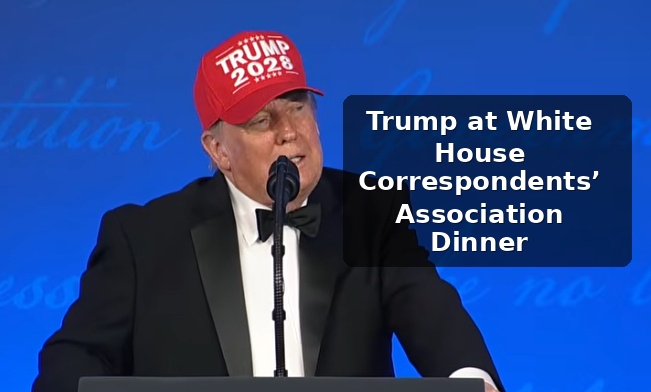
The following is the full transcript of President Trump’s address at White House Correspondents’ Association Dinner, July 24, 2026.
Editor’s Notes: In this White House address, President Trump announces a major milestone in American nuclear innovation, celebrating the successful startup of four advanced nuclear reactors by private companies. These reactors exceeded the administration’s goal of three by the July 4 deadline set in his 2025 executive orders, marking the first privately funded advanced designs to come online in the United States in over four decades. Trump highlights the role of Energy Secretary Chris Wright’s pilot program and regulatory reforms in accelerating development, framing the achievement as the start of a broader nuclear renaissance. The remarks emphasize expanded domestic energy capacity, greater energy security, and restored U.S. leadership in advanced nuclear technology.
Trump Speaks at the White House Correspondents’ Association Dinner
DONALD TRUMP: Wow. That was very beautiful, but this has not been an easy evening, all these awards. Do I have a say in those awards or those awards? But it’s great to be back at a place that I know very well because I built it. And I’m very proud of it because I built it for $2.9 billion less than the Federal Reserve Building, which is a lot smaller, by the way.
Figure that one out. But I am delighted to be here at the White House Correspondents’ Dinner. Amazing people. A lot of people that I like. Some I don’t like at all, but I respect most of them.
I must say that you do a great job. Amazing job, and it’s an honor. As I said three months ago, the show must go on. We were backstage, and we both wanted to just have it go on whether it was 2:00, 3:00 in the morning. It didn’t matter.
But in the end, it made more sense to do it the way we’re doing it. And we had a great news conference at the White House in a very important room, and you did very well. I think we all did very well. It was a hell of an evening, I can tell you that. Won’t soon be forgotten.
And I think a lot was learned from that evening. A tremendous amount was learned about security and about other things, the dangers of what we all do. But just like my presidency, the second time is always better. It’s always better. And the third time will be better yet.
I’m only kidding.
Reflecting on the Attack at the Washington Hilton
From the earliest moments after the attack on our dinner last April, I knew we had to reschedule this event as soon as possible. We had to do it very quickly, and we met very quickly. And we figured something out. But the attempted mass murder at the Washington Hilton — that’s what it could have been — was an assault on our democracy itself.
Very serious situation. Many of you were there with me, and some showed extreme bravery, like Pete Hegseth, Steve Miller, Tom Homan. Really? They were standing on tables, and most of you were under the tables. Okay?
But they did. They showed. I saw every one of them that was standing up at those tables. I didn’t know if they were brave, if they were smart, if they were stupid as hell, but they were on those tables in some cases. And there were a lot of different feelings going on in the room at that moment.
But after hearing the gunshots, many people yelled, “Get down, get down,” which caused Nicki Minaj to start twerking. Do you believe it? “Get down.” She’s the only one that really understood what that meant. It’s quite an evening.
But tonight, we come back together to answer that heinous attack with unwavering resolve, and every one of us here this evening to show that in America, we do not yield to political violence. We don’t — we can’t do that. Can’t do it. So in this country, we believe in freedom of speech. We settle our differences not with bullets, but with open and vigorous debate.
And no deranged loser with a gun will ever change that. We can’t let that ever happen. A lot of very dangerous people out there. We can’t let it happen.
Honoring the Secret Service
I want to begin by expressing our gratitude to the incredible men and women who put their lives on the line every day to protect my family and myself, all presidents, and lots of others. That’s the United States Secret Service. So I appreciate it very much. And Sean and the whole group — amazing job. Amazing job.
In recent months, they’ve repeatedly responded to threats with speed and professionalism and extraordinary courage. And there is no better example of that than officer Victor Gonzales, who we just met. It was amazing. What he did was amazing. When the would-be assassin charged the checkpoint at speed, he was fast. You know, when you looked at that, you had to look at it about 10 times before you really saw what was going on.
He was quick, nasty. The gun made him nasty, actually. But officer Gonzales engaged the attacker without hesitation and took a bullet to the chest — after his ballistic vest, fortunately, was on — saved his life. And Victor did not even want to go to the hospital for a checkup. We insisted, really, we wanted him to do it. We insisted, but he didn’t want to go.
So to officer Gonzales, Secret Service, Metropolitan Police, law enforcement generally, and even all of the militaries around us in the room tonight — we salute you and we thank you with all of our hearts. Thank you very much. Great job. Great job. Great job. These are great people.
A Little Bit of Fun
So this evening, we’re picking up right where we left off.
You know, I said, what do we do here? Is this supposed to be fun? Am I supposed to be serious? Am I supposed to be a comedian? So I guess you said, maybe a little bit of everything.
I know one thing I could never have done — the speech that I had ready, just a short while. Oh, that was going to be a doozy. I was so psyched. I was going to rip people. And I don’t know. Just something changed. It’s really for the better, but I just wouldn’t want to do that. But we’ll do a little ripping, if you don’t mind.
But it is true. I said, how do we handle this? It’s going to be a different kind of an evening, and it is. And in many ways, it’s a more beautiful evening, actually.
Everyone’s looking really good tonight, and I know it was not easy finding shoes to go along with your bulletproof vest, which many people didn’t want to wear because they’d rather die than look 20 pounds heavier. You know that, right? We have that a lot. They put one on me. I said, “You sure I’m not wearing this?” No. They say, “Sir, it’s about 21.” Not good.
Thanking the WHCA Leadership
But I want to thank the outgoing president of the White House Correspondents’ Association. Now she won’t admit it, and she should not admit it, but we sort of became friendly. You know, in times of stress, on occasion, you become friendly. I have a lot of respect for Weijia. And I tell you, we went through a little bit of a war together. It turned out pretty good. It turned out pretty good because of a lot of good people. They stopped the tragedy.
So I want to thank you very much. Fantastic job. And we just worked extremely hard to ensure this dinner was rescheduled, and we want to just thank her family. I just met her parents, her children, her husband. What a perfect family. So it’s really great. Thank you very much all for putting up with this. For putting up with this. Right?
But let me also thank the incoming president of the Correspondents’ Association, Jacqui Heinrich. She could be very tough as a reporter, I will tell you. She could be nasty. She looks so beautiful, but she could be so nasty. How could that happen?
But she just got married to a very successful congressman, very good congressman. I’d like to have a couple of more votes from him. That’s okay. On occasion, he chose a little independence. We don’t like that. But now he’s a very professional guy and he loves our country.
But that’s a big thing. I just see what takes place. We’re talking about what takes place to be in the position that you’re leaving and that Jacqui’s coming into. And it’s a lot of work, a lot of friendships, a lot of talent. And so, Jacqui, congratulations. Thank you.
Congratulating Karoline Leavitt
And congratulations are also in order for our favorite White House press secretary, Karoline Leavitt, who just had her second child. You and your husband — she’s great. She’s done a fantastic job. We all love her. She’s done a fantastic job. She’s another one — she can be nasty. But sometimes she has no choice. Right?
But Karoline may have one of the hardest jobs in the White House. She has to deal with all of you all of the time, and you could be very difficult. You could be very, very difficult people, but I’m probably being a little bit oversensitive.
The Media and Trump Derangement Syndrome
Sometimes I really do think that some of you don’t like me. In fact, I read a report — I get 93% negative publicity. 93. So how the hell did I win the election by so much? Think of it. I don’t think that’s true. I can’t believe it’s 93. In the eighties, maybe, but not 93.
But this place is really the largest group of Trump Derangement Syndrome people ever put together at one time, I suspect. Some of you are lucky that our last dinner was cut short because I had brought with me what would possibly have been — I’m telling you, I had something. I was going to go after you. I feel so badly doing this. It’s got to be such a letdown. But your lives were really in danger the last time, for an opposite reason.
But on the plus side, your careers were saved. And we have — we really do. We have a complete and total — you know, I love the words “complete and total.” They say it means almost the same thing. I said it doesn’t matter when you say it. It’s called emphasis. It’s called emphasis.
The New White House Ballroom and Drone Port
But everyone is now really warming up to the new White House military center drone port, highly protected ballroom. We have our ballroom. The windows are this thick. I said to the people, “Well, if a bullet hits, what happens?” Nothing. Nothing. “It bounces right off, sir. This is the greatest bulletproof glass.” I said, “A K-47 — that’s supposed to be a big one. I don’t know so much about the guns. My sons know a lot. But I said, hey, I know it’s big. What would happen?” They go, meaning it can take more. I said, “So if I’m making a speech and I hear that pinging sound at a window, what would I do?” “Sir, leave the room right away, but you’re going to be safe.”
We’re building something that’s going to be amazing. And in light of what we went through, I think people understand it. It’s going to be amazing. A phenomenal — one of the biggest drone ports anywhere in the world, right on the roof, right protecting the White House. Not only the ballroom.
And I think — I was just telling the whole group sitting at the table, we were talking about it, and I said, “I think, you know, it’s White House Correspondents’, so I don’t see any reason why you wouldn’t be able to use that.” It’s going to be very large and very beautiful and very safe, and that’s what you need.
Senator Fetterman and the Ballroom
So I was thrilled to see that after witnessing the attack, even Democrat senator John Fetterman told his fellow Democrats to drop the Trump Derangement Syndrome and build the White House Ballroom — but it’s much more than that. It’s something that you’re going to use. I predict that you’re going to end up using it, and a lot of people are going to end up using it. They’ll be as safe as you can possibly be.
The Hottest Ticket in Town
But despite everything that happened at the previous dinner and all of the dangers involved, I’m told that this is still the hottest ticket in town. This ticket to get in tonight — because it’s a smaller room. It’s a beautiful room. It’s a luxury room.
See those beautiful chandeliers? I can tell you everything about them if you’d like to know. See that beautiful Capitol above? See the beautiful Capitol? See the everything, the brass? Those chandeliers are great. I’m looking at them saying, I wonder if I could — you know, I sold this building, and they’re doing a nice job, but they’re nice people. But I’ll tell you, I’m looking at them saying, I wonder if I could walk out with those chandeliers, because you can’t buy them. They’re very special.
The Waldorf and the White House Correspondents’ Dinner
I won’t tell you the fact — I won’t mention that they’re Czech crystal because I’d like to say everything’s made here, but they are Czech crystal. And they are beautiful. And the Waldorf people are doing a really nice job. We’re proud of them, actually, because, you know, when I left town — and I agree — I was a little bit angry.
I was offered a nice price. I said, “I’m getting out of that place.” And then I said, “Let’s make a comeback.” But I was very proud of this building. This building was hot.
Remember the lobby floor? 82,000 feet. For those in the real estate business, 82,000 feet. That’s a major — that’s a major floor. That thing was packed every single night.
It was packed — mostly Republicans, I would say — but it was packed every single night. It almost brings back memories. But I left town, and I have just had nothing but good experience. And this might be the best experience of all, having all of these incredible people in this room. It’s a great — it’s a great feeling, frankly.
It’s a great feeling. But tonight’s event — thank you. Thank you. But tonight’s event is even crazier than the last time. In fact, it’s so successful that I’ve been informed by CBS News’ David Ellison, who’s going to do a fantastic job.
He’s the owner. He’s the owner. He bought it, spent a lot of money, and he’s going to make, I think, fantastic changes and keep some of the great stuff going. But that next year, they’re going to call it the Trump White House Correspondence Center. He told me that, and I like that very much.
We’re going to change the name of it. Okay? Oh, it’s going to be so hot, just like our country is hot. We are hot, by the way. But to be honest, it’s just about the only way that they’re going to ever get me back here.
You’re going to have to change the name of the dinner. But how’s that one going? Not too good.
Bobby Kennedy and the Beef Tenderloin
I hope that everyone finally got to enjoy their entire, very delicious beef tenderloins — very special beef. And I want you all to know that Bobby Kennedy, who’s right here, personally ran over the cow in his car. Boom. And he cut it up, and he brought it here for you to eat tonight. So it’s very fresh.
And Bobby also suggested an appetizer featuring his favorite cut of male raccoon roadkill. But we drew the line at that, Cheryl. We said, “No, we’re not going to do that. We’re not doing that.”
We love Bobby. I’ll tell you, he is a piece of work. You think it’s fun, but he is a very different kind of a person. I will tell you. But he has what it takes, and he’s smart, and he loves the country, and he wants people to be made to feel good. You agree with that, Bobby? He wants people to feel good, and he’s doing a fantastic job. Thank you, Bobby. Thank you. We can joke all we want, but thank you.
The UFC Freedom 250 Fight at the White House
A lot’s happened since the last time we were all together. Last month, we hosted one of the most incredible sporting events in world history at the White House — the UFC Freedom 250 fight, the UFC fight. When I announced that we’re going to build a boxing ring right outside of the front door of the White House, that took a lot of heat.
But it turned out that was — they say — about the most viewed fight in history. It was beautiful. So many things happened. It was supposed to rain. We were going to do it the week before, and the weather was beautiful.
And the weather came, and it went. And now we came up to Wednesdays. They said, “Sir” — this was on a Sunday night, replacing 60 Minutes, which is nice and unusual because usually it’s Saturday night. And they said, “Sir” — this was from Wednesday on — “tell me about weather.”
Right? Sure. “It’s going to rain. I think you’re going to have to — it’s going to be one of the worst storms that we’ve seen in a long time. It’s coming up the coast. It’s going to hit you on Sunday night. It’s going to be a disaster.”
I’m saying, “Can you believe?” And you saw the ring we built — Dana White, the great Dana White — and everything. We had the best fighters in the world. Turned out we had the best fights that most people have ever seen, including me. It was just a miracle.
But what happened is we’re waiting for this rain to come all day long, and it’s coming, it’s horrible. And it’s 8:00, and we say, “Think we should — it hasn’t rained yet.” I said, “Maybe we should postpone it an hour. Maybe we should make it the next day.” We didn’t know what to do. And finally, we just said, “Let’s just have it.” And it never rained. It was perfect.
In fact, the week before, it was 92 degrees. It was nice, but it was — this was like 72 degrees. And the rain was coming, and it came right over the White House, and it was like, “Thank you very much.” It went like this. And other areas were drenched a few miles away. We didn’t have a drop of rain, and it was absolutely one of the most incredible things anybody’s ever seen. People said it’s one of the most incredible nights of their lives.
So just remember — before I came along, if you wanted to see someone lose consciousness on the South Lawn of the White House, all you had to do is ask Joe Biden a question. They’d remember that. Oh, you think I’m kidding.
But the big fight was such an amazing success that tonight, I’m pleased to announce that we’re going to host an even bigger one right in front of the White House — every Friday night, every Saturday night. We’re going to have fights in front of the White House.
But we do have something coming — and I’m only kidding. You know, the one thing about the press that I learned: don’t be sarcastic. Because I’m a very sarcastic person, and I get sarcastic, and most people know that. But you have some bad people that will write it exactly like I say it. And I said, “I was only kidding.”
The Indy 500 Coming to Washington
But we are going to have the Indy 500. Roger Penske is coming in mid-August, and they’re going to have it all throughout Washington — the greatest cars, the greatest drivers in the world. And that’s going to be something. Already, they have over 350,000 people signed up, going down Pennsylvania Avenue, around the Capitol.
And Roger, who’s incredible — he won the Indianapolis 500 20 times. Think of it. Germany, Japan, all these countries — they spend billions and billions of dollars trying to win the Indy 500, and Roger wins it. He literally won it 20 times. On the eighteenth time, I said, “You know, that’s amazing. I’m going to give him the Presidential Medal of Freedom.” And I had him up, and then he won it two times after that. The guy’s amazing. And he lost the last one by about six inches, if anybody watched it.
So they’re coming here, and it’s going to be something really exciting. We have unbelievable events. It’s an unbelievable country.
The July 4th Celebration
And on July 4, we were over at the Mall, and it was raining. It was supposed to be really bad again. And we had 450,000 people show up, and that’s a light number. And I was told, “Sir, we’re going to have to cancel the event.” This was not good. And it was drizzling a little bit, not raining very hard.
And people are calling me. Friends of mine were calling me. And I got a call from Bret Baier. Bret Baier said, “It’s not raining.” I said, “Where are you?” “I’m standing at the Mall, and I’m waiting to go in the White House.” Then others called up. They said the same thing.
And I said, “You know, this is terrible.” But there was lightning — not big lightning, but you don’t have to have big lightning. It just takes a little bit to do some big damage. So they said everybody must leave. All 450,000 people were forced to leave, and they left.
And then I said to myself, “Let me call up and find out what the hell is going on.” And I called up, and I spoke to a brilliant young man. He said, “Don’t worry about it, sir. We can do it in a couple of weeks.” I said, “You can’t do it in a couple of weeks. This is the 200th birthday. In two weeks, what are we going to do? Say, ‘Let’s go? We’re going to have a redo?’ No.”
I said, “I’ll speak if I have to speak at 3:00 in the morning, 2:00, 1:00 — I don’t care. Call them all back.” They’re all gone — 450,000 — and most of them were in cars. They were heading back to Texas, and it was sad.
And we said, “The show must go on.” Very much like here, we said the same term. Right? The show — it’s a great term. It’s true in life. The show has to go on. The show must go on. And I said, “The show must go on.” I put it out on Truth. “The show must go on.”
And we had probably — Peter, a 150,000 people come back — come back up higher, maybe. Thank you. Let’s just stand up, Peter. Tell them. More. Right? It might have been more, but it was amazing. It was just an amazing crowd.
And actually it worked out better — a little like this. It worked out better than if we had done it at the normal 7:00, 8:00 time. It was incredible. We started speaking at 11:00 in the evening, but tremendous numbers of people — tens — I mean, thousands and thousands came roaring back, and it was a great evening. And it was a celebration. And we didn’t do it the following day, and we didn’t do it two weeks later. We did it when we were supposed to do it. It was a fantastic celebration.
The Heavyweight Matchups
But I can exclusively reveal to you this evening that for the heaviest of the heavyweights, we will have sloppy Chris Christie — one of the sloppiest human beings you’ll ever meet — fighting, I would say, I could mention the governor of Chicago, but I’m going to mention instead Jerry Nadler. And they’re fighting for a big piece of cheesecake. Big, fat piece of cheesecake. Who the hell wrote that line?
But it is true. And then you have a congresswoman, Alexandria Ocasio-Cortez — AOC Plus 3. That’s her three friends. Right? AOC plus three.
And I watched her give that answer when she was over in Europe. It was not a good answer. If I ever gave that answer, I would be out of politics. Remember, you cannot have a nineteen-second wait time to answer — it really was a very quite simple question. But we’ll then have a rematch against an extreme simple question on a foreign policy from Munich Security Conference. It was a big security conference, and this was her first time up in terms of that. And we had a sort of little preview.
The Media Personalities
And then Anderson Cooper, who is going to fight Lawrence O’Donnell — I’m not a fan of Lawrence O’Donnell. I like Anderson, actually, because he’s covered me well for many years. Then he went bad as soon as I went for politics. But for years, he loved interviewing. I did so many interviews with him, and he was great. But, you know, he’s got a little different persuasion than me in many ways, actually. And Lawrence O’Donnell — never liked him, never thought he had any talent. But he’s still making a living, I can’t knock it.
But we had a contest for who had the lowest ratings and the lowest IQ on television, and that was actually Don Lemon, I think. You know, when I said that he’s the dumbest man on television — I said, “You know, when you say some things, you never make a comeback.” It’s not like, “Oh, gee. Hey, Don. Let’s have dinner some night.” But I know what I’m saying.
And then you have Bette Midler and Jane Fonda — they actually held a concert to protest the first UFC fight. They didn’t want to see the fight, and very few people did. They held an event — like, three people showed up. And given the choice between seeing some of the really beat-up faces of the UFC, almost everyone chose the people in the UFC. It was between the two of them and the UFC.
Bruce Springsteen
And what about Bruce Springsteen? What the hell happened to that guy? He looks like hell. I don’t care what anyone says. I’m not supposed to say — I’m sure he doesn’t like the way I look, but I don’t look so bad.
But in a recent conscience, Bruce — all he did was talk politics. He ought to run for office. That’d be interesting. But all he talked about — he made four political speeches in his three-hour show. The tour has been renamed “Bored in the USA.” And his new song was so bad that Chris Christie — who’s like a fan, you know — he goes out and tells everybody how he hates Chris Christie. “Keep that guy out of my —” And I see Chris Christie there again, high-fiving Bruce Springsteen in the aisle, and Bruce Springsteen saw him and didn’t even lift his hand up.
And I just wanted — because I used to be friendly with Chris — “Chris, when somebody doesn’t like you, write them off. Forget it. You got billions of people in the world. You don’t have to make a jerk out of yourself.”
Barack Obama and the Correspondents’ Dinner
But usually, a comedian hosts this dinner, and I think we sort of changed it. Tonight, we’re going to have somebody who I think is really spectacular. But I’ve watched comedians get up at the dinner — because I have been here, actually, quite a few times, people don’t realize.
And there’s one time in particular when Barack Hussein Obama hosted it. Do you know who that is? And he hit me hard, but actually he hit me with respect. I was sitting with Melania at a table, and you had Brooklyn Decker — supermodel — at a table right next to her. And she — I really always will like her. She’s married to a great tennis player, Andy Roddick. And she was at the table, not at my table. And I have watched this clip thousands of times.
On the White House Correspondents’ Dinner
TRUMP: They keep playing it because they think that was the evening I decided to run for president. It was not. In fact, I loved the evening. I looked at my wife. I said, “Can you believe it? All these people, that’s all they’re doing is talking about me.” I love this dinner. It’s true. And Obama was nice. You know, it’s amazing how things work out.
He actually showed a picture of the White House with a big Trump on top, like I put a sign. And, you know, I’m sort of doing that when you think about it. Right? I mean, he wasn’t really wrong. But, no, he was respectful. He was good. And it had nothing to do with it. I just decided that I wanted to make America great again. This had nothing to do with that dinner.
I’ve gotten so many calls, and for years, they’ve been saying, “Was that the moment you decided to run?” Really? No. I left that night, and the press was there. A lot of the same people that I see. They said, “Did you have a good time?” Unbelievable. And some thought I didn’t have a good time, but I did. And I always remember, though, Ivanka. She was so angry. She was much angrier than me. She was angry. She thought they were mocking me, and they really weren’t. It was just one of those things, and I had a great time.
But I left, and I thought — I’d been there three or four times before that — but I sort of thought, “Wow, that dinner is really something special.” And then I ran. I got elected. I thought the press treated me very, very unfairly. And I don’t know. I think I made the right decision because you hate to go where maybe you’re not wanted, but they did want me. They wanted me for ratings, and they wanted me for other reasons, but not for love.
On Skipping the Dinner for Four Years
TRUMP: And I said, “You know, I’m not going to go.” First time that ever happened, I think. Was that the first time? Just about. Presidents always came. And I didn’t go for four years because I got treated terribly by the press. And, you know, in my opinion, unfairly. I know unfairly because I know the facts, but I got treated unfairly. I didn’t go.
And this year, I was called by your president and your chairman and all of the people, and they said, “We’d like to do it.” And I said, “You know what? With time, time goes by, time passes, and you sort of look at life a little bit differently.” I said, “Let’s do it.” And I didn’t know it was going to turn out the way it did.
It turned out to be the biggest event in the history of your dinner. That was, by far, the biggest. Right? For all the wrong reasons. But as I said before, a lot was learned from that evening. So much having to do with so many different things, including security. But it’s an honor to do it. This is my first — I mean, I’ve been to it numerous times, but as president, I haven’t been here. And I’m glad. And they said, “Would you do it next year?” I said, “We’ll be back next year.”
Now, if you get really, really nasty, maybe not. I don’t know. But we’re going to be back next year. Or Jackie will treat me very badly.
On the Entertainment
TRUMP: But this year, the association decided not to have a comedian, so they considered using Jimmy Kimmel, Jimmy Fallon. These guys, they’re terrible. They’re terrible. Stephen Colbert — these are people without talent. They get a lot — they have talent. You know who has talent? Their agent, getting them the amount of money they get. They have no talent. But they are not comedians. They’re not funny people. They’re angry people. They’re sick people.
But the association really put on a big show, and they have somebody very special. I look forward to seeing him. And so they thought about going with a professional clown for entertainment, but Adam “Shifty” Schiff was not available.
You know, I called him — I hate some people, you know. I shouldn’t say this. I’m president. I’m not supposed to hate him. I’m supposed to love everybody, but he’s a terrible person. He’s a liar. And I called him “watermelon head” because he has the largest head I’ve ever seen with the smallest neck — pencil neck. How does that big, fat, ugly head stand on a little pencil neck?
And then I’m told that even Rosie O’Donnell reached out from Ireland. She really wanted to be here in order to honor me. She loves me very much, and she was desperate to come back to the United States and pay her respect to Donald J. Trump. But that didn’t work out, unfortunately, because nobody wanted her to come back. She’s one of the greatest sufferers of Trump Derangement Syndrome. And she’s a sick young woman — sick older woman, I guess, now I have to say.
So instead, we’re honored to have for entertainment the very talented mentalist, Oz Pearlman. Oz Pearlman. And everybody said, “You going to stay?” I said, “Yeah, I’ll stay.” I mean, I think I’ll stay. What the hell else am I going to do? I’ve got Iran. I’ve got this. I’ve got that. Which is all going extremely well. Don’t believe the fake news.
On Iran
You know, it’s the only thing — we were talking before. I said, “So we’ve hit Iran very hard.” Their navy is gone. Air force is gone. 250 jets, no longer. 159 boats — good boats. In fact, they said, “Why the hell didn’t we keep them? We could’ve used them.” But 159, all at the bottom of the sea. They have no radar. They have very few drones left, despite what you see. And every once in a while, they’re going to set some things up, but they don’t have much left.
And by the way, they are talking to us right now. They’d love to make a deal. I don’t think they’re ready to. I don’t think it’s time yet, but I’m willing to listen. But they cannot have a nuclear weapon. We don’t want to see Washington, D.C., or any of our cities, or Israel, or frankly, the Middle East, destroyed with a nuclear weapon, because I know the power of nuclear weapons. I see it. I get to see it. We’re not going to let that happen. So this is all about — we will not let them have a nuclear weapon. And they would use it. They would use it if they had it.
On Oz Pearlman
TRUMP: But, Oz, I do have one question about what happened that time, because he was there. How the hell did you not see that coming? He sees everything. He sees everything. He’s telling me about your grandmother and your this — why the hell didn’t we — I’ve got to ask him that question when he gets up here. Why didn’t he see that coming?
On the Fake News Media and Awards
TRUMP: But, of course, this evening, it’s really all about the fake news media and your handling of prizes, writing, and producing, and performing made-up stories — like the Academy Awards. You know, the Academy Awards used to be the epitome of ratings. Outside of the Super Bowl, it got the second most ratings. Now it’s down in the dumps. Nobody wants to watch it anymore because they took on Trump. They hit me all night long. They hit me. “The winner is so and so. I want to talk about Donald Trump. I hate this man.” Nobody wants to hear this stuff. Right, Peter? Nobody wants to hear it. You ever see the ratings? They used to have 48 million people. Now they have two people watching. But they’ll learn their lesson.
But I want to personally congratulate CNN’s Kaitlan Collins on receiving her award. It was all about me. It’s a fake. She shouldn’t get the award. It was a fake, but I didn’t mind. I said, “Kaitlan, congratulations.” But it was fake. There’s no question about it.
But she’s a young, attractive woman. She never smiles. I said, “Kaitlan, do you ever smile? Smile. You have a nice position. You’re at CNN — fake news. You should be a happy person. So smile, Kaitlan. Just smile.”
But we attack — and I thought Kaitlan had really made it big with a major new sponsorship, but then I informed her that it wasn’t her on the Bud Light can. It was Dylan Mulvaney. And Dylan Mulvaney cost Bud Light $35 billion in market cap. That was the worst commercial ever made, by the way, for those few people that want to hear that. Most people don’t care, but I would. I wouldn’t want to hire Dylan anytime soon. Think of it. They hired Dylan Mulvaney, their market cap has gone down by $35 billion. Who wrote that commercial?
On Josh Dawsey
TRUMP: And then you have writer Josh Dawsey. He also received — he’s been killing me for years. And yet tonight, he shakes my hand. He hugs me. Everything nice. He kills me. Josh is amazing. He writes more stories than any human being. There’s nobody that writes more than Josh. He’ll write four stories about me a day, all different subjects. I mean, I had the other day three stories — one on the — but he was upset about this. One was on page seven, three were on page one. They were all written by Josh. But he’s hit the big time, and he’s a workhorse. And yet, he’s almost unhirable. You know, he’s just one of these guys. Wall Street Journal’s lucky to have him, but it’s unbelievable. He’s almost unhirable.
On Jake Tapper and the Press
TRUMP: CNN is also here, and I’m very disappointed they didn’t bring Jake Tapper, because he’s had a rough couple of years. You know, he calls me up every once in a while. If I pick it up — you know, I pick up my phone. I used to go to this young lady. I’d say, “Any calls from the press?” “No, sir.” I said, “Oh.” Now I’m the president of the United States. Right?
I’d say to Steven Cheung — is Steven here someplace? Where’s Steven? He’s one of the toughest human beings I’ve ever met. Don’t ever wrestle Steven. You’ll be in big trouble. But I say, “Steven, let me ask you. Did the press call?” “No, sir.” You know, when I was a developer, I’d get a call every half an hour. For whatever reason, I always got disproportionate press. So I said, “Steven, nobody called?” “No, sir.” Two hours later, I said, “Hi, Steve. How are you doing? Everything good? Anybody call?” “No, sir. No press calls.” I said, “I’m president.” Nope. They never called.
So this went on for about a week. I’d say, “Caroline, did the press call?” “No, sir. No calls.” I said, “Nothing? That’s over a week. I haven’t received a call.” So I said, “You know what I’ll do? I’m going to give the press my phone number.” That was the stupidest thing I ever did. I’m getting a call every three point seven minutes. “Steven, I don’t know where the hell you’ve been, but the press calls — I’m getting calls. Ring, ring.” I was with somebody today. They said, “I’ve never heard a phone ring as much.”
Now, look at the thing, and usually I just delete, delete, delete. Every once in a while, it’ll be one of the people in this room that I like, and I’ll pick it up. Like this one right here calls me on occasion. Right? She’ll call me and she says, “Hello, how are you? We want to talk about some horrible subject, like a horrible, depressing subject.” I said, “Jackie, I don’t want to talk about it. Congratulations, however, on your new marriage, but I don’t want to talk about it.”
But it’s true. And people call me now, and so for weeks, I go — no calls. And I learned then that both of them, they feel that I’m doing a great job, and they feel I’m above it all. And that no person — hundreds of people call — no person is good enough to talk to Trump, and so we don’t even bother telling you. That’s not the way it works, Caroline. You have to let me know, because sometimes I do want to — I do like to speak to the press.
But now I have the best setup I’ve ever had. It rings, and just so you understand, you’re much better at putting your name, because if there’s no name, I just — I just can’t do that. You know, I pick up every once in a while. “Hello.” “I’m from Reno, Nevada. We’re a startup paper. We’re calling this the Reno Express.” I said, “Do you believe I’m the president of the United States?” “Mister President, could I have your views on Iran?” And I just hang up. No. I get the craziest calls. I mean, some of them — my wife said, “I can’t believe you do this. This is a hell of a way to live.”
But sometimes they get calls from very important people. Sometimes they can straighten out stories that are going to be fake, and I can make them from a fake story to a good story. I always find that when you don’t speak to the press, you always get a bad story. When you do speak to the press, you have a shot at getting a good story.
Oh, look — no, look. If I were a reporter, and let’s say I’m a big reporter, I work for the failing New York Times, or I work for — I don’t know. Do they ever come to these dinners? Didn’t they cancel out a long time ago? Big mistake. They should be here. But I’ve always found that, you know, speaking to them, you just do better. You do better when you can, when you have the time. You speak to the reporter. You treat the reporter with respect.
Sometimes, now, there are reporters where it doesn’t matter. You can be so nice to them, it doesn’t matter. You get treated unfairly. But you have a lot of great reporters where when you speak to them, you can get your point across, and that’s a good thing.
But some people say that Jake Tapper is a great investigative reporter in D.C., and that’s why after moderating our debate, it only took him one year to break the story that Joe Biden might possibly have suffered from cognitive decline.
On Jill Biden, Gavin Newsom, and Ilhan Omar
Took him one year. He wrote a book about how great he was mentally, not too good. And I don’t like Biden because Biden was very unfair to a lot of people. But Jill Biden insists that Joe would have beaten me in 2024 even though he was way down. She said he was way behind in the polls because he was seriously ahead.
She felt he was going to win because he was seriously ahead on deceased voters. He was leading on the deceased crowd, and there were a lot of them. You’re finding out there’s a lot of them. Look at the numbers that just came out yesterday.
And it’s traditional that at least one or two potential presidential hopefuls attend the Correspondents’ Dinner, but many of them seem to have really chickened out.
I was disappointed that Gavin Newsom didn’t show up. He didn’t show up. He should be here. But I heard that he recently said that we will lose our country if we don’t fight fire with fire. And to be fair, there’s only one thing we know about Gavin, and that’s that he definitely doesn’t want to fight fire with water.
He’s got a lot of water, never uses. What a disaster. That should’ve never happened.
But Gavin Newsom recently did a career-threatening — one of the worst interviews I’ve ever seen — where he said that he can’t read a speech. He’s incapable of reading a speech. He’s a low IQ person. He’s smarter, however, than all of the people in the room, and then he gets sued for being a racist. Okay? When he said that. But he basically said he has various mental incapacities. He has difficulty in various other ailments mentally.
And I’m looking at it and saying, this is the worst interview. I’m watching this interview. I said, this is the worst interview I’ve ever seen given by a professional politician. I’ve been watching politicians for a long time, mostly on the previous side, because I haven’t been doing this too long.
How am I doing? Not bad for the number of minutes spent. Not bad.
But with Gavin, so he said all these things, and anybody running against him, all they have to do is take that one interview and you can’t lose. I actually put out a statement that Gavin Newsom has come out and said he will not be running for president because nobody can say what he said about himself and survive.
Newsom was in big trouble when he openly admitted that Kamala was smarter than him. He said Kamala is smarter. If Kamala is smarter than someone, you don’t want that person to be president of the United States of America.
Between California’s policies of enabling wildfires, paying drug addicts to be homeless, giving free sex changes to illegals, and telling rich people they’re going to take away all of your money — people are fleeing, and they’re fleeing in droves. We can’t have that in this country.
It’s becoming such a horrible and dangerous location that Ilhan Omar, one of my favorites, and her brother are thinking about moving together, very much in love. A video has surfaced recently of Ilhan giving a speech referring to World War II as World War Eleven. And they asked her about that. She still thought she got it right.
But I’m not surprised because she’s a low IQ person, and she’s also a very dishonest person. And she ought to get the hell out of our country. She shouldn’t be here. She shouldn’t be in our country. She also calls her brother husband number one.
Omar is reportedly being investigated for fraud. She revised her net worth. I was shocked to see that she was worth much more than $30 million. And then when the press got on her, she revised it slightly downward to less than $18,000. So she went from much more than $30 million to $18,000.
On Democrats, JB Pritzker, and Elizabeth Warren
And I know Democrats, and the word Democrat is something that’s come into fashion. I changed the E with a U, and most people don’t know that “dumb” has a B, so we don’t have to worry about that. It’s very quiet. I thought it was quite good, but I haven’t gotten much credit for that. Fake news, good. Pocahontas, good.
I won’t say “Lyin’ Ted” because he’s at my side. I don’t talk about past conquests, but we have a lot of them. I won’t talk about — they got a whole table full of Republicans there. They’re saying, “No. Don’t mention my freaking name, will you, please?” But we’ve had a lot of good names.
But the Democrats are there to destroy wealth, and honestly, they’ve gone absolutely crazy. Gavin Newsom’s not only a man who really wants to run for president, he’s doing a bad job running a state. You can’t have somebody like a JB Pritzker, who I understand is not president, sadly, but, you know, some people say, “Never use the fat word,” and I don’t. I would never call anybody fat. I have my own problems. You know? It’s not like I’m perfect.
Sir, in the back, don’t call him a fat pig. Okay? That’s — I’m sticking up for him. Don’t call him — you can’t do that, sir. You can’t call JB Pritzker a fat pig, please. Alright? Thank you very much. I appreciate it. Everyone’s trying to figure out who is that guy. Does he exist?
But the nice part is when you do that, the press can’t get you because I’m defending a man who obviously has a problem. Actually, he’s lost a lot of weight. I saw him recently. He lost quite a bit of weight. I don’t know what the hell. He’s got no chance, believe me. Anything he does — a family threw him out of the business.
A number of other potential Democrat contenders sadly refused to show up tonight. We invited Elizabeth “Pocahontas” Warren. She’s referred to as Pocahontas because, in fact, I had to apologize. People came up, they said, “We want you to apologize to Elizabeth Warren for calling her Pocahontas.” And I ended up apologizing to the real Pocahontas. But Elizabeth Warren was supposedly of Indian heritage, and then she took the test, and she only had one one-thousand-and-twenty-fourth Native American. And I said, “You know what? I think I’m more of an Indian than she is.” So this is what we have to deal with.
But Senator Warren did not accept our invitation to debate. I wanted to debate her in various and sundry things, and she decided not to do it. And I decided to bury the hatchet. It doesn’t matter. And she — well, I’m not going to say this next one. Do you want to hear this one? How bad? She wasn’t high up on her totem pole. Who the hell wrote that? No. She’s bad news.
On Jack Smith and Chuck Schumer
I wanted to make sure that Jack Smith — deranged Jack Smith. Remember, he went after me for about two years. How did he do? Not too good. I’m in the White House, and he’s not doing as well. I was going to say he’s in a different kind of a house, but he’s a deranged human being. He’s a bad prosecutor. You know, prosecutors are very important. A great prosecutor, a fair prosecutor — but that’s the great prosecutors, the ones that are fair. They’re very important to a country, but this guy was a deranged lunatic.
I saw his invitation tonight. He was invited because, you know — but I put it in a private text to Chuck Grassley. And Chuck saw it with him, and he did a certain thing.
And then there’s one man that we had who should be here — he turned Palestinian. This was a man who was 100% for Israel. 100% — Chuck Schumer, crying Chuck. Remember he cried at the airport over illegal immigrants. They were the fakest tears. There were people throwing water at his face.
But now he’s a proud, very proud Palestinian. In fact, I’m going to send him a beautiful Palestinian outfit tomorrow so he can greet Bibi Netanyahu when he comes to town next week, along with the mayor who I’m sure would love to meet Bibi. They’re not treating Bibi too well, but Chuck wanted to join us tonight, but he didn’t want to be violating many parts of the Palestinian rules, regulations, and certainly, he didn’t want to violate Sharia law — his new founding.
On Term Limits
And all joking aside, I do think we need term limits in Congress. I think term limits are very important because I see what’s happening. I see what’s happening.
The other day, a senator I knew got a text, a great guy, from his wife. And she said, “When you get home, I want to have you immediately come up the stairs and make love to me.” And he said, “I can’t do both.” You know what? In other words, can’t go up the stairs and make love. Does anybody get that?
Well, I thought that was actually pretty good. That was actually the only thing I thought was good in this whole freaking stupid speech that they wrote. That was the only good one, and that went down with not exactly great laughter. I think, you know, in other words, you can’t go up the stairs and make love — walk in it. So we’re looking for term limits. Does anybody understand this?
On Democrat Candidates: Maine and Texas
But I really do wonder whether the Democrats are trying to lose the midterms. In Maine, they nominated a guy with a Nazi tattoo. But don’t worry, Democrats. Word is that Platner is the replacement. He throws bottles at women. This guy throws bottles. This guy is another lunatic, by the way.
Although, I think Platner might have done surprisingly well because we’re in the age of Trump. Just call it what you want. People can do well today. Platner, I don’t know. But, you know, people don’t have the guts to stick it out, but it looked like he was guilty of a lot of stuff. He certainly didn’t defend himself very well.
In Texas, the Democrats are running a candidate named James Talarico, who hates guns, hates oil, hates sex, hates women, and who said he is, quote, “a Christian who hates Christianity.” Other than that, I think his platform is quite good. And that means that he’s not going to do very well against Ken Paxton, who hopefully in Texas is going to win.
But Talarico — he’s — you know what he looks like to me? Alfred E. Neuman. Do you remember Alfred E. Neuman? Mad Magazine. I said, that guy is Alfred E. Neuman. Can’t imagine he’d win.
On the Media and Washington, DC
Well, I have all of the press here in one place. I have to say that we’re having an amazing load of accomplishments that the media never talks about.
For example, under my administration, a once feared and powerful regime that relentlessly attacked America has finally been toppled. Their former leaders have been removed, and they’re now being run by a gay dictator facing internal divisions. But I, for one, wish Bari Weiss all the best at CBS News. She’s a wonderful woman.
Most of the press lives here in Washington, DC, and you should be thankful for me for what my administration and I have done to make our nation’s capital — which was one of the most dangerous and unsafe cities anywhere in the world — one of the safest cities in the United States.
Crime is down 88%, and our capital is shining again with 62 monuments, statues, water fountains looking more beautiful. The graffiti’s all gone. The tents are all moved out of the parks. The fences are all done. Our capital looks like it’s really in good shape.
And people coming here — people in the White House, they work in the White House — they all say young women, young guys walk up. They say, “Thank you, sir. Two years ago, we lived in a dangerous city. We lived in a city where 150 people were killed a year. And now we have almost a crime-free city.”
Our National Guard has done an incredible job, and we’ve removed over 5,000 career criminals. You know, we removed — there’s one stat. I think it’s a great stat. It’s fantastic. 2% of the people create 91% of the crime. That’s something you can fix, and we fix it. We moved out over 5,000 career criminals out of Washington, DC, and we have the greatest capital in the world.
Again, it’s beautiful. It’s thriving. The restaurants are thriving. You couldn’t get into a restaurant because they didn’t have — all the restaurants were closing. And if you even got in, you felt unsafe. People were getting into Ubers, and they were being attacked when they were in an Uber. Not happening anymore. We have tough, smart people, and they have done a fantastic job.
Washington, DC is safe again. You can’t get into a restaurant. The restaurants are opening up. They’re opening up all over the city. They can’t get — it’s the exact opposite. They can’t get space.
On TikTok
But mostly, I’ve given up on you and the media, so now I just gave up on you, and I’m number one on TikTok. Did you see that I’m number one, Steven? Is that true? I’m number one on TikTok.
So how could they be so bad? Think of this — 425 billion views. Can you believe that, Peter? I mean, let’s go, Peter. I gave up on you people. I gave up on traditional press, and it obviously worked because we did win in a landslide. I mean, somebody’s got to be saying something good about me.
But TikTok, good old TikTok, and I was able to get it sold to a group of very wealthy people, mostly Americans. I was told President Xi, who’s a man that I get along with very well, he was a hard no for the sale of TikTok. They all said he’s a hard no. I said, “Well, let’s call — put your group together.” They put it together — billions, hundreds of billions of dollars.
I called up President Xi as their president. “Look. These are American people. They’re wonderful people. In fact, one of them happens to own CBS, actually.” I mentioned his name. I said, “These are wonderful people, and it’ll be a good thing. Doesn’t mean anything, President. It’s nothing. It’s nothing. They love your country. We’d love to see you approve the deal.”
And he goes, “Alright.” That was it. It was done. And we sold TikTok. And he’s a friend of mine.
The search confirms that “Caroline” in the transcript is a speech-to-text error for Karoline (Leavitt), the White House Press Secretary. The “Peter” reference is likely to a reporter in the room — no specific last name is confirmed, so it will remain as “Peter.” The name “Jackie” also appears in the transcript; given the context of the dinner and the search results referencing WHCA President Weijia Jiang, “Jackie” may be a phonetic mishearing, but without a clear confirmation I will leave it as is.
On the Free Press and Transparency
TRUMP: And he’s not contributing to problems like other people contribute to problems. So we get along. But we made the deal. But number one on TikTok is Trump, and that’s probably why we won. But for all of the trouble that you give me, you give me a lot of trouble, a lot of heartache.
I hope all of you know that I believe in the free press more than anyone in this room does. Maybe not quite. But that’s why I’m proud to be the most open and transparent president in history. They called me that. You know who calls me that?
Karoline. That’s about itself. Would anybody else call me that? I think Peter would call me that. Am I the most transparent?
Biden never used to answer your questions. He’d ask Biden 20 questions. He’d never get an answer. Who’s the most transparent president, Peter? Who?
Who? I look at him. It’s the first time he’s tongue-tied. I cannot believe it. Ho ho. He’s not going to be happy tomorrow.
On the Media’s Dependence on Trump
But you people have no idea how lucky you are when I’m gone. You’re all going to be broke. Your business model is going to be finished. No. It’s true. When I’m not around, you’re going to be broke. There’s not going to be anybody to report on. Nobody gives a damn about anybody else.
The New York Times the other day had five stories about me. You know, before I got into politics, in my whole life, I had seven front page stories. This is years of success. I think six were good, one was bad. I had five stories, seven, five good. Yeah.
I had a total of seven stories on the front page of the New York Times. This is not bad. Now I average about three or four a day. All different topics. All bad. Everything bad. But here we are. I mean, here we are. In fact, when I’m finished, I’m going right back to the Oval Office, so I have to be doing okay. But we are all doing good together.
Announcing a Run for a Fourth Term
That’s why tonight, to show just how much I care about the press, and I want to save your ratings, I’m pleased to announce my intention to — and this is somewhat of a scoop — my intention to run for a fourth term as president of the United States. I will be doing that.
I will be having an official — in fact, I think I have — yeah. I won three times. Now I’m going to do it again. Thank you. I’m going to do it again. It should be easy. I’m getting very good at running for president. Now, won three times. Did very well the second time, by the way.
It’s a rigged election, but we don’t have to talk about it. You know, it’s interesting. When you come back and you do a good job like we did, you don’t care about it so much, but we do have to tighten up these elections because they really are in seriously bad shape.
Closing Remarks
But on a serious note, I want to say once again, I just want to thank you all. It’s been an interesting evening. I didn’t really know what to expect, and it’s far worse than I actually thought. But if you want to know that — but I didn’t know exactly what to expect. And I’ve made a lot of friends tonight. I’ve made a lot of good friends tonight. Probably made some enemies also.
But it’s been an experience that is something that we’ve all shared together, because we’re all in this room tonight because most of us went through a period of trauma from just a short while ago. And you know, some people said they wanted to come, but they were afraid to come, and you people weren’t afraid to come. There were a lot of people that said, Jackie, they don’t really — you know, they didn’t have the courage to come, and we don’t want that to happen. And I’m sure it’s not going to happen. We’re going to do things.
Tribute to Law Enforcement and the Military
Again, I want to thank our law enforcement. Keeps us safe. All law enforcement. We have the greatest people on earth. You know, we had two years ago, we had the worst record of recruitment in, as an example, the military, army, navy, air force, marines, the coast guard, space force.
I love space force. Look at all that shooting we’re able to do from space. That was my baby. But all of the branches — you couldn’t get people to join. This was two years ago.
And last week, you probably saw — some of you wrote the story — we have the single best recruiting of people into our armed forces than we have ever had in the history of our country. We have — they are brimming over with great people, and that’s a big statement. And that also goes for the police departments where they were having a tremendous problem recruiting. You can’t get into a police department now if you’re looking for a job. It’s very tough.
And that also includes our great fire departments because people forget about them. They’re unbelievable, the job they do. So I just want to thank you.
The Golden Age of America
Look, we’re on the cusp of something big, and I call it — and this I’m being very serious when I say this — that this is the golden age of America. We have $19.2 trillion being spent in our country.
A record was China. I think it was ten years ago, $3 trillion. Trillion is a lot. Four years, they went less than $1 trillion under Biden, and we have $19.2 trillion. And this is a period of, actually, thirteen months, not even current because we’re here a little bit longer than that, but that was as of reporting dates.
$19.2 trillion is being spent. Factories are coming. Toyota just announced they’re going to be building the biggest car plant in the world. They’re leaving Mexico. They’re coming here. Tariffs did that. Tariffs did that. And maybe November 5 did that too, the election.
But our country is doing things that nobody’s ever seen before, and it is true. We were — and you’ve heard me say this — we were a dead country two years ago. Other leaders would see me and they’d say it’s a miracle. President Xi told me that a few weeks ago in China, and he’s coming here in September, I think, the twenty-fourth. Coming in September, the end of September. Going to be exciting.
But he said the same thing. The king of Saudi Arabia said it. Everyone said almost the same words: “We thought you were a dead country. We never thought you had a chance. You were never going to make it back. And in a period of one year, you made it the hottest country anywhere in the world.”
We all did that together. It’s not me. We all did it together. And we do. We have the hottest country anywhere in the world, and we’re going to keep it going.
Final Thanks
And I just want to say, it is the room — I have tremendous respect for the people in this room. Sometimes, I don’t feel you treat me fair, or maybe you do. I don’t know. I don’t feel that, but sometimes you treat me very fairly. And I have a lot of respect for your profession. Your profession’s amazing.
And I just want to thank you for having me, and it’s been fun, and I’ve met a lot of great people. And you know, I used an expression, and I’ve used it right from the beginning. I did this for one reason, to make America great again, and that’s what’s happening right before your very eyes. We have made America great again, and it’s going to get a lot greater. So thank you all very much. It’s an honor to be with you. Thank you. Thank you very much.
.


No comments:
Post a Comment