 |
| Pix credit here |
I was delighted to learn that my colleagues over at the Talk About: Law and Religion Blog, a blog (really a formidable essay site of the the International Center for Law and Religion Studies (ICLRS) at BYU Law, edited by co-editors are Dmytro Vovk (Director of the Center for the Rule of Law and Religion Studies, Yaroslav the Wise National Law University, Ukraine), and Amy Lynn Andrus (Associate Director of the ICLRS), with contributing editors are Jane Wise (former ICLRS Associate Director), and blog originator Donlu Thayer (ICLRS Senior Fellow) had recently published a quite interesting essay, authored by a long time colleague Pablo Lerner (Professor of law at the Zefat Academic College and the College of Law and Business in Ramat-Gan (Israel)) and first published at Talk About on 19 February 2026.
The essay is entitled "Freedom of / from Religion in Pubic Spaces? About New Law Proposal in Israel." It is also reproduced below. Professor Lerner describes the object of the essay this way:
Last year a draft law was presented in the Israeli parliament regulating a variety of issues regarding religion in public spaces. In particular, the law prohibits public authorities from interfering with the putting on of, or the helping of others put on, tefillim (phylacteries) in public spaces. The draft law also prohibits public authorities from impeding the act of praying in a public space or public building. However, in a synagogue or educational institution, authorities may require that any prayer be conducted according to local Jewish custom. The draft law also establishes the duty to install a mezuzah (scroll case) in public buildings.
One can study this draft law as part of a series of legislative initiatives launched by the parliamentary coalition composed of religious and right-oriented parties currently ruling in Israel; in that light, the draft law could be seen as the result of what has been defined as an alliance between religious-infused markers of identity and the current populist assault on constitutional democracy in Israel. This short post does not attempt to enter into cumbersome political questions but rather limits its analysis of the draft law’s text to seminal questions about the relationship between state and religion in Israel. ("Freedom of / from Religion in Pubic Spaces? About New Law Proposal in Israel." )
My mind immediately wandered to Quebec (among other places in the liberal democratic West):
Quebec Premier François Legault and Secularism Minister Jean-François Roberge announced that they will introduce a new law this fall to ban prayer in public spaces. The measure comes in response to what Roberge described as the "proliferation of street prayer" — a practice that has become synonymous with mass Islamist displays, particularly in the wake of pro-Hamas and pro-Palestinian demonstrations. Street prayer is no longer the image of quiet devotion. From Toronto to Times Square, it is political theater, often conducted en masse, blocking roads, obstructing entrances and projecting intimidation into the heart of civic life. (here)
Pix credit here

Yet this was an effort that was strongly opposed by Christian faith communities for value their own evangelization practices (Quebec bishops slam proposed public prayer ban). And, indeed, Christian evangelism and the legal structures in places like the United States suggest a constricted space for State regulation, but not management: subject to reasonable and neutral time, place, and manner rules (and the avoidance of public disorder limits), everyone is welcome to preach the "good news" of their own faith communities to their hearty's content, or the requirements of their faith but subject to public disorder limits as well.
 |
| Pix credit here |
And that suggests the issue for Professor Lerner--the nature and shape of neutrality in a State that acknowledges its foundational religious character. In the old days (and not so long ago), majority Christian or Muslim communities "solved"the issue through programs of hierarchically structured privileging. The contemporary approach is neutrality--but formal neutrality can be undone "in effect" in everyday life (as opposed to the abstracted space of theory or principle incarnated as text). In the context of great disparities of numbers, habits, expectations, and the like, faith communities may be effectively privileged by the way in which they can physically displace or occupy spaces in ways that suggest not neutrality by effective control on the ground. These are old problems; but for the most part they are problems left unattended precisely because they tend to stir "things" up. Yet this "stirring things up," when undertaken by a majority faith community, merely confirms in physical space, the occupation of virtual spaces which may be understood as the connection between the faith community and social-cultural expectations and baselines. When the displacing is undertaken by minority faith communities (or their smaller sub-communities) against the space assumed by the majority that displacement may seem to distort their relative societal "claims" to shared spaces.
That is the conundrum that Professor Lerner explores but in the context of a "Jewish" Israel where that context produces a certain irony, but one not unknown either to Judaism or for that matter to any of the Abrahamic religions: "According to the draft law’s explanatory notes, the reason for the proposed law is that “in recent years, we have witnessed cases in which the denial of the ability to wear tefillin or conduct Jewish prayer in the Israeli public sphere occurs, whether through bureaucratic restrictions or through public pressure . . . .”". ("Freedom of / from Religion in Pubic Spaces? About New Law Proposal in Israel." ). This can be understood in one of two principal ways (there are others of course). The first touches on delineating "fairness" in sharing public spaces as between different religions (the essence of the problem highlighted by Quebec). The second touches on contests for control of shared spaces among sub-communities (sects) within a larger single faith community. Here the issue touches not on Jewish-Christian-Muslim jostling for spaces, but as between different faith communities within Judaism. Yet Judaism merely provides an example of a much larger problem--the Abrahamic religions, Judaism, Christianity, Islam, and perhaps even that last of its incarnations as Marxism--have all fractured into a variety of sects the conversations and conflicts between them may be as intense and deeply felt as between the aggregated faith community and others. Professor Lerner provides a window onto a problem, the resolution of which is not easy, yet the intensity of the need for resolution is high.
These two ways of approaching the issue are united by at least two issues that they reflect. The first is personal to those performing (witnessing) their faith in public--variations of what one might call faith based communal self-actualization. One must, in this context perform publicly one's faith as a means of declaring one's faith allegiance and to comply with the dictates for conformity to the expectations of religious behavior that connects one more tightly to the community of believers in ways that are not hidden. That is an outward expression of personal reinforcement of faith. The second, and for the State perhaps more challenging int he context of providing structures for stability--is projected from out of the faith community and onto those who must witness these faith performances in public spaces. That is, that the personal performance of religion in public spaces is not merely personal to the individual but is directed toward the infidel (in its original sense of those who are not part of the community of the faithful). It is meant to perform evangelization in spaces where the infidel may be found--and thus found, perhaps converted to the faith. In that form, and under some circumstances, it can produce political instability in the sense of disturbing the relations among faith communities sharing a single political space. This is especially pronounced where evangelization is interpreted by another faith community as directed against them (and the faith community must feel targeted for all sorts of reason). For some large faith communities, the two are intimately intertwined (See, e.g., Catechism of the Catholic Church, §§ 4-10; 849-855; 904-907). But that intertwining is contextual and varies widely, including in ways that belie the formal textual expectations for faith communities but appear in practice (eg Pakistan: UN experts alarmed by lack of protection for minority girls from forced religious conversions and forced marriage). These bring the realities of incarnated abstractions very very close to home in ways that can be deeply felt; and that is what separates the more cerebral and virtual world of formal text from the rougher world where the virtual assumes physical form in the physical spaces in which physical humans act, that is where they transform the potential expression of text into its specific performance in time, place, and space.
Over these trajectories are placed the political-economic framework within political cohesion is structured. These focus, in many liberal democratic states (at least recently) on formal neutrality (by the State) and open access (formally) to all groups, limited, to some extent where formal approaches may be overtaken by the functional consequences of facially neutral legal and operational structures. The result of these trajectories in multi-religious political communities is that the State faces quite difficult choices especially where the State operates within cognitive structures of formal neutrality (limited by corrupted intent) but in which faith communities feel what on the ground appears to be an unwilling obligation to engage in the evangelization efforts of (numerically) superior or powerful faith communities seeking to strip them of members, and perhaps position,
It is within this larger context that one can understand Professor Lerner's quite important analysis in the Israeli context, and not just in the Israeli context, but also within the context of the management of interactions as expressed in and through public spaces among different sub-faith communities all seeking not just self-affirmation but evangelization among a specific target population (members of the Jewish community perceived as in need of the correction of religious error in belief and practice). This "internal dialogue" among Jewish sub-communities has been ongoing in sometimes very public forms since the time of the occupation (or association) of the Kingdom of Israel by the Romans. Likely before that as well (if for example one considers the controversy over the primacy or monopoly of Temple practice after challenge by the Egyptian Jewish community in Elephantine (The Jewish Temple at Elephantine),and perhaps with more relevance, the quite contentious intro-Jewish religious divisions which was the religious state of affairs during the time accepted as that of the ministry of Jesus (the well known Pharisees, Sadducees, Essenes, Zealots, Samaritans, Herotians, etc.). The religious and political fluidity n that sot of religious environment might well continue to serve as a source for "learning applied to contemporary problems.
Professor Lerner suggests that the State of Israel appeared to solve the problem of friction within the greater Jewish community in time honored liberal democratic ways--time, place, and manner regulations . He notes both the explanation of the problem and the traditional approach this way:
According to the draft law’s explanatory notes, the reason for the proposed law is that “in recent years, we have witnessed cases in which the denial of the ability to wear tefillin or conduct Jewish prayer in the Israeli public sphere occurs, whether through bureaucratic restrictions or through public pressure . . . .”This explanation can hardly be considered sufficient. First, most people who put on tefillin every day do so at home or at the synagogue and not in public places. Second, municipal inspectors do not generally interfere with the putting on of tefillin in public. While they have removed tefillin stands and fined those who set them up without proper authorization, such incidents have been relatively few and have been resolved relatively easily. So, why has the draft law been proposed? ("Freedom of / from Religion in Pubic Spaces? About New Law Proposal in Israel").
In effect, the State noted the problem in context with respect to the fulfillment of personal religious obligation (to wear tefillin) and the importance of its evangelization objectives (through State management of tefillin stands). Something else, then, might be at play in the marshaling of State regulatory power to move away from this approach to the one adopted.
Professor Lerner suggests the context. The first speaks to history. These arguments are found in the draft law's explanatory note. That is that there ought to be special sensitivity toward the regulation of those essential symbols of Judaism that had been used as the instruments of thousands of years of persecution--which continues into contemporary times ("the proposed law aims to ensure that symbols for which and through which Jews were persecuted throughout generations will not become controversial in the Jewish state" Freedom of / from Religion in Pubic Spaces? About New Law Proposal in Israel"). Professor Lerner suggests that the explanation while powerful in itself loses punch in context. That context appears to favor, through the neutral language of the law, a particular preference of the State a particular sub-group among the Jewish community of the faithful within a State context that moves closer to a more intimate connection between that form of Jewish community and the State ("While this provision could not be characterized as having a specific theocratic flavor, it envisages at least a very particular understanding of the parameters used to define Jewish identity." Ibid.). Professor Lerner also notes that liberal democracy continues to protect (though the limits and understanding of this is more contested now in virtually all liberal democratic constitutional systems) people against religion. That is that it protects religious and non-religious Jews against the annoyance or unwelcomness of evangelization, especially evangelization of forms that appear to be privileged by the State. "Therefore, [Professor Lerner suggests] the draft law seems to embody the current parliamentary coalition’s religious populism by endorsing values of particular groups interested in fostering a specific lifestyle for the whole Jewish collective" (Freedom of / from Religion in Pubic Spaces? About New Law Proposal in Israel").
This possibility, born of possible intent and the interpretation of long running conflicts among Jewish cub-communities respecting authenticity, enhanced by parallel contests for the control of the mechanisms of State to add "umph," then, shapes consequence. And those consequences center on the definition and management of public spaces for religious expression. Here, Professor Lerner suggests the interpretive problems of the draft law. They include unintended consequences and the usual failures by a legislature to think things through. Yet those are the ordinary stuff of legislation that appears, like the3 common cold, in legislation all over the world and without regard to the lofty generative premises of a political system.
That is not, however, the principal focus of Professor Lerner, who also and quite astutely notes--one runs up against our old interpretive "friends"--formalist neutrality (and with it its high though abstract ideals) on the one hand, and, on the other, the realities of context that can transform even the most glorious neutral principle into an instrument for displacement, privilege and effectively corrupting any sort of "level playing field" for the intertwined performance of personal religious obligation in communal setting, and evangelization within the broad umbrella that is Judaism, even in Israel. Jews in Herodian Israel might have understood this better than their progeny in the contemporary State of Israel. The resonance and its politics, however is unavoidable and perhaps, given the unique context of Jewish life over the last two millenia, and the politics, internal to Israel, around the establishment of the State, perhaps to some extent sui generis.
In Israel, the regulation of religion in public spaces reflects the status quo that existed during the Mandate. In 1947, the Israeli government reached an agreement with Orthodox groups that the government would not alter the regulations pertaining to Shabbat, kashrut (kosher foods), marriage and divorce, and the autonomy of the religious education system as it existed prior the establishment of the State of Israel. While the goal of this status quo was to find a compromise with Orthodox groups, it also served to protect the autonomy of Orthodox communities. The status quo has never been a static idea, and there have been shifts, clashes, and discussions over issues like the opening of shops, the use of public transportation on Saturdays, or the introduction of hametz (leavened grain products) in hospitals during Passover. Should the draft be approved, it could be seen as a new shift of the status quo in favor of strengthening Orthodox presence in the public space. (Freedom of / from Religion in Pubic Spaces? About New Law Proposal in Israel").
Encapsulated within this is the concern over the privileging of one of Judaism's faith streams as against the others. At stake is the control of the concept of "Jewish identity"--but much more to the point, the effort to reduce that "identity" to a single stream of variation within the aggregated Jewish faith communities. Yet if Jewish identity is to be understood in the plural (the way that Muslim and Christian identity is also multiplied by its various sects, some of which are quite large and powerful and some of which are not) the the use o the State to develop a political concept of a singular Jewish identity carries with it the challenge of avoiding the instrumntalization of that political identity with a political choice about the privileging of some sub-communities over others within the variegated ecologies that is in its micro-lived manifestations that is modern Jewish identities on the ground. As Professor Lerner puts it:
The question regarding uses of public spaces is also associated with the idea of equality (equal access of different religious groups to public facilities and spaces), but the draft law disregards equality under the rubric of fostering Jewish identity. If authorities must exercise this power in an equal and proportionate manner, could the possibility of other religious political groups setting up stands in the streets be rejected? And what about placing stands for secular purposes in clearly ultra-Orthodox neighborhoods? (Freedom of / from Religion in Pubic Spaces? About New Law Proposal in Israel"; and with respect to the last point consider: 'We Rattle the Public Order': Israeli Cops Shut Jerusalem 'Secularization' Stand for Haredim, Allow Tefillin Stand).
Of particular interest are two areas that Professor highlights respecting this quite difficult challenge. The first touches on issues of process and "choice of [Jewish] law." The second touches on the use of the State to define what it means to be Jewish and through that process to exclude some who except in the eyes (and doctrine) of other members of the Jewish faith-family view themselves as Jewish. With respect to the first, Professor Lerner focuses on that part of the draft law that "provides that a dispute brought before the courts, relating to the draft law, should be decided by a judge who passed an evaluation showing that he knows how to use Hebrew Law as a tool for deciding issues of legal lacunae and for resolving disputes relating to this law. The draft law adds that no judge who has not successfully passed this evaluation shall be appointed to any forum." ("Freedom of / from Religion in Pubic Spaces? About New Law Proposal in Israel"; noting that the draft law defines Hebrew Law as "Torah law as practiced by the Council of the Chief Rabbinate and in accordance with its directives" Ibid, n. 8). Professor Lerner notes the slippery slope of choosing judges well versed in the interpretation of Hebrew law where there are various schools of interpretation corresponding to various Jewish sub-communities of the faithful. This calls to mind the way other faith communities have handled similar challenges--Catholics consolidated religious law, Protestants learned to live with fracture and loose confederation as against outsider; Muslims developed institutionalized schools of jurisprudence within a matrix of differentiated sub-communities in Islam (Sunni, Shia, etc.). For Israel the effect might be to bring Hebrew law more intimately connected with general legality ("Hebrew law was included alongside Israeli Heritage, but even since then, and apart from questions of personal status, Hebrew law has fallen short of playing a significant role in Israeli law." Ibid.).
With respect to the second, and quite contentious issue in Israel, Professor Lerner notes:
According to the proposal, a Jew is someone whose Judaism has been recognized by the Chief Rabbinate of Israel for marriage purposes according to Israeli law, or who meets the Rabbinate’s requirements for such recognition. This definition is different from the definition found in Section 4b of the Law of Return 1950, where Jew means a person who was born of a Jewish mother or has become converted to Judaism and who is not a member of another religion. In Israel conversion, Reform and Conservative, at least done abroad, is recognized for purposes of immigration according to the Law of Return. However, the draft law attaches the definition of Jew to the definition of the Central Rabbinate, which excludes Reform and Conservative Judaism. ("Freedom of / from Religion in Pubic Spaces? About New Law Proposal in Israel").
The complications of this failure of coordination can be viewed in a number of ways. One of them is carelessness; another is as an instrument to effectively modify the Law of Return from the side. Perhaps, and impossibly in the current climate, the resolution might require reshaping the Chief Rabbinate. One is back to the world of Biblical Judaism, but one with stronger State structures, more sophisticated jurisprudence and sharpened rivalries for evangelization and dominance among the many communities that together constitute contemporary Judaism. The draft law is in this sense symptomatic of larger issues that sometimes tend to dominate the internal life of religious communities, not just that of the Jewish community (except with respect to its own context). And to that extent there are lessons worth considering here applicable everywhere where religious interaction with the apparatus of multi-religious states, even those with a religious foundation, may find worth contemplating. But s is its alternative: that the State may or must choose among competing sub-communities and construct their systems of religious interaction on that basis. And that is not an problem of Israeli law; but one that touches all political systems that have not chosen the path of laïcité. . . . or of theocratic governance (the theory of which I once considered here). Israel has attempted the harder middle path and has chosen to consider its operation within Judaism as opposed to between Jewish and other faith communities in Israel. And that creates the problem and the goal the articulation of which ends Professor Lerner's essay: "There is nothing negative in trying to involve more people in liturgy and Jewish practices. Religion and tradition should be allowed to freely practice and thrive. But this should not be done by dodging basic principles of the rule of law and public order." ("Freedom of / from Religion in Pubic Spaces? About New Law Proposal in Israel").
The complete essay follows below and may be accessed in the original here.
Freedom of / from Religion in Pubic Spaces? About New Law Proposal in Israel Post published:February 19, 2026
Pablo Lerner is a professor of law at the Zefat Academic College and the College of Law and Business in Ramat-Gan (Israel).
Last year a draft law was presented in the Israeli parliament[1] regulating a variety of issues regarding religion in public spaces. In particular, the law prohibits public authorities from interfering with the putting on of, or the helping of others put on, tefillim[2] (phylacteries) in public spaces. The draft law also prohibits public authorities from impeding the act of praying in a public space or public building. However, in a synagogue or educational institution, authorities may require that any prayer be conducted according to local Jewish custom. The draft law also establishes the duty to install a mezuzah[3] (scroll case) in public buildings.
One can study this draft law as part of a series of legislative initiatives launched by the parliamentary coalition composed of religious and right-oriented parties currently ruling in Israel; in that light, the draft law could be seen as the result of what has been defined as an alliance between religious-infused markers of identity and the current populist assault on constitutional democracy in Israel.[4] This short post does not attempt to enter into cumbersome political questions but rather limits its analysis of the draft law’s text to seminal questions about the relationship between state and religion in Israel.
Freedom of Religion?
According to the draft law’s explanatory notes, the reason for the proposed law is that “in recent years, we have witnessed cases in which the denial of the ability to wear tefillin or conduct Jewish prayer in the Israeli public sphere occurs, whether through bureaucratic restrictions or through public pressure . . . .”
This explanation can hardly be considered sufficient. First, most people who put on tefillin every day do so at home or at the synagogue and not in public places. Second, municipal inspectors do not generally interfere with the putting on of tefillin in public. While they have removed tefillin stands and fined those who set them up without proper authorization, such incidents have been relatively few and have been resolved relatively easily. So, why has the draft law been proposed?
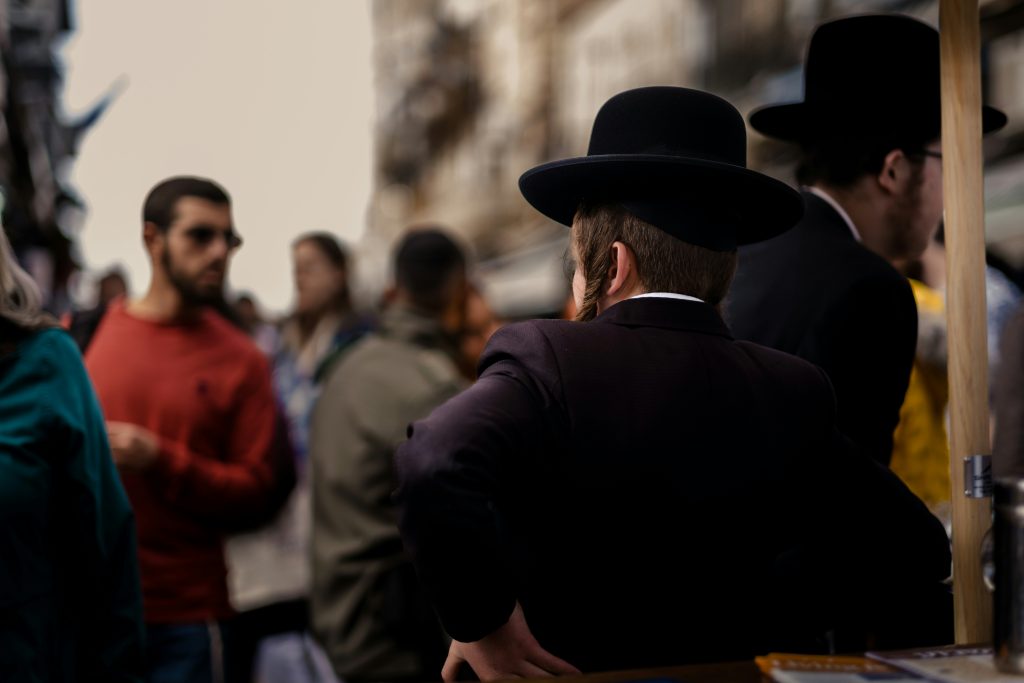 A tefilin stand in Juresalem / Levi Meir Clancy, Unsplash
 The draft law’s explanatory note states that the proposed law aims to ensure that symbols for which and through which Jews were persecuted throughout generations will not become controversial in the Jewish state. This purported aim is somewhat baffling because it assumes a certain analogy between the persecution of Jews over history and the future enforcement of the law by Israeli authorities. If this analogy reveals the real spirit of the draft law, it also reveals drafters’ ideas of the substance of Israel. According to Section 1 of the draft, the law’s overarching goal is to ensure the ability of the people of Israel to express their national and religious identity in their sovereign state, as “commanded by the Creator of the world.” While this provision could not be characterized as having a specific theocratic flavor, it envisages at least a very particular understanding of the parameters used to define Jewish identity.
Religious or traditional people could see the proposal as strengthening freedom of religion. But secular Israelis could see in the draft an attack on freedom from religion or even legitimization of a practice (offering to wear a tefillin) that could amount to forced, though indirect, imposition of religious values. Even if we put the issue of imposition aside, many may find this practice to be a type of proselytism by Orthodox groups who claim to know what is good not only for themselves but for every Jew.[5] Therefore, the draft law seems to embody the current parliamentary coalition’s religious populism by endorsing values of particular groups interested in fostering a specific lifestyle for the whole Jewish collective.
Religion in Public Spaces
According to the explanatory note, the “Knesset of Israel must stand in the breach and ensure that the public sphere in the State of Israel remains a place where every Jew can express their faith with pride and in public.” The principle contained in Israeli case law is that placing a physical installation in public spaces requires prior approval from the local authority in order for the installation not to constitute a nuisance or unreasonable obstruction of public space. The draft does not distinguish clearly between two types of public spaces: open-air public spaces and public or governmental buildings. Although this distinction might not always be relevant, public space in general is space that is accessible to the whole public but at the same time subject to control and restriction by authorities. An overarching immunity carved out for certain religious practices in public spaces is quite far-reaching, altering the balance between the rights of different members of the public to use it.
The discussion about balancing different interests regarding the use of public space is certainly not unique to Israel and is often connected to the role the state assigns to religion. In countries such as France, where there is a clear-cut separation of religion from state, the use of public space for religious purposes is certainly different from countries such as Italy or Spain, which exhibit more openness to religion and, in particular, the Catholic Church.
In Israel, the regulation of religion in public spaces reflects the status quo that existed during the Mandate.[6] In 1947, the Israeli government reached an agreement with Orthodox groups that the government would not alter the regulations pertaining to Shabbat, kashrut (kosher foods), marriage and divorce, and the autonomy of the religious education system as it existed prior the establishment of the State of Israel. While the goal of this status quo was to find a compromise with Orthodox groups, it also served to protect the autonomy of Orthodox communities.[7] The status quo has never been a static idea, and there have been shifts, clashes, and discussions over issues like the opening of shops, the use of public transportation on Saturdays, or the introduction of hametz (leavened grain products) in hospitals during Passover. Should the draft be approved, it could be seen as a new shift of the status quo in favor of strengthening Orthodox presence in the public space.
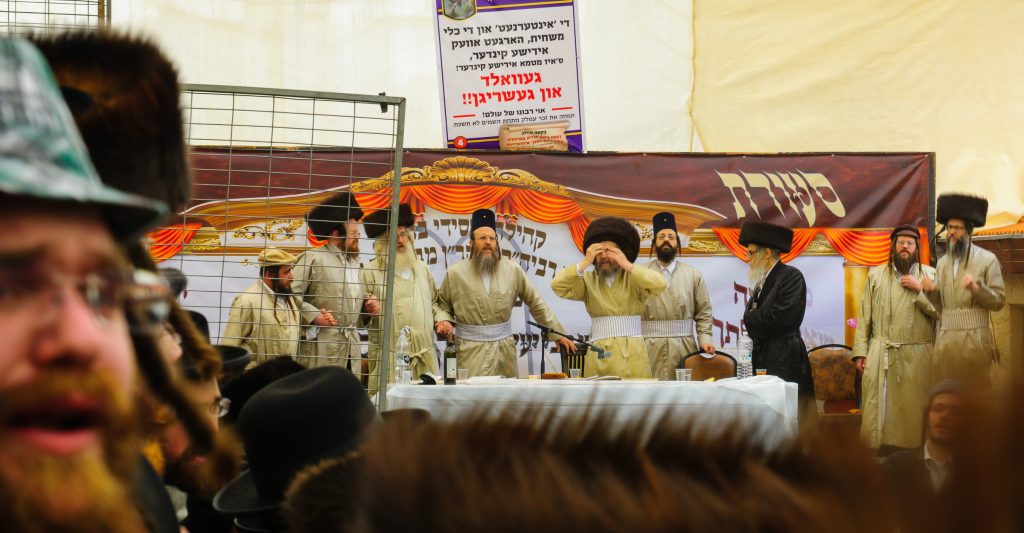 Purim celebration in the ultra-Orthodox neighborhood Mea Shearim in Jerusalem / Istock
 The question regarding uses of public spaces is also associated with the idea of equality (equal access of different religious groups to public facilities and spaces), but the draft law disregards equality under the rubric of fostering Jewish identity. If authorities must exercise this power in an equal and proportionate manner, could the possibility of other religious political groups setting up stands in the streets be rejected? And what about placing stands for secular purposes in clearly ultra-Orthodox neighborhoods?
While Israel explicitly assumes itself a Jewish state (even if the meaning of Jewish state has always been difficult to define precisely), this fact does not supersede the need to consider how the use of public space should be managed. As mentioned, the draft law seems to ignore this issue.
Adjudication Issues
The draft law establishes particular rules regarding the adjudication of disputes that arise from this law. In the case of conflict regarding the liturgy to be used in a synagogue, the competent authority is the Chief Rabbinate. That might sound logical since the definition of religious practice is a religious question, but Conservative or Reform groups might raise eyebrows at this rule. Making this provision even more controversial, the draft law provides that a dispute brought before the courts, relating to the draft law, should be decided by a judge who passed an evaluation showing that he knows how to use Hebrew Law[8] as a tool for deciding issues of legal lacunae and for resolving disputes relating to this law. The draft law adds that no judge who has not successfully passed this evaluation shall be appointed to any forum.
Discussion of the role of Hebrew law and its place in the Israeli legal system began even before the establishment of the state. In 1980, with the enactment of the Foundations of Law Act,[9] Hebrew law as a basis for lacunae was given a residual role after statutes, case law, and analogy. Even then, Israeli heritage, rather than Hebrew law, was expressly referenced, providing a very open formula that might include different sources of Jewish life and not only Hebrew law. In 2015, Hebrew law was included alongside Israeli Heritage, but even since then, and apart from questions of personal status, Hebrew law has fallen short of playing a significant role in Israeli law.
The draft law seems intended to enhance the importance of Hebrew law. But it may introduce a slippery slope, making it possible to argue that in every adjudicated issue connected to Jewish values or tradition the competent judge should show proficiency in (a specific version of) Hebrew law. At bottom, the draft law expresses very clearly the lack of confidence of Orthodox groups in the judiciary, charging it with being too secular and aiming to strengthen the role of Hebrew law.
Definition of Jew
Since the proposal is intended to defend the freedom of religion of Jews and protect Israelis’ ability to express their national and religious identity, the proposal takes care to define who is a Jew, entering one of the thorniest questions in Israeli law and society. According to the proposal, a Jew is someone whose Judaism has been recognized by the Chief Rabbinate of Israel for marriage purposes according to Israeli law, or who meets the Rabbinate’s requirements for such recognition. This definition is different from the definition found in Section 4b of the Law of Return 1950, where Jew means a person who was born of a Jewish mother or has become converted to Judaism and who is not a member of another religion. In Israel conversion, Reform and Conservative, at least done abroad, is recognized for purposes of immigration according to the Law of Return. However, the draft law attaches the definition of Jew to the definition of the Central Rabbinate, which excludes Reform and Conservative Judaism.
Conclusion
While not its express main purpose, the draft law stresses tensions that have existed from the beginning of the State of Israel and accepts a quite Orthodox approach to questions of religion and state. There is nothing negative in trying to involve more people in liturgy and Jewish practices. Religion and tradition should be allowed to freely practice and thrive. But this should not be done by dodging basic principles of the rule of law and public order.
At the time of this post’s publication, it is unclear whether the draft law will be approved, and if the law does pass, the final text will likely differ from the draft. But even if the draft law is not approved, the discussion about the religious dimension of public space in Israel will certainly not disappear.
References:
[1] The Bill for the Realization of Jewish Identity in Public Space, proposed by MK Galit Distal Atbrian et al, P5807/25 (2 Dec. 2025) (Isr.).
[2] For those unfamiliar with the term, tefillin (also called phylacteries) are two small black leather boxes containing scrolls of parchment inscribed with verses from the Torah. One box is placed on the upper arm while the other is positioned on the forehead. Religious Jewish men (and some reform religious women) wear them during weekday morning prayers as a biblical commandment.
[3] A mezuzah is small case containing a small parchment scroll with verses from the Torah, which is affixed to the doorposts of Jewish homes and buildings.
[4] See Ran Hirschl & Ayelet Shachar, Competing Orders: The Challenge of Religion to Modern Constitutionalism, 85 UNIVERSITY OF CHICAGO LAW REVIEW 425, 441 (2018).
[5] See Raphael Cohen Almagor, Coercion by the Orthodox Minority in Israel, in MULTICULTURAL CITIZENSHIP: LEGACIES AND CRITIQUES 86, 89 (Francois Boucher & Jean-François Caron eds., 2024).
[6] BARAK MEDINA, HUMAN RIGHTS IN ISRAEL 673ff (2016) (in Hebrew).
[7] Yaron Katz, Identity Politics in Israel the Ultra Orthodox Challenge 36 JOURNAL OF INTERDISCIPLINARY STUDIES 69, 73 (2024).
[8] According to the draft law, Hebrew law is Torah law as practiced by the Council of the Chief Rabbinate and in accordance with its directives.
[9] Regarding the Foundation of Law Act, see BENJAMIN PORAT, A PROPOSAL TO AMEND THE FOUNDATION OF LAW ACT WITH ANALYSIS AND CRITIQUE (2016) (in Hebrew).


No comments:
Post a Comment