
My friend and colleague Klaus Larres has just published a quite interesting take on the state of Europe, or perhaps better put the state of the crisis in Europe, one that is only now becoming clearer. That crisis touches not just on the state of European economies and integration, but also on its political cultures, its institutional cultures of governance, and the ideological neural networks of its fundamental political line. All of this at a time when many in Europe appear willing to reconsider who their friends and enemies arte among the larger powers that keep nudging themselves into European political life.
Here is his description:
"WHAT EUROPE'S TUNNEL VISION MISSES" is a new essay which I have just published on my Substack. "What Europe's Tunnel Vision Misses: Despite Continuing Tension with the Trump Administration, a new Pragmatism is Essential. Insights from the GlobSec 2026 Forum."
The essay is a slightly revised English version of an op ed published in German in my column "Understanding America" for the German daily newspaper 'Koelner Stadtanzeiger' (Monday, June 1, 2026). If you like the essay, then please subscribe to my Substack for Free. And feel free to ask your friends and family to do so too. https://klauslarres.substack.com/

The point is fairly straightforward: in the face of what the Europeans and fellow traveler global elites perceive as the incompetence of the Trump Administration, what is to be done with or without the U.S. And yet oddly they continue to rehash increasingly other worldly iterations of historical hand wringing about the status of Ukraine in and as Europe (especially with respect to NATO and EU membership). And the contempt for the US-Israeli actions in the middle east appeared to be generally shared, and with it, an assessment: "So far, China has been the strategic winner of Trump’s misguided Middle East policy. The U.S. is increasingly viewed—not least in the non-Western world—as a hotbed of chaos and a source of war and instability, while China is able to position itself as a supposed pole of stability and reliability." They continue to fret about the pervasiveness of Russian influence on their political discourse and cultures. And so on.
The problem (for Europe) of course, is that all of this analysis is plausible only from and within the cognitive cage within which Europeans continue to operate. In essence they both neither understand nor can tolerate the fundamental shift in cognitive orientation of the U.S. from that of an institutional-bureaucratic form to that of the merchant-transactionalist cognitive orientation (see, discussion at The Conceptual Architecture of America First—Ideological Transactionalism and the Case of Cuba). From the institutional perspective they are of course absolutely correct; but from that of the merchant-transactional their anaysis is certainly less relevant and unlikely to resonate with the Americans. Bu that may be the point. The hope is that the Trump Administration's approach to the transformation of the fundamental political line of the Republic will not outlast the Trump Presidency and that one must prepare for some sort of return to "cognitive normalcy" after 2028. It is not clear, though, that this is likely to occur. While the European conversation is vitally important on its own terms, and on that basis respected and considered, it also suggests the current failures of US-European dialectics and the necessary independence of European action on their own terms (something that ironically enough, the Americans appear to be encouraging--as long as trade and markets are not too badly affected). Though from a different perspective Larres point is well taken: "OVERALL: Europe must become more pragmatic and creative—and quickly. Lamenting missed opportunities and venting anger over the Trump administration’s enormous incompetence may provide emotional relief, but they achieve nothing."
The Essay, which may be accessed in its original form here, is reproduced below.
What Europe's Tunnel Vision Misses: despite continuing tension with the Trump administration, a new pragmatism is essential. Insights from the GlobSec 2026 Forum.
This is slightly revised English version of an essay which is published in German in the German daily newspaper 'Kölner Stadtanzeiger' on June 1, 2026.
Europeans
are realizing more and more clearly that lamentations and outbursts of
anger over the incompetence of the U.S. government are pointless and
that they must act differently.
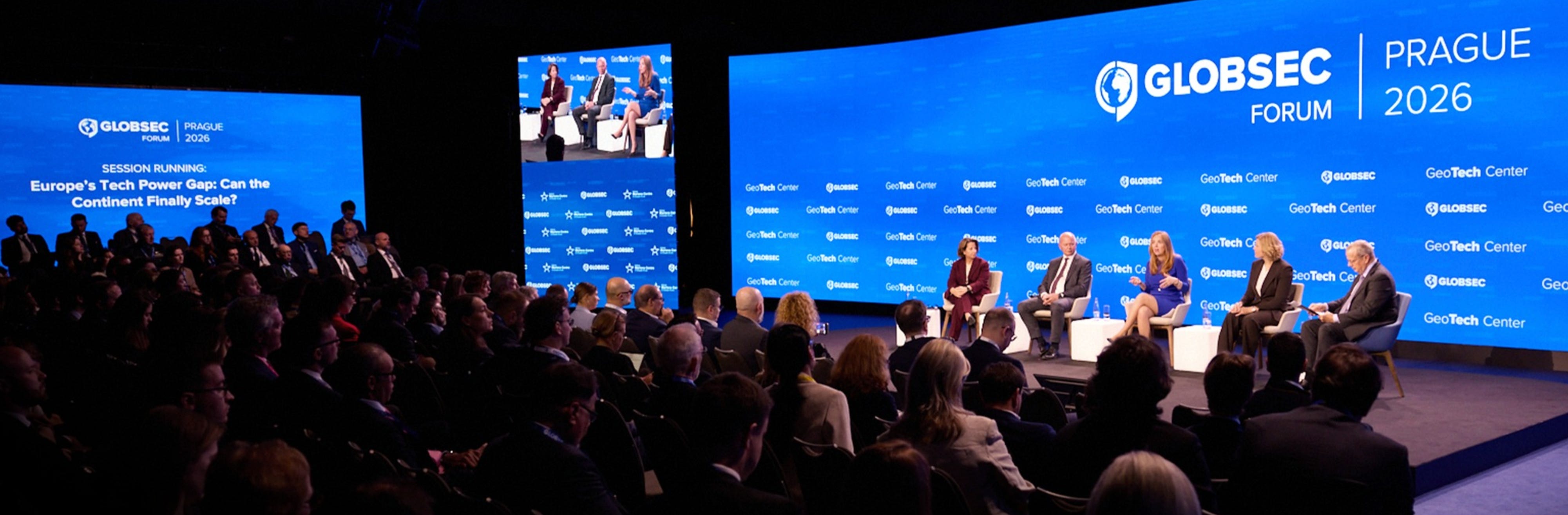
One of the world’s most significant security conferences, “GlobSec 2026,” with more than 2,000 participants, was recently held in the Czech capital, Prague. Only the Munich Security Conference is larger. Under the somewhat dry title “Global Systemic Transformation,” a few dozen prime ministers and foreign ministers as well as several heads of state discussed the complex geopolitical and technological—and the many military—problems currently facing the world and central and eastern Europe in particular. Lieutenant General Michael Vetter represented the German Ministry of Defense as one of the Bundeswehr’s highest-ranking officers. Many senior officers from other countries were also present.
Even though a somewhat forced-sounding optimism was occasionally heard, such as in a discussion with the foreign ministers of Germany and Poland, Johann Wadephul and Radoslaw Sikorski, the overall assessment of the presentations and meetings in smaller groups was sobering. Short interviews with prominent politicians, organized by the magazine Politico in the “Speakeasy Corner” of the conference, highlighted not least the many domestic political problems facing politicians such as Czech President Petr Pavel or Moldovan President Maia Sandu. Both highlighted the massive Russian influence in their nations.
Lithuania’s Foreign Minister Kestutis Budrys and his Romanian counterpart Oana-Silvia Toiu expressed deep concern about the near-daily cyberattacks on their countries. At that point, Toiu could not yet have known about the most recent Russian drone attack on an apartment building in the Romanian town of Galati, which is only a few miles from the borders with Ukraine and Moldova.
U.S. policy was the focus of numerous presentations and other contributions. Yet a representative of the Trump administration was nowhere to be found. Neither the State Department nor the Department of Defense was represented in Prague. Only a few former U.S. ambassadors and politicians had come to Prague. The self-absorbed U.S. leadership has little interest in engaging with its European counterparts. Yet participants took away important insights from GlobSec 2026, particularly regarding three topics.
1. Military developments
Last year, Europeans collectively spent over 370 billion euros on defense. That is 20 percent more than in 2024. Given these enormous investments—admittedly financed mostly through debt—European defense policies currently have few financial concerns. Rather, they cannot expand their capacities fast enough. The European defense industry has a clear production problem.
The average delivery time for many defense goods is over five years. For example, the Europeans promised the Ukrainian government several years ago to produce more than one million artillery shells per year. Currently, they can produce at most half that amount. Many GlobSec participants suggested that EU governments should already be acquiring land for arms factories and make other forward looking arrangements. The construction of new factories could then be completed within twelve months, if this should prove necessary.
The war in Ukraine demonstrates that modern warfare is based primarily on industrial capacity, rapid technological adaptation, and constant innovation. Ukraine can now produce ten million drones per year on its own and has thus become significantly more independent from the U.S. Ukraine has become an important part of Europe’s defense and security policy. According to the findings at the GlobSec Forum, Europe cannot do without Ukraine’s operational experience on the battlefield and its innovative defense efforts. It is therefore worth considering seriously, whether Ukraine should not, sooner or later, be granted membership in NATO as well as in the EU.
2. The Iran War
Much of the discussion at the GlobSec conference centered on the war in Iran waged by the U.S. and Israel. There was broad consensus that the EU countries as well as the UK must take a greater interest in the region than they have in the recent past and should participate in efforts to resolve the conflict, reopen the Strait of Hormuz and ensure that it stays open. It is not enough to keep emphasizing that the U.S. should never have started the war in the first place. And it is not enough to wait until the end of the war to deploy the European maritime protection initiative, led primarily by London and Paris.
So far, China has been the strategic winner of Trump’s misguided Middle East policy. The U.S. is increasingly viewed—not least in the non-Western world—as a hotbed of chaos and a source of war and instability, while China is able to position itself as a supposed pole of stability and reliability. Europeans must therefore take an active role in resolving the conflict and help the U.S. out of its self-imposed predicament—regardless of how strongly they oppose Trump’s policies and dislike the president personally.
3. Energy and critical raw materials
The issues of energy and critical raw materials also received special attention in Prague. After all, energy prices in Europe are on average about four to five times higher than in the U.S. There was broad agreement that the former dependence on Russia in terms of oil above all must not be replaced by a new dependence on China in other fields. Beijing controls more than 70 percent of the world’s facilities for refining rare earths—which are vital to the automotive, electronics, and defense industries—and also plays a leading role in the supply chains for new clean technologies. Here, the EU must urgently develop its own capabilities and build its own refineries.
Europeans aimed to hold a 20 percent share of the global semiconductor market by 2030 - but they will likely reach no more than 12 percent. The EU has little to counter the enormous, mostly private investments in the U.S. and Asia, not least in Taiwan and South Korea. Europeans also fare poorly when it comes to artificial intelligence (AI), cybersecurity, and the massive data infrastructure emerging in the U.S. and elsewhere. While the U.S. has so far developed more than 40 foundational AI models and China at least 15, Europe has contributed only three, even though—on a per-capita basis—30 percent more AI researchers work here than in the U.S.
The EU should therefore focus above all on becoming more involved in areas where it is (still) competitive, such as the manufacture of hardware, high-quality packaging materials, tiny specialized semiconductor components (chiplets), and chip design capabilities.
OVERALL: Europe must become more pragmatic and creative—and quickly. Lamenting missed opportunities and venting anger over the Trump administration’s enormous incompetence may provide emotional relief, but they achieve nothing.


No comments:
Post a Comment