
One of the most interesting things of the current round of debate about genocide (as distinguished from prior rounds in the 1990s around the killings in Rwanda and in the former Yugoslavia among others) is not so much whether the facts on the ground in Ukraine and Gaza fit the definition of genocide, or can be made to so fit, so much as whether the definition of genocide and the theoretical understanding of its "essence" as norm, law, and ethos, ought to be changed. That change, in turn, is grounded , in some respects on a changing sensibility about killing people in the course of war--a change well underway during the course of the more intense periods of civilian rich fighting in Iraq in the early part of the century, and in the way in which civilian based casualties are meant to relate to military operations--mostly by State actors, though, sometimes grudgingly, by others.
In a sense, then, the contemporary debates about genocide are occurring at two different but inevitably interconnected levels. The first is one that more or less accepts whatever legal parameters are thought currently to exist and then to "lawyer" them in the traditional way. The other is to use the occurrences on the ground as a means of effecting a change in the fundamental character and normative baselines of the concept (within legal structures or otherwise), which are then to be applied to the facts on the ground. Genocide, in these senses, may be understood either as an instrument for a larger object, or as the consequential collective rationalization of aggregated events and objects the collection of which produces its meaning; and its consequences. One either sees and understands things the way one sees them or one changes the lens through which it is possible to see some "thing" in a particular way.
That, more than its substance, serves as a quite fascinating element of the current dynamic nature of law and legal systems, and with it, on the notion of "rule of law." In one sense there is a semiotic and phenomenological conflict that goes to the heart of the enterprise of law in liberal democratic states and as the normative structural foundation of international legality (institutional or not). That conflict centers on the signification of objects and actions in the context of their relationship with the meaning (and the consequences of that meaning) which are attached to them. In one sense, genocide may be increasingly understood as a set of triggering actions around killing that can be aggregated in a way that in their context produces a "living" definition or interpretation or confirmation of genocide. That is that genocide is driven by its contextual objectivity. On the other side is the notion that the signification of objects and actions--the rationalization and investment of phenomenological events and their objects--must be a function of the structures of interpretation from which it is possible to extract meaning (and consequences).
At its heart one encounters a meaning phenomenology of killing--the typologies of which appear to be changing, and changing rapidly. At the same time the normative semiotics of genocide have also been changing, as a function of changes in the normative understanding of killing. The value of genocide in this changing typology is its normative punch. If one wants to end war, and if one wants to eliminate the killing of as many people as possible in war then the impact--culturally (and legally) of the accusation of genocide may serve as a substantial inducement to avoid the charge even as becomes easier to make. At its limit, one might envision the conflation of civilian killing with genocide, and thus with a core objective of viewing all killing of civilians as genocidal--as taboo. In either sense, there is no inherent or natural "truth" or facticity in genocide--there is only a normative judgment producing interpretive structures and collectively embraced consequences flowing from collective meaning making generally, or varying by context.
It is in the latter respect, of course, that things becomes more fascinating still--intersectionality in genocide has hardly begun to be considered at a deeply theoretical level. That intersectionality produces its own typologies of killing in which even in regimes where all killing is presumptively suspect in conflict, not all killing is suspect in conflict--the presumption can be overcome. And it is in that overcoming that intersectionality, politics, and normative judgments about collectives can have a significant impact on a reality shaping set of core assumptions--all killing is bad, some killing that can be aggregated around a set of motives or intentions are worse (genocide at its limits), but some killing, even aggregated and tainted by nonspecific collective intent, may be excused. It is in the construction of these Baroque cognitive cages that, as lawyers like to say (and sometimes philosophers) that context matters; if that is the case then multilevel context can have substantially interesting effects on the application of genocide if not its conceptual basis. And, of course, in a world that has deeply embraced identity and identity topographies (sometimes with characteristics attached), the dangers of intersecting interpretations and their effects on each other can have profoundly distorting effect, ones which then make it impossible, at the limit, to suggest that these concepts produce anything like predictable and consistent results (if only because that is very little that can be generalized). That latter point can be generalized as the fundamental conundrum of law and its rule at the start of the second quarter of the 21st century. It follows that though none of this is peculiar to genocide theory and practice (and its evolution in whatever direction one desires to take it), the normative nature of genocide is itself an intensifier of effect.
Whatever one's position on the underlying theory or its application to current context, the debate is worth considering. To that end Verena Buser, a historian of the Holocaust in Berlin, has recently published an essay that may be worth reading: "Targeting History: Anti-Israel Activism among Progressive Holocaust and Genocide Scholars" published to the Telos website. It may be accessed here and follows below. Dr. Buser takes a side, and has a target; but then so do many others in all sorts of directions. That is what makes the essay worth pondering whatever conclusion one comes to at the end. I leave it to readers to engage as they like and draw their own conclusions.
Targeting History: Anti-Israel Activism among Progressive Holocaust and Genocide Scholars
by Verena Buser
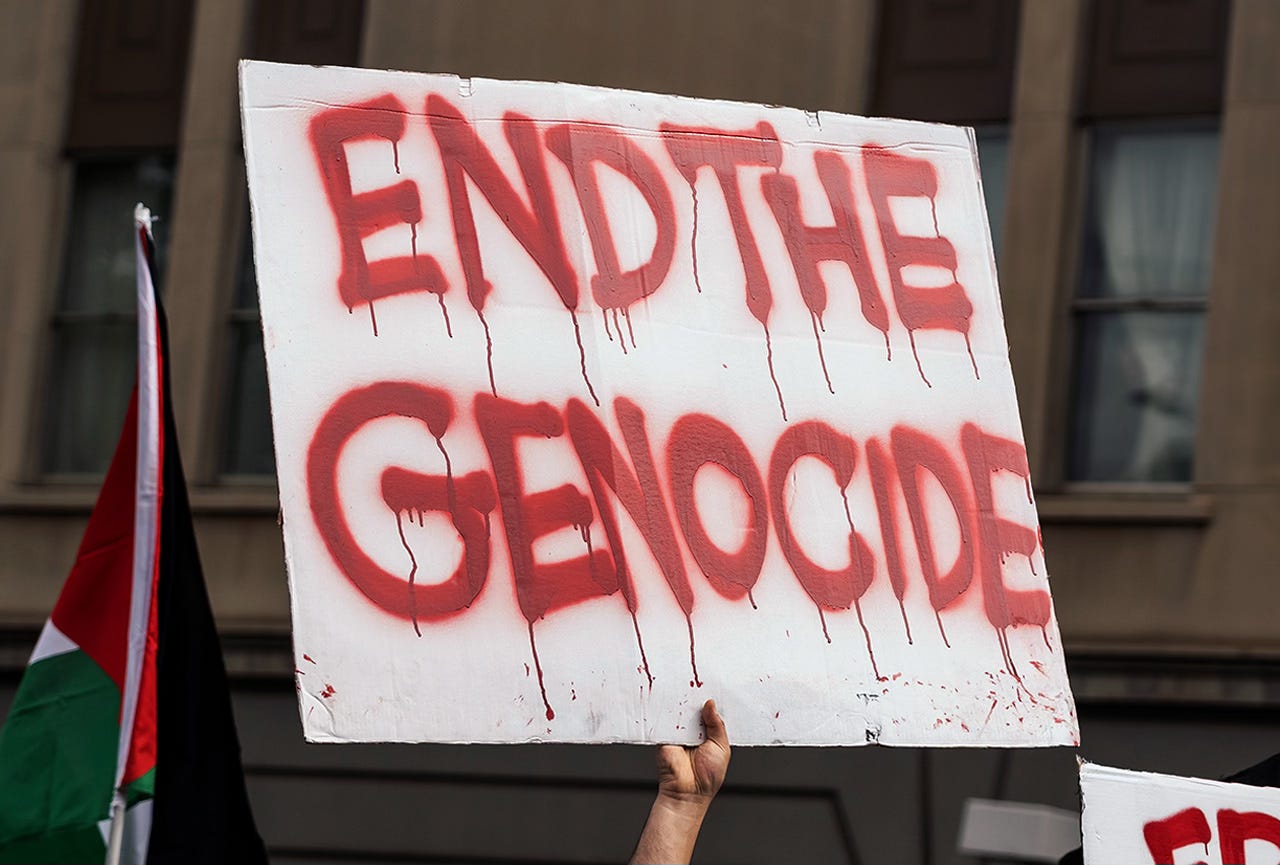
The accusation by some international Holocaust and genocide scholars that Israel is engaged in genocide is part of a politically motivated, largely anti-Zionist campaign that traffics in historical revisionism and that features attacks on standard definitions of the Holocaust, antisemitism, and genocide itself. The intellectuals who engage in these accusations are, in their perception, progressive scholar-activists who view themselves as pro-Palestinian—their essential self-image.1 Their activism is characterized by one-sided criticism of the Israeli government’s conduct of the war in Gaza, typically described as “genocide” or, additionally, “scholasticide.”2 Notably, it rarely, if ever, includes criticism of Palestinian leadership and its political decisions, and it is characterized by uncritical use of Hamas propaganda. One might ask: why don’t these scholars—who single-mindedly criticize both Israel’s conduct in war and the right-wing government of Prime Minister Netanyahu—regard Palestinians and their leaders as morally responsible subjects of their own history? History itself might offer some perspective on the question.
The one-sided critical tendency of this circle began long before the Hamas-led massacres in Israel on October 7, 2023, and the Israeli response to them. Many Holocaust and genocide scholars who speak of a “genocide in Gaza” participated in Historikerstreit 2.0, the “Catechism Debate” initiated in 2021 by genocide scholar A. Dirk Moses. Moses is part of a small group of thinkers who, as the Israeli Holocaust scholar Yehuda Bauer argues, seek to undermine the common view of the historically unprecedented character of the Holocaust in its ideological, global, and total scale.3 In his book The Problems of Genocide, published in German in an essay collection under the title Nach dem Genozid, Moses argues that the traditional concept of genocide, in which the “intent” to destroy a particular group is central, should be replaced by a supposedly more humane standard that emphasizes the effects of violence on civilian populations. In his view, the “intent” of the killings is not of interest: “[W]hat difference does it make to civilian victims whether the violence against them is carried out with genocidal or military intentions?”4 This approach seems to weaponize humanitarian issues for a political agenda; otherwise, the argumentation applied to the war in Gaza would be more carefully considered and research on the situation and living experiences of Palestinians in Gaza would have been taken into consideration. Removing “intent” from the concept of genocide and replacing it with a supposedly more humane concept may sound well-meaning. However, in the case of Gaza, Moses and others never question the numbers provided by the Hamas authorities in Gaza, nor do they ask how many fighters were killed, how many of them were children abused as child terrorists, or whether the numbers are reliable at all. Neither Hamas nor their allies are considered responsible for the devastating situation in Gaza. Moreover, comparing Gaza to a ghetto or a Nazi-like concentration camp proves that the necessary research was never conducted.
For Moses, genocide is subordinated to his principle of “illegitimate permanent security,” a concept inspired by postcolonial theory that gives the strong impression of delegitimizing the State of Israel’s desire for security. “Permanent security” is ultimately based on the kind of protective assertions made in court by Otto Ohlendorf, SS-Gruppenführer and commander of Einsatzgruppe D. German courts already rejected this line of argumentation in the first Einsatzgruppen trial in Würzburg in 1950 because it is what it is: an exculpatory effort to distract from a murderous ideology. The circle likewise seeks to define global antisemitism as a form of racism, thus distorting its historically unique character as an ideology that unites the far right, the far left, and Islamists, while providing a common concept of an enemy that must be fought and eliminated.

Some of the proponents of this school of thought are members of the editorial board of the Journal of Genocide Research5 and founders of the Genocide and Holocaust Crisis Network, which recently went online in April 2025 and which is trying set the agenda for the future of genocide and Holocaust studies.6 The network promotes all the aforementioned redefinitions. Yet it also defines antisemitism as a form of racism; it defames—but of course—the working definition of antisemitism adopted by the International Holocaust Remembrance Alliance (IHRA) and instead supports the competing Jerusalem Declaration on Antisemitism (JDA), which some of its proponents also helped initiate; and the network generally sets the stage for new, unempirical approaches to the rewriting of history. Most notably, in an ahistorical step, it hijacks the Nakba and defines it as a “mass atrocity” crime, without reference to the historical genesis of the term and its definition in Palestinian society.7 The aim is to squeeze Nakba into the framework of a global history of violence in which there exists only one aggressor: Israel.
While the spiritual guides of this circle are scholars like Amos Goldberg or Bashir Basir, its dominant voice is Omer Bartov, an American-Israeli Holocaust scholar who constantly excuses October 7 as legitimate resistance, as he mischaracterized it already on October 13 in the German press, which downplays the eliminatory, antisemitic nature of the Hamas-led massacres of October 7: “The despicable attack by Hamas must be seen as an attempt to draw attention to the plight of the Palestinians.”8 At the same time, they portray the October 7 massacres as acts of Palestinian resistance or as an uprising against the occupation, while downplaying the role of antisemitism in the Hamas attacks. This is not only false but dangerous: Hamas is ideologically linked to the Islamist Muslim Brotherhood, which has networks worldwide and seeks to undermine Western societies. Its motor is pro-Palestinian activism, according to Iraqi historian Omar Mohammed. Moreover, Hamas is the fifth-richest terror organization in the world (estimated at $500 million, according to Forbes in 2022), and its leadership has repeatedly stated that it is not responsible for protecting civilians (Abu Marzouk) but fights in civilian clothing. This is also reflected in their misuse of civilian facilities as weapons depots or rocket launch sites. Even the Hamas tunnel system in Gaza City, where the remaining hostages in the Gaza Strip are presumably being held captive and which is crucial for the conduct of the war, is not mentioned in the considerations of Holocaust and genocide researchers. The discussion also fails to address Hamas’s “hybrid” warfare, which is based on a social media manipulation campaign, or the propagandistic struggle in Western countries. Last but not least, there is no mention of the extermination antisemitism formulated in the Hamas charter or the genocidal crimes of October 7, 2023.
“Two people with a history of violence”:9 In this perspective, acknowledging each other’s suffering is said to be the leading idea, one that will bring peace to the Middle East while also dissolving the State of Israel as a Jewish state and ignoring the ethnic cleansing of Jews from Arab lands, anti-Jewish pogroms in the Arab world, or decades of Palestinian terror in the name of liberation.10 But wasn’t the PLO founded before Israel occupied the West Bank or Gaza, from which it unilaterally withdrew? The formulation lacks a profound understanding of antisemitism, ignoring its function, nature, and role in the conflict. We know that antisemitism radicalizes itself and—as can be seen easily today—it becomes successively more aggressive, violent, and eliminatory, as sadly shown by the shooting of Israeli embassy staff in Washington, DC, which was followed by an online hate campaign.11
The circle’s simplistic worldview, which is detached from the realities in the Middle East, now seeks to dominate the field of Holocaust and genocide studies. Alongside the practice of “multidirectional memory” advocated by literary scholar Michael Rothberg12—who insinuates that the memory of the Holocaust obscures the memory of African slavery, colonial crimes, and other mass atrocities—their positions bear striking parallels to the stereotypical definition of Israel as the “root cause” of the conflict.13
If only the Holocaust would not be so prominent, everything would be better!
Let us delve further into the outlook of the members of this circle. It is small, but in meeting the widespread international impulse to criticize Israel, well beyond the academy, it is all the more prominent for its size. Yet its errors and evasions are legion.
They begin with a general stance of critical disingenuousness. In an open letter published in the New York Review of Books on November 20, 2023, the signatories not only try to portray themselves as balanced—even warning against the dangers of “emotions . . . running high”—but also allow that “antisemitism often increases at times of heightened crisis in Israel-Palestine, as do Islamophobia and anti-Arab racism.”14 Yet they assert at the same time that no comparison of the Holocaust and October 7 is intellectually or morally permissible, declaring that “appealing to the memory of the Holocaust obscures our understanding of the antisemitism Jews face today, and dangerously misrepresents the causes of violence in Israel-Palestine.” The move is typical in its distortions, which carry through much of the circle’s work.
Many of its distortions are factual. In the structure of its arguments, for instance, the group focuses on the issue of intent as part of its strategy to apply the 1948 UN Convention on the Prevention and Punishment of the Crime of Genocide to Israel. In doing so, its members regularly insinuate that the IDF deliberately targets innocent civilians and destroys civilian infrastructure, such as schools and mosques.15
In addition, by uncritically adopting Hamas propaganda about facts on the ground, amplified through postcolonial analytic theory, the circle promotes broader misleading historical narratives about Israeli “apartheid” and “Jewish supremacy,” thereby framing October 7 as part of an indigenous uprising and as a legitimate resistance to colonial power.16
Likewise, its members advance a line of post-factual propaganda, which is especially important in Germany. They claim that pro-Palestinians—including, presumably, themselves—are being silenced out of a sense of guilt about the Holocaust.17 Such claims are demonstrably false and require a fact check. Encampments on university campuses that criticize Israel, for instance, and which also critique the IHRA’s working definition of antisemitism, usually receive broad support. But for these scholars, the memory of the Holocaust is literally too much to bear: it colonizes the mind and obscures our understanding of current events in Gaza and the Middle East.
Even more important than its factual distortions are those the circle promotes on the conceptual level.
Most notably, it seeks to develop new, misleading analytic definitions that drain prior concepts of their power. Under Moses’s much-discussed notion of “permanent security,” for instance, genocide is just one of the three instruments that “the West” employs in its broader anticipatory drive to eliminate threats against itself—for instance, in its war on terror, through which it kills countless civilians. In this view, genocide is not “the crime of crimes” but rather is subsumed under an allegedly larger category, thereby draining it of its full significance. The charge of “genocide” becomes no longer an analytical or legal category, but a political weapon.
Yet the most consequential tool of the circle’s genocide allegation against Israel is its use of genocide inversion—a new phenomenon. In their discussions of Israel-Palestine, its members repeatedly compare the case there to German South West Africa, as well as to Rwanda, Guatemala, Armenia, Kurdistan, Myanmar, and elsewhere. Amos Goldberg: “In most cases of genocide, from Bosnia to Namibia, from Rwanda to Armenia, the perpetrators said they were acting in self-defense.”18 The analytic move produces a moral inversion. Moreover, by including the Nakba within its analysis, it removes the term from its historical and contemporary context within Palestinian society.19
Among specific scholars utilizing this inversion, Bartov—until today the dominant voice among them, and not only in Germany—should be highlighted first and foremost. Despite some earlier doubts, expressed in the New York Times in November 2023, he saw the Israeli invasion of Rafah in May 2024 as clear proof of genocide.20 Indeed, during a lecture to reservists at Ben-Gurion University of the Negev in June 2024, he drew parallels between the mindset of Israeli soldiers and the soldiers of the Wehrmacht.21
More recently, Bartov speaks of the cumulative radicalization of Israeli warfare, the aim of which, he claims, was from the outset to make Gaza uninhabitable—though he also repeatedly states that genocide is difficult to prove because there is no “leader’s order” from the Netanyahu government.22 In this tendentious line of argument, the very lack of a direct order to engage in genocide is ironically used to insinuate a historical parallel between Israel and genocidal regimes. We have reached a low point where it’s enough, obviously, to state: “I’m a Genocide Scholar. I Know It When I See It” (Bartov, New York Times, July 15, 2025).23 This source-critical perspective is being disseminated worldwide as academic expertise. It is also being used as a pretext to promote hatred, incitement, and boycotts of Israeli academics.
A low point was reached on January 27, 2025, the International Holocaust Remembrance Day. The German magazine Der Spiegel published an interview with Bartov with the ahistorical question: “Gaza Equals Auschwitz?” The headline was followed by a subheading that quoted the researcher: “The Holocaust serves Israel as a lesson in inhumanity.” Although the headline was changed shortly afterward, the article remains a one-sided, defamatory attack on the State of Israel.24
While Holocaust inversion is a key line of argument in every conflict and war between Hamas and Israel, as well as in other wars in which Israel is involved, genocide inversion is a relatively new tool in the Israeli-Palestinian conflict. In short, Holocaust and genocide inversion involves the uncritical application of the scholarship of other genocides to the Israel-Hamas war. In this framework, the State of Israel is always portrayed as the perpetrator, and the Palestinian side is always portrayed as the victim.
Most often, scholar-activists use the German genocide of the Herero and Nama in German South West Africa as a historical analogy to “explain” the war in Gaza. This genocide was a “counter-genocide.” The uprisings of the indigenous Herero and Nama against the German colonial power were the trigger for the extermination order by German commander Lothar von Trotha. By applying this framework to the war in Gaza, scholar-activists exonerate Hamas and its exterminatory antisemitism, and they frame October 7 as indigenous resistance against settler-colonial Israel.25 Islamist and jihadist mass violence and massacres, like those of October 7 in the south of Israel, are portrayed as “legitimate resistance” or as a response to Israel’s policy with regard to Palestinians.26
An influential study on the genocide of the Herero and Nama is that of the aforementioned German Africanist scholar Jürgen Zimmerer, Von Windhoek nach Auschwitz? His argument includes the claim that the Holocaust is conceptually present in all German colonial crimes. As German antisemitism researcher Steffen Klävers in Decolonizing Auschwitz has shown, as have many others, this thesis lacks empirical proof.27 Yet one of the most prominent scholars who supports it is, naturally, Moses, who defines the Holocaust as an “atypical” colonial genocide—Germans felt colonized by Jews—and as a racist hate crime.28
It is not difficult to see this as an attempt to subsume antisemitism under the category of racism. The most questionable aspect of this continuity thesis is that it trivializes the role of antisemitism or defines it by analogy with racism or its subforms. As Israeli Holocaust scholar and IHRA founding member Yehuda Bauer has made clear, the Holocaust was an “ideological project” based specifically on an irreducible antisemitism. The newly founded Crisis Network in this framework represents a further step in implementing new regime of historical interpretation. Viewing the atrocity decontextualized from broader historical events—the declaration of independence of the State of Israel, the 1948 war, and the ethnic cleansing of Jews from Arab lands—is not based on empirical scholarship but rather is motivated by activism that is supposedly “pro-Palestinian.”
By framing the October 7 massacres as an uprising, Hamas is in turn denied agency and the ability to commit genocide nearly by definition. Likewise, there is no demand that Hamas lay down its arms or release the hostages in Gaza. Such demands are directed entirely at the Israeli government. After more than a year and a half of Holocaust and genocide inversion, as well as a lack of critical analysis of the information emerging from Gaza, every critical question targeting Hamas is now said to be Israeli propaganda.29 Bartov quotes Amnesty, Amnesty quotes Bartov. A closed system of argumentation—contradictions are neither permitted nor deconstructed. Moreover, while reading Holocaust and genocide scholars who are at the forefront of blaming the State of Israel for genocide in Gaza, it becomes obvious that they must only read each other: the lines of argumentation are the same, and a “growing consensus” is insinuated.
There is never any criticism of the Palestinian side, nor any mention of the regular proclamations by Hamas officials to repeat October 7, the calls to attack Jews and Jewish institutions worldwide, the shameless insistence that the deaths in Gaza are deliberate (we need “the blood of women, children and the elderly . . . so that it awakens our revolutionary spirit”),30 and the assertion that Hamas is not responsible for protecting civilians in Gaza.
Palestinians are the eternal victims. And the victims, the colonized, can never be blamed. They do not have to account for October 7 or decades of jihadist terror, because the reason is not antisemitism but the policies, the oppression, and the occupation of the State of Israel.
Antisemitism is also exploding on university campuses worldwide, yet scholars of the “Crisis Network” downplay this dynamic, and they fail to explain that Jews are targeted worldwide in the name of “Palestine solidarity” and “genocide in Gaza.” In short, this network fuels antisemitism and violent anti-Zionism by blaming Israel alone for the war in Gaza. This approach does not promote a peaceful solution; rather, it perpetuates the conflict in the Middle East. At a time when the concept of “multidirectional memory” (Michael Rothberg) is being celebrated as “progressive,” the reception of the war in Gaza is covered monodirectionally. For the “pro-Palestine” crowd, including “progressive” academics, Israel is an apartheid state, an aggressor, a troublemaker, and the root cause of the conflict. Empathy for the permanent war situation of the Israeli civilian population31 is completely lacking among “pro-Palestinian” academics, political elites, and human rights activists.
Indeed, following the ceasefire agreement between Israel and Hamas on January 19, 2025, and the resumption of fighting in Gaza, they were back: the voices of those who shout out “genocide in Gaza” yet who remained silent during the weeks of the release of Israeli hostages and the accompanying inhuman spectacle broadcast around the world.
They are also quiet at the moment of this writing, when thousands in Gaza are protesting in the streets against Hamas, while opponents are arrested and tortured or killed by the terrorist organization, which executes them as alleged “spies”—including those who regard themselves as “pro-Palestinian.”32 They were quiet in the past too when Gazans went to the streets in 2019 and 2023 to protest against Hamas in the “We Want to Live” protests.
But there is a glimmer of hope. For the first time in the history of the conflict, voices have been heard, since October 7, 2023, from Palestinians and the Arab and Muslim world, expressing fundamental criticism of the resistance narrative and the one-dimensional view of Palestinians.33 Their perspective on inner-Palestinian life, unresolved problems, and conflicts within Palestine is of crucial importance.
Yet their stories are instructive.
In March 2025, Hamza Abu Howidy, a peace activist from Gaza, from which he fled in August 2023, was a guest in Berlin-Pankow—as always, only possible under police protection. Together with Israeli Shay Dashevsky, he is fighting for new perspectives.34 While in Berlin, at a public event I attended, Hamza Abu Howidy asked the understandable question of why he had to hide. There was no answer.
Another example is Ahmed Al Khatib from Gaza, who lives in the United States and, despite his own family losses in the war, founded Realign for Palestine.35 He belongs to a self-critical generation of Palestinians who want to take a new path. They question a discourse that has dominated Palestinian society and the diaspora for decades. Its rule says: “Israel is always to blame.” Unlike the initiators of the Jerusalem Declaration on Antisemitism and the aforementioned scholar-activists who ignore all these critical and truly progressive voices, they want to criticize Palestine, to make it truly better, and therefore do not need to defame or demonize the State of Israel. They also do not want to dissolve or destroy it—and so they are cast out and denigrated as Zionists.
Why such low expectations of Palestinians? And why are these critics not included in “pro-Palestinian” discourse? These are questions worth pondering. The Palestinian side may be militarily inferior, but for decades it has used antisemitism as part of its arsenal. Global antisemitism, the “devil that never dies”36 that led to the Holocaust, is the most powerful weapon in existence. Orchestrated by Hamas and its allies, it unites the right, the left, and Muslim communities. And so around the world today, it seems, everything and everyone identified as Jewish and not explicitly anti-Israel or anti-Zionist are viewed as legitimate targets of hatred, propaganda, and violence. This makes it all the more important to pay attention to critical Palestinian perspectives that call for peace without simultaneously calling for the elimination of Israel and that reject murderous terror as a means of “resistance.”
Topics: Israel Initiative
Dr. Verena Buser is a historian of the Holocaust in Berlin.
For a discussion, see Shira Klein, “The Growing Rift between Holocaust Scholars over Israel/Palestine,” Journal of Genocide Research, January 8, 2025, https://doi.org/10.1080/14623528.2024.2448061.
The latest piece in this vein is Omer Bartov, “Infinite License,” New York Review of Books, April 24, 2025, https://www.nybooks.com/articles/2025/04/24/infinite-license-the-world-after-gaza/. For criticism of the repeated accusation, see Verena Buser, “Agitprop mit Genozid,” Jungle World, January 2 2025, https://jungle.world/artikel/2025/01/gegen-israel-agitprop-mit-genozid. See also Verena Buser, “Anatomie eines Völkermordvorwurfs. Der 7. Oktober 2023 und der Völkermordvorwurf aus der Holocaust- und Genozidforschung,” in Antisemitismus in Deutschland nach dem 7. Oktober 2023, ed. Olaf Glöckner and Günther Jikeli (Hildesheim: George Olms Verlag, 2024), pp. 257–91. For an English version, see Verena Buser, “The Genocide Allegation: Amnesty, UN and Holocaust and Genocide Scholars,” Jewish Journal, January 7, 2025, https://jewishjournal.com/commentary/opinion/378221/the-genocide-allegation-amnesty-un-and-holocaust-and-genocide-scholars/. For the “scholasticide” accusation, see “Signatories to Resolution for Consideration at the January 2025 Business Meeting,” American Historical Association, January 2025, https://www.historians.org/about/governance/business-meeting/signatories-to-resolution-for-consideration-at-the-january-2025-business-meeting/. For criticism of the resolution, see Jeffrey Herf, “Agitprop at the AHA,” Quilette, January 15, 2025, https://quillette.com/2025/01/15/agitprop-at-the-aha-scholasticide-hamas-antisemitism/.
Yehuda Bauer, Die dunkle Seite der Geschichte: Die Shoah in historischer Sicht. Interpretationen und Re-Interpretationen (Frankfurt am Main: Jüdischer Verlag im Suhrkamp Verlag, 2001), originally published as Rethinking the Holocaust (New Haven, CT: Yale University Press, 2001), p. 75.
Dirk Moses, Nach dem Genozid: Grundlage für eine neue Erinnerungskultur (Berlin: Matthes & Seitz, 2023), p. 10.
See the articles published by the Journal of Genocide Research on the “Forum Israel-Palestine,” https://www.tandfonline.com/action/showAxaArticles?journalCode=cjgr20.
See “Genocide and Holocaust Studies Crisis Network,” https://www.ghscn.org/home.
For a discussion of the “homogenizing image of ‘the Palestinian refugees’ in social science discourses,” see Ahmed Albaba, “Palastinensische Familien in den Flüchtlingslagern im Westjordanland,” doctoral dissertation, Georg-August-Universität Göttingen (2020), https://www.academia.edu/44873522/Pal%C3%A4stinensische_Familien_in_den_Fl%C3%BCchtlingslagern_im_Westjordanland.
Omer Bartov, “Netanjahu hat den Wind gesät, den Israel nun als Sturm ernten musste,” Berliner Zeitung, October 13, 2023, https://www.berliner-zeitung.de/kultur-vergnuegen/historiker-genozid-holocaust-forscher-omer-bartov-netanjahu-hat-den-wind-gesaet-den-israel-nun-als-sturm-ernten-musste-li.2148815.
René Schlott, “Mit klarem Blick auf beide Seiten,” Süddeutsche Zeitung, April 27, 2025, https://www.sueddeutsche.de/politik/omer-bartov-perspektiven-holocaust-genozid-deutschland-holocaust-und-genozid-israel-palaestina-rezension-li.3226884?reduced=true.
On the issue of anti-Jewish pogroms, see the exhibition “The Vicious Circle” curated by Prof. Maiken Umbach of Nottingham University (UK), which among other issues “explores the recurring delusion behind the anti-Jewish pogrom. A delusion recycled by false prophets who promise that slaughtering Jews brings the world freedom.” “Dramatic and Visual Exhibition Tackling Past and Present Antisemitism Opens in London for Holocaust Memorial Day,” University of Nottingham, January 14, 2025, https://www.nottingham.ac.uk/news/exhibition-tackling-past-and-present-antisemitism-opens-for-holocaust-memorial-day.
Matthias J. Becker, “‘Kvetching Intensifies’: Antisemitic Discourse Online after the Washington Embassy Shooting,” MJB’s Substack, May 23, 2025, https://decodingantisemitism.substack.com/p/kvetching-intensifies-antisemitic.
Michael Rothberg, Multidirectional Memory: Remembering the Holocaust in the Age of Decolonization (Stanford, CA: Stanford Univ. Press, 2009).
For a contrary view, see Yehuda Bauer, “Preserving Historical Integrity: A Call to Avoid Politicising the Holocaust,” Jewish Chronicle, December 8, 2023, https://www.thejc.com/lets-talk/preserving-historical-integrity-a-call-to-avoid-politicising-the-holocaust-if56foss.
Omer Bartov, Christopher R. Browning, Jane Caplan, et al., “An Open Letter on the Misuse of Holocaust Memory,” New York Review of Books, November 20, 2023, https://www.nybooks.com/online/2023/11/20/an-open-letter-on-the-misuse-of-holocaust-memory/. A response was published shortly after: Jeffrey Herf, Norman J. W. Goda, et al., “An Exchange on Holocaust Memory,” New York Review of Books, December 8, 2023, https://www.nybooks.com/online/2023/12/08/an-exchange-on-holocaust-memory/. For further criticism, see Ingo Elbe and Enrico Pfau, “Comparing the Hamas Pogrom of 7 October to the Holocaust Is a Misuse of Holocaust Remembrance say Omer Bartov, Raz Segal, Christopher Browning et al. This Is Why They Are Wrong,” Fathom, December 2023, https://fathomjournal.org/comparing-the-hamas-pogrom-of-7-october-to-the-holocaust-is-a-misuse-of-holocaust-remembrance-say-omer-bartov-raz-segal-christopher-browning-et-al-this-is-why-they-are-wrong/.
For one of many examples, see Omer Bartov, “As a Former IDF Soldier and Historian of Genocide, I Was Deeply Disturbed by My Recent Visit to Israel,” Guardian, August 13, 2024, https://www.theguardian.com/world/article/2024/aug/13/israel-gaza-historian-omer-bartov.
See Raz Segal, “A Textbook Case of Genocide,” Jewish Currents, October 13, 2023, https://jewishcurrents.org/a-textbook-case-of-genocide; Ulrich Seidler, “Genozidforscher zu Hamas-Attacke: ‘Netanjahu hat den Wind gesät,’” interview with Omer Bartov, https://www.fr.de/kultur/israel-konflikt-genozidforscher-hamas-attacke-netanjahu-hat-den-wind-gesaet-92581137.html; Amos Goldberg, “Yes, It Is Genocide,” Jewish Voice for Labor, May 14, 2024, https://www.jewishvoiceforlabour.org.uk/article/prof-amos-goldberg-yes-it-is-genocide/; A. Dirk Moses, “More than Genocide,” Boston Review, November 14, 2023, https://www.bostonreview.net/articles/more-than-genocide/.
Academics4peace, https://www.academicsforpeace.org/.
Goldberg, “Yes, It Is Genocide.”
See Albaba, “Palastinensische Familien in den Flüchtlingslagern im Westjordanland.”
Omer Bartov, “What I Believe as a Historian of Genocide,” New York Times, November 11, 2023, https://www.nytimes.com/2023/11/10/opinion/israel-gaza-genocide-war.html; Bartov, “As a Former IDF Soldier and Historian of Genocide.”
Bartov, “As a Former IDF Soldier and Historian of Genocide.”
“Why Israel's War in Gaza Is EASILY a Genocide—Israeli-American Genocide Scholar Prof. Omer Bartov,” Ashin Rattansi’s Going Underground, Rumble, September 15, 2025, https://rumble.com/v5f0kul-why-israels-war-in-gaza-is-easily-a-genocide-israeli-american-genocide-scho.html.
Omer Bartov, “I’m a Genocide Scholar. I Know It When I See It,” New York Times, July 15, 2025, https://www.nytimes.com/2025/07/15/opinion/israel-gaza-holocaust-genocide-palestinians.html.
Omer Bartov, “Die Unfähigkeit, die Realität als das zu sehen, was sie ist, kann Israel selbst sehr schaden,” Spiegel, January 28, 2025, https://www.spiegel.de/ausland/historiker-omer-bartov-ueber-israels-traumata-die-unfaehigkeit-die-realitaet-als-das-zu-sehen-was-sie-ist-kann-israel-selbst-sehr-schaden-a-f361cdf4-a5db-4462-bfcc-eecfaf48fd94.
Moses, “More than Genocide.”
Recently published: Patrick Wintour, “No Evidence of Genocide in Gaza, UK Lawyers Say in Arms Export Case,” Guardian, May 13, 2025, https://www.theguardian.com/world/2025/may/13/no-evidence-of-genocide-in-gaza-uk-lawyers-say-in-arms-export-case.
Steffen Klävers, “Postkoloniale Holocaustdeutungen und der Historikerstreit 2.0,” in Erinnern als höchste Form des Vergessens? (Um-)Deutungen des Holocaust und der “Historikerstreit 2.0,” ed. Stephan Grigat, Jakob Hoffmann, Marc Seul, and Andreas Stahl (Berlin: Verbrecher Verlag, 2023), pp. 289–31; Klävers, Decolonizing Auschwitz?
A. Dirk Moses, Nach dem Genozid: Grundlage für eine neue Erinnerungskultur (Berlin: Matthes & Seitz, 2023).
Bartov, “I’m a Genocide Scholar. I Know It When I See It”; Omer Bartov and Daniel J. Wakin, “A Genocide Scholar on the Case against Israel,” New York Times, July 23, 2025, https://www.nytimes.com/2025/07/23/opinion/israel-gaza-genocide-scholar-response.html.
See “Hamas Leader: We Need the Blood of Women, Children and the Elderly of Gaza,” JNS, October 29, 2023, https://www.jns.org/hamas-leader-we-need-the-blood-of-women-children-and-the-elderly-of-gaza/.
Verena Buser und Boaz Cohen, “‘Ich war 17 Stunden lang im Schutzraum’: Verbrechen an israelischen Kindern und Jugendlichen: Der 7. Oktober 2023,” in Nurinst 2024: Beiträge zur deutschen und jüdischen Geschichte: Schwerpunktthema: Jüdische Zeitungen und Autoren, ed. Jim G. Tobias und Andrea Livnat (Nuremberg: Antogo, 2024), pp. 115–31.
On the protests and encampments, see: Hamza Howidy, “Message from a Gazan to Campus Protesters: You're Hurting the Palestinian Cause,” Newsweek, April 25, 2024, https://www.newsweek.com/message-gazan-campus-protesters-youre-hurting-palestinian-cause-opinion-1894313; Ahmed Fouad Alkhatib, “Israel Killed 31 of My Family Members in Gaza. The Pro-Palestine Movement Isn’t Helping,” Free Press, June 12, 2024, https://www.thefp.com/p/pro-palestinian-movement-not-helping-gazans.
Verena Buser, Ahmed Albaba, and Maiken Umbach, eds., Breaking the Vicious Circle: Critical Voices and Positions on and from the Middle East (forthcoming, 2026); Verena Buser, “Ungehörte palästinensische Stimmen für Frieden und Demokratie,” in Was tun? Wie Antisemitismus in Deutschland bekämpft werden kann, ed. Susanne Krause-Hinrichs and Julius H. Schoeps (forthcoming, 2025).
We Want to Live, https://iamfromisraelaskmeanything.squarespace.com/.
Realign for Palestine, https://realignforpalestine.org/.
Daniel Jonah Goldhagen, The Devil That Never Dies: The Rise and Threat of Global Antisemitism (New York: Back Bay Books, 2016).


No comments:
Post a Comment