 |
| Pix credit here |
Chinese New Era Theory stresses the critical importance of self-revolution for the sort of social revolution that carries a political collective forward ( Social Revolution (社会革命) as Self-Revolution (自我革命) and the New Quality Production of CPC Modernization: 习近平 深入推进党的自我革命 [Xi Jinping, Deepen the Party's Self-Revolution] (Part of a speech at the Third Plenary Session of the 20th Central Commission for Discipline Inspection on January 8, 2024)). Of course, one does not have to embrace Chinese Marxist-Leninist theory to apply context relevant trajectories of self-revolution and social revolution.
 |
| Pix credit here |
We now understand that “President Trump is the President of Peace." (President Trump Brokers Another Historic Peace Deal). It ought to follow that the Republic is now, collectively, a Republic of Peace--self-revolution ushers in a state of social revolution. That, one might be excused for thinking, is the thrust of President Trump's message to the Republic. This is a message that has been underscored and elaborated by Secretary of State Rubio, whose discussion of the notion of peace, and states of peace brokered by a strong Republic reflects the more fundamental self-revolution of "transactional-merchant phenomenology and its understanding of peace as an essential element of something larger: "As they say in some movies--peace, like death, is not an end but a doorway. That acquires a quite interesting aspect in transactional spaces." (The Phenomenology of Peace and the Price of the Deal--Text of and Reflections on the Interview: Secretary of State Marco Rubio with Brian Kilmeade of Fox Radio).
 |
| Pix credit here |
Nonetheless, peace is not its own object. It is a state of (dis)engagement that permits the fundamental logic of the operation of self and social systems toward the realization of its apex goal and purpose--the regularization of spaces in which transactions may be undertaken for the further fulfillment of self and social revolution. It might be understood as movement toward development (or modernization, however these terms are understood) that improves (or in some systems perfects) things and conditions of life for individuals and collectives. In other words, the object is not peace; the object is the achievement of a state of stable transactions--iterative, perhaps even purposeful beyond the value of the transaction--that then manifest desired states of being. Peace is the predicate condition for the merchant; and the merchant is the predicate actor in development (not either the functionary or the warrior); and the work of the merchant is essential for the operationalization of transactional frameworks deployed to whatever ends suits society engaged in its endless processes of self-actualization, and for some, the attainment of states of perfection (at least until they die and a new generation starts the process again). That provides the framing of reality that serves as the foundation of the peace mission of the Republic with the President at is core.

For today; for today it is for us to contemplate the nature, function, and states of peace into which we are all traveling toward. . . . one way or another. Self-revolution and social revolution leads the Republic toward an embrace of the ordering principle that peace is a predicate to development; and that development is the foundation of transactional cultures in which individuals and collectives prosper, each in their own way--until the contradictions of transactions in context moves both back to not-peace. That, in turn, sheds light on the ordering framework of the dialectics of the human condition: Conflict-peace-transactions-conflict-peace. What is peace? Peace is truce; peace is a condition of managed conflict; peace is a state of ritualized engagement; peace is a temporal space and a platform. Managing peace, not conflict, becomes the key--perhaps that is so. Conversely managing conflict, not peace, is the key of equal value. The temporal objectification of both makes it possible to better use them; perhaps that is also a possibility. I leave that to others.
The text of President Trump Brokers Another Historic Peace Dealand merits study.
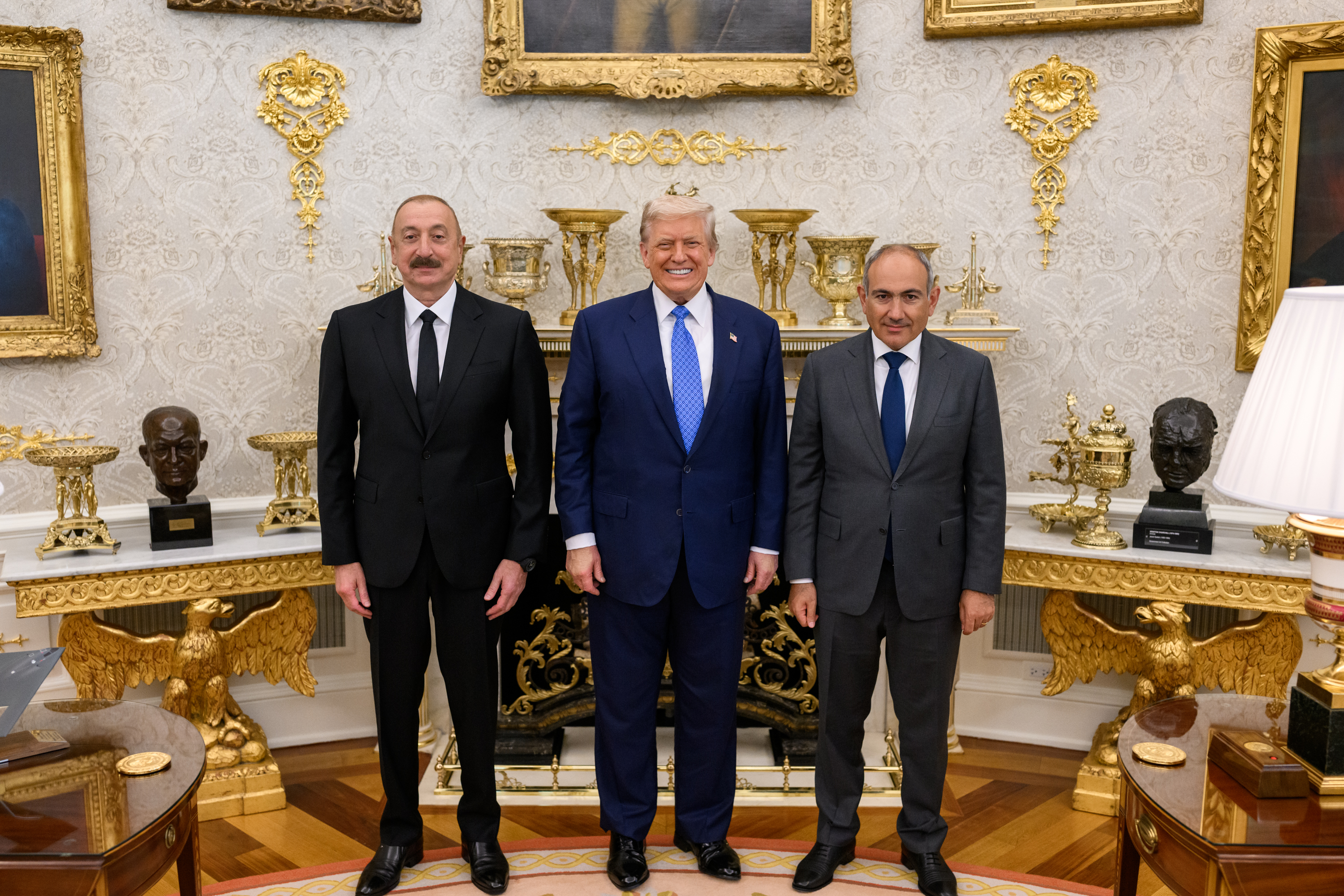
Today, President Donald J. Trump hosted Azerbaijani President Ilham Aliyev and Armenian Prime Minister Nikol Pashinyan at the White House, where the two leaders signed a historic joint declaration for peace after decades of bitter conflict and scores of lives lost — a landmark achievement for international diplomacy that only President Trump could deliver.
The two leaders also signed bilateral economic agreements with the U.S., unlocking the great potential of the South Caucasus region in trade, transit, energy, infrastructure, and technology, and creating new opportunities for the American people and American businesses.
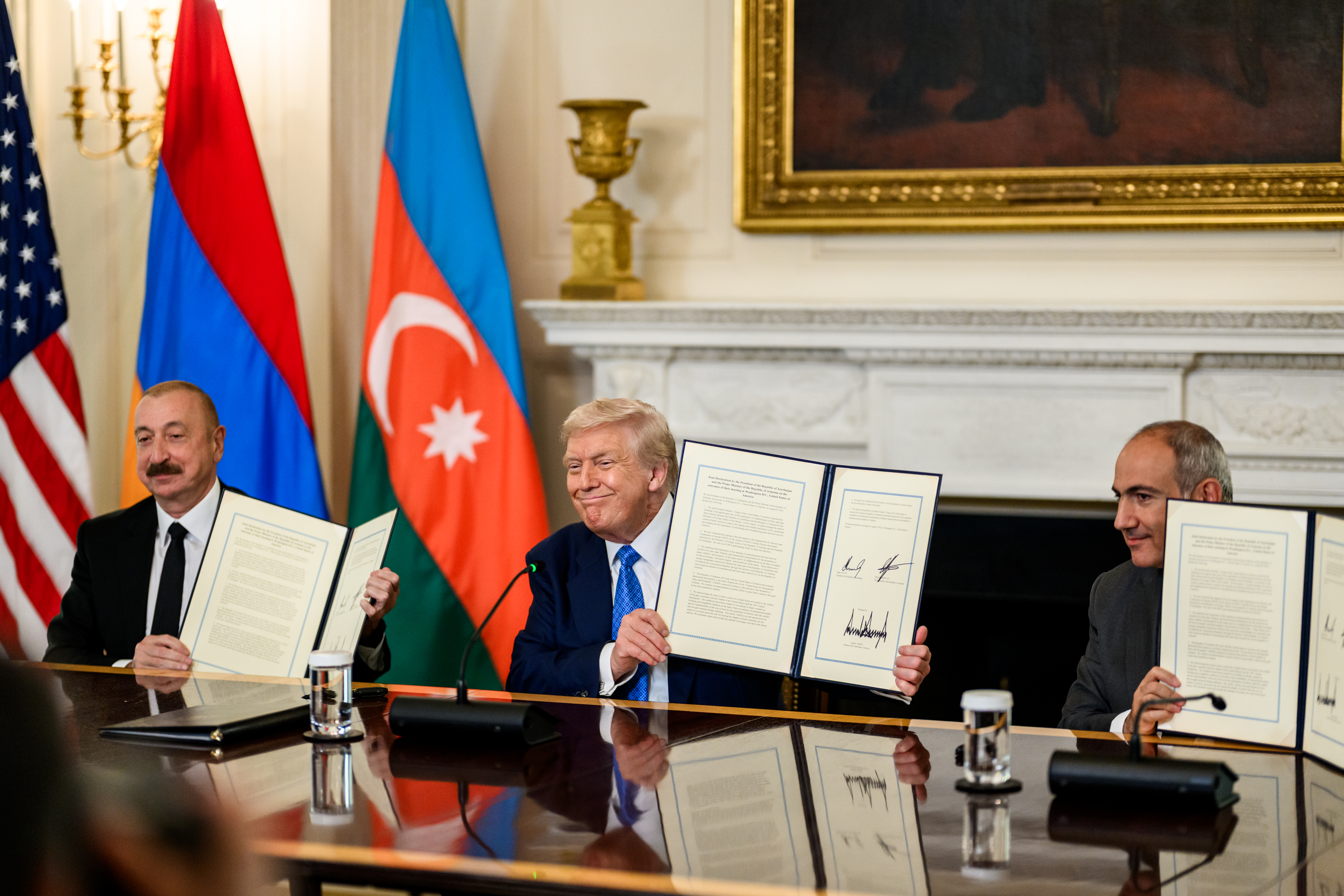
“For more than 35 years, Armenia and Azerbaijan have fought a bitter conflict that resulted in tremendous suffering for both nations… Many tried to find a resolution… and they were unsuccessful. With this Accord, we’ve finally succeeded in making peace,” said President Trump.
“It’s a day which will be remembered by the people of Azerbaijan with a feeling of pride and gratitude to President Trump… Within several months, he managed to put an end to conflicts in Asia, in Africa, and now in South Caucasus — what we could not achieve for more than 30 years… We will turn the page of standoff, confrontation, and bloodshed, and provide a bright and safe future for our children,” said President Aliyev.
“Today, we have reached a significant milestone in Armenian and Azerbaijani relations. We are laying a foundation to write a better story than the one we had in the past. This breakthrough would simply not have been possible without President Trump’s personal engagement and his resolute commitment to peace,” said Prime Minister Pashinyan.
President Trump is the President of Peace. As President, he has brokered peace between Azerbaijan and Armenia, Cambodia and Thailand, Israel and Iran, Rwanda and the Democratic Republic of the Congo, India and Pakistan, Egypt and Ethiopia, Serbia and Kosovo, and with the Abraham Accords.
President Trump is proving that nations across the globe can move beyond longstanding conflicts of the past toward a shared future of peace, prosperity, and success.


No comments:
Post a Comment