Thursday, April 14, 2022

Call for Papers: 16th Annual Meeting European China Law Studies Association


  This from the organizers of the 2022 European China Law Studies Association Annual Meeting:

We are glad to share with your this year’s Call for Papers for the upcoming Annual Conference. The conference will be held from September 21 to 23 in Copenhagen.

Dr. Wen Xiang and his team at Copenhagen University will be welcoming us this year.

We are looking forward to receiving your abstracts and panel proposals on a wide range of topics relating to Law in China. More Information may be found here: https://jura.ku.dk/icourts/calendar/2022/european-china-law-studies-association-annual-conference-2022/

Information also follows below.

Wednesday, April 13, 2022

Video Recording of Event: "Natural Law and the US Constitutional Order" (Penn State Law Federalist Society 12 April 2022) and Edited Transcript of My Remarks "On the ‘Natural’ in Natural Law--From Aspiration to Signification and Back Again"


I am delighted to share the video recording of the  event recently sponsored by the Penn State Law Federalist Society: "Natural Law and the US Constitutional Order" which was held at Penn State law 12 April 2022. We has a lively discussion after the presentations.

The recording may be accessed HERE.

The edited transcript of my remarks, a portion of which I delivered, On the ‘Natural’ in Natural Law--From Aspiration to Signification and Back Again, follows below. The remarks may be downloaded here: Backer_On the Nature of Natural Law


Tuesday, April 12, 2022

US Department of State: National Action Plan on Responsible Business Conduct: Notice of Opportunity To Submit Written Comments


Pix Credit here

 
The United States has had a thoroughly odd relationship with both the OECD Guidelines for Multinational Enterprises and the UN Guiding Principles on Business and Human Rights.It's not that the state officials in the United States are particularly fond or particularly dislike these mechanisms.  It is more like a kind of ennui that aristocratic peoples reserve for their inferiors, but one's that they can find, on occasion in the proper role, useful.These mechanisms are useful in the way that Christianity was useful in exporting projecting a civilizing power to the inferior regions of the world--and as a basis for the rationalization of economic activity managed from its center in the United States.  But it was not for the United States or its activities within its sovereign territorial space. Nor was in meant for home entities in their own self governance at the core of leadership of global production.  

That was certainly the mind set among the grandees of American officialdom.  These instruments were great as gesture but they had to be kept in their place.  And they had to be kept at a distance. Specific instances ought not to been encouraged--and certainly everything  must be done to ensure they do not acquire the influence and dignity of judicial pronouncement. The standards were to be off shored.  And the entire enterprise was to be reduced to a set of therapeutic interventions designed more for networking, and solidarity among key players and their public analogs than for embedding or developing the principles in either law or norm. 

That certainly was the essence of the last version of the U.S. National Acton Plan (NAP). It was one that I criticized precisely for its failures and for the pathos of its focus on gesture, the construction of highly linked self-referencing elites that could then curate appropriate behavior by inferiors effectively locked out of any process (except in form),  and its determined out sourcing of responsibility to virtually any place except the American metropolis.  See   On the U.S. National Action Plan on Responsible Business Conduct--Business and Human Rights: Public Leadership and Private Governance (2016). But many of my friends and colleagues appreciated the effort all the same.  And that merits some recognition.  Perhaps that is all one can expect from government and from the elite controlling group. For reasons that I can only speculate, and speculate wildly. I will leave that to others better suited to that sort of task. 

Well, perhaps the second try is the charm.  In yet another well choreographed effort at inclusion and consultation, the leading forces of such tasks within the public bureaucracies of the United States, along with their supporters elsewhere are now seeking, having likely already fleshed the thing out, to  update and revitalize the United States' National Action Plan on Responsible Business Conduct (NAP RBC) for U.S. businesses operating and investing abroad. (Federal Register / Vol. 87, No. 39 / Monday, February 28, 2022 p. 11114).

On June 16, 2021, Secretary of State Antony Blinken announced on behalf of the Biden-Harris Administration that the Department will soon begin updating and revitalizing the United States’ National Action Plan on Responsible Business Conduct (NAP RBC) for U.S. businesses operating and investing abroad. This notice provides background and welcomes written comments concerning this initiative for U.S. Government agencies to take into account in developing the updated NAP RBC. Comments may concern issues addressed in the prior (2016) NAP RBC or other issues suggested as priorities.
DATES : Comments must be received May 31, 2022. (Ibid.).

This is an important initiative with great potential effects. Please consider submitting comments. Having said that the objectives of this revision may be most noteworthy for their lack of ambition:

  • help provide clear and consistent expectations for U.S. businesses in their global operations;
  • facilitate internal U.S. government communication and coordination;
  • strengthen communication among stakeholders;
  • identify U.S. government commitments and steps to assist in creating a rights-respecting, enabling environment for businesses operating abroad; and
  • further promote responsible business conduct.

The NAP will address what the U.S. government is doing in this space; highlight best practices, relevant initiatives, and experiences; and identify U.S. government commitments and actions going forward.

One lacks even the ambition to consider an extensive reporting mechanism that mimics Modern Slavery disclosure regimes.  And one certainly does not see any push for even a sift law or discretionary version of supply chain due diligence or its reporting. Still, first things first. . . it is the thought that counts. And even attention, however attenuated, is a very positive development given the track record of the U.S.  

Supplementary information from the Federal Register posting follows, along with  the FAQs on the revisions from the  National Action Plan for Responsible Business Conduct WEBSITE

Monday, April 11, 2022

Zoom Link Information for Event: "Natural Law and the US Constitutional Order" Organized by the Penn State Law Federalist Society 12 April 2022


Event: "Natural Law and the US Constitutional Order" Organized by the Penn State Law Federalist Society 12 April 2022 at 1300 hours US East Coast Time.

PLEASE JOIN US.  ZOOM LINK INFORMATION FOLLOWS BELOW. 

MORE INFO HERE.

Objectively speaking, natural law, as a term of politics and jurisprudence, may be defined as a loosely knit body of rules of action prescribed by an authority superior to the state. These rules variously (according to the several differing schools of natural-law and natural-rights speculation) are derived from divine commandment; from the nature of humankind; from abstract Reason; or from long experience of mankind in community. (Russell Kirk, "The Case For and Against Natural Law").

Ius naturale est, quod natura omnia animalia docuit: nam ius istud non humani generis proprium, sed omnium animalium, quae in terra, quae in mari nascuntur, avium quoque commune est. (The law of nature is the law instilled  by nature on all creatures: this law does not just pertain only to humans but is common to all creatures of the land and  the sea, as well as birds.)  (Justinian, Institutes Book One Tit. I.2).

Sunday, April 10, 2022

Marxism by Referendum: Cuba's New Family Code; The State is Leading But Will the People Follow?


 In recent work I have noted the unique aspects of the development of Cuban Marxist-Leninism (see here and here).  Among its most interesting feature has been the increasing use of the popular referendum to validate the enactment of important changes to the law and the governmental structure of Cuba.   In many ways, this represents a unique development of Marxist Leninist governmentalism--undertaken to be sure under the leadership of the Cuban Communist Party and its related mass organs (PCC), but at the same time indicative of an effort at something like a more consultative form of engagement with the masses. For all of its potential, it remains very much a work in progress.  Elections and referendums in Cuban Marxist-Leninism cannot be operated and interpreted the way that such devices are understood and used in liberal democratic states.  The vote of a majority is not merely a signal of approval but also an indication of the sense of the community.  But equally important isthe process of mass consultationthat precedes thevote.  While thevotesignals thesuccess of thevangiuard's ability to manage a process of developing popular buy-in and affirmaiton ofits policy choices, the consultaitonprocess provides the mostsignificant opportunity tohear what popular opinionis and to either "change" the draft or "engage" with the people.  That, at any rate appears to be the form in which Cuban Marxist-Leninism is sometimes perfoemed (for its conceptualizaiton as well as its many challenges, see Cuba's Caribbean Marxism (2018) and generally Larry Catá Backer and Flora Sapio, "Popular Consultation and Referendum in the Making of Contemporary Cuban Socialist Democracy Practice and Constitutional Theory," University of Miami  International and Comparative Law Review 27(1):37-130).

This has become more obvious in the current context of efforts by the Cuban leadership to enact and subject to a popular referendum a new Family Code (Anteproyecto del Código de las Familias). As reported by Reuters:


Cuba's communist government is seeking to rally support for a new family code that would open the door to gay marriage and boost women's rights, but experts and a recent survey suggest an upcoming referendum vote may not provide a rubber stamp. Tepid support for the reforms, which clash with the island's entrenched "machista" culture, threatens to hand state-backed supporters a defeat amid a government push to encourage open and frank debate.

The proposed 100-page code, under scrutiny in town-hall style meetings throughout Cuba, groups together a swath of new regulations on family conduct. It overhauls several 1975 laws from the era of former Cuban President Fidel Castro. * * * The new code would legalize same sex marriage and civil unions, allow such couples to adopt children, double down on women's rights, and promote equal sharing of domestic responsibilities. It also adds such novelties as prenuptial agreements and assisted pregnancy. Parents would have "responsibility" instead of "custody" of children, and be required to be "respectful of the dignity and physical and mental integrity of children and adolescents."

* * * But the outcome of the referendum vote, slated for sometime this fall, is far from certain. The Cuban Roman Catholic Church has lashed out against gay marriage, saying the proposal is riddled with "gender ideology" that threatens parental authority and would lead to "indoctrination of children in schools without parental consent." The Communist Party daily, Granma, reported in mid-March on a high level meeting where organizers said that with more than half of the scheduled meetings through April already complete, just 54% of participants had expressed support for the new code. (Cubans split over more liberal family code as referendum nears).

EN PDF:
Descarga: Anteproyecto del Código de las Familias (Versión 22)
Descarga: NOTA INTRODUCTORIA A LA PUBLICACIÓN DE LA VERSIÓN 22 DEL ANTEPROYECTO DE CÓDIGO DE LAS FAMILIAS Y SUS PRINCIPALES ASPECTOS.

The "Introduction to the draft" follows below in Spanish.

Friday, April 08, 2022

Implementing the Principle of the Right to a Clean and Healthy Environment as a Human Right: Periodic Informal Report of United Nations Special Rapporteur on Human Rights and the Environment


 I am happy to pass along the recently distributed Periodic Informal Report of United Nations Special Rapporteur on Human Rights and the Environment.  It is notable for the reporting on the extent to which national and international bodies have taken up the call in HRC Resolution 48/13 (18 October 2021) to  recognize "the right to a clean, healthy and sustainable environment as a human right that is important for the enjoyment of human rights" (¶ 1) and to note "that the right to a clean, healthy and sustainable environment is related to other rights and existing international law" (¶ 2). 

One continues to wonder, however, whether it makes sense to continue to define the right to a clean and healthy environment by reference to human rights, or whether it might be more useful to start thinking about defining human rights by reference to the clean and healthy environment in which it must necessarily be situated. That would undo or perhaps almost a century of framing human rights, still it may be time to begin a more rigorous project of de centering the human from rights and rights discourse.

Thursday, April 07, 2022

UN Resolution A/ES-11/L.4 (Suspension of the Rights of Membership of the Russian Federation in the Human Rights Council)


On 7 April 2022 the UN General Assembly approved Resolution A/ES-11/L.4 (Suspension of the Rights of Membership of the Russian Federation in the Human Rights Council). 

Russia's deputy U.N. Ambassador Gennady Kuzmin said now was not the time for "theatrical performances" and accused Western countries and allies of trying to "destroy existing human rights architecture."

"We reject the untruthful allegations against us based on staged events and widely circulated fakes," Kuzmin told the General Assembly before the vote, defending Russia's record as a Human Rights Council member.

After abstaining on the previous two General Assembly votes, Russia's partner China opposed the resolution Thursday.

"Such a hasty move at the General Assembly, which forces countries to choose sides, will aggravate the division among member states, intensify the confrontation between the parties concerned - it is like adding fuel to the fire," China's U.N. Ambassador Zhang Jun said before the vote. (United Nations suspends Russia from human rights body over Ukraine)

The Text of the Draft Res. A/ES-11/L.4 follows. The Russian delegation response is extraordinarily rich with irony. Yet what will linger is the quite astute observation of the Chinese delegation--states have been asked to choose sides. To China's chagrin that choice was put to the fracturing global order before it was prepared to maximize its own benefit from the action. And yet here we are. States have been asked to take sides. They have done so, at least in this first preliminary round.  The consequences of these choices will become better exposed in the coming months. What is beginning to appear on the near horizon, however, are the alignments of dependency that mark both the border and peripheries of emerging bi-polar systems.


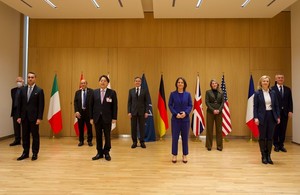
"Russia’s war of aggression against Ukraine: G7 foreign ministers' statement, 7 April 2022"

A picture is worth a thousand words and this one is priceless for the way it conveys in imagery the reality of the nature of Anglo-European solidarity, excused by the cover of COVID sensibilities that reveals more than it hides


G7 foreign ministers and the High Representative of the European Union issued a joint statement on Russia and Ukraine following a meeting at NATO today, 7 April. Entitled "Russia’s war of aggression against Ukraine: G7 foreign ministers' statement" a copy in English was posted to the website of the UK government from the Foreign, Commonwealth & Development Office and the UK Foreign Secretary, The Rt Hon Elizabeth Truss MP (who had also made a speech on 4 April 2022 at the UK Embassy in Poland).

As is customary for such statements, especially when those speaking wish one side well and one side ill but about which there is a determination to avoid engagement beyond a certain point, certain ritual points were elaborated.  

1. Condemnation " in the strongest terms the atrocities committed by the Russian armed forces in Bucha and a number of other Ukrainian towns" with a veiled threat of invoking the machinery of international law and institutions in response. As is also customary the object is on punishment for acts already done with less focus on prevention on the additional acts that all parties anticipate. Again, as I have mentioned before (e.g. here) the discursive tropes of the market--one can determine a willingness to commit atrocities by the price that will be extracted in the markets for public law and politics--remains very much at the foundation of the G7's ideological approach. 

2. Solidarity "with the Ukrainian people and [expression of] our deepest condolences to the victims of this war and their families" with the reward for bearing the brunt of the regressionist gamble of the Russian core of leadership. That reward is strictly confined to those a limited number of equipment and financial support, plus a greater tolerance for migration across Ukrainian borders of civilians seeking to avoid being on the wrong side of what appears to be Russian leadership's current predilections for the commission of atrocity. 

3. Accountability for "those responsible for these heinous acts and atrocities, including any attacks targeting civilians and destruction of civilian infrastructure." This is to be undertaken through the international legal-juridical mechanisms developed for that purpose and focus on a granular application of law against specific individuals to the extent that the appropriate chain of causality and sufficient proof of the relevant elements of offense may be successfully interposed in the proceedings. It might be borne in mind that some states may seek justice within their own domestic legal orders (see here). 

4. Advancing a politically binding character of internationalist legality ("Russia must immediately comply with the legally binding order of the International Court of Justice (ICJ) to suspend the military operations that it commenced on 24 February 2022"). Recall, though, that this represents something of a novel elaboration of the system if what is meant is that enforcement measures may either be on the agenda or that states will take measures against Russia for its failure to comply. There is here an opportunity to advance a general consensus of the legality of countermeasures to enforce ICJ decisions that will itself require considerably more elaboration becomes it becomes workable other than in extraordinary situations. 

5. Protection of a compliance based international order. The Statement aggregates a number of points here. One touches on state responsibility to comply with treaty obligations (chemical, biological or nuclear weapons) though the spectre of Russia's Syrian adventures remains  a spectral element here that detracts from the power of the statement. Another touches on bad faith discourse--the gaslighting that has been the hallmark of the Russian discursive offense in this war (and yet again use of disinformation has become an essential element of warfare and thus the construction of rules for the acceptable and unacceptable use of disinformation in war becomes notable here by its absence). Most interesting is the quite veiled  reminder to certain states (perhaps China and Belarus) of the potential penalties for facilitating disinformation campaigns both within their home territories and projected abroad..  That is something to which the G7 might eventually become more concerned about.

6. Disruption of international regimes of nuclear safety around the seizure of "control of nuclear facilities, and other violent actions in connection with a number of nuclear facilities, nuclear and other radioactive material, which have caused and continue to pose serious and direct threats to the safety and security of these facilities and their civilian personnel." Beyond the obvious one must question whether the G7 is looking here principally at the Ukrainian situation or in the way Russian actions are spoiling efforts to conclude a nuclear deal with Iran.  Another barely visible elephant in this room.

7. Support of the structures of humanitarian principles in the conduct of war. This includes a negative element--the "demand that Russia upholds its obligations under international humanitarian law and desists from further blatant abuses" (G7 Statement ¶7). It also includes a positive element--a commitment "to supporting the Government of Ukraine’s humanitarian coordination structure and to disburse humanitarian support quickly" (G7 Statement ¶8).

8. Reaffirmation of sanctions regimes and the limits of support to economic measures and defensive objects ("we have already adopted unprecedented and coordinated economic and financial sanctions against Russia that impose a significant cost on its economy" (G7 Statement ¶9). Sanctions regimes are solidified as the baseline measures that mark the limit of sympathetic action for states that only want to get indirectly involved.  In the process the G7 further cultivates sanctions as the narrative and modality of support, solidifying the concept that blood sacrifice marks the borderlands between involvement and support. Ukrainian blood; international support is the order of things in post-global warfare involving a superior (though in this case not an apex) power. 

9. Commending "those neighbouring states to Ukraine that demonstrated great solidarity and humanity by welcoming Ukrainian refugees and third country nationals affected by the conflict" G7 Statement ¶10). Also emphasized is the problem of Moldova, "which hosts the largest group of refugees from Ukraine per capita" the problems of which required the "establishment of the Moldova Support Platform." The themes of passive solidarity is emphasized. In the process an opportunity to speak to issues of ethnic cleansing and warfare through forced displacement of civilian populations is left dangling by focusing on the virtues of recipient states.

The net effect of these are to continue the status quo, one in which  the parties are left to their own devices, and providing a large space for their own choices, but all within the sphere of conflict and subject to systems of rewards and penalties beyond it) the following points well underlined.

The text of the statement follows below. 

Wednesday, April 06, 2022

Speech by the President of Ukraine at a meeting of the UN Security Council


Pix Credit Times of Israel

 Ukrainian President Zelenskyy has been left the perhaps unenviable task of running around the globe seeking aid from states and other actors who are as interested in being begged and lectured, and cajoled, and complemented as they are in actually opening their larders of useful objects and sharing them with Ukraine. That is an old story.  Dependent states--even those well thought of--are always in search of patrons.  And patrons enjoy that the objects of their largesse perform, and perform well.  Over the course of the Russo-Ukraine war this has acquired something of a ritual character of President Zelenskyy has "sung for his supper" in virtually every major  and involved capital in the world.

"Sing for your supper, /And you'll get breakfast/Songbirds always eat/If their song is sweet to hear. . .So sing and you'll be fed."(Sing for your supper, Lyrics by Lorenz Hart, music by Richard Rodgers (1938) YouTube original performance Rodgers & Hart - "Sing For Your Supper" from "The Boys From Syracuse").

This has acquired a more intense character in the face of Russian actions in Ukraine that appear to suggest a host of criminal actions. It is unlikely that the Russian forces will change their behaviors in the future, and they do not appear ready to retreat back behind Russian borders as they existed  before 2014.  This situation added urgency and direction to a quite moving and blunt speech delivered by President Zelenskyy to the UN Security Council (Speech by the President of Ukraine at a meeting of the UN Security Council). While in most other venues President Zelenskyy has been focusing on singing for a supper consisting of war materials and actions designed top isolate and starve Russia into reconsidering the value of this adventure, before the UN Security Council President Zelenskyy  suggested something more basic.  In the face of mounting evidence of war crimes and the general brutality of the Russian invasion strategy on the ground, President Zelenskyy asked out loud what had been on the minds of many--has the UN system now broken down--and is that breakdown sufficiently fundamental that the justification for the continued existence of the organization ought to be considered (and thus considered replaced with something more effective).

So where is the security that the Security Council must guarantee? There is no security. Although there is a Security Council, as if nothing happened. So where is the peace that the United Nations was created to guarantee? It is obvious that the key institution of the world, which must ensure the coercion of any aggressors to peace, simply cannot work effectively. * * * We are dealing with a state that turns the right of veto in the UN Security Council into a right to kill. Which undermines the whole architecture of global security. Which allows evil to go unpunished and spread the world. Destroying everything that can work for peace and security. If this continues, the finale will be that each state will rely only on the power of arms to ensure its security, not on international law, not on international institutions. Then, the UN can simply be dissolved. . . . Are you ready for the dissolving of the UN? Do you think that the time of international law has passed? (Speech by the President of Ukraine)

These are indeed questions that are worthy of sustained consideration.  Though the object here might have been to arose sufficiently strong feelings of shame and guilt to move the UN to act in some way, it also poses those fundamental questions about the way in which the collective of states manages their relations, and the price they are willing to pay to achieve core objectives.  It also suggests the value of a necessary review of the form and value of a generations long process of legalization and judicialization that appears, when it is needed most, to produce something less than a satisfactory response.  Or perhaps it has--it might well be that the current state is the optimal result of thus system--that is that the system produces the legitimating forms (through law and rule) that effectively shields states form those feelings of shame and guilt as one of their own is subjected ls and elevated discourse of a victory that was not that of those who will gloat most) than at prevention and mitigation (though one can debate the value of sanctions in this respect--that certainly is something the ambiguity of which plagues the Biden Administration, see here and here). 

But of course there is much more going on here.  Perhaps most importantly is the continued curation of the cases that Ukraine is building against Russia--and Russians--with respect to their criminal activity in connection with their invasion (and including the invasion itself). To the extent that speeches like this produce further pronouncements from the General Assembly (the Security Council is a lost cause--though that is useful too in Ukraine's campaigns against Russia), these can be used in helping to shape consideration in judicial fora (eg the ICJ and ICC) and perhaps in IOs, where the participation of Russia may be challenged (beyond the Human Rights Council).   The cumulative effect of these, if successful, might be to strip Russia of effective participation at the supra-national level as a first tier state. The speech and especially its imagery can also be used to leverage Ukrainian efforts to reach and shape popular opinion.  This is critically important in shaping the response of leaders of liberal democratic states. Ukraine also creates a public record--not just of the injustice of the actions taken against it, but of the indifference--and the term is not used lightly here--of the rest of the globe, an indifference that ranges from sympathetic timidity to facilitation of the efforts of the Russians. All of these are baselines that can be the basis of middle and lower tier state rethinking of their relationship to apex states in post-global re-arrangements of relationships of dependence. And it is a reminder that technology can at times be the great leveler of power relationships. Russia, of course, stubbornly clinging to 19th and 20th century tropes of territorial empire, can do little to counter and indeed contributes to the discursive, visual and conceptual victories of the Ukrainians. That will not change--though it is a warning to those who cling to 19th and 20th century performance tropes.

President Zelenskyy is correct, of course, though perhaps foreshadowing a conversation that is to occur a little more forward in time--the state system reconstructed on principles of equality and bounded in a grand project of global convergence is no longer workable.  And that end of the global convergence era also suggests that the great institutional manifestation of that older era notion also no longer works in the new era. The Russian invasion and global fear of ending it suggests both the characteristics of parts of the new era of post global relations of power but also of the inability of the older institutions to adjust to changing conditions.  In this context he begins to offer, to tease, something like a set of ideas that may be is use to states now caught in the middle of this global transformation. It may be that as the global community changes, and changes its institutions, to better respond to the new era, middle tier states might now re-consider the value of stronger mutual alignments.  This is not a reprise of the Bandung Conference or its sensibilities, but something different--the development of a sub apex collective of similarly situated states that can act to serve its own interests against those of the hub imperial centers.  It is too early for this, but at the same time almost too late as the global community moves out of the old and into its new era. 

The text of the speech follow.

Tuesday, April 05, 2022

From De Gruyter--FREE ACCESS to eBooks and journals articles on Ukraine and Russia Thru 30 June 2022