Tuesday, February 18, 2025

"With the rarest of exceptions": Statement of the Association of American Law Schools on Executive Branch Compliance With Court Orders and Text of ABA Statement "The ABA Supports the Rule of Law"


 The Executive Committee of the Association of American Law Schools has issued a Statement on Executive Branch Compliance With Court Orders. It follows a perhaps more comprehensive Statement distributed under the signature of the President of the American Bar Association and entitled "The ABA supports the rule of law." Both follow below without comment. I note only that while virtually everyone will agree with the general principles described, the challenges occur  at the margins, in context, and around the way in which words and concepts are understood and applied.


Nzambi and the Conceptual Flesh of a Departed Spirit Now Controlled by Powerful Sorcerers--Text of the UN General Assembly Resolution (19 December 2024) "Towards a New International Economic Order"


Pix credit here


It is satisfactory, however, that the no less important philosophy of Pythagoras and Empedocles, and the Plantonists, take the contrary view, and declare the soul to be immortal; affirming, moreover, in a way which most nearly approaches (to our own doctrine), that the soul actually returns into bodies, although not the same bodies, and not even those of human beings invariably: thus Euphorbus is supposed to have passed into Phythagoras, and Homer into a peacock. They firmly pronounced the soul's renewal to be in a body, (deeming it) more tolerable to change the quality (of the corporeal state) than to deny it wholly: they at least knocked at the door of truth, although they entered not. Thus the world, with all its errors, does not ignore the resurrection of the dead. (Tertulian, On the Resurrection of the Flesh).

Humans constantly prove the value of Fidel Castro+s insight that ideas cannot be killed.  They live on, whether in the flesh, or in the flesh or another, or through some other mechanism that perpetuates the conceptual in the flesh of something else. So it is with the now ancient New International Economic Order--a concept that once played significantly in the devolution of the post-colonial, anti-imperialist, and European Marxist-Leninist camp, but that after the mid-1970s, appeared to drown in its own contradictions, and the contradictory agendas of all of its adherents in a world about to go mad about markets and development.

Resurrection in part propels notions about the importance of a body postmortem.  It also suggests, in some cultures, particularly those from Africa transformed through the horrors of the experience of slavery, that the care of the body is not merely one of preservation but also of control and animation during the time that the spirit and body are apart or before the spirit  is able to depart to one+s ancestors.

African scholars who deign to seriously discuss such topic as the zombie, say the word comes from the Kongo word for "soul", nzambi. When slaves were brought to Haiti and the Vodou religion grew amidst old African traditions and the harsh conditions of slavery, the idea of the zonbi was born. It is estimated that 80-90% of Haitians "serve the spirits" or practice Vodou. In Vodou, all people die in two ways--naturally (sickness, gods' will) and unnaturally (murder, before their time); those who die unnaturally linger at their grave, unable to rejoin ancestors until the gods approve. Souls are vulnerable at this time: their will may be snatched up by a powerful sorcerer (boko) and locked in a bottle which the boko uses to control their un-dead but un-living body. Other times he lets their body rest but uses just the soul. (Haiti & the Truth About Zombies)
Pix credit here

These are the principal thoughts that come to mind as a read through the re-animated New International Economic Order--"Towards a New International Economic Order" UNGA A/RES/79/215 (23 December 2024). One might be excused for wondering whether this effort at re-animation is Tertulian or more likely the manifestation of boko magic on the body of an old idea, the spirit of which has departed from its body. a body of text re-animated by powerful contemporary boko long after its spirit has departed and is seeking to go join its ancestors. But it cannot--for the contemporary sorcerers within the community of nations have managed to capture the soul of the dead New International Economic Order, and seek to use it to re-animate its ancient flesh(text) in the service of the sorcerer's interest. In the process the soul of the boko  drives the flesh of the text of the body (NIEC) which now appears to be itself but is actually another. The essence of deceit and of usurpation runs deep; deeper still the effort to appear to embody the spirit and flesh of a time now long gone and withered.

The text of the UNGP Resolution on the New International economic Order follows below. The untangling of the treads of the old body from the agency  of its re-animators I leave for personal reflection. What is unavoidable is the sense that this old corpse was resurrected as a means of providing a body that once moved the Global South (before there was a Global South and its discourse) as an instrument for the achievement of the aims of the boko who now control that re-animation. A body, then, appeared to be needed to give more coherence to the assemblage of actions, hopes, dreams, narratives, directives, and actions undertaken  over the course of this century but which lacked a body through which it could be rationalized and made manifested, in the flesh. 

¶2 Notes that the 2030 Agenda for Sustainable Development, the Addis Ababa Action Agenda of the Third International Conference on Financing for Development and the Paris Agreement adopted under the United Nations Framework Convention on Climate Change carry forward many of the ideas and recommendations of the Declaration on the Establishment of a New International Economic Order and the Programme of Action on the Establishment of a New International Economic Order; 

The effort is not unique and follows a pattern of resurrection after a long period of diminution toward irrelevance, except in the propaganda offices of certain states and within the normative aspirations of certain elements of civil societyt.  I have suggested, for example, the way that those who have been driving the forms and norms of the current effort to draft a legally binding international instrument for business and human rights have also sought to animate their text with the spirit of the NIEC (see here). Still, here on witnesses an effort at a more comprehensive resurrection into the body of the aspirations of a certain group of boko in the post-global. That alone is worth a careful study.

Will this incantation be enough? We will see. The text of the Resolution follows.

Monday, February 17, 2025

For those who Missed it: President Trump and Prime Minister Modi United States-India Joint Leaders' Statement 13 February and the “U.S.-India COMPACT (Catalyzing Opportunities for Military Partnership, Accelerated Commerce & Technology) for the 21st Century”


Pix credit The New Indian

 As the leaders of sovereign and vibrant democracies that value freedom, the rule of law, human rights, and pluralism, President Trump and Prime Minister Modi reaffirmed the strength of the India-U.S. Comprehensive Global Strategic Partnership, anchored in mutual trust, shared interests, goodwill and robust engagement of their citizens.

Today, President Trump and Prime Minister Modi launched a new initiative – the “U.S.-India COMPACT (Catalyzing Opportunities for Military Partnership, Accelerated Commerce & Technology) for the 21st Century” – to drive transformative change across key pillars of cooperation. Under this initiative, they committed to a results-driven agenda with initial outcomes this year to demonstrate the level of trust for a mutually beneficial partnership. (United States-India Joint Leaders’ Statement).

The United States and Inida's relationships continues its transformation, and perhaps at an accelerating clip. During the course of a visit to Washington, D.C. by Prime Minister Modi and a meeting with President Trump,  the expectations for that relationship going forward were set out in a  United States-India Joint Leaders’ Statement, which follows below. Its crown jewel, perhaps, was the announcement of the “U.S.-India COMPACT (Catalyzing Opportunities for Military Partnership, Accelerated Commerce & Technology) for the 21st Century”. The initiative  includes action in defense, trade and investment, energy security, technology and innovation, multilateral cooperation, and people-to-people cooperation. If things go well it may serve both U.S. and Indian interests (expressed quite differently) but united in cooperation against a common competitor , and its nearby dependent states. As interesting within this new architecture is  the announcement that the "United States and India are launching a new Autonomous Systems Industry Alliance (ASIA) aimed at boosting co-development and co-production of maritime drones and counter-drone systems." (here). An analysis from the Indian side here, and here)

Ironically that is undertaken in ways that signal convergence of the forms of relations in the post-global. To the extent that this framework serves as the new template for U.S. outbound relations, the convergence with the sensibilities of China's Belt & Road Initiative continues to move forward, but with American characteristics. The possibilities were sufficient to elicit a precautionary response from the Chinese side, one that backhandedly acknowledged the potential  value of the cooperation scheme: "

Beijing on Friday urged the US and India to avoid “using" China as a “talking point” to “incite” bloc confrontation, state media reported. “In developing relations and conducting cooperation between nations, it is important not to use China as a talking point, nor should it be an opportunity to incite group politics and bloc confrontation,” Foreign Ministry spokesman Guo Jiakun told reporters in Beijing. The statement came after US President Donald Trump hosted Indian Prime Minister Narendra Modi in Washington for summit-level talks on Thursday. (Avoid ‘using’ China to incite bloc confrontation: Beijing tells US, India).
The remarks were made by Foreign Ministry Spokesperson Guo Jiakun at the MOFA Regular Press Conference on February 14, 2025 (see here). The understatement drove home the point.


EU Commission Makes Available its "Living Repository to Foster Learning and Exchaneg on AI Literacy" and Third AI Pact webinar on AI literacy 20 February 2025


Pix Credit here


Article 4 of the EU AI Act (Regulation (EU) 2024/1689 of the European Parliament and of the Council of 13 June 2024 laying down harmonised rules on artificial intelligence and amending Regulations (EC) No 300/2008, (EU) No 167/2013, (EU) No 168/2013, (EU) 2018/858, (EU) 2018/1139 and (EU) 2019/2144 and Directives 2014/90/EU, (EU) 2016/797 and (EU) 2020/1828 (Artificial Intelligence Act) (Text with EEA relevance) PE/24/2024/REV/1) provides:

Providers and deployers of AI systems shall take measures to ensure, to their best extent, a sufficient level of AI literacy of their staff and other persons dealing with the operation and use of AI systems on their behalf, taking into account their technical knowledge, experience, education and training and the context the AI systems are to be used in, and considering the persons or groups of persons on whom the AI systems are to be used.

To those ends, the European Commission has established a living repository.  The Press Release (Living repository to foster learning and exchange on AI literacy, with links to the compilation) described the effort to date:

The EU AI Office has gathered some of the ongoing practices among the pledgers of the AI Pact with the purpose of creating a living repository (download the PDF below) to provide examples on ongoing AI literacy practices.  The list of practices is non-exhaustive and will be updated with further practices on a regular basis. The practices so far published are divided alphabetically according to their different level of implementation (fully implemented, partially rolled-out, planned). While replicating the practices collected in this living repository does not automatically grant presumption of compliance with Article 4, the repository aims to encourage learning and exchange among providers and deployers of AI systems. By publishing the practices, the Commission does not imply either endorsement or evaluation in any way. The living repository is part of a broader effort of the EU AI Office to support the implementation of Article 4 of the AI Act.

In addition the EU Commission announced a webinar on AI Literacy scheduled for 20 February 2025: Third AI Pact webinar on AI literacy | Shaping Europe’s digital future. The webinar will be open to all and streamed live on our YouTube channel.

The Living Repository as of 31 January 2025 may be accessed HERE. It current contents follow below along with information about the Third AI Pact webinar on AI literacy.

Sunday, February 16, 2025

Opening Remarks by Secretary of Defense Pete Hegseth at Ukraine Defense Contact Group (As Delivered)


Pix credit here


“There is no betrayal there. There is a recognition that the whole world and the United States is invested and interested in peace. A negotiated peace,” Hegesth told reporters. (PBS here)

 Secretary Hegseth delivered a pretty little speech Opening Remarks by Secretary of Defense Pete Hegseth at Ukraine Defense Contact Group (As Delivered)posted to the U.S. Defense Department website. It serves as a refreshingly more candid expression of bargaining poaition than the more flowery and ambiguous language much on display at the Munich Security Conference. That, though, ought not to be unexpected. 

Politicians have a penchant for map drawing that extends back to the beginnings of modernity and the modern State. This current crop of political actors is no different.  What is different is the context in which the fetish of map drawing is undertaken, and the hidden agendas  that find concrete expression in maps.  In the case of the 2nd Trump Administration, as described by Secretary Hegseth, that apparently includes two important elements. The first is that the map of Europe does not include Ukraine. The second thing is that as a, at best, third level state, Ukraine ought not to have any illusions about the integrity of its borders in the face of demands from higher level states. 

Fair enough, if that is the system of global relations that marks the emerging new historical era into which States are all marching. What Secretary Hegseth offers are an abundance of paper--paper on which the most sincere and elaborately constructed text may be placed, with all the flourishes and ceremonies attendant on such solemnities, and in multiple languages. These papers may be contracts of a sort, but Ukraine has a long history of understanding that the value of the contract and of its guarantees is inversely related to the solemnity and ceremonials, to the loft language and heartfelt intention of whatever it is that serves as its text. 

And, indeed, Secretary Hegseth is at some pains to remind Europeans that they can go crazy with whatever guarantees and solemnized text suits them and their conscience. From a principled perspective perhaps that makes sense when one considers the premises of contract under civil and common law.  The sensibilities may be distinct enough to matter--Pacta sunt servanda ("agreements must be kept.") on the one hand, the principle of efficient breach (Lake River Corp. v. Carborundum Co., 769 F.2d 1284 (7th Cir. 1985)) on the other.


Spicing Things Up at Munich--the 2025 G7 Foreign Ministers’ Statement on the Margins of the Munich Security Conference With Comparison to that of G7 2024 Statement


Pix Credit US Embassy in Italy Media Note


Cooks have known for thousands of years that a little bit of space can perk things up. In politics, dissonance is a sort of spice that makes the multi-sourced engagement among States, disaggregated into the many voices purporting to speak for or through it, a much spicier affair. It is in that spirit that one might approach the G7 Foreign Ministers’ Statement on the Margins of the Munich Security Conference, also from 15 February 2025. But the real dissonance is the difference between the G7 Statement of 2025 and that of 2024, especially but not only with respect to Ukraine (Statement by Antonio Tajani, Minister for Foreign Affairs and International Cooperation of Italy in his Capacity as Chair of the G7 Foreign Ministers' Meeting at the Munich Security Conference).

Both are reproduced below. What a difference a year makes.

Saturday, February 15, 2025

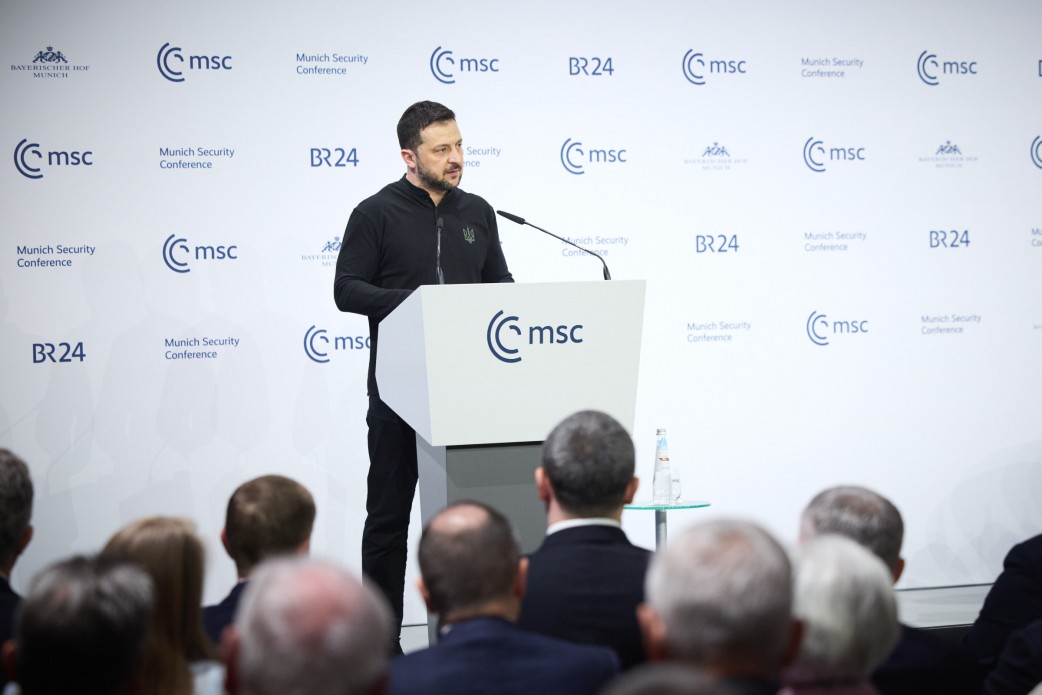
President Zelenskyy's Reponse to Vice President Vance at the Munich Security Conference: Text of Remarks--"I Really Believe That Time Has Come: The Armed Forces of Europe Must Be Created"


We must give strength to Europe first. Does America need Europe? As a market – yes. But as an ally? I don’t know. For the answer to be “Yes”, Europe needs a single voice – not a dozen different ones.  Even those who regularly come to Mar-a-Lago, need to be part of a strong Europe – because President Trump doesn’t like weak friends. He respects strength. ()

Volodymir Zelenskyy addressed the Munich Security Conference. His remarks,  I Really Believe That Time Has Come: The Armed Forces of Europe Must Be Created – Speech by the President at the Munich Security Conference might be understood to serve as a response and a plea to the leadership of the United States which, in its rush to set things right may wind up doing the opposite, at least as measured by American interests, and those (in the style of win-win) of its closest allies (as rambunctious as that relationship has been since the end of the 18th century). To that end, President Zelenskyy attempts to strategically use the single mindedness of American demands (accepting them at face value) to maximize their chances of survival as intact as possible--within NATO and the European Union. To that end  he urges the European Union be do as Mr. Trump suggests--to become  a much more substantial military force--a force autonomous of that of the United States bit, as Mr. Trump suggests for the United States, one capable of pursuing its own agendas, even when those put it in conflict with their American friends. To that end, Europe must build and deploy its own armies.

In a large sense, the remarks are an elaboration, now more blunt and focused, of the Address President Zelenskyy gave at the Davos Conference in January, an address the text of which and my reflections can be found here:  Davos Discourse 2: Special Address by Volodymyr Zelenskyy, President of Ukraine--Searching for Europe and Ukraine Within it. The remarks follow below. The fundamental problem remains the same from the start of the Russian invasion in 2014: is Ukraine to be European or a Russian province, perhaps even of the sort as Belarus; and is Ukraine to delineate the border between Europe and what will be, as they were before 1914, the extent of the Russian imperial domains bordering Europe but not part of it.


Shuyu Chu: The Infrastructure of Control: Rethinking Party Discipline in China’s Political-Legal System (European China Law Research Hub)


Pix credit here 


 The folks over at the European Chinese Law Research Hub (with thanks to Marianne von Blomberg, Editor ECLR Hub, Research Associate, Chair for Chinese Legal Culture, University of Cologne) have posted  a marvelous new short essay authored by Shuyu Chu (former China Law and Policy Fellow at Georgetown University (2021–2023)), The Infrastructure of Control: Rethinking Party Discipline in China’s Political-Legal System.

Von Blomberg sets the stage:

Drawing on unique access to internal Party materials, extensive empirical research, and an innovative application of Foucauldian theory, this groundbreaking study offers unprecedented insights into China’s disciplinary systems. It is now being developed into a book manuscript. She welcomes discussions with publishers interested in bringing this timely analysis to market. 

The research is described this way:

[It] examines a fundamental puzzle: why does the CCP persist with its opaque, Party-centered disciplinary approach despite widespread criticism? Drawing on Party regulations, news reports, propaganda TV programs, internal cadre training materials, Chinese and English scholarship, and interviews with Party disciplinary officials, I argue that the answer lies in understanding the dual nature of Party discipline (党纪). While commonly viewed as a regulatory system of rules and punishments, Party discipline also functions as what I call a “disciplinary infrastructure”, a Foucauldian framework, in that it simultaneously shapes Party members’ behavior and deters misconduct. This duality reveals that the CCP uses discipline not just as a control mechanism, but as an elaborate apparatus for producing political compliance. 
Shuyu Chu identifies four critical characteristics: (1) it shapes behavior; (2) it seeks to naturalize those behaviors in cadres; (3) it is maintained through the structures of power/knowledge frameworks; and (4) it functions as a comprehensive system of surveillance.  This Shuyu Chu explains helps "explain several paradoxes in the CCP’s approach to discipline. Consider the Party’s handling of official misconduct through internal disciplinary system." The analysis provides a quite interesting perspective on what is usually an ideologically grounded analytics. In that respect, the application of Foucault's insights are particularly relevant for the way they suggest two insights: The first is that Foucault helps bridge party discipline as an ideological expression and as a phenomenological closed system of experiential dialectics grounded in biopolitics. The second is that this biopolitics, and its expression in the Party's disciplinary systems can be transposed to any closed system of managing people through internalized self-referencing systems.  In this later case one might wonder about the insights that systems of Party discipline may, under a Foucaultian analytics, be useful in constructing disciplinary systems within operational units elsewhere. There is a link here, of course, to social credit mechanisms that will likely add depth to the analysis.  There is also a link  to notions of systemic autonomy and the critical role of what is now known as self-revolution. More interesting may be the way in which the biopolitics and governmentality of Party discipline may, in the face of technological advances, become a self-operating system without the need for a human apparatus of the kind currently in place. All of this suggests the likely richness of the analysis.

I am cross posting the essay below. The original ECLRH post may be accessed HERE. And as a plug for the marvelous work at the European Chinese Law Research Hub: if you have observations, analyses or pieces of research that are not publishable as a paper but should get out there, or want to spread event information, calls for papers or job openings, or have a paper forthcoming- do not hesitate to contact Marianne von Bloomberg.


Democratic Demons and Family Drama, A Valentine's Day Text From the United States for their European Soulmates--Vice President JD Vance's Remarks Delivered at the 2025 Munich Security Conference


Pix credit The Guardian


I believe that dismissing people, dismissing their concerns or worse yet, shutting down media, shutting down elections or shutting people out of the political process protects nothing. In fact, it is the most surefire way to destroy democracy. Speaking up and expressing opinions isn’t election interference. Even when people express views outside your own country, and even when those people are very influential – and trust me, I say this with all humour – if American democracy can survive ten years of Greta Thunberg’s scolding you guys can survive a few months of Elon Musk. (JD Vance, Remarks Delivered at Munich Security Conference)


 We are all the products of our relationship with our demons; and sometimes those demons, over the course of a life, take on human form. Those demons guard the cognitive cages within which one can find comfort and perhaps a sense of safety; perhaps they are the bars of those cages. Eventually those demons might well come to form the only basis through which it is possible to understand the world which is the accumulated product of demonic acts. When aggregated, these singular experiental engagement with, and rationalization of, the world around one (the world as people, mostly, though the rest of it as a function of the human for most or exteriorized  in some exogenous virtual essence), produce what sometimes passes for political first principles around which human society is organized, defended, corrupted, reformed, and organized again as new generations come to fill up the body politic, social, economic, and cultural.   

This approach might be helpful in understanding, and perhaps situating, the somewhat remarkable (and quite deliberately so) performance by JD Vance, the American Vice President, at the Munich Security Conference. His Valentines Day speech to the collectively august body of people who matter had the desired effect--both on the bodies onto which it was projected, and those for whom it was meant to be affirm solidarity within shared cognitive cages in need of expansion.  It was the sort of Valentine's Day offering that could not have been better scripted  by Hollywood or Bollywood. . . . .

The speech produced the intended reaction among the audience and their followers, dutifully reported by press and media organs. The ritual was almost theatrical. "Vice President Vance delivered a stinging message to European leaders when he took the stage at the Munich Security Conference on Friday: the biggest threat to their continent, he said, comes not from Russia or China, but from within. . . Vice President Vance delivered a stinging message to European leaders when he took the stage at the Munich Security Conference on Friday: the biggest threat to their continent, he said, comes not from Russia or China, but from within." (NPR Reporting here). The Germans were among the most willing to return the favor of the Vice President's bluntness with bluntness of their own: "German Defence Minister Boris Pistorius hit back in his speech to the conference later in the day, calling Vance's remarks "unacceptable". He said Vance had called into question democracy not only in Germany but in Europe as a whole." (Reuters). 

Mr. Vance is no stranger to the Munich Security Conference.  His remarks in the 2024 Conference were also memorable--but perhaps only a warm up to the blunt enthusiasm that only victory at the polls could generate.  (The Sleeper Awakens: Text of Senator JD Vance's Remarks Delivered at the Munich Security Conference 18 February 2024 and Some Reflections). In that sense the audience ought to have been prepared for the performance that Mr. Vance delivered. At the time I suggested the following:

Pix credit here
 Mr. Vance also appears to have been embracing the role of evangelist for gōdspel (from the Old English gōd ‘good’ + spel ‘news). And what better place to awaken other sleepers to the good news of the coming re- or trans-valuation of all values (Umwertung aller Werte) than at the Munich Security Conference. There, on 18 February 2024 "Senator JD Vance (R-OH) delivered a “wake up call” to Europe." (Press Release and Transcript of Remarks). In it here awake to the successes, during his first term, of President's Trump Russia policy, and what it might mean both for the European security apparatus and the priorities of the United States.

In the process he also provided an insight into the premises that shape those views and that judgment. These, in turn, are grounded in some sort of Manichaen dualist view of the world as composed of an infinite number of binaries that when aligned add up to zero. In particular, the view that productive capacity cannot grow but is merely shifted around to reflect priorities, is worth some considerable consideration. But more than that, the remarks suggest the semiotics of context--that is the way that values and premises about the world shape the possibilities and assessment of the possibilities within that self-referencing meaning-cube. As such, the premises, principles, and outlooks--the core assumptions that drive Mr. Vance's analysis, are not merely conceptually Manichaean but also in their application quite traditionally imperial in that way that this term itself has changed meaning and force (see essays here).

Pix credit here (roast goose with Black truffles)
But the 2025 speech was also remarkable for the audience to which it was targeted. Clearly those included the European leadership vanguard--those both in power and those waiting in the wings. But it was also targeted to their American counterparts: in effect what was sauce for the goose is sauce for the gander. ("Free speech, I fear, is in retreat and in the interests of comedy, my friends, but also in the interest of truth, I will admit that sometimes the loudest voices for censorship have come not from within Europe, but from within my own country, where the prior administration threatened and bullied social media companies to censor so-called misinformation."(JD Vance, Remarks Delivered at Munich Security Conference).) 

Both are to be cooked in equal measure; and in the service of what? Well this appears to be a new form of cognitive caging the bars of which are constructed from out of the demons of regulatory controls by the State and its apparatus. t is in this sense that Mr. Vance's remarks are better read, perhaps, alongside his quite direct challenge to the Europe model of liberal democratic regulatory governance, one grounded in an increasingly comprehensive guidance from the state overseen by large techno-bureaucracies interlinked with the bureaucracies of private sector enterprise leaders (more on that below). (See Vice President JD Vance's Jack Ma Moment?: AI and the EU, Text of Remarks Delivered at the AI Summit, Paris France 11 February 2025)

Pix credit here
It is premised on the ideal of a clawed back State, the principal duty of which is to protect its subjects from themselves and from outsiders. In this model the principal role of the State (for now) is the protection of its sovereignty--what goes on within its sovereign borders becomes a concern only  where sovereignty is threatened.  None of this s well defined; nor can it be. But to does suggest a challenge to and a retreat from a century or more of state centered administrative leadership and guidance increasingly of a mandatory character and of the triumph of public policy over private choices. Yet nothing is entirely clean cut and there is messiness at the margins. It appears that the disagreement in concepts of the state apparatus is not about Max Weber and the idealized bureaucracy for efficient management of institutions as much as it might focus on what, why, and how these efficient institution are created and used as a function of core conceptions of the ideal liberal democratic state and its balance between human autonomy and collective solidarity, and critics might argue, the role and nature of its biopolitics.

Internal protection appears to be grounded in notions of preventing corruption of the system in which personal autonomy, including the effects of asymmetrical relations among autonomous persons, may produce constantly iterative deal making among them, in the aggregate (and by definition) to the greater glory of the community but without the normative guidance of the State.  That principle suggests the limits of State internal passivity. One one sees this already in the early actions of the Trump administration that has used State authority to intervene decisively in a variety of matters and to use its leverage to guide private collectives (business and other groups) toward preferred behaviors in moving the State appropriately along the Americas First path. 

However it is framed, Mr. Vance projects a view that substantially challenges the consensus developed over the last century or so  and expressed in its liberal democratic and Marxist Leninist forms, which posits a growing normative role for the State, the necessity of the guidance of the State's government apparatus toward both the articulation of objectives and its attainment, and the deployment of that apparatus toward those ends (considered here). In China that produces both the Socialist Path (toward a communist society) guided by its vanguard of leading forces organized as a Communist Party. In the liberal democratic states it produces large techno bureaucracies overseeing compliance based  governance driven by the imperative to fulfill public policy goals, in which personal autonomy is bent through rules and compliance based systems, to the goals. None of this is bad or good--historically contingent demons produce their own cages, and sometimes when historical stages of development move on, resistance or challenge.  That role, in a sense, in what, in his own way (whether conscious of this or not) Mr. Vance serves. In a large sense, then, Mr. Vance might be suggesting that when he examines the systems of China and the EU, at least with respect to the role of the State, he might be tempted to conclude that there may be difference but only in degree.

The text of the remarks follows below as they were kindly posted first to the Spectator website, where it may be accessed HERE (JD Vance, Remarks Delivered at Munich Security Conference).  

Beyond that, there is not much to say other than to admire or be repelled by the details that the proffered challenge envisions. I leave that to readers. Still, a few points in this bonfire of the vanities, understood from the context of Renaissance Florence in 1497 and Savonarola, or from that of the anxieties of later 20th Century America, might be worth underscoring.  

1. The focus on the interiorization of security  further refined the  conceptual cage within which Mr. Vance, and perhaps the 2nd Administration of President Trump operates. That is not good or bad but worth knowing. The cues have already been quite visible to those who chose to see them: the focus on sovereignty, the critically important transformation of the concet of invasion, and the conflict with internal elites whose control over personal autonomy is thought to be distasteful.  In more religious terms, all of this points to a notion of corruption of the soul that itself must confess, express contrition, do penance, and recieve absolution for a personal and social transformation more in keeping with the fundamental theology around which a properly ordered society ought to be framed. And that theology views the current architecture as an expression of a fundamental heresy that threatens the immortal soul of the liberal democratic construct. 

2. All of this is bent not to rupture but to the coming back together of the community of believers in liberal democracy. That requires both the rooting out of heresy and its correction. To those ends, an informal Holy Office might be required.

F or years we’ve been told that everything we fund and support is in the name of our shared democratic values. Everything from our Ukraine policy to digital censorship is billed as a defence of democracy. But when we see European courts cancelling elections and senior officials threatening to cancel others, we ought to ask whether we’re holding ourselves to an appropriately high standard. And I say ourselves, because I fundamentally believe that we are on the same team. (JD Vance, Remarks Delivered at Munich Security Conference).

That serves as the basis for the urgency--the Manichean notions already on display in 2024 now move to center stage as the founding premise of the urgency of housecleaning. And the Manichean impulse also produces change in the United States which is intended to be projected outward, but using the language of deal making emblematic of the current administration. "So I come here today not just with an observation, but with an offer. And just as the Biden administration seemed desperate to silence people for speaking their minds, so the Trump administration will do precisely the opposite, and I hope that we can work together on that." (Ibid.).

3. And thus the inquisition: and the tone--deliberating irritating. The irritation was quite conscious and for the reasons that are fairly obvious. The first was to use irritation to underscore power relations, a superior speaking to . . . . others.  The second was to provoke reaction. That worked well as Europeans leaders and American elites took the bait.  The third was to control the focus and flow of conversation among allies. This agenda setting is also an exercise and underscoring of power relations, but here also bringing in mass management which was a strong object of the initial portions of the remarks. And fourth and perhaps least was to use irritation as a warning about the nature of deal making and the possibility of win-win, even asymmetrical win-win, between the United States and its traditionally most important external core.  

4. Yet that rhetorical irritant is a double edged sword.  All of that fancy talk about popular mandates is well and good--but it hardly worked in favor of American influence after any number of exceedingly close elections over the last century, including those of 2000 and 2016. And that is a problem that Mr Vance avoids as he paints with Caravaggio's chiaroscuro to emphasize stark binaries of which he is quite fond. In particular is the notion that mandates are not binaries always or necessarily. Closer elections suggest the need, the obligation, to take into account the values and intentions of all participants; and all the more so where the difference between victory and defeat, was measured by exceedingly slim margins. Consensus, and win-win (even asymmetric win-win) is as much a form of populism is the notion that a popular mandate provides a basis for doing what one likes within the boundaries of that "mandate." Indeed, to do otherwise if to reduce elections to a form of democratic centralism--a core value of Marxist-Leninist systems (on the Chinese version here). In this case Mr. Vance effectively substitutes voting mandates for the result of discussion and debate within the ruling vanguard party. That may not be what Mr. Vance had in mind, but the operational consequences and convergence with core Leninist theory, is hard to avoid, even if it is masked within the forms and conceits of liberal democracy.  That cannot be what he means, but one might be excused for considering whether that is where he will wind up.

 5. It is in this sense that the temptation, that Mr Vance could not resist, to suggest some sort of connection between the habits of European officials and their techno-bureaucracies and the operating style of Soviet nomenklatura and their discursive tropes appears less potent ("Now, to many of us on the other side of the Atlantic, it looks more and more like old entrenched interests hiding behind ugly Soviet era words like misinformation and disinformation, who simply don’t like the idea that somebody with an alternative viewpoint might express a different opinion or, God forbid, vote a different way, or even worse, win an election." (JD Vance, Remarks Delivered at Munich Security Conference)). A pity really because the conception and challenge of information, mis-, dis- and mal-information for sovereignty and collective solidarity (to use the conceptual lens of Mr. Vance) are certainly issues that touch on security as well as discourse and merit something of a more comprehensive discussion. 

Pix credit here
6. And that leaves external security, about which Mr. Vance offered very little.  What he did offer was a light hearted scolding about the miserliness of Europeans when it comes to their own defense spending--but that critique is as old as the Kennedy administration of the early 1960. Less lighthearted was the intimation that the nature of the American defense umbrella is changing: "President Trump has made abundantly clear, he believes that our European friends must play a bigger role in the future of this continent. We don’t think you hear this term ‘burden sharing’, but we think it’s an important part of being in a shared alliance together that the Europeans step up while America focuses on areas of the world that are in great danger." (JD Vance, Remarks Delivered at Munich Security Conference)). Mr Vance has made it abundantly clear that Europe ought to get used to fending for itself as the American focus turns to the East. Many might disagree, even within the small space democratic centralism permits within American political discourse under our election mandate system (to use Mr Vance's conceptual cage). Certainly form the reshaping vision of post-global empire, the fruits of which permitted Mr. Vance to deliver these remarks in Munich, apex powers must cultivate mutual inter dependencies--and security is among the most valuable commodities in the arrangements of dependency. This is true even as the focus of dependence and control shifts from territory to intangibles--like production chains, and sentry posts along both the American and Chinese silk roads.  To some extent, Mr. Vance's remarks here show a remarkable unwillingness to time travel back from the first half of the 20th century to our own times. Yet 20th century thinking will neither help the Americans nor their European partners--whatever the hierarchies of those relationships. 

7. Curiously, that viewpoint that seems to serve as the foundation of the way Mr. Vance perceives the world around him, tends to be more in accord with the outlook of Mr. Putin than of the rest of the vanguard of state leading forces (on Putin's view see hereThe Stories One Tells Incarnated in Rituals of Blood Sacrifice: Alexander Dugin as Storyteller to Russia and China in the New Era). Within that framework, the United States  best serves itself as a mediating power (« une puissance médiatrice » The Semiotics of Humiliating Russia), serving its own interests. That invites conceptual contradiction, or at least dissonance between the flourishes of discourse and the realities of action (A Principle of Solidarity for States Navigating the Peripheries of Empires--Full Text: Ukraine President Zelensky’s speech to Israeli Knesset 20 March 2022)). It would be a pity if that were so. And yet for years, abd certainly respecting Ukraine since 2014, there has been a sense of contradiction between what liberal democracies say and what they are doing, and in the process the disjunction reveals  liberal democracy's "Yalta Moment" (Liberal Democracy's Yalta Moment: Burning Opportunity Along With Bridges; Thoughts on Framing a Blueprint for Post Conflict Settlement in a Post Global Order). This is not to suggest that the Americans won't out of a necessity born of their own interests as they now see it, force concessions that are distasteful to allies. It is to suggest that early 20th century territorial thinking may not be the most fruitful way of understanding and protecting the national interest--especially where that policy is meant to further the Americas First project. Nor is the sort of unfortunate elitism and old school mean-kid clubbiness (and here apologies for the strong condemnation and language) that would lead (whatever the form and content of the public rationales advanced) either to roadblocks for Ukrainian admission to NATO (and thus to the fortification of European borders in an efficient way) and to the European Union. Here is certainly one area where the Americans and European elites share common ground in ways that ought to embarrass them both, one in which both appear to have expended a substantial amount of resources in the management of popular opinion (the success of which remains to be seen). That embarrassment is both a product of fear (of Russia) and of advantage (to the extent that they profit from the current arrangements). If the Americans and Europeans really have something to chat about it would be this. And if, at the end, they are both willing to sacrifice Ukraine, then they ought--as Mr. Vance suggests--be quite transparent to their populations, including suggesting what may be the consequences that the masses will have to bear (because perhaps almost certainly those who control risk on both sides of the Atlantic may be able to insulate themselves from any negative impacts of risk).


Pix credit here


Friday, February 14, 2025

Vice President JD Vance's Jack Ma Moment?: AI and the EU, Text of Remarks Delivered at the AI Summit, Paris France 11 February 2025

Pix credit here

Good innovation can coexist with regulations, but not regulations of yesterday. We cannot manage an airport the way we manage a train station, nor can we manage the future the way we managed yesterday. (Jack Ma, Jack Ma’s speech at the Bund Summit 2020 in Shanghai," Apple News (11 August 2020)) (from Platform Government--The Emerging State of Contests for Control of Society From Jack Ma and China to Mark Zuckerberg and Australia)
Pix cedit here


 The Vice President of the United States serves a purpose; the difficulty normally is figuring out what that is.  Mr. Vance has approached that challenge with gusto. That gusto seems directed, for the moment, at trying to describe, in his own way, what distinguishes the American liberal democratic path from that of Europe. None of what he articulates, in his own way, is startling, or new, or unknown by those in the business of understanding those things. It is now virtually common knowledge that the U.S. and Europe have moved noticeably apart on the matter of the theory about the optimum relationship between the State and the masses. The Europeans have come to more assertively embrace the idea that the masses require guidance and that this guidance is best managed through the State. Tied to that is the notion, also embraced with increasing vigor, the this guidance ought to be undertaken in ways that more clearly align private actions to State policy, increasingly through compliance oriented regulatory structures overseen by techno-bureaucracies that interlink public and private collectives. The Americans, and especially those currently holding high elective office, have taken a different view. They have become more impassioned about the value of markets driven behavior and the need for the State to manage markets but not people.  The masses, according to this view, require protections against systemic corruption, but not protection against their own choices.  What separates the two systems, beyond the levels of trust or distrust in the constitution and operation of large compliance driven techno-bureaucracies, is  the fundamental attitude toward risk and personal autonomy. The Europeans have increasingly embraced fundamental principles of de-risking grounded in avoidance of actions that cause negative impacts as a function of policy goals.   The Americans tend to cultivates greater tolerance for risk. Though these gross generalizations viel a tremendous amount of disagreement within each of these systems, and do not justice to the spectrum of variation in approaches within each of these systems, it is useful as a crude and grossly simplified way of thinking about what appears to divide European from American cognitive cages.

There are lots of ways of approaching these differences and acknowledging what the speaker might extract as consequences and perhaps even bridging  programs. And there are lots of places where those differences and their policy consequences, might be discussed openly and honestly. Among all of these possibilities, and within the possibilities of emphasis  among the huge variations  that mark these different approaches, Mr Vance has chosen to make at least some of it in public fora, in ways that are, in some sense, with a nod to the rhetorical style of Mr. Trump. There is nothing wrong with that as far as it goes--but the choices of discursive style and the places where they are put out on display also have consequences. And the consequences can prove to be distracting from the issues they are meant to underscore and the interests, including common interests, they are meant to serve. All of this it is likely that Mr. Vance understands. And in his calculus--and perhaps given his own approach to risk--he has undertaken to engage with core allies of the United States in a particular way.

He is not the only one deploying these discursive forms.  And likely also not the only one who will have to live with the consequences of the discursive choices made.  The price, of course, is a function of Mr. Vance's objectives--is it to make a pint in a provocative but memorable way, or is it to advance an agenda and find common ground that satisfies those who would profit more from some sort of accommodation between them.  But we cannot get nto Mr. Vance's head--we are left only with the footprints that he leaves in the rhetorical sands and its consequences that guide the actions of people who may not represent the power of the United States but are still an essential part of American interest. For all that, it appears that Mr. Vance might not have profited from the lesson of Jack Ma, with whom he shares a little bit the same approach to regulatory structures as a function of fostering innovation, growth, and wealth (see here). Both touch on the  the deeper problem of regulatory philosophy--that of Mr. Vance within liberal democracy, and that of Jack Ma within Marxist-Leninist operating principles.

All of these strands came together with some dramatic flair when Mr. Vance addressed the persons assembled for the AI Summit in Paris on 11 February 2025.   The text of the remarks follows below (with gratitude to the folks at the Spectator which first made them available and which may be accessed HERE).

Though the focus was on AI regulation, the fundamental issue touches on philosophies of regulation, the role of the state, and the relationship between innovation and state policy as fundamentally central driving forces shaping economic activity. Mr. Vance makes for deeply relational points, points that like those of the European side, make for great discourse but which  are amalgams of words the meanings of which in context remains elusive. 

Number one, this administration will ensure that American AI technology continues to be the gold standard worldwide, and we are the partner of choice for others, foreign countries, and certainly businesses as they expand their own use of AI. Number two, we believe that excessive regulation of the AI sector could kill a transformative industry just as it’s taking off, and we’ll make every effort to encourage pro-growth AI policies. And I like to see that deregulatory flavour making its way into a lot of the conversations this conference. Number three, we feel very strongly that AI must remain free from ideological bias and that American AI will not be co-opted into a tool for authoritarian censorship. And finally, number four, the Trump administration will maintain a pro-worker growth path for AI so it can be a potent tool for job creation in the United States. (Vance Remarks HERE).

The first speaks of the American version of the Chinese Belt & Road model. Effectively it is built around a core or hub apex state around which relationships are built as a function of the leadership of the hub state and arranged through the spokes of policy and production radiating out from the core through which outer rings can be arranged in relation to the hub. That merely conforms a suspicion that the Chinese and the Americans are aligning their organizational models, but with characteristics aligned with their respective political-economic models. But hubs tends to view competitor hubs as a threat and it tends to like to protect its spoke relationships. That might have been the point Mr. Vance further elaborated:

We will safeguard American AI and chip technologies from theft and misuse, work with our allies and partners to strengthen and extend these protections, and close pathways to adversaries attaining AI capabilities that threaten all of our people.  And I would also remind our international friends here today that partnering with such regimes, it never pays off in the long term. From CCTV to 5G equipment, we’re all familiar with cheap tech in the marketplace that’s been heavily subsidised and exported by authoritarian regimes. But as I know, and I think some of this – some of us in this room have learned from experience, partnering with them means chaining your nation to an authoritarian master that seeks to infiltrate, dig in, and seize your information infrastructure. (Vance Remarks HERE).

The second articulates the American approach to regulatory governance. Nonetheless it leaves much to ambiguity. It speaks of excessive regulation but gives no sense of the means by which that is measured. Certainly under their model the Europeans are equally convinced that they have produced the "right amount" of regulation in the "appropriate " form. But not all European leaders. "French President Emmanuel Macron said Monday the Paris AI summit is “a wakeup call” for a European strategy to get competitive in a tech world now dominated by the U.S. and China. Macron also called on “simplifying” rules in France and the European Union to allow AI advances, citing sectors like healthcare, mobility, energy, and “resynchronize with the rest of the world.”" (as reported in Fortune, here) While Mr. Macron speaks the European language of regulatory simplification, Mr Vance appears to adopt the Chinese style discourse of The only hint of the measure appears to be a Chinese style emphasis on high quality production advancing development in palpable (and measurable) ways in the form of what was termed "an open regulatory environment."

The third speaks to stripping AI development of ideological bias. Ironically that position is also an expression of an ideological bias. The Trump administration has been particularly concerned about the curation of speech and speech acts by a master class of overseers (as they see it),  and what they see as the corruption inherent in discursive tropes like mis-information ("but it is one thing to prevent a predator from preying on a child on the Internet, and it is something quite different to prevent a grown man or woman from accessing an opinion that the government thinks is misinformation."(Vance Remarks HERE)). For Mr. Vance, the AI revolution will never come to pass  "if we allow AI to become dominated by massive players looking to use the tech to censor or control users’ thoughts. . . he Trump administration will ensure that AI systems developed in America are free from ideological bias and never restrict our citizens’ right to free speech. We can trust our people to think, to consume information, to develop their own ideas, and to debate with one another in the open marketplace of ideas." (Vance Remarks HERE). But of course that leaves open a host of derivative issues  about which collective society has only begun to consider. 

The last is fairly straightforward.  If undertaken "correctly" AI is an industrial sector that can make its investors quite rich and also make money for an increasingly larger pool of workers. "Finally, this administration wants to be very clear about one last point. We will always centre American workers in our AI policy. We refuse to view AI as a purely disruptive technology that will inevitably automate away our labour force." (Vance Remarks HERE).   In this sense, and ironically, an aversion to regulation also expresses a strong public policy that provides direction to AI productive forces. 

Lamentably, Mr. Vance appears to focus on quantity; he might have  also focused on regulatory quality.  And, indeed, beyond the complexities of the European regulatory project and the fear that it amounts to a governmentalization of economic activity is the question of whether the regulatory structures adopted actually serve their purpose. They certainly add to the burdens of doing business, and they appear to have driven innovation elsewhere (the lament recently of President von der Leyen in Davos (Davos Discourse 3: Europe between Between Eagle, Bear, and Dragon and No Place to Go--Special Address by President von der Leyen at the World Economic Forum)). The difficulty arises because regulation of technology itself may be less useful than regulation of human interactions with that technology. And yet the focus of regulation was discussed, if only in a dismissive way.  Mr. Vance rejected the idea that regulatory efforts ought to focus on a precautionary principle (at the core of the European regulatory project)--his preference was opportunity ("we’re developing an AI action plan that avoids an overly precautionary regulatory regime while ensuring that all Americans benefit from the technology and its transformative potential." (Vance Remarks HERE)). That also touched on ideology--and certainly the ideology of de-risking, of prevention, is one that Mr. Vance rejects. 

And here is nicely distilled JD Vance's Jack Ma moment. Compare what might be the more elegant and nuanced version by Jack Ma:

I think there is another phenomenon. Many regulatory authorities around the world have become zero risk, their own departments have become zero risk, but the entire economy has become risky, the whole society has become risky. The competition of the future is a competition of innovation, not a competition of regulatory skills. Now, each country’s regulation is more ruthless than the next, all the development is a mirage, but by not allowing it, each cut is bloody. Based on my understanding, what President Xi said about “enhancing governing ability” means to maintain healthy and sustainable development under orderly regulation, not no development due to regulation. It is not difficult to regulate. What’s difficult is to deliver regulation that achieves the purpose of producing sustainable and healthy development. (Jack Ma Bund Finance Summit Speech supra)

Putting it all together Mr. Vance means this: "Now with the President’s recent executive order on AI, we’re developing an AI action plan that avoids an overly precautionary regulatory regime while ensuring that all Americans benefit from the technology and its transformative potential. Now we invite your countries to work with us and to follow that model if it makes sense for your nations." (Vance Remarks HERE). Along the way, Mr. Vance is somewhat highly critical and dismissive of the European approach--that is not a unique view given the more temperate version of this critique delivered by President von der Leyen at Davos in January and Mr. Macron at the Summit, but opposed to the Leninist variant of regulatory guidance  (especially domestically but also on an inter-governmental basis that constitutes China's vision (Davos Discourse 4: The Chinese Path--Address by Vice-Premier Ding Xuexiang's at World Economic Forum Annual Meeting 2025 ). 

The risk here is that Mr. Vance's performance may have satisfied him and the people to whim he looks for approval, but it might have been less effective on those onto whom that discourse was projected. Yet that also might have been the plan--to what ends remains to be seen. And yet it might have been most effective as a contrast to the Chinese rather than the European vision of AI regulation. And here again Mr. Vance's Jack Ma moment.  What Mr. Ma could not convince the vanguard to consider in the construction of the internal Chinese tech regulatory structures Mr. Vance might have more success with the US's allies in Europe. And at a sufficiently high enough level of generality--both the United States and China now offer up two distinct ways of using regulation as a productive force for the nation: the Chinese view regulation and central guidance as the touchstone for proper approaches to development, innovation (new quality production) and global leadership; the Americans offer the same results with respect to innovation, and wealth creation, but under a quite different and markets managed regulatory model.

There is a lot here that is worth discussing. It would be a pity if the only consequence of these remarks is to make those conversations more unlikely. For comparison the text of Jack Ma's 2020 Bund remarks also follows below.