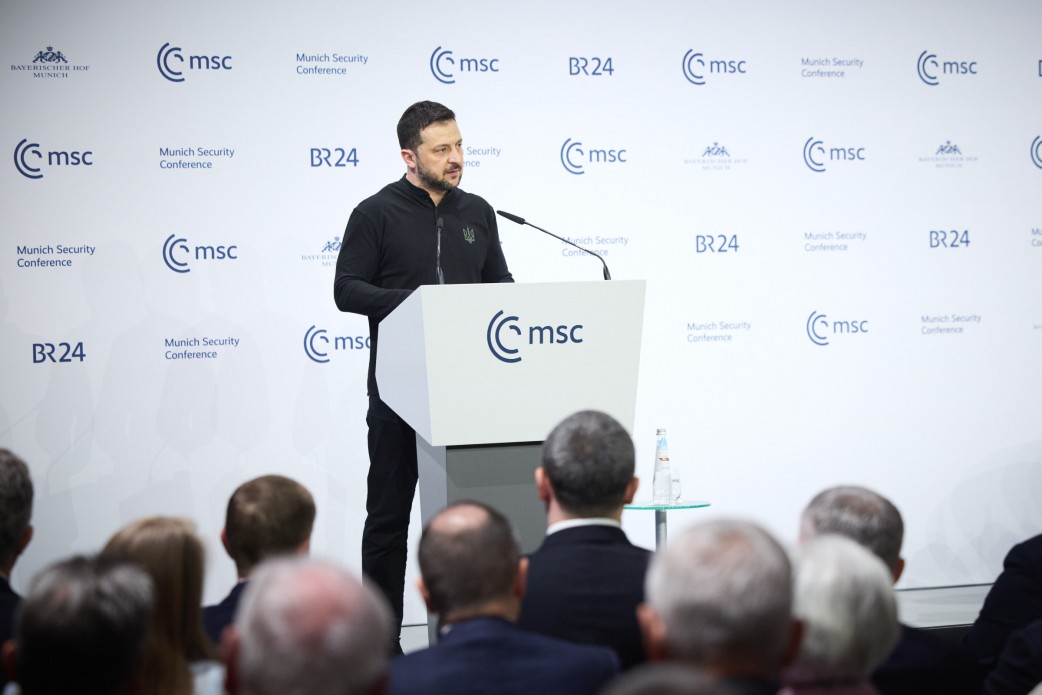
I believe that dismissing people, dismissing their concerns or worse yet, shutting down media, shutting down elections or shutting people out of the political process protects nothing. In fact, it is the most surefire way to destroy democracy. Speaking up and expressing opinions isn’t election interference. Even when people express views outside your own country, and even when those people are very influential – and trust me, I say this with all humour – if American democracy can survive ten years of Greta Thunberg’s scolding you guys can survive a few months of Elon Musk. (JD Vance, Remarks Delivered at Munich Security Conference)
We are all the products of our relationship with our demons; and sometimes those demons, over the course of a life, take on human form. Those demons guard the cognitive cages within which one can find comfort and perhaps a sense of safety; perhaps they are the bars of those cages. Eventually those demons might well come to form the only basis through which it is possible to understand the world which is the accumulated product of demonic acts. When aggregated, these singular experiental engagement with, and rationalization of, the world around one (the world as people, mostly, though the rest of it as a function of the human for most or exteriorized in some exogenous virtual essence), produce what sometimes passes for political first principles around which human society is organized, defended, corrupted, reformed, and organized again as new generations come to fill up the body politic, social, economic, and cultural.
This approach might be helpful in understanding, and perhaps situating, the somewhat remarkable (and quite deliberately so) performance by JD Vance, the American Vice President, at the Munich Security Conference. His Valentines Day speech to the collectively august body of people who matter had the desired effect--both on the bodies onto which it was projected, and those for whom it was meant to be affirm solidarity within shared cognitive cages in need of expansion. It was the sort of Valentine's Day offering that could not have been better scripted by Hollywood or Bollywood. . . . .

The speech produced the intended reaction among the audience and their followers, dutifully reported by press and media organs. The ritual was almost theatrical. "Vice President Vance delivered a stinging message to European leaders
when he took the stage at the Munich Security Conference on Friday: the
biggest threat to their continent, he said, comes not from Russia or
China, but from within. . . Vice President Vance delivered a stinging message to European leaders
when he took the stage at the Munich Security Conference on Friday: the
biggest threat to their continent, he said, comes not from Russia or
China, but from within." (NPR Reporting here). The Germans were among the most willing to return the favor of the Vice President's bluntness with bluntness of their own: "German Defence Minister Boris Pistorius hit back in his speech to the conference later in the day, calling Vance's remarks "unacceptable". He said Vance had called into question democracy not only in Germany but in Europe as a whole." (Reuters).
Mr. Vance is no stranger to the Munich Security Conference. His remarks in the 2024 Conference were also memorable--but perhaps only a warm up to the blunt enthusiasm that only victory at the polls could generate. (The
Sleeper Awakens: Text of Senator JD Vance's Remarks Delivered at the
Munich Security Conference 18 February 2024 and Some Reflections). In that sense the audience ought to have been prepared for the performance that Mr. Vance delivered. At the time I suggested the following:
Mr. Vance also appears to have been embracing the role of evangelist for gōdspel (from the Old English gōd ‘good’ + spel ‘news). And what better place to awaken other sleepers to the good news of the coming re- or trans-valuation of all values (Umwertung aller Werte) than at the Munich Security Conference. There, on 18 February 2024 "Senator JD Vance (R-OH) delivered a “wake up call” to Europe." (Press Release and Transcript of Remarks). In it here awake to the successes, during his first term, of President's Trump Russia policy, and what it might mean both for the European security apparatus and the priorities of the United States.
In the process he also provided an insight into the premises that shape those views and that judgment. These, in turn, are grounded in some sort of Manichaen dualist view of the world as composed of an infinite number of binaries that when aligned add up to zero. In particular, the view that productive capacity cannot grow but is merely shifted around to reflect priorities, is worth some considerable consideration. But more than that, the remarks suggest the semiotics of context--that is the way that values and premises about the world shape the possibilities and assessment of the possibilities within that self-referencing meaning-cube. As such, the premises, principles, and outlooks--the core assumptions that drive Mr. Vance's analysis, are not merely conceptually Manichaean but also in their application quite traditionally imperial in that way that this term itself has changed meaning and force (see essays here).
 |
| Pix credit here (roast goose with Black truffles) |
But the 2025 speech was also remarkable for the audience to which it was targeted. Clearly those included the European leadership vanguard--those both in power and those waiting in the wings. But it was also targeted to their American counterparts: in effect what was sauce for the goose is sauce for the gander. ("Free speech, I fear, is in retreat and in the interests of comedy, my
friends, but also in the interest of truth, I will admit that sometimes
the loudest voices for censorship have come not from within Europe, but
from within my own country, where the prior administration threatened
and bullied social media companies to censor so-called misinformation."(JD Vance,
Remarks Delivered at Munich Security Conference).)
Both are to be cooked in equal measure; and in the service of what? Well this appears to be a new form of cognitive caging the bars of which are constructed from out of the demons of regulatory controls by the State and its apparatus. t is in this sense that Mr. Vance's remarks are better read, perhaps, alongside his quite direct challenge to the Europe model of liberal democratic regulatory governance, one grounded in an increasingly comprehensive guidance from the state overseen by large techno-bureaucracies interlinked with the bureaucracies of private sector enterprise leaders (more on that below). (See Vice
President JD Vance's Jack Ma Moment?: AI and the EU, Text of Remarks
Delivered at the AI Summit, Paris France 11 February 2025)
It is premised on the ideal of a clawed back State, the principal duty of which is to protect its subjects from themselves and from outsiders. In this model the principal role of the State (for now) is the protection of its sovereignty--what goes on within its sovereign borders becomes a concern only where sovereignty is threatened. None of this s well defined; nor can it be. But to does suggest a challenge to and a retreat from a century or more of state centered administrative leadership and guidance increasingly of a mandatory character and of the triumph of public policy over private choices. Yet nothing is entirely clean cut and there is messiness at the margins. It appears that the disagreement in concepts of the state apparatus is not about
Max Weber and the idealized bureaucracy for efficient management of institutions as much as it might focus on what, why, and how these efficient institution are created and used as a function of core conceptions of the ideal liberal democratic state and its balance between human autonomy and collective solidarity, and critics might argue, the role and nature of its
biopolitics.
Internal protection appears to be grounded in notions of preventing corruption of the system in which personal autonomy, including the effects of asymmetrical relations among autonomous persons, may produce constantly iterative deal making among them, in the aggregate (and by definition) to the greater glory of the community but without the normative guidance of the State. That principle suggests the limits of State internal passivity. One one sees this already in the early actions of the Trump administration that has used State authority to intervene decisively in a variety of matters and to use its leverage to guide private collectives (business and other groups) toward preferred behaviors in moving the State appropriately along the Americas First path.
However it is framed, Mr. Vance projects a view that substantially challenges the consensus developed over the last century or so and expressed in its liberal democratic and Marxist Leninist forms, which posits a growing normative role for the State, the necessity of the guidance of the State's government apparatus toward both the articulation of objectives and its attainment, and the deployment of that apparatus toward those ends (considered here). In China that produces both the Socialist Path (toward a communist society) guided by its vanguard of leading forces organized as a Communist Party. In the liberal democratic states it produces large techno bureaucracies overseeing compliance based governance driven by the imperative to fulfill public policy goals, in which personal autonomy is bent through rules and compliance based systems, to the goals. None of this is bad or good--historically contingent demons produce their own cages, and sometimes when historical stages of development move on, resistance or challenge. That role, in a sense, in what, in his own way (whether conscious of this or not) Mr. Vance serves. In a large sense, then, Mr. Vance might be suggesting that when he examines the systems of China and the EU, at least with respect to the role of the State, he might be tempted to conclude that there may be difference but only in degree.

The text of the remarks follows below as they were kindly posted first to the Spectator website, where it may be accessed HERE (JD Vance,
Remarks Delivered at Munich Security Conference).
Beyond that, there is not much to say other than to admire or be repelled by the details that the proffered challenge envisions. I leave that to readers. Still, a few points in this bonfire of the vanities, understood from the context of Renaissance Florence in 1497 and Savonarola, or from that of the anxieties of later 20th Century America, might be worth underscoring.
1. The focus on the interiorization of security further refined the conceptual cage within which Mr. Vance, and perhaps the 2nd Administration of President Trump operates. That is not good or bad but worth knowing. The cues have already been quite visible to those who chose to see them: the focus on sovereignty, the critically important transformation of the concet of invasion, and the conflict with internal elites whose control over personal autonomy is thought to be distasteful. In more religious terms, all of this points to a notion of corruption of the soul that itself must confess, express contrition, do penance, and recieve absolution for a personal and social transformation more in keeping with the fundamental theology around which a properly ordered society ought to be framed. And that theology views the current architecture as an expression of a fundamental heresy that threatens the immortal soul of the liberal democratic construct.
2. All of this is bent not to rupture but to the coming back together of the community of believers in liberal democracy. That requires both the rooting out of heresy and its correction. To those ends, an informal Holy Office might be required.
F or years we’ve been told that everything we fund and support is in the name of our shared democratic values. Everything from our Ukraine policy to digital censorship is billed as a defence of democracy. But when we see European courts cancelling elections and senior officials threatening to cancel others, we ought to ask whether we’re holding ourselves to an appropriately high standard. And I say ourselves, because I fundamentally believe that we are on the same team. (JD Vance, Remarks Delivered at Munich Security Conference).
That serves as the basis for the urgency--the Manichean notions already on display in 2024 now move to center stage as the founding premise of the urgency of housecleaning. And the Manichean impulse also produces change in the United States which is intended to be projected outward, but using the language of deal making emblematic of the current administration. "So I come here today not just with an observation, but with an offer. And just as the Biden administration seemed desperate to silence people for speaking their minds, so the Trump administration will do precisely the opposite, and I hope that we can work together on that." (Ibid.).
3. And thus the inquisition: and the tone--deliberating irritating. The irritation was quite conscious and for the reasons that are fairly obvious. The first was to use irritation to underscore power relations, a superior speaking to . . . . others. The second was to provoke reaction. That worked well as Europeans leaders and American elites took the bait. The third was to control the focus and flow of conversation among allies. This agenda setting is also an exercise and underscoring of power relations, but here also bringing in mass management which was a strong object of the initial portions of the remarks. And fourth and perhaps least was to use irritation as a warning about the nature of deal making and the possibility of win-win, even asymmetrical win-win, between the United States and its traditionally most important external core.
4. Yet that rhetorical irritant is a double edged sword. All of that fancy talk about popular mandates is well and good--but it hardly worked in favor of American influence after any number of exceedingly close elections over the last century, including those of 2000 and 2016. And that is a problem that Mr Vance avoids as he paints with Caravaggio's chiaroscuro to emphasize stark binaries of which he is quite fond. In particular is the notion that mandates are not binaries always or necessarily. Closer elections suggest the need, the obligation, to take into account the values and intentions of all participants; and all the more so where the difference between victory and defeat, was measured by exceedingly slim margins. Consensus, and win-win (even asymmetric win-win) is as much a form of populism is the notion that a popular mandate provides a basis for doing what one likes within the boundaries of that "mandate." Indeed, to do otherwise if to reduce elections to a form of democratic centralism--a core value of Marxist-Leninist systems (on the Chinese version here). In this case Mr. Vance effectively substitutes voting mandates for the result of discussion and debate within the ruling vanguard party. That may not be what Mr. Vance had in mind, but the operational consequences and convergence with core Leninist theory, is hard to avoid, even if it is masked within the forms and conceits of liberal democracy. That cannot be what he means, but one might be excused for considering whether that is where he will wind up.
5. It is in this sense that the temptation, that Mr Vance could not resist, to suggest some sort of connection between the habits of European officials and their techno-bureaucracies and the operating style of Soviet nomenklatura and their discursive tropes appears less potent ("Now, to many of us on the other side of the Atlantic, it looks more and more like old entrenched interests hiding behind ugly Soviet era words like misinformation and disinformation, who simply don’t like the idea that somebody with an alternative viewpoint might express a different opinion or, God forbid, vote a different way, or even worse, win an election." (JD Vance, Remarks Delivered at Munich Security Conference)). A pity really because the conception and challenge of information, mis-, dis- and mal-information for sovereignty and collective solidarity (to use the conceptual lens of Mr. Vance) are certainly issues that touch on security as well as discourse and merit something of a more comprehensive discussion.
6. And that leaves external security, about which Mr. Vance offered very little. What he did offer was a light hearted scolding about the miserliness of Europeans when it comes to their own defense spending--but that critique is as old as the Kennedy administration of the early 1960. Less lighthearted was the intimation that the nature of the American defense umbrella is changing: "President Trump has made abundantly clear, he believes that our European friends must play a bigger role in the future of this continent. We don’t think you hear this term ‘burden sharing’, but we think it’s an important part of being in a shared alliance together that the Europeans step up while America focuses on areas of the world that are in great danger." (JD Vance,
Remarks Delivered at Munich Security Conference)). Mr Vance has made it abundantly clear that Europe ought to get used to fending for itself as the American focus turns to the East. Many might disagree, even within the small space democratic centralism permits within American political discourse under our election mandate system (to use Mr Vance's conceptual cage). Certainly form the reshaping vision of post-global empire, the fruits of which permitted Mr. Vance to deliver these remarks in Munich, apex powers must cultivate mutual inter dependencies--and security is among the most valuable commodities in the arrangements of dependency. This is true even as the focus of dependence and control shifts from territory to intangibles--like production chains, and sentry posts along both the American and Chinese silk roads. To some extent, Mr. Vance's remarks here show a remarkable unwillingness to time travel back from the first half of the 20th century to our own times. Yet 20th century thinking will neither help the Americans nor their European partners--whatever the hierarchies of those relationships.
7. Curiously, that viewpoint that seems to serve as the foundation of the way Mr. Vance perceives the world around him, tends to be more in accord with the outlook of Mr. Putin than of the rest of the vanguard of state leading forces (on Putin's view see here
The
Stories One Tells Incarnated in Rituals of Blood Sacrifice: Alexander
Dugin as Storyteller to Russia and China in the New Era). Within that framework, the United States best serves itself as a mediating power (
« une puissance médiatrice » The Semiotics of Humiliating Russia), serving its own interests. That invites conceptual contradiction, or at least dissonance between the flourishes of discourse and the realities of action (
A
Principle of Solidarity for States Navigating the Peripheries of
Empires--Full Text: Ukraine President Zelensky’s speech to Israeli
Knesset 20 March 2022)). It would be a pity if that were so. And yet for years, abd certainly respecting Ukraine since 2014, there has been a sense of contradiction between what liberal democracies say and what they are doing, and in the process the disjunction reveals liberal democracy's "Yalta Moment" (
Liberal
Democracy's Yalta Moment: Burning Opportunity Along With Bridges;
Thoughts on Framing a Blueprint for Post Conflict Settlement in a Post
Global Order). This is not to suggest that the Americans won't out of a necessity born of their own interests as they now see it, force concessions that are distasteful to allies. It is to suggest that early 20th century territorial thinking may not be the most fruitful way of understanding and protecting the national interest--especially where that policy is meant to further the Americas First project. Nor is the sort of unfortunate elitism and old school mean-kid clubbiness (and here apologies for the strong condemnation and language) that would lead (whatever the form and content of the public rationales advanced) either to roadblocks for Ukrainian admission to NATO (and thus to the fortification of European borders in an efficient way) and to the European Union. Here is certainly one area where the Americans and European elites share common ground in ways that ought to embarrass them both, one in which both appear to have expended a substantial amount of resources in the management of popular opinion (the success of which remains to be seen). That embarrassment is both a product of fear (of Russia) and of advantage (to the extent that they profit from the current arrangements). If the Americans and Europeans really have something to chat about it would be this. And if, at the end, they are both willing to sacrifice Ukraine, then they ought--as Mr. Vance suggests--be quite transparent to their populations, including suggesting what may be the consequences that the masses will have to bear (because perhaps almost certainly those who control risk on both sides of the Atlantic may be able to insulate themselves from any negative impacts of risk).