 |
| Pix credit here |
In a recent post I considered the role of proscription lists in the patterns of proscription-terror/rectification/purges-and revolution that has a long history in the centers of two great empires. The focus of the last one was the list of people identified in the multimillionaire document dump that is the so-called Epstein files, from out of which emerged a "definitive list of 305 high-profile individuals, including celebrities and politicians, have been published by the Department of Justice as part of Bondi's required update sent to Congress on February 14." (here) See discussion here: Proscription Lists, the Sovereignty of Terror, and Revolutionary Pathways Forward in the Digitalized Age--A Thought Experiment. The point was no to hand wring or harangue but to consider, at a more detached level of abstraction the changes if any that tech has produced in the traditional cycles of proscription lists, revolutionary trajectories and the almost regular connection to "terror"--usually one that consumes its creators as well as its victims, who are swpt up in lists which serve as trigger and judgment. Proscription lists are common enough, and ancient enough, but their critical semiosis is as the harbinger of more profound changes that sweeps away not just systems and vales but also people.
It is unlikely that the "Epstein list" will be the last of this current cycle of change. And it is even less likely that the putting together of lists for purging or rectifying individuals who also serve as the semiotic incarnation of their office and as the body on whom punishment is meant to serve as a substitute for the punishment of the institutions the corruption of stress in which may have served as catalyst (eg here, with a rare for the West reference to Yan'an).
Now comes this new list, one that might also serve as a proscription list of sorts; though it first blush it is meant to serve as the evidence necessary for rectification. Cheryl Yu has just published for Jamestown Foundation's China Brief, a report: Harnessing the People: Mapping Overseas United Front Work in Democratic State.
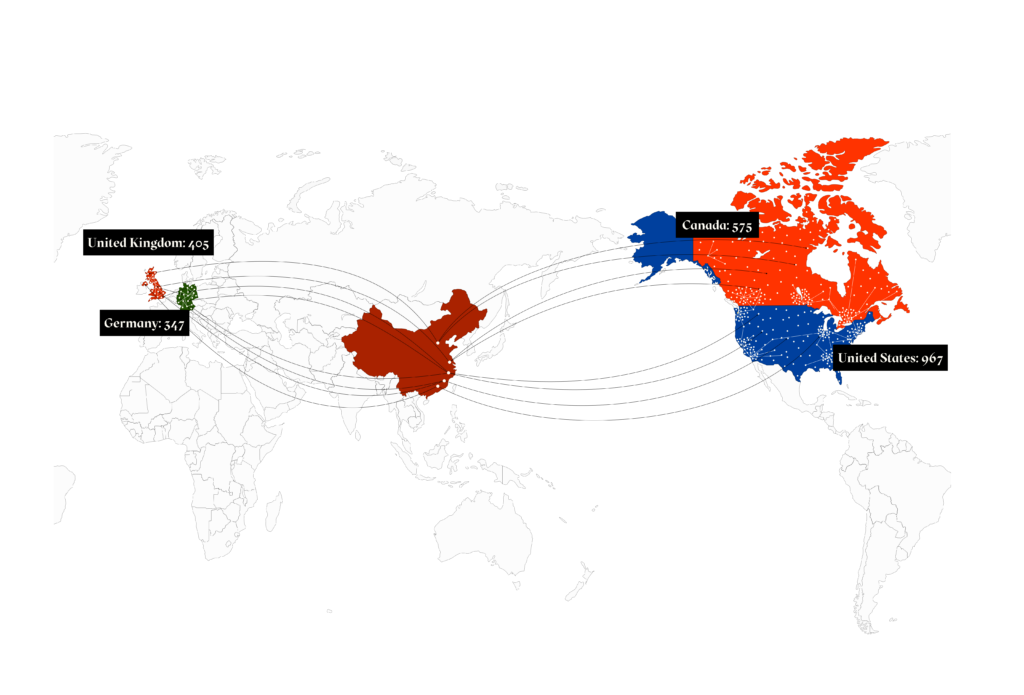
The Executive Summary, the text of which follows below organizes the finding into seven key points: (1) The Chinese Communist Party (CCP) has created a global network of individuals and organizations as part of its united front system; (2) Beijing’s network is the product of protracted co-optation of existing civil society organizations overseas and the global expansion of domestic united front elements; (3) The Party leverages this global network to support its primary goal of national rejuvenation; (4) This includes engaging in malign and illegal activities in foreign countries; (5) In democratic countries, these groups influence political decision-making by conditioning stakeholders to consider Beijing’s interests and sensitivities; (6) Where the CCP encounters opposition, the united front functions as a political weapon to isolate, neutralize, or counter Beijing’s critics; and (7) Constraining the CCP’s ability to interfere in democracies requires active transparency.
Of course, United Front work has long been an element of Marxist Leninist systems going back to Soviet days. Technology and migration has enhanced its possibilities, and the turn, perhaps revolutionary, of States to treat issues of patriots and enemies, of state secrets and interference with internal affairs, in ways that now takes a mechanisms that had been worth managing to one the actors of which, now labeled (and the label applied with equal vigor in the US and China) as agitators in the pay or thrall of a foreign power, may be not just exposed but proscribed. And there is no mechanism That is the point) for treating these proscription lists to fact finding or other process protective mechanisms that impede quite and emotive judgment--and thus the shift from proscription to terror/purge/rectification.
The introduction and historical background are useful reading for people unfamiliar with the context as is the chart on page 14 describing the evolution of United Front work objectives. But of course, what people demand is the list. And a listing is provided starting on page 18 (labelled "Data"). They are categorized "into eight broad types based on their function and target membership. These eight include identity-based organizations, cultural promotion centers and friendship organizations, business and trade promotion
organizations, educational organizations, student organizations, professional organizations, political groups, and media organizations." (Report, p. 18).
Executive Summary:
- The Chinese Communist Party (CCP) has created a global network of individuals and organizations as part of its united front system. In four democratic states—the United States, Canada, the United Kingdom, and Germany—this network includes more than 2,000 organizations. These constitute latent capacity that the Party can mobilize to advance the Party’s agenda.
- Beijing’s network is the product of protracted co-optation of existing civil society organizations overseas and the global expansion of domestic united front elements. The Party has spent decades assiduously cultivating overseas Chinese community organizations, co-opting local leaders and institutions to embed its preferences within civil society. Even groups that previously spent decades supporting the Republic of China (Taiwan) now fly the flag of the People’s Republic of China (PRC).
- The Party leverages this global network to support its primary goal of national rejuvenation. According to the Party’s definition, rejuvenation entails unification with Taiwan and making the PRC the global leader in terms of national power. United front work supports this goal by contributing to the PRC’s diplomatic, economic, scientific, and even military development, as well as the Party’s ability to respond to crises, such as the COVID-19 pandemic.
- This includes engaging in malign and illegal activities in foreign countries. Overseas groups with ties to the united front have directly supported illicit technology transfer, espionage, talent recruitment, and voter mobilization on Beijing’s behalf. These groups also engage in transnational repression, monitoring, harassing, and/or intimidating dissidents, ethnic minorities, and other critics of the Party.
- In democratic countries, these groups influence political decision-making by conditioning stakeholders to consider Beijing’s interests and sensitivities. United front organizations have been instrumental in shaping the approaches of local governments and political actors, particularly where oversight is weak. They have influenced legislation and public statements, and managed official engagements with the PRC.
- Where the CCP encounters opposition, the united front functions as a political weapon to isolate, neutralize, or counter Beijing’s critics. The united front system leverages its network of organizations to remove impediments to the achievement of core CCP ambitions through influence, subversion, co-optation, and coercion. These goals include building support for and neutralizing resistance to the annexation of Taiwan.
- Constraining the CCP’s ability to interfere in democracies requires active transparency. Much of the CCP’s united front activity is at least partially visible in democratic societies. Better education and information sharing could help officials and the general public recognize risks and avoid entanglement. United front groups are rarely listed in existing foreign agent registration systems, limiting the ability of governments to monitor or investigate them.
United Front-Linked Organizations Identified by Country


No comments:
Post a Comment