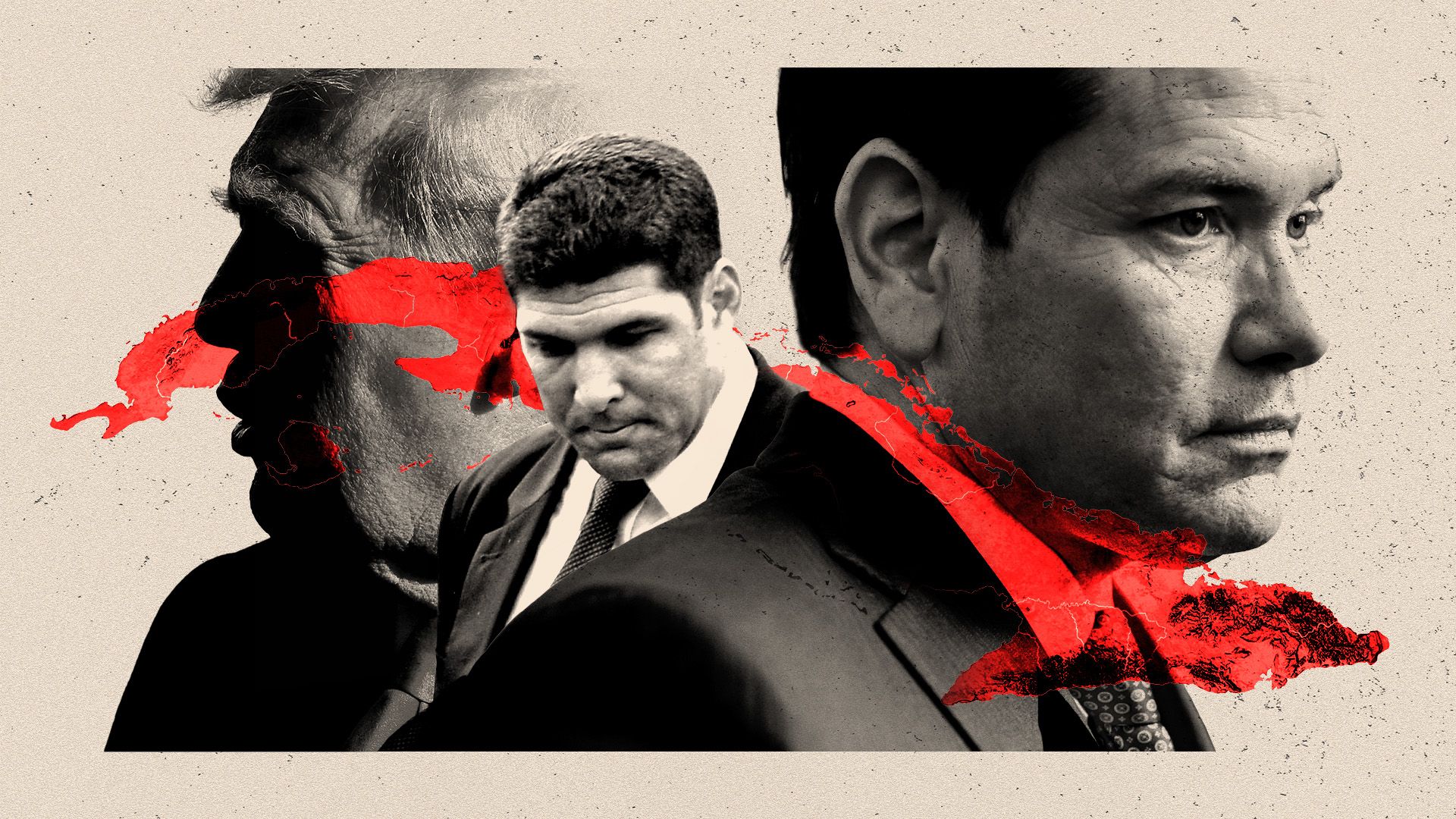
Axios has reported on the conversations between Secretary of State Marco Rubio and key elements of the Cuban military establishment--the Fuerzas Armadas Revolucionarias (FAR). Marc Caputo, "Exclusive: Rubio's secret squeeze on Raul Castro's Cuba" Axios.
FAR, of course is the more or less intact remnant of what had been the revolutionary government of Cuba between 1959 and 1976 when the present political-economic model was formally instituted. It has remained autonomous enough, its relationship with the state apparatus mimicking that between the brothers Fidel and Raul Castro. The nomenklatura remains committed to the vision of Fidel Castro and the protection of the temporally stagnant purity of Caribbean Marxist-Leninism. They have been key elements in suppressing reforms within Cuba within its Marxist-Leninist parameters, including those of Raul Castro himself at the end of the first decade of the 21st century. The FAR has been Raul's bailiwick almost form the beginning. FAR tends toward a more pragmatic and transactional approach with closer ties to their counterparts in China. But both are extremely sensitive to issues of sovereignty and territorial integrity. In that respect they follow the discursive pattern of Mexico.
The full reporting follows below, which in essence is essence--reading the signs from hints and whispers that are being dropped. . .strategically. . . including the Axios story.
 |
| Pix credit Independent |
The fundamental story line though is likely accurate enough and might be elaborated further this way:
1. The signalling about negotiating a Venezuelan resolution to the problem posed by a Cuban State of Misery now beyond control of a nomenklatura that for internal political reasons cannot be displaced is now overwhelming. (Backer, Cuba's Caribbean Marxism, 2018))
2. The Cuban nomenklatura has stood in the way of reform from within for decades. And to some extent they are NOT irrevocably tied to FAR. The Cuban military revolutionary government preceded the nomenklatura, they can serve as a bridge toward the future, the way they did in the 1960s, but this time in a more pragmatically beneficial direction for the Cuban people. Separating the two might not be perceived as a drastic shift if it under appropriate discursive cover. And it provides for internal rectification along lines that resonate with the Cubans themselves.
3. The Mexicans might play a critical role in this discussion of the future. Mexico can serve as a sort of guarantor of good faith, and perhaps a mediator for safe harboring those people whose exits might be necessary to move Cuba forward. That may produce benefits in two ways, first facilitating good faith and trust relationships and secondly strengthening potentially the bonds between the US and Mexico.
4. The Venezuelan pathway underscores the need to start from the premise that no group is going to get everything they want. That is fine. But every group is going to have to value the pathways forward positively from their framework of measurement. That includes internal Cuban constituencies, the Cuban diaspora and its elites in Miami, and the Caribbean regional actors. That is tricky but not impossible and much of it can be postponed.The reality is that no one feasts until the kitchen is built. And everyone's rigidity has made kitchen building impossible.
5. The focus is likely most advantageously transactional. That is natural for the Trump Administration. Ironically, and if framed correctly, aligned with the experiences and operations of FAR. The key is to get the language right--initially that may require working with the FAR's economic enterprises and negotiating a slow and well managed opening of transactional spaces within Cuba. That builds the meta-spaces for economic activity; consumer level activity and the legal structures for its development might have to start with a reboot built up from and through the so-called informal economy. If everyone means what they say about "people-centered" forward movement than that is essential. Anything else, especially coming from above would severely undermine any pretense that there is any interest in Cuban people, in Cuba, driving changes to their transactional environment. Guidance and capacity building for the long term, of course. And the old Lineamientos projects can serve as a rationalizing structure. (e.g., Larry Catá Backer, 2011. ""Order, Discipline and Exigency": Cuba's VI Party Congress, the Lineamientos (Guidelines)and Structural Change In Education, Sport and Culture?," Annual Proceedings, The Association for the Study of the Cuban Economy, vol. 21.)
6. There is already a basis for a democratic organization of the State without abandoning its "socialist" ideals and centering markets driving economics. All you have to do is look--and look beyond the labels. See Larry Catá Backer and Flora Sapio, Popular Consultation and Referendum in the Making of
Contemporary Cuban Socialist Democracy Practice and Contemporary Cuban Socialist Democracy Practice and Constitutional Theory Constitutional Theory, 27 U. MIA. Int'l & Compar. L. Rev. 37
(2020). Available at: https://repository.law.miami.edu/umiclr/vol27/iss1/4
7. All the the pieces are here: (1) internal actors ready for reform; (2) the possibilities of reform without chaos and within the current structures of political organization, (3) the framework for economic organization that serves as a nuclear of reform going forward; (5) the development of an informal sector that can serve as the driver and foundation for consumer and end product indigenous economic operations, and (6) potential key regional partners who can facilitate what can be organic movement in ways that provide a (socialist) democratic transition that may be sufficient to end the current state of relations between the US and Cuba.
8. All that is then left is money (lots f it); and patience--and infrastructure and development--the sort of transactional positives that may, in their own way provide a space for diaspora and mainland Cubans to begin better relations, and for regional development with synergies benefiting all participants.
 |
| Pix credit here |
In the meantime the more than 75 year long debates continues; one can almost choke on the staleness of its cadaverous immobility. One hopes that this will not kill the possibilities of a deal.
Exclusive: Rubio's secret squeeze on Raul Castro's Cuba
Photo illustration: Sarah Grillo/Axios. Photos: Chip Somodevilla, Yamil Lage/AFP, and Juliane Sonntag/Photothek for the German Federal Foreign Office via Getty Images


No comments:
Post a Comment