
A recent issue (2026年第20期《求是》目录) of Qiushi [求是"Seeking Truth"], the official theoretical journal and news magazine of the Chinese Communist Party (CCP), included many interesting articles (table of contents and links below). Two essays were especially interesting to me:
--Xi Jinping, "以更高标准、更实举措推进全面从严治党" ["Advancing Comprehensive and Rigorous Party Self-Governance with Higher Standards and More Substantive Measures"], Qiushi 2026, No. 20 (the principal portion of Xi's January 12, 2026 address to the Fifth Plenary Session of the Twentieth Central Commission for Discipline Inspection).
--Qiushi Magazine Editorial Department, "把习近平党建思想贯彻到从严管党治党实践中" ["Implementing Xi Jinping Thought on Party Building in the Practice of Rigorous Party Management and Governance"], Qiushi 2026, No. 20.
These are important essays, essays produced at a critical moment in the movement through China's New Era, and a foundation for what comes after when it is again time to consider the next stage of Chinese historical development, and of the general contradiction that must then be confronted, Yo to that the Party and its architecture must be ready. And it is tho that ed that these essays provide some beginnings of guidance, drawn from the lessons of the current era of historical development, and of the way in which the Party's leadership and guidance, provided the structures and impetus for the efforts of the nation to meet them.
My Reflection is titled Reflections on Two Essays from Qiushi (求是), 2026, No. 20: Translation, Internal Analysis, and a Reading Through Theories of Foundational Principles and Structures of Chinese Marxist-Leninism (25 October 2026). Claude Sonnet 5 was used in the writing and was especially useful in the translation of the Original Chinese text of the essays. The rest, including the ideas and analysis, and its errors are entirely my own. Part 1 of the essay consists of the translations of the original texts (also reproduced below) into English. Part 2 attempts a semiotic analysis of the texts. It means to read the two texts strictly on their own terms—asking what they are trying to accomplish, what they take for granted, and what interpretive horizon has to already be in place for their sentences to function as they are plainly designed to function. This is not yet an application of any external theoretical apparatus; it is an attempt to describe the cognitive cage from the inside, before asking, in Part Three, what a reader equipped with thoughts I have developed around the notion of governing-loop in and as Chinese Marxist-Leninist constitutionalism (Contradiction, Mass Line, and Democratic Centralism as a Constitutional Governing Loop—and People's Democratic Dictatorship as Its Gatekeeper (Discussion Draft, August 2026)) and other work cited at the end of this essay.
If there is a single thread running from the transliteration choices of Part One through the bracketed internal reading of Part Two to the fully theorized reading of Part Three, it is that these two short, repetitive, almost formulaic texts turn out, on sufficiently patient examination, to be dense with the entire architecture they never once cite by name—contradiction theory, the mass line, democratic centralism, the dual revolutions, people's democratic dictatorship, and the sedimented modernizing horizon that gives all of the foregoing their direction. That density is not an artifact of the reading method imposed upon them; it is, rather, what any text produced from deep within a fully elaborated governing tradition will necessarily exhibit; the alternative, a text that argued its premises from the ground up for a skeptical outside reader, would not be recognizable, within the tradition's own terms, as a Party-building address at all, but as something closer to a philosophical treatise addressed to no one in particular. (Reflections on Two Essays from Qiushi (求是), 2026, No. 20: Translation, Internal Analysis, and a Reading Through Theories of Foundational Principles and Structures of Chinese Marxist-Leninism (25 October 2026))
Here is a section of Part 3. The full essay follows below and may be DOWNLOADED HERE.
 |
| Pix credit here (1984; "energetically complete the task of Party rectification, bring about a basic turn the better in Party spirit) |
PART THREE: A READING THROUGH CHINESE MARXIST-LENINIST THEORY IN ITS NEW ERA
What follows attempts to read the essays through the lens of my recent essays on Chinese Marxist-Leninist constitutionalism—most fully elaborated in an effort at a reconstruction of the governing loop of contradiction theory, the mass line, and democratic centralism under the meta-mechanism of people's democratic dictatorship, and in an account of modernization as the Lebenswelt, the historically sedimented horizon, within which that loop alone becomes intelligible.
It would be a mistake, though a tempting one, to read these two texts from the Fifteenth Plenary Session's discipline-inspection address and its accompanying Qiushi gloss as merely the latest installment in a long-running and somewhat repetitive genre—one more exhortation against the "Four Malfeasances," one more promise that the cage of institutions will finally be woven tightly enough, one more catalogue of two-faced persons whose species, if one has read the genre before, will seem depressingly familiar. That reading is available, and it is not wholly wrong; the texts themselves, after all, concede as much when they describe corruption as "forever on the road," which is a confession, stated without apparent embarrassment, that the object pursued has not yet been caught. But the more interesting question—the one that occupies most of what I have tried to do in reconstructing the governing loop of contradiction theory, the mass line, and democratic centralism as a single recursive system operating within the historically sedimented horizon of modernization—is not whether the campaign has succeeded on its own stated terms, a question the texts themselves seem oddly unanxious about, but what kind of system would produce texts of exactly this shape, texts that are simultaneously diagnostic, confessional, and self-congratulatory, and that treat the coexistence of those three postures as entirely unproblematic.
I. The essays as an instance of contradiction theory's normative strand, read against its own history
Begin with what Essay 1 is doing when it identifies, yet again, non-implementation of central decisions, under-policed institutional loopholes, and recurring corruption as the three matters requiring address. In the four-strand architecture I have elsewhere proposed—normative (N), state-constitutional (S), Party-line (L), and Party-internal-organizational (O)—this address operates almost entirely within the L-strand: it is Xi's own speech, subsequently canonized as "the principal portion" of an address to the Central Commission for Discipline Inspection, and its natural home, as the second essay makes explicit, is the Selected Works of Xi Jinping on Party Building, item 102 of 102, rather than any amendment to the state constitutional text.
One should resist the temptation to treat this placement as incidental. The CPC Constitution's General Program, as I have argued elsewhere, does real work as the textual site where contradiction-diagnosis becomes programmatic content binding on the Party's own conduct; these two essays are best read as a fresh deposit on that site, a further layer of jidian (积淀, sedimentation) accreting onto the already-thick sediment of fourteen years' worth of "Four Malfeasances" rectification, itself resting on Mao's much older distinction between antagonistic and non-antagonistic contradiction. What is being diagnosed here—dilatory implementation, institutional loopholes, recurring graft—is not treated, and could not coherently be treated within the doctrine's own terms, as evidence that the underlying arrangement has reached a limit it cannot absorb. It is instead treated as the ordinary texture of a contradiction "among the people," the very category Mao's 1957 essay supplied for exactly this purpose: internal disagreement, laxity, and even corruption, so long as they are susceptible to criticism and self-criticism rather than treated as evidence of enemy status, register as the normal, recurring material that the loop exists to process rather than as the sign of a crack the loop cannot close.
This matters because it reframes a question an outside reader is tempted to ask—why does the campaign never conclude?—into a question the doctrine itself would regard as malformed. A campaign against non-antagonistic contradiction is not supposed to conclude in the sense of extinguishing its object; contradiction, on Mao's 1937 formulation, is universal and absolute, present in every process at every stage, so that what concludes is not the condition but the particular configuration of the condition characteristic of a given developmental moment. Read this way, the Fifteen-Five period's version of the discipline-inspection address is not evidence of institutional failure so much as evidence that the modernizing horizon has, once again, re-calibrated which fissure—in the vocabulary of the Guiguzi's chapter on exploiting fissures, 抵巇—is currently worth probing. The three numbered sections of Essay 1 are, on this reading, three currently-salient fissures rather than three unsolved problems in the sense a liberal constitutional reader would expect a government white paper to name and then, eventually, to report solved.
II. The mass line's absence, and what that absence discloses about this text's place in the loop
It is worth pausing over what these two texts do not do, because the absence is diagnostically interesting. Neither essay performs, in any explicit or thematized way, the gathering half of the mass line's characteristic movement—"from the masses." There are no petition-office statistics, no field-research findings, no digital consultation-platform results cited as the evidentiary basis for the three diagnoses offered. The texts move directly to concentration and to the return: "to the masses," in the sense of cadres and Party members who are to implement the resulting prescriptions, but without first performing, on the page, the probing gesture (揣, in Guiguzi's vocabulary) by which popular grievance is gathered and converted into diagnosis. This is not evidence that no such gathering occurred—inspection tours, audits, and letters-and-visits channels are referenced as sources of the information underlying the diagnosis—but it is evidence that this particular textual genre, the discipline-inspection address and its canonizing gloss, sits closer to the concentration and return legs of the loop than to its gathering leg. One might say that these texts are democratic centralism's textual residue rather than the mass line's: they are what the loop looks like at the moment concentrated judgment is being handed back down the chain of subordination—individual to organization, lower level to higher level, entire membership to the Central Committee—as binding practice, dressed in the register of exhortation rather than statute.
This placement within the loop has a consequence for how one should read the "two-faced person" taxonomy, which is at once the most vivid and the most theoretically revealing passage in either essay. A taxonomy this elaborate—liberalism, opportunism, factionalism, departmentalism, "good-person-ism"—is doing exactly the sorting work that, in my account of people's democratic dictatorship as a Peircean semiotic thirdness, precedes rather than follows from any individual's observed conduct: it is an act of intelligent naming, in the vocabulary the Guiguzi supplies for the classical rhetoric of 明名, that constitutes the category of internal-enemy-adjacent conduct before any particular cadre's compliance or defiance can be read against it. The "two-faced person" is not discovered through some neutral process of behavioral observation and then classified; the category is elaborated first, with sufficient specificity to leave no plausible dissenting posture uncategorized, and only then does the text instruct its readers—during the "clear-eyed" scrutiny that leadership transitions are said to require—to go looking for instances. This is thirdness doing its gating work one register below where I have located people's democratic dictatorship proper: not sorting the population into "the people" and "the enemy," the dictatorship's classical operation, but sorting Party members themselves into the loyal and the merely performatively loyal, a finer-grained internal analogue to the same semiotic operation, operating entirely within the domain the dictatorship has already constituted as governable through consultation and discipline rather than through coercion.
III. Self-revolution as the dual-revolution doctrine's present test case
The passage in Essay 1 announcing that "our Party has deeply advanced self-revolution" and has thereby "successfully forged a path... that addresses both symptoms and root causes" is not, within the governing loop, a stray rhetorical flourish; it is the point at which the dual-revolution doctrine—self-revolution (自我革命) paired with, and said to lead and safeguard, social revolution (社会革命)—becomes explicitly operative rather than merely implicit. If one accepts, as I have argued, that self-revolution names the mechanism by which the Party keeps its own perceptual apparatus sensitive to the fissures its sedimented categories might otherwise fail to register—inspection tours, democratic life meetings, and criticism and self-criticism functioning as Level 4 feedback at the scale of the Party's own conduct, reopening sedimented dispositions to test whether they still track the field they claim to govern—then these two essays are themselves instances of that feedback loop closing on itself in textual form. The Qiushi editorial essay is not merely reporting on self-revolution; by canonizing Xi's address as item 102 of a 102-item corpus and organizing that corpus around the "Fourteen Upholds," it is performing self-revolution's characteristic operation of testing whether a decade and a half of accumulated practice ("from制定和落实中央八项规定开局破题...到以零容忍态度反腐惩恶") still coheres as a single intelligible line, and finding, unsurprisingly, that it does—a finding the loop is structurally disposed to reach, since the alternative finding (that the line no longer coheres) would itself have to be processed through the very apparatus whose coherence was in question.
The democratic life meeting convened by the Political Bureau on December 25–26, 2025, and depicted in the accompanying photograph, deserves notice on exactly this point. It is tempting for an external observer to read a Political Bureau "democratic life meeting"—a term translated, not without a certain irony that the text itself does not register, into the register of "democracy"—as theater rather than governance. But within the loop as I have reconstructed it, the democratic life meeting is precisely where the O-strand of democratic centralism (the Party-internal-organizational sense in which the chain of subordination governs how disagreement and compliance function inside a branch meeting) is supposed to intersect with the N-strand (the normative diagnosis currently in force): it is the institutional site at which the Politburo subjects itself to the same criticism-and-self-criticism discipline it prescribes, in Essay 1's third section, for discipline-inspection organs generally ("坚持刀刃向内," turning the blade inward). Whether the meeting in fact performed this function with the candor the doctrine requires is a question the texts give an outside reader no evidentiary basis to answer; what the texts do allow one to see is that the doctrine itself treats the meeting's occurrence, reported without further elaboration of its content, as sufficient demonstration that the self-revolutionary mechanism remains active.
IV. The Guiguzi vocabulary and the problem of "penning a cat in a cattle shed"
It is difficult to read the institutional-cage section of Essay 1—"把权力关进制度笼子" and its accompanying idioms, the cat penned in the cattle shed, the paper cage that cannot hold a tiger—without hearing an echo, however unintended by the drafters, of the Guiguzi's much older vocabulary of 量权, the measuring of power, and 抵巇, the exploitation of fissures. The passage's complaint is precisely that existing institutions are 过于原则笼统 (excessively general and principled) and lack 针对性操作性 (targeting and operability)—a complaint that, translated into the Guiguzi's idiom, is a complaint that the measuring has not been fine-grained enough, that the cage's dimensions have been estimated rather than calculated against the actual size, strength, and cunning of what it is meant to contain. The solution the text proposes—density without redundancy ("密而不繁"), enforcement calibrated to close the gap between "explicit rules" (明规矩) and "implicit rules" (潜规则)—is an engineering solution to what the Guiguzi's vocabulary would recognize as a problem of insufficiently probing measurement, 量权 performed too coarsely to register the actual contours of the field being governed. One should resist, however, the inference that this makes the problem merely technical in the deflationary sense; within the governing loop, a coarse measurement is not a correctable oversight external to the system but a recurring structural feature of any attempt to translate sedimented diagnosis into the "complete, workable" (完善) institutional form the text demands, which is precisely why the complaint recurs across fourteen years of near-identical formulations rather than being solved once and retired.
V. What the loop cannot see from inside: a reconstructive rather than normative observation
I have argued elsewhere that accurate reconstruction of this governing loop in its own vocabulary must precede any normative judgment about it, and that measuring Chinese constitutional practice against the assumptions of liberal constitutionalism—separation of powers, electoral accountability, judicial review as an external check on power—commits something like a Lebenswelt category error, projecting onto this system the evaluative apparatus of a different one and then mistaking the resulting mismatch for a discovered defect. That caution should be observed here as rigorously as anywhere. And yet reconstruction, properly pursued, is also entitled to notice what a system's own vocabulary makes structurally difficult for that system to register about itself, without thereby smuggling in an external normative standard. What these two texts make visible, read through the governing-loop architecture, is that the loop's own self-revolutionary mechanism—the apparatus by which the Party is meant to test whether its sedimented categories still track the field they claim to govern—is itself staffed, convened, and evaluated entirely by the same hierarchy whose fidelity is in question, such that the only available signal of the mechanism's success or failure is the mechanism's own report of its success, mediated through inspection tours, audits, and democratic life meetings whose findings are, again, reported rather than independently verifiable by this text's reader. This is not a claim that the mechanism is therefore ineffective; effectiveness is an empirical question the theory explicitly declines to adjudicate from within reconstruction alone, since empirical testing can only proceed once the system has been correctly identified in its own vocabulary. It is, rather, an observation about what the loop's architecture makes it structurally difficult for the loop to notice about itself from the inside—namely, whether fourteen years of recurring diagnosis of the identical three problems, each time met with the promise of "higher standards and more substantive measures" rather than a different theory of why the problems recur, represents the loop functioning as designed, or represents sediment hardening into reflex in precisely the way I have elsewhere warned self-revolution exists to prevent. The texts themselves supply no vocabulary for distinguishing these two possibilities, because the doctrine's own grammar treats "永远在路上"—forever on the road—as a confession of permanent vigilance rather than as a question that might, under a different and not necessarily hostile reading, also be asked of a loop whose return signal has stopped changing shape.
VI. Reading the discipline essays against the endogenous architecture of Whole Process People's Democracy
The two Qiushi essays examined above say nothing, on their face, about political parties other than the CPC, about the CPPCC, about the National People's Congress, or about consultation in any of its institutionalized forms; their field of vision is confined to the Party's own internal governance of itself. It would be a mistake, however, to read that silence as evidence that the discipline-inspection address and its canonizing gloss occupy a separate province of doctrine, loosely connected at best to the architecture I have elsewhere reconstructed for Whole Process People's Democracy (全过程人民民主) and the consultative constitutionalism built around it. The silence is better read as a consequence of strand-specificity rather than of doctrinal distance: these two essays are Party-internal-organizational (O-strand) texts almost in their entirety, concerned with how the vanguard disciplines, tests, and purifies itself, and it is a structural feature of the four-strand architecture, not an oversight of these particular texts, that O-strand material of this kind is only loosely constrained by how the corresponding principle is elaborated at the normative (N), state-constitutional (S), or Party-line (L) levels where consultation, representation, and the mass political organizations proper reside. Party building (党建), in other words, is the self-regarding face of a system whose other, outward-facing institutional architecture—the CPPCC, the "new type of political party system," the United Front—belongs to a related but distinguishable undertaking: the construction of a representative apparatus through which the masses, rather than the Party's own membership, are linked to the state. That the two essays never mention this apparatus is not an absence requiring explanation; it is what one would expect to find if the four-strand architecture is correctly specified, since the O-strand's internal discipline and the L/S-strand's external consultative structures are, as I have argued, wired to each other only loosely and are revised on largely independent schedules.
Yet the connection, once one goes looking for it, is closer than the essays' silence first suggests, and it runs through the people's democratic dictatorship itself. The endogenous/exogenous distinction I have elsewhere drawn—liberal democracy as an essentially exogenous practice organized around the insertion of elected representatives into a government apparatus detached from the business of governing, Chinese Whole Process People's Democracy as an essentially endogenous practice organized around structured consultation attached to the business of governing itself—presupposes, as its very first move, that the population over which either form of democracy might operate has already been sorted into "the people," to whom democratic practice of either exogenous or endogenous variety is extended, and everyone else, over whom dictatorship rather than democracy is practiced. The "two-faced person" taxonomy that occupies so much of Essay 1's first section performs a formally identical sorting operation one register further in: not the classical gate-keeping function of people's democratic dictatorship, which decides who counts as "the people" prior to any individual's conduct, but a finer-grained internal analogue that decides, among those already admitted to "the people" by virtue of Party membership, who is sincerely rather than merely performatively loyal to the collective project the dictatorship exists to advance. One might describe this as a second, nested thirdness (collective interpretation as the manifestaiotn and applicaiton of cognitive cages of ideoligical ordering) operating entirely within the domain the first thirdness has already constituted as governable through consultation rather than coercion—the dictatorship's classificatory work is not repeated here so much as recursively applied, at finer resolution, to a population that has already cleared its threshold.
This nesting illuminates something the WPPD White Papers state explicitly and the two Party-building essays only presuppose: that the "patriotic" political parties organized under the United Front, no less than the CPC's own membership, are themselves objects of a prior classification before they can participate in consultation at all—they must already be, in the language of the China's New Political Party System White Paper, "socialist participating part[ies] with Chinese characteristics," which is to say, already sorted onto the democratic side of the people's democratic dictatorship's foundational line, before the question of how well or sincerely they discharge their consultative function can even arise. The discipline essays' "two-faced person," read against this architecture, is the O-strand's own version of the same anxiety that animates the S/L-strand concern with ensuring that consultative parties remain "participating" rather than becoming, in the White Paper's own anxious phrase, a center of "opposition." Both discourses are worried about the same structural possibility—formal inclusion within the governable field coexisting with substantive defection from the project that inclusion is supposed to serve—and both resolve that worry the same way: not through an external check capable of adjudicating the question independently, but through continuous internal supervision (督查, 巡视, 民主生活会 on one side; political consultation, democratic oversight, and United Front capacity-building on the other) conducted by the very hierarchy whose fidelity is in question.
The comparative, outward-facing argument that structures the White Paper on The State of Democracy in the United States, and the Summit for Democracy it was drafted to rebut, also sheds a retrospective light on a feature of the two Party-building essays that might otherwise seem like mere rhetorical flourish: Essay 2's observation that "many international observers have commented that Xi Jinping Thought on Party Building... breaks the illusions some hold concerning Western party systems and theory, contributing Chinese wisdom to the progress of world political civilization." This sentence, easy to pass over as boilerplate self-congratulation, in fact performs the same legitimation-through-contrast operation that the WPPD White Papers perform at far greater length and with far more explicit comparative apparatus (the "eight cans," the catalogue of January 6, wealth inequality, and media capture). What differs is genre and audience rather than argumentative structure. The White Papers conduct their comparison in the register of state-to-state and system-to-system apologetics, addressed outward along the spokes of the Belt and Road Initiative and the United Front's internationalized apparatus, as Flora Sapio's account of the United Front's extension into BRI party-to-party exchange makes explicit. The Party-building essays conduct what is structurally the identical comparison in a single compressed sentence, addressed inward to a Party readership being told that its own internal disciplinary project—turning the blade inward, hunting "two-faced persons," weaving the institutional cage more tightly—is not parochial housekeeping but a contribution to "world political civilization" that foreign observers themselves are said to recognize. The rhetorical economy here is worth noticing: self-revolution, which Section III above located as the mechanism testing whether the Party's own sedimented categories still track the field they claim to govern, is here also offered as the mechanism underwriting the external legitimacy of the whole Marxist-Leninist constitutional order vis-à-vis its liberal democratic rival. Internal purification and external legitimation are not two projects running in parallel; within this discourse they are the same project read at two different scales, exactly as I have argued the internal/external distinction generally functions as a change of scale within one semiotic order rather than a boundary between consultation and something else.
This also clarifies why the two discipline essays can afford to say nothing about elections, consultation, or the CPPCC, even though Essay 2 insists that Party building is the chapter of Xi Jinping Thought that must be read alongside every other chapter as part of a single, internally coherent system. The WPPD architecture supplies the missing premise the discipline essays do not need to restate: that democratic centralism's vertical chain of subordination—individual to organization, lower level to higher level, entire membership to the Central Committee, the same chain Article 3 of the 1982 Constitution encodes as a rule binding state institutions and the CPC Constitution encodes independently as a rule binding the Party's own conduct—is what makes it coherent for a Party-internal discipline campaign to be described, as Essay 2 describes it, as using "governance of the Communist Party of China" to "lead and safeguard" "the governance of China" as a whole. The O-strand's purification of the vanguard is not merely analogous to the S/L-strand's construction of consultative democracy for the masses; within democratic centralism's own logic, the former is the precondition of the latter's legitimacy, since a vanguard whose own internal sincerity cannot be verified is a vanguard whose concentration of mass-line input into binding policy carries no guarantee of fidelity to what was gathered. The discipline essays' silence about consultation, representation, and political parties is therefore not an indication that Party building occupies a separate conceptual province; it is an indication that Party building is, within the governing loop's own self-understanding, the maintenance work the loop's other, more visible, and more frequently theorized institutional surfaces (the mass line's gathering, democratic centralism's concentrating, the CPPCC's consulting) all silently depend upon, and whose breakdown neither White Paper nor Party-building address treats as a live possibility requiring a contingency the doctrine has not already supplied.
 |
| Pix credit here |
Two Essays from Qiushi (求是), 2026, No. 20: Translation, Internal Analysis, and a Reading Through Theories of Foundational Principles and Structures of Chinese Marxist-Leninism
Source texts (verified against qstheory.cn, the official site of Qiushi):
- Xi Jinping, "以更高标准、更实举措推进全面从严治党" ["Advancing Comprehensive and Rigorous Party Self-Governance with Higher Standards and More Substantive Measures"], Qiushi 2026, No. 20 (the principal portion of Xi's January 12, 2026 address to the Fifth Plenary Session of the Twentieth Central Commission for Discipline Inspection).
- Qiushi Magazine Editorial Department, "把习近平党建思想贯彻到从严管党治党实践中" ["Implementing Xi Jinping Thought on Party Building in the Practice of Rigorous Party Management and Governance"], Qiushi 2026, No. 20.
Abstract
This essay undertakes a translation and two-stage interpretive reading of two companion texts from Qiushi (求是), 2026, No. 20: Xi Jinping's address to the Fifth Plenary Session of the Twentieth Central Commission for Discipline Inspection, and the Qiushi editorial department's canonizing gloss situating that address within "Xi Jinping Thought on Party Building." Part One supplies an integral, transliteration-sensitive English translation attentive to the idiomatic and doctrinal freight carried by terms such as 两面人, 四风, 明规矩/潜规则, and the "Fourteen Upholds," which resist flattening into single English equivalents without loss. Part Two reads the two texts strictly within their own terms, asking not whether their claims are true but what premises must already be accepted—continuity of the Party's founding mission as standing identity rather than revisable history, internal diagnosis and correction as a self-sufficient epistemic loop requiring no external check, repetition of the same three problems across fourteen years as evidence of vigilance rather than failure, and sincerity rather than mere compliance as the object of discipline—for the texts' sentences to function as they are plainly designed to function. Part Three then considers the essays against the broader and more fundamental cognitive cage of Chinese Marxist Leninism-- of the governing loop of contradiction theory, the mass line, and democratic centralism under the meta-mechanism of people's democratic dictatorship, together with Chinese style modernization as the sedimented Lebenswelt within which that loop operates. Read through this apparatus, the two essays emerge as an almost purely Party-internal-organizational (O-strand) deposit within a four-strand architecture, performing concentration and return rather than mass-line gathering, instantiating self-revolution as recursive testing of the Party's own sedimented categories, and nesting a nowhere-stated classificatory operation—sorting the sincere from the performatively loyal—inside the prior gate people's democratic dictatorship has already constituted. The essay closes by locating these texts' silence about consultation and political parties within, rather than outside, the Whole Process People's Democracy architecture that depends on them.
PART ONE: TRANSLATIONS
Translator's note on method: these are integral, paragraph-by-paragraph translations rather than paraphrases or summaries. Where a term carries doctrinal or idiomatic weight that resists a single English equivalent, the Chinese term and its Hanyu Pinyin transliteration are supplied in parentheses on first occurrence, and the English rendering is held constant thereafter. Numbered sub-headings and photograph captions appearing in the original (which function rhetorically as authenticating apparatus rather than as mere illustration) are retained and marked as such.
Essay 1
Advancing Comprehensive and Rigorous Party Self-Governance with Higher Standards and More Substantive Measures*
Xi Jinping
The "Fifteen-Five" period (十五五, shiwuwu—the Fifteenth Five-Year Plan period, 2026–2030) constitutes the critical period for consolidating the foundations of, and exerting effort across the board toward, the basic realization of socialist modernization. To translate into reality the blueprint charted by the Fourth Plenary Session of the Twentieth Central Committee, it is necessary to uphold and strengthen the Party's overall leadership, to advance comprehensive and rigorous Party self-governance (全面从严治党, quanmian cong yan zhi dang) with unremitting persistence, to intensify the sense of mission and the will to struggle throughout the entire Party, to consolidate the Party's unity and solidarity, to preserve the purity of the Party's ranks, and to raise the Party's governing capacity and leadership level.
[Photograph caption: On January 12, 2026, General Secretary of the CPC Central Committee, President of the People's Republic of China, and Chairman of the Central Military Commission Xi Jinping delivered an important address at the Fifth Plenary Session of the Twentieth Central Commission for Discipline Inspection of the Communist Party of China. Photograph by Xie Huanchi, Xinhua News Agency correspondent.]
I. Implementing the Central Party Leadership's Major Decisions and Arrangements with Greater Resolve and Effectiveness
Implementing the major decisions and arrangements of the Party Central Committee is a fundamental requirement for safeguarding the authority of the Party Central Committee and its centralized, unified leadership, and it is also an important historical experience accumulated in the continuous development and advancement of the cause of the Party and the people. The Communist Party of China was born of an ideal and fights for a mission. It is precisely under the firm leadership of the Party Central Committee that successive generations of Communists, undaunted by hardship, have struggled in unbroken succession and successfully led the Chinese people, step by step, from a semi-colonial and semi-feudal society to standing up, growing prosperous, and becoming strong, opening up the correct path of socialism with Chinese characteristics. We have now reached the critical period for basically realizing socialist modernization, and the road ahead will inevitably confront major tests amid high winds and choppy waters, even turbulent seas. So long as one carries an ideal in one's heart, carries the nation and the state in one's breast, and carries a mission upon one's shoulders, one will be able to stand tall and see far, continuously strengthening confidence and strength; one will be able to overwhelm every difficulty rather than be overwhelmed by difficulties, forging a situation in which the whole Party is of one mind and the whole country moves as a single chessboard, genuinely implementing well the major decisions and arrangements of the Party Central Committee, and uniting hearts and pooling strength to conquer successive "Loushan Passes" and "Lazikou Passes" (two celebrated sites of hard-won Red Army victories during the Long March, invoked here as metaphors for present difficulties). Party organizations at every level, and the broad ranks of Party members and cadres, must strengthen their sense of political responsibility and historical mission, take the Party's original aspiration as their own heart and the Party's mission as their own life, and concentrate the whole of their wisdom and strength on realizing the Party's central tasks. Leading cadres at every level must, proceeding from the realization of the Party's missions and tasks, establish and practice a correct outlook on political achievement, examining whether their own thought and conduct have deviated from the lofty ideal of communism and the common ideal of socialism with Chinese characteristics, whether they have departed from the fundamental purpose of serving the people wholeheartedly, whether they have drifted from the Party's line, principles, and policies and the Party Central Committee's major decisions and arrangements, and whether they have become detached from actual national conditions and the actual conditions of their own region or department—advancing Chinese-style modernization single-mindedly, in the spirit that success need not be attributed to oneself, yet one must certainly have contributed to that success.
Regarding the implementation of the Party Central Committee's major decisions and arrangements, our Party possesses a sound mechanism that is, on the whole, smooth and effective. At the same time, information gathered through inspection tours and inspections (巡视巡察, xunshi xuncha), audits, and supervisory checks shows that problems of non-implementation and disorderly implementation of the Party Central Committee's major decisions and arrangements still exist, and in some respects remain rather pronounced. It must be made clear that implementing the Party Central Committee's major decisions and arrangements is a basic requirement of the Party's political discipline and political rules. Our emphasis on the "Two Upholds" (两个维护, liang ge weihu—upholding Comrade Xi Jinping's core position on the Party Central Committee and in the Party as a whole, and upholding the Party Central Committee's authority and its centralized, unified leadership) and on maintaining a high degree of consistency with the Party Central Committee must be manifested in concrete action implementing the Party Central Committee's major decisions and arrangements; it cannot be an empty slogan, still less can one say one thing and do another. Whoever violates this must be held accountable—criticized where criticism is due, reassigned where reassignment is due, disciplined where discipline is due—and this cannot be glossed over or treated ambiguously. Political oversight in this respect must be genuinely strengthened.
During the Fifteen-Five period, the tasks of China's economic and social development are extremely heavy. It is necessary to focus closely on implementing the new development philosophy, promoting high-quality development, and accelerating the construction of the new development paradigm, and other strategic arrangements; to concentrate on the requirements of building a modern industrial system, developing new quality productive forces in light of local conditions, building a unified national market, expanding high-level opening to the outside world, solidly advancing common prosperity for the entire population, preventing a return to poverty on a normalized basis, resolving local government hidden debt, strengthening ecological and environmental protection, and coordinating development and security; to strengthen oversight that is concrete, precise, and normalized; to make good use of the results of inspection tours and strengthen oversight of rectification; and to ensure that every decision and arrangement of the Fourth Plenary Session of the Twentieth Central Committee is genuinely implemented. Beginning this year, localities will successively undergo leadership transitions, and it is necessary to prevent, in the approach to such transitions, a wait-and-see inaction, and, after transitions occur, an eagerness for quick results that amounts to "flipping the pancake" (翻烧饼, fan shaobing—reversing prior policy for the sake of a new leader's visible achievements), ensuring instead that a single blueprint is carried through to the end. It must be pointed out that resolute and effective implementation of the Party Central Committee's major decisions and arrangements is not in contradiction with creative work. Any work must proceed from reality and seek truth from facts, strictly guarding against mechanical copying or uniform treatment from top to bottom. While strengthening oversight, it is necessary to support and encourage every region and department to explore, in light of their own actual circumstances, effective methods and pathways for implementing the Party Central Committee's major decisions and arrangements, ensuring that the final effect accords with the Party Central Committee's decision-making intent and the original purpose of its policies.
The key to implementing well the Party Central Committee's major decisions and arrangements lies in people, and one must be vigilant against "two-faced persons" (两面人, liangmianren) who harbor divided loyalties and whose words do not match their deeds. The manifestations of "two-faced persons" take many forms. Chiefly, there are those who repeatedly profess political loyalty and the "Two Upholds," who respond very quickly and in a very high-pitched tone when it comes to implementing the Party Central Committee's major decisions and arrangements, yet who in reality are duplicitous and act as they please, even to the point of failing to carry out orders and failing to halt prohibited conduct, engaging extensively in the "seven haves" (七个有之, qi ge you zhi—a Xi-era catalogue of factional and oppositional behaviors within the Party). There are others who practice liberalism in thought, who worship the supremacy of the individual, and who apply Xi Jinping Thought on Socialism with Chinese Characteristics for a New Era when convenient and discard it when inconvenient; there are those who practice opportunism politically, who speak cleverly and ingratiatingly, who shift with the wind, who burrow toward wherever benefit lies, and who stand ready at any moment to "jump ship"; there are those who practice factionalism organizationally, who establish their own fiefdoms and form cliques, who exclude dissenters, and who pursue small-group self-interest in the name of the collective; there are those who practice departmentalism in their work, whose self-interest runs deep, who see only their own "one-third of an acre," and who are willing to damage the whole for the sake of the part, or to sacrifice the long term for the sake of the immediate; and there are those who practice being a "good-person-ist" (好人主义, haorenzhuyi) in fulfilling their responsibilities, who, upon discovering problems, neither halt nor correct them but allow them to spread and proliferate unchecked, dressing this up in the fine name of preserving unity when in fact it is an evasion of responsibility. All such conduct runs counter to the principle of Party spirit, severely obstructs the implementation of the Party Central Committee's major decisions and arrangements, and does great harm to the Party's cause and the Party's image; it must be exposed without hesitation and resolutely cleared out. In the process of leadership transitions, it is imperative to keep one's eyes open and to put to use cadres who are genuinely loyal and reliable, whose outward conduct matches their inward character, and who shoulder their responsibilities, while never allowing "two-faced persons," or those who place self-interest first, to slip through in disguise.
II. Locking Power Within the Cage of Institutions More Scientifically and Effectively
Locking power within the cage of institutions (把权力关进制度笼子, ba quanli guanjin zhidu longzi) is an important task of comprehensive and rigorous Party self-governance in the new era. After the Eighteenth Party Congress, the first important intra-Party regulation we formulated was the Central Eight-Point Regulation (中央八项规定, zhongyang baxiang guiding). The reason we began and broke through the problem at this point is that the "Four Malfeasances" (四风, sifeng—formalism, bureaucratism, hedonism, and extravagance) problem, while superficially a matter of estrangement from the masses and indulgence in pleasure-seeking and extravagance, is in essence a matter of forming cliques for private gain and colluding for mutual benefit, concealing transactions of power for power, power for money, and power for sex, which severely damaged the Party's image in the hearts of the masses. We proceeded from the problems about which the masses complained most strongly, established iron rules and rigid constraints, held fast without letting go, and pursued implementation in the spirit of "driving a nail," thereby halting a great many deviant tendencies once thought impossible to halt, removing a number of chronic maladies that had resisted removal for many years, ending the chaotic state of affairs in which "hundreds of documents could not control a single mouth," and, through an act akin to the ancient practice of "moving a post to establish trust" (徙木立信, xi mu li xin), bringing about a complete transformation of Party and governmental conduct, thereby gathering tremendous positive energy for the development of the cause of the Party and the state. The study and education campaign carried out throughout the Party last year further unified thinking and deepened understanding, summarized experience and refined measures, demonstrating the firm resolve to carry the implementation of the spirit of the Central Eight-Point Regulation through to the very end. There is no shortcut to implementing the spirit of the Central Eight-Point Regulation; the key lies in the two characters for "constancy" and "persistence" (常, chang, and 长, chang): without regular enforcement, backsliding easily occurs; without sustained, long-term enforcement, it is difficult to form conscious habit. It is necessary to consolidate and expand the achievements of the study and education campaign on thoroughly implementing the spirit of the Central Eight-Point Regulation, continuously improve the mechanism for the regular discovery and resolution of problems, and advance the normalization and institutionalization of conduct-building on a long-term basis.
[Photograph caption: On December 25–26, 2025, the Political Bureau of the CPC Central Committee convened a democratic life meeting (民主生活会, minzhu shenghuo hui); General Secretary of the CPC Central Committee Xi Jinping presided over the meeting and delivered an important address. Photograph by Xie Huanchi, Xinhua News Agency correspondent.]
The practice of thoroughly implementing the spirit of the Central Eight-Point Regulation tells us that locking power within the cage of institutions requires both perfecting institutional provisions, so as to weave the cage tightly and firmly, and raising the effectiveness of institutional enforcement, so as to strengthen rigid constraint. Since the Eighteenth Party Congress, the Party Central Committee has placed great importance on the building of laws, regulations, and institutions, and the number formulated and revised is unprecedented; a relatively complete system of laws, regulations, and institutions has now taken shape. At the same time, it must be recognized that some laws, regulations, and institutions are excessively general and principled, lacking sufficient targeting and operability; that coordination among different laws, regulations, and institutions is insufficiently close, leaving gaps and loopholes; and that the building of laws, regulations, and institutions targeting new domains, new business forms, and new groups is comparatively lagging. It is necessary to continuously perfect laws, regulations, and institutions, strengthening institutional supply in accordance with the actual needs of Party management and governance—establishing promptly where there are blanks or vacancies, and revising and supplementing promptly where provisions are incomplete or lagging—so that institutions are dense yet not cumbersome, and effective and workable, guarding against "penning a cat in a cattle shed" (牛栏关猫, niulan guan mao—an idiom denoting institutional constraints too loose or ill-fitted to restrain the conduct they target).
In recent years we have also adopted a series of measures to strengthen the enforcement of laws, regulations, and institutions, yet the problem of some Party organizations' institutions idling without effect still exists, and in some localities institutional enforcement weakens as it passes down through successive levels, resulting in a situation in which "a paper cage cannot hold a tiger" (纸笼禁虎, zhilong jinhu). Where explicit rules fail to be made manifest, implicit rules will inevitably flourish; where implicit rules run rampant, explicit rules will be reduced to mere ornament. Why is it that so many political brokers and political swindlers remain active in society? It is precisely because implicit rules render laws, regulations, and institutions ineffective and produce a broken-windows effect, such that some cadres rely on personal connections rather than organization, and some people trust personal relationships rather than discipline and law. Over the long run, this inevitably leads to "bad money driving out good" and to the situation in which "an official seal counts for less than a personal note," inevitably eroding the political ecology and breeding chaotic conditions of corruption. Curbing implicit rules depends crucially on strengthening the enforcement of explicit rules. It is necessary to strengthen publicity and education regarding laws, regulations, and institutions, guiding Party members and cadres to understand discipline and law, to be clear about rules, and to maintain a sense of awe, recognizing that laws, regulations, and institutions are both a "tightening spell" (紧箍咒, jingguzhou—the restraining incantation from Journey to the West) and, still more, a "talisman of protection" (护身符, hushenfu). It is necessary to further raise the transparency of Party and government affairs, genuinely allowing power to operate in the sunlight, so that implicit rules lose their market. It is necessary to uphold the principle that all are equal before laws, regulations, and institutions, that there is no privilege in observing them, and no exception in enforcing them, dealing severely with those who "run the red light" or "climb over the fence," resolutely holding accountable those among them who bear leadership responsibility, and ensuring that institutional provisions genuinely become an electrified high-voltage wire.
Whether an institution is well enforced in a given region or department depends crucially on the "first-in-command" (一把手, yibashou—the top leader of a given unit). Locking power within the cage of institutions requires focusing on resolving the problem of the "first-in-command" taking the lead in enforcing institutions. The Party Central Committee's opinions on strengthening oversight of "first-in-commands" and leading bodies have set forth clear requirements regarding the implementation of democratic centralism and the perfection of the "Three Major Matters and One Large Sum" (三重一大, sanzhong yida—major personnel appointments, major decisions, major projects, and large sums of money) decision-making oversight mechanism; members of leading bodies at every level, and especially the "first-in-command," must lead by example and take the lead in full implementation, and corresponding oversight must likewise be brought fully into place.
III. Advancing the Struggle Against Corruption with Greater Clear-Mindedness and Resolve
Since the Eighteenth Party Congress, our Party has deeply advanced self-revolution (自我革命, ziwo geming) and resolutely opposed corruption, successfully forging a path of anti-corruption with Chinese characteristics, under the centralized and unified leadership of the Party Central Committee, that addresses both symptoms and root causes and advances in integrated fashion the goals that officials "dare not, cannot, and have no desire" to be corrupt. This path must be resolutely continued.
At present, corruption problems remain prone to frequent occurrence. The facts once again demonstrate that the Party Central Committee's judgment that "the situation in the fight against corruption remains severe and complex, and the task of eliminating the soil and conditions that breed corruption remains arduous and heavy" is entirely correct; the fight against corruption is forever on the road and forever a work in progress, and it must be pursued to the end in the spirit of the Foolish Old Man who moved the mountains and the mythical bird Jingwei who filled the sea. The facts once again warn us that corruption is the greatest risk, the greatest threat, and the greatest challenge confronting our Party, a tiger blocking the road and a stumbling block in the course of the development of the cause of the Party and the state; if allowed to breed and spread unchecked, it will inevitably damage the environment for economic development, provoke every manner of risk and hidden danger, and shake the very foundations of the Party's governance. Practice once again instructs us that the fight against corruption is a major struggle that cannot be lost and must not be lost, one that cannot pause for an instant and cannot retreat by half a step—"beside the sinking boat a thousand sails pass by; before the withered tree, ten thousand trees spring into bloom" (a classical couplet invoked to signal that removing the corrupt clears the way for renewal)—and the "withered tree" must be uprooted or felled wherever it stands. One must "press home the pursuit of the retreating foe with all remaining strength," maintaining strategic resolve and combat resilience, continuing to expose and clean out corruption thoroughly, so as to purify the source at its very root. No matter how great the resistance encountered or the cost to be borne, the fight against corruption must be carried through to the end! No matter who it may be, no matter how high the position or how great the contribution, whoever engages in corruption will never be shown leniency!
It is essential to maintain the high-pressure posture without wavering. One must uphold the principle that corruption must always be opposed wherever found, that graft must always be punished wherever found, and that evil must be eliminated utterly, leaving corrupt elements no place to hide. It is necessary to focus on domains where power is concentrated, capital is dense, and resources are abundant, keeping close watch on problems such as collusion between political power and commercial interests, power providing protection for capital, and capital penetrating into the political domain; to intensify the investigation and punishment of corruption problems among "first-in-commands" and younger cadres; to work vigorously to eliminate corrupt actors who refuse to restrain or cease their conduct and act with reckless abandon; to resolutely investigate and punish those who offer bribes knowingly and repeatedly; to dig deeply and investigate thoroughly new forms of corruption and concealed corruption such as expected future benefits, arrangements involving nominee holding of assets, and "revolving doors" between government and business; to deeply advance the concentrated rectification of unhealthy tendencies and corruption problems close to the masses; and to intensify the governance of cross-border corruption and the pursuit of fugitives and stolen assets. Localities and departments where major corruption cases have occurred must earnestly eliminate lingering poison and resolutely and thoroughly purge the source of contamination.
It is essential to continuously raise the penetrating power of the fight against corruption. It is necessary to grasp new trends and new characteristics of corruption, innovate methods and approaches, and further achieve timely discovery, accurate identification, and effective governance of every type of corruption problem. It is necessary to deepen the joint investigation and joint remediation of "malfeasance and corruption" (风腐同查同治, feng fu tong cha tong zhi), seeing through the superficial appearance of "malfeasance" to expose the underlying essence of "corruption," digging deeply into the phenomenon of merchants sustaining officials and officials shielding merchants that underlies inaction or reckless action, thoroughly investigating the favor-seeking and benefit transfer that underlie improprieties connected to banqueting at public expense, and severely punishing conduct such as consorting with political brokers and political swindlers. It is necessary to strengthen empowerment through science and technology, placing emphasis on the use of big data and other means to raise the efficacy of oversight, discipline inspection, and law enforcement. Naturally, the use of new technological means must strengthen ethical norms and data security, and must be conducted strictly in accordance with regulations, discipline, and law. It is necessary to perfect the mechanism for implementing anti-corruption responsibility. Party committees (Party groups) at every level must resolutely shoulder primary responsibility, with the secretary earnestly fulfilling the responsibility of first-in-charge, taking a firm stand and a clear-cut attitude, and leading every relevant party to genuinely shoulder its responsibility—one must not assume that fighting corruption is solely a matter for discipline inspection and supervision commissions, but must genuinely understand, assume, and fulfill one's responsibility.
[Photograph caption: On July 15, 2026, General Secretary of the CPC Central Committee, President of the People's Republic of China, and Chairman of the Central Military Commission Xi Jinping conducted an inspection tour in Shanghai. Here, while inspecting the community Party-mass service station in the Shimin Xincun residential area of Bansongyuan Road Subdistrict, Huangpu District, Xi Jinping engaged warmly with resident representatives, subdistrict cadres, and community workers. Photograph by Xie Huanchi, Xinhua News Agency correspondent.]
It is essential to devote still greater effort to advancing integration. The integrated advancement of the goals that officials "dare not, cannot, and have no desire" to be corrupt is weighted toward, and also finds its difficulty in, the word "integrated" (一体, yiti): it is necessary to strengthen systems thinking and achieve simultaneous effort, effort in the same direction, and comprehensive effort. In practice, there may be relative emphases, but these goals cannot be severed from one another or unevenly favored, guarding against a staged or segmented approach that would undermine the actual effectiveness of the fight against corruption. It is necessary to further perfect the working mechanism for the fight against corruption, coordinating task deployment, resource allocation, work advancement, and performance assessment, linking together daily oversight by Party organizations, discipline inspection and supervisory oversight, and oversight through inspection tours, audits, letters and visits, and public opinion, and other such forms, making coordinated use of the "shadowless lamp" of comprehensive oversight together with the "scalpel" of forceful case-handling, promoting integrated governance through full-chain cooperation. It is necessary to earnestly use cases to promote reform and governance, analyzing the causes of corruption, identifying management loopholes, and using representative cases to conduct cautionary education, so that old problems are not allowed to recur and costs already paid are not wasted. It is necessary to select and employ personnel in accordance with the standard for good cadres of the new era, constructing a positive and healthy set of relationships among Party comrades and between government and business that is both close and clean, and continuing to purify the political ecology. It is necessary to strengthen the cultivation of a culture of integrity for the new era, raising the targeting and effectiveness of clean-governance education, and vigorously fostering a social environment that honors integrity and rejects corruption, and that esteems frugality and guards against extravagance.
Discipline inspection and supervisory organs bear a weighty responsibility and a glorious mission in advancing comprehensive and rigorous Party self-governance, and must always remember what their own purpose is, firmly safeguarding the Party's unity and solidarity, and firmly defending the Party's advanced nature and purity. It is necessary to continuously strengthen the standardized, rule-of-law-based, and regularized construction of discipline inspection and supervisory work, continuously raising the quality and effectiveness of oversight, discipline enforcement, and law enforcement. It is necessary to uphold the practice of turning the blade inward and resolutely eliminating the black sheep within one's own ranks. It is necessary to continuously strengthen the building of the discipline-inspection and supervisory workforce in accordance with the requirements of being politically reliable, professionally competent, well-disciplined in conduct, and clean in integrity, striving to forge an iron army of discipline inspection and supervision that is loyal, clean, responsible, and courageous and skillful in struggle.
*This constitutes the principal portion of General Secretary Xi Jinping's address delivered on January 12, 2026, to the Fifth Plenary Session of the Twentieth Central Commission for Discipline Inspection.
Essay 2
Implementing Xi Jinping Thought on Party Building in the Practice of Rigorous Party Management and Governance
Editorial Department, Qiushi Magazine
Managing and governing the Party, and invigorating and strengthening the Party, can never for a moment dispense with the guidance of thought. Since the Eighteenth Party Congress, the Party Central Committee with Comrade Xi Jinping at its core, upholding the principle that the Party must manage the Party (党要管党, dang yao guan dang) and comprehensive and rigorous Party self-governance, has, in addressing the major question of the era—what kind of long-governing Marxist party to build, and how to build it—put forward a series of new concepts, new ideas, and new strategies, forming Xi Jinping Thought on Party Building (习近平党建思想, Xi Jinping dangjian sixiang), which provides the fundamental guide for strengthening Party building in the new era.
Comprehensive and rigorous Party self-governance is forever on the road. On January 12, 2026, General Secretary Xi Jinping delivered an important address at the Fifth Plenary Session of the Twentieth Central Commission for Discipline Inspection; "Advancing Comprehensive and Rigorous Party Self-Governance with Higher Standards and More Substantive Measures" is the principal portion of that address. In this important essay, General Secretary Xi Jinping stressed the need to "advance comprehensive and rigorous Party self-governance with unremitting persistence," and profoundly expounded three major questions: implementing the Party Central Committee's major decisions and arrangements with greater resolve and effectiveness, locking power within the cage of institutions more scientifically and effectively, and advancing the struggle against corruption with greater clear-mindedness and resolve—matters of major guiding significance for further tightening and substantiating every task of Party building, and for continuously governing our Party well and building it strong. It is necessary, in conjunction with studying this important essay by General Secretary Xi Jinping, to thoroughly comprehend the core essence and practical requirements of Xi Jinping Thought on Party Building, to implement with higher standards and more substantive measures the Party Central Committee's decisions and arrangements concerning comprehensive and rigorous Party self-governance, and to continuously open up a new chapter in managing and governing the Party and in invigorating and strengthening the Party.
Fully Recognizing the Profound and Far-Reaching Guiding Significance of Xi Jinping Thought on Party Building
The power of a thought often must be tempered through the trial of practice and tested by history before its truth can shine forth ever more brightly.
In the period before the Eighteenth Party Congress, the great new project of Party building had achieved notable results, yet at the same time a series of long-accumulated and newly emerging prominent contradictions and problems urgently required resolution, and at that time not a few people both within the Party and in society were deeply anxious about the future of the Party and the state. Confronted with such circumstances, General Secretary Xi Jinping, meeting with Chinese and foreign journalists as a member of the Standing Committee of the Political Bureau of the Eighteenth Central Committee, declared resoundingly: "We must uphold the principle that the Party must manage the Party and that the Party must be governed with strictness, and genuinely resolve the Party's own prominent problems."
Words were matched by deeds, and what was said was done. From that time forward, beginning with the Political Bureau itself and tightened first among leading cadres, the screws of Party management and governance were turned ever tighter, and Party and governmental conduct and the conduct of society continued to improve. Once, "hundreds of documents could not control a single mouth," and wining and dining at public expense and extravagant waste repeatedly occurred despite prohibition; today, the spirit of the Central Eight-Point Regulation has become deeply rooted in people's hearts, and "wastefulness at the tip of the tongue," "deviant tendencies within private clubs," and "corruption on four wheels" have been effectively curbed, so that the "Four Malfeasances" problems close to the masses have diminished. Once, the political ecology in some localities was polluted, with the buying and selling of official positions and vote-buying and bribery occurring from time to time, and implicit rules of every description chilled the hearts of cadres and worried the masses; today, the atmosphere surrounding personnel selection and appointment has visibly improved, the political ecology is growing clearer by the day, and ever more cadres devote their energies to accomplishing their work, earning the trust of the masses through genuine achievement. Once, some grassroots Party organizations were weak and lax, and the masses had nowhere to turn and no one to find when seeking to handle affairs, with policies benefiting the people becoming stuck at the "last mile"; today, the role of grassroots Party organizations is better realized, the masses have someone to manage their affairs and someone to help with their difficulties, and the Party's banner flies high on the front lines at the grassroots. Once, systemic, landslide-style corruption occurred in some localities and departments, and not a few people harbored doubts as to whether the fight against corruption could be sustained in depth over the long term; today, with "hunting tigers," "swatting flies," and "chasing foxes" advancing on multiple fronts together, the effectiveness of the integrated advancement of the goals that officials dare not, cannot, and have no desire to be corrupt grows ever more apparent, and the confidence and satisfaction of the people with respect to the building of Party conduct and clean government and the fight against corruption continue to rise.
These fourteen years since the Eighteenth Party Congress are but an instant in the long river of history; yet for the Communist Party of China, these fourteen years have witnessed, in the course of revolutionary tempering, profound changes visible to all. What has this depended upon? Fundamentally, it has depended upon the Party Central Committee with Comrade Xi Jinping at its core navigating and steering the ship, and upon the scientific guidance of Xi Jinping Thought on Socialism with Chinese Characteristics for a New Era. As the Party-building chapter of Xi Jinping Thought on Socialism with Chinese Characteristics for a New Era, Xi Jinping Thought on Party Building provides a powerful weapon and a guide to action for resolving major theoretical and practical problems of Party building in the new era, and for using "governance of the Communist Party of China" to lead and safeguard "the governance of China."
Practice is the wellspring of theory. A very important reason comprehensive and rigorous Party self-governance in the new era has been able to achieve epoch-making, pioneering accomplishments lies in the fact that our Party, grounded in the magnificent practice of Party management and governance, has summarized, reflected upon, and elevated concurrently, promptly raising successful experience and effective practice to the level of law-like understanding, which in turn guides new practice. From formulating and implementing the Central Eight-Point Regulation as the point of beginning and breakthrough, to clarifying the overall requirements for Party building in the new era; from placing the Party's political construction in the commanding position among all aspects of Party building, to upholding the simultaneous application of building the Party through ideology and governing the Party through institutions; from establishing a sound organizational system that is well-connected from top to bottom and forceful in execution, to forging a high-caliber cadre contingent that is loyal, clean, and responsible; from persistently rectifying work style and enforcing discipline, to combating and punishing corruption with an attitude of zero tolerance—a series of major measures has taken effect in unbroken succession and deepened step by step, powerfully propelling Party management and governance from being lax, soft, and loose to being strict, tight, and hard, and achieving a qualitative leap from practical exploration to theoretical elevation. It may be said that Xi Jinping Thought on Party Building was formed in response to the questions of the age, and in the mutually reinforcing advance of practice and understanding, and that it is suffused with the profound anxious concern of a century-old great party for its own and the nation's future and destiny, constituting a systematic summation and theoretical elevation of the practical experience of comprehensive and rigorous Party self-governance in the new era.
"Every principle has the century of its appearance." Viewed against the long river of history of Marxist party building, and against the backdrop of the development of political party systems around the contemporary world, one may more profoundly grasp the significance of the era and the great importance of Xi Jinping Thought on Party Building. The classical authors of Marxism, constrained by particular historical conditions, neither did nor could systematically answer the question of how a proletarian party, having seized power, achieves long-term governance. The historical responsibility of answering this major question has fallen upon the shoulders of Chinese Communists. Xi Jinping Thought on Party Building, grounded in the Party's new historical position of governance in the new era, integrating the basic tenets of Marxism with the concrete realities of China and with China's fine traditional culture, has constructed a complete theoretical system centered on Party building under conditions of long-term governance. This thought both upholds the most basic and most essential content of the Marxist doctrine of party building, and summarizes and inherits our Party's achievements and theoretical results in Party building, upholding fundamental principles and breaking new ground while researching new circumstances and resolving new problems, enriching and developing the Marxist doctrine of party building with a series of original theoretical results imbued with the character of the age. The power of truth transcends national boundaries. Xi Jinping Thought on Party Building, surveying the course of development of political party systems the world over, deeply analyzing the rise and fall and success and failure of political parties worldwide, and profoundly summarizing and drawing lessons from the experience of Marxist parties, offers useful reference for the building of Marxist parties throughout the world. Many international observers have commented that Xi Jinping Thought on Party Building not only provides guidance for the "largest party in the world" in advancing toward becoming the "strongest party in the world," but also breaks the illusions some hold concerning Western party systems and theory, contributing Chinese wisdom to the progress of world political civilization.
[Photograph caption: Central Party and state organs constitute the first formation in practicing the "Two Upholds" and the "first kilometer" in implementing the Party Central Committee's decisions and arrangements, and must play an exemplary and demonstrative role in studying and implementing Xi Jinping Thought on Party Building. Pictured is the symposium on studying and implementing Xi Jinping Thought on Party Building convened in Beijing on July 29, 2026, by central Party and state organs, which made arrangements for continuing to deepen and carry forward the study and implementation of Xi Jinping Thought on Party Building. Photograph provided by the Central and State Organs Work Committee.]
Xi Jinping Thought on Party Building was formed in the great historical process of strengthening the Party and strengthening the nation in the new era, and carries major practical significance and long-term guiding significance for managing and governing the Party, invigorating and strengthening the Party, and strengthening and rejuvenating the nation. At present, the basic realization of socialist modernization has entered a critical period of consolidating foundations and exerting effort across the board, a period in which strategic opportunities and risks and challenges coexist, and in which uncertain and unpredictable factors are increasing. Looking outward, the once-in-a-century changes unfolding across the world are accelerating, unilateralism and protectionism are intensifying, and the complexity, severity, and uncertainty of the external environment are rising. Looking inward, reform, development, and stability confront no few deep-seated contradictions that cannot be avoided or evaded, and the capability, competence, and spirit of the cadre contingent still fall short of the requirements of modernization-building. Looking at the Party itself, the Party's "four major tests" and "four dangers" persist over the long term, the roots of the "Four Malfeasances" problem remain even after the tree has fallen, the situation in the fight against corruption remains severe and complex, and the task of eliminating the soil and conditions that breed corruption remains arduous and heavy. All of this makes the long-term, arduous, and complex nature of Party management and governance ever more pronounced. Xi Jinping Thought on Party Building, grasping the profound changes in world conditions, national conditions, and Party conditions, both addresses prominent problems in the present and, with an eye to the long term, undertakes systematic deliberation and arrangement, and will surely guide the whole Party to uphold well and apply well, with higher standards and more substantive measures, the precious experience of comprehensive and rigorous Party self-governance in the new era, to rectify well and resolve well the prominent problems confronting Party building, to consolidate well and develop well the favorable political situation formed through Party management and governance, and to provide a firm political guarantee for building a strong nation and national rejuvenation.
Deeply Comprehending the Rich Content and Practical Requirements of Xi Jinping Thought on Party Building
Opening Volumes I and II of Selected Works of Xi Jinping on Party Building, one finds 102 works, including the important essay "Advancing Comprehensive and Rigorous Party Self-Governance with Higher Standards and More Substantive Measures"; these works vividly record the historical course of the formation and development of Xi Jinping Thought on Party Building, presenting in panoramic fashion its rich content.
What are the "four beams and eight pillars" of this theoretical edifice that is Xi Jinping Thought on Party Building? They are the "Fourteen Upholds" (十四个坚持, shisi ge jianchi). These "Fourteen Upholds" are concise yet laden with profound meaning. "Upholding Party leadership as the most essential characteristic of socialism with Chinese characteristics" stands first among them, fully manifesting the essential determinative role of Party leadership for socialism with Chinese characteristics and clarifying the fundamental political guarantee for upholding and developing socialism with Chinese characteristics in the new era. "Upholding the Party Central Committee's centralized, unified leadership" is the supreme principle of Party leadership; grasping this requires deeply comprehending the decisive significance of the "Two Establishes" (两个确立, liang ge queli—establishing Comrade Xi Jinping's core position and establishing the guiding position of Xi Jinping Thought on Socialism with Chinese Characteristics for a New Era) and resolutely achieving the "Two Upholds." "Upholding comprehensive and rigorous Party self-governance" is the strategic policy of Party building in the new era, and the strict tone, strict measures, and strict atmosphere must be upheld over the long term. "Upholding the commitment never to forget our original aspiration and to keep our founding mission firmly in mind" expresses the Party's fundamental position and value orientation; one must remember that the rivers and mountains are the people, and the people are the rivers and mountains, taking the creation of well-being for the people as the greatest political achievement. The Party's political construction determines the direction and effect of Party building, and "upholding the Party's political construction as the commanding element" clarifies the fundamental requirement for Party building in the new era. "Upholding the use of the Party's innovative theory to unify hearts and forge souls" is the fundamental task of the Party's ideological construction; it is necessary to strengthen theoretical innovation and theoretical armament, consciously becoming firm believers in, and faithful practitioners of, Xi Jinping Thought on Socialism with Chinese Characteristics for a New Era. "Upholding the tempering of firm Party spirit" is a lifelong subject for every Party member and cadre; every Party member and cadre must remember that their first identity is that of a Communist Party member, being loyal to the Party, sharing the Party's worries, shouldering the Party's responsibilities, and fulfilling the Party's duties on the Party's behalf. The Party's strength derives from organization, and "upholding the establishment of a sound organizational system that is well-connected from top to bottom and forceful in execution" is where the Party's advantage and strength lie; it is necessary to strengthen the political function and organizational function of Party organizations, promoting the comprehensive advancement and comprehensive strengthening of grassroots Party organizations. "Upholding the building of a high-caliber cadre contingent equal to the heavy responsibility of national rejuvenation" is a pivotal question bearing on the cause of the Party and the state; it is necessary to implement the standard for good cadres of the new era, coordinating the selection, training, management, and employment of cadres, and forging a high-caliber cadre contingent that is loyal, clean, and responsible. "Upholding the advancement of work-style construction on a normalized and long-term basis" is an effective pathway for preserving the Party's flesh-and-blood ties with the people; it is necessary to implement the spirit of the Central Eight-Point Regulation unremittingly, persisting without letup over the long haul. Discipline is the ruler by which the Party is managed and governed, and "upholding the use of strict discipline to manage and govern the whole Party" is the fundamental policy of comprehensive and rigorous Party self-governance; discipline must genuinely be placed in the forefront, becoming a truly electrified high-voltage wire. Corruption is the greatest risk, threat, and challenge facing our Party, and "upholding the integrated advancement of the goals that officials dare not, cannot, and have no desire to be corrupt" is an important strategy of comprehensive and rigorous Party self-governance and the basic policy of the fight against corruption; it is necessary to resolutely wage the tough, protracted, and total battle against corruption. "Upholding governance of the Party through institutions and governance of the Party in accordance with regulations" is the long-term and fundamental policy of comprehensive and rigorous Party self-governance; it is necessary to establish a sound system of intra-Party laws and regulations, continuously raising the scientific, institutionalized, and standardized level of Party management and governance. "Upholding the implementation of political responsibility for Party management and governance" is the "key link" that must be firmly grasped in comprehensive and rigorous Party self-governance; it is necessary to establish a sound structure of responsibility for Party management and governance in which each party bears its own responsibility within a unified and coordinated framework, genuinely grasping Party-building work firmly, meticulously, and thoroughly.
The "Fourteen Upholds" are internally connected and mutually reinforcing, forming a scientific system of rigorous logic and systematic completeness. Viewed thematically, each "Upholds" closely engages the major question of the age—what kind of long-governing Marxist party to build, and how to build it—expounding this from different aspects and angles; the "Fourteen Upholds" answer a single question together, with one central thread running through them from beginning to end. Viewed structurally, the first four "Upholds" constitute a general introduction, profoundly clarifying the supreme principle, strategic policy, and value pursuit of Party building; the middle nine "Upholds" constitute particular discussions, successively expounding the Party's political construction, ideological construction, organizational construction, work-style construction, discipline construction, the fight against corruption, and institutional construction, clarifying the overall arrangement of Party-building work in the new era and the focal tasks in each respective field; the final "Upholds" governs implementation, serving as a forceful guarantee for translating every task of comprehensive and rigorous Party self-governance into concrete effect. The general introduction raises the banner and sets the direction, the particular discussions unfold systematically, and the final item consolidates responsibility—the "Fourteen Upholds" possess a clear hierarchy, with the key link firmly grasped drawing the whole net taut. Viewed in terms of ultimate purpose, this system profoundly reveals the inherent connection among Party management and governance, invigorating and strengthening the Party, and strengthening and rejuvenating the nation, situating Party building within the overall plan for strengthening the nation and achieving rejuvenation. The theme runs consistently throughout, the structure occupies its proper place at every level, and the ultimate purpose converges toward a single point—the "Fourteen Upholds" are joined into a single whole, and the edifice of this scientific system stands firm and solid.
[Photograph caption: Since the Eighteenth Party Congress, political responsibility for Party management and governance has been continuously tightened and substantiated, propelling comprehensive and rigorous Party self-governance to advance ever more deeply. Pictured is the Discipline Inspection and Supervision Commission of Fu'an City, Fujian Province, conducting heart-to-heart conversations with young Party members and cadres on September 16, 2026, candidly exchanging views and examining existing problems. Photograph by Cai Xiaomin, Organization and Publicity Department, Fu'an Municipal Discipline Inspection and Supervision Commission.]
Grasping the essence and core meaning requires both understanding the scientific content and appreciating the theoretical character. Xi Jinping Thought on Party Building profoundly clarifies the fundamental question of what the Communist Party of China is and what it seeks to accomplish, manifesting the power of Marxist truth and embodying General Secretary Xi Jinping's political wisdom, the radiance of his thought, and the charisma of his character, possessing a distinctive and compelling theoretical character. Firm ideals and convictions furnish us with powerful motivation to fix our direction, discern right from wrong, and strive unswervingly; a high degree of historical initiative allows us to preserve forever the sober awareness and firmness of one still "taking the examination"; a clear problem orientation drives us to fix our sights on prominent problems and address them in targeted fashion, confronting difficulties head-on; a strong sense of mission and responsibility manifests the decisive role of the great new project in relation to the great struggle, the great cause, and the great dream; a profound sentiment for the people grounds every item of work in the people's aspiration for a better life; and a scientific method of thought guides us to think with foresight, plan comprehensively, and advance the building of the Party in integrated fashion. Thoroughly studying and comprehending these qualities allows one better to grasp the spiritual essence of Xi Jinping Thought on Party Building, drawing from it the power of truth, the power of spirit, and the power of character.
The value of scientific theory must ultimately be manifested in its answering practical problems and guiding practical development. Xi Jinping Thought on Party Building possesses the distinctive characteristic of clarifying substance in order to reach application, with substance and application interpenetrating (明体达用、体用贯通, ming ti da yong, ti yong guan tong—a formulation drawing on the classical Chinese philosophical pairing of substance, ti, and function, yong). Clarifying substance means profoundly revealing the fundamental direction, major principles, and inherent laws of the building of a Marxist governing party; reaching application means transforming law-like understanding into practical requirements, institutional mechanisms, and working methods for managing and governing the Party and invigorating and strengthening it; interpenetration means that substance and application are internally unified, with fundamental principles established and practical requirements brought down to earth. Within the "Fourteen Upholds," each "Upholds" carries both abundant theoretical exposition and clear practical requirements, addressing both how to view matters and how to handle them, both deploying the task of "crossing the river" and guiding the resolution of the method of "the bridge or the boat." Substance is established correctly precisely so that application may travel far; and where substance and application interpenetrate, the key to that interpenetration likewise lies in application. Whether it be the Party's political construction, ideological construction, organizational construction, work-style construction, discipline construction, the fight against corruption, or institutional construction, or the implementation of responsibility, every task of comprehensive and rigorous Party self-governance should seek its guiding principle and its method within this scientific system, checking itself against the standard and correcting any deviation. That Xi Jinping Thought on Party Building constitutes a powerful ideological weapon for managing and governing the Party and for invigorating and strengthening it finds its reasoning precisely here.
Implementing Xi Jinping Thought on Party Building Throughout the Entire Process and in Every Aspect of Party Building
Studying and implementing Xi Jinping Thought on Party Building is a process proceeding from knowledge to conviction and thence to action. Study is the starting point, and also the premise and foundation. Study must uphold reading the original works, studying the original texts, and comprehending the original principles, learning in connection with actual practice, while also exerting effort toward systematic depth—striving for comprehensive interpenetration of the entire system, completing the elevation from fragmentary understanding to systematic grasp; striving for thorough mastery of its standpoint, viewpoint, and method, promoting the deepening from surface-level cognition to law-like understanding; and striving for ideological self-consciousness and value identification, achieving the elevation from theoretical cognition to conviction and faith. Only through such step-by-step deep study and detailed comprehension can one truly grasp and internalize the essence of this important thought, and thereby transform the effectiveness of study into the vivid practice of comprehensive and rigorous Party self-governance.
Action is the ultimate point of focus. Xi Jinping Thought on Party Building clarifies the "roadmap" and "task list" for Party management and governance; only by persisting in using this important thought to plan and advance every aspect of Party building, implementing it throughout the entire process and in every aspect of Party building, can its practical power be fully manifested. It is necessary to connect closely with the work currently underway, focusing on key domains, and identifying precise points of entry and leverage for one's work, doing the work of integration well. Party management and governance is a task shared by the whole Party, yet circumstances differ vastly across different levels, fields, and sectors, and the focal tasks to be grasped and the methods to be adopted should likewise possess their own respective characteristics. Divorcing oneself from reality and ignoring differences, applying arrangements and requirements uniformly across every level without distinction, not only fails to help advance the work but readily leads to responsibility being left hanging in the air and implementation being weakened. It is necessary to uphold seeking truth from facts and acting in accordance with local conditions, refining the Party Central Committee's unified arrangements and requirements into concrete measures suited to one's own actual circumstances. For instance, organs and units should focus on strengthening the Party's political construction, work-style construction, and the effectiveness of fulfilling their duties, reinforcing overall awareness and strict discipline and rules, while also strengthening oversight and restraint over key posts and critical power, fully exercising an exemplary and leading role; urban and rural grassroots units should emphasize serving the masses and raising governance effectiveness, building strong combat fortresses, properly resolving every kind of contradiction and problem, and safeguarding the immediate interests of the masses; various enterprises, public institutions, and "two new" organizations (两新组织, liangxin zuzhi—new economic organizations and new social organizations) need to closely integrate the attributes and characteristics of their own industry and field, promoting the deep integration of Party-building work with their central tasks, achieving mutual reinforcement between Party management and governance and the development of their undertakings. Only by upholding category-specific policy and precise effort can Xi Jinping Thought on Party Building be caused to take root and bear fruit, transformed into real and tangible effect.
Implementing the Party Central Committee's major decisions and arrangements is an important point of leverage for studying and implementing Xi Jinping Thought on Party Building, and also an important standard for testing the effectiveness of such study and implementation. General Secretary Xi Jinping clearly points out in this important essay that implementing the Party Central Committee's major decisions and arrangements is a fundamental requirement for safeguarding the authority of the Party Central Committee and its centralized, unified leadership, and is also a basic requirement of the Party's political discipline and political rules, emphasizing that implementation must be more resolute and effective. In this respect, it is necessary to deepen understanding from a political height, genuinely manifesting the "Two Upholds" in concrete action, not merely shouting empty slogans, still less saying one thing and doing another. It is necessary to genuinely strengthen political oversight, acting with a firm hand, holding accountable whoever violates this, never glossing over matters or treating them ambiguously. At the same time, it must also be recognized that resolute and effective implementation of the Party Central Committee's major decisions and arrangements is not in contradiction with creative work; every region and department should explore, in light of its own actual circumstances, effective methods and pathways for implementation, ensuring that the final effect accords with the Party Central Committee's decision-making intent and the original purpose of its policies. The key to implementing well the Party Central Committee's major decisions and arrangements lies in people. The General Secretary stresses the need to be vigilant against "two-faced persons" who harbor divided loyalties and whose words do not match their deeds, identifying a prominent factor obstructing, in real practice, the implementation of the Party Central Committee's major decisions and arrangements. For this reason, it is imperative to guard the gate of personnel selection and appointment closely, putting to use cadres who are genuinely loyal and reliable, whose outward conduct matches their inward character, and who shoulder their responsibilities, while never allowing "two-faced persons," or those who place self-interest first, to slip through in disguise.
Comprehensive and rigorous Party self-governance in the new era has achieved great accomplishments, yet prominent problems within the Party concerning impurity of thought, impurity of organization, and impurity of work style have not yet been fundamentally resolved, and new circumstances and new problems continue to emerge without end. Implementing Xi Jinping Thought on Party Building requires sustained effort in researching and resolving prominent problems in Party management and governance. Among these problems, how to uphold governance of the Party through institutions and governance of the Party in accordance with regulations, and how to lock power within the cage of institutions more scientifically and effectively, is a question bearing fundamental and overall significance. General Secretary Xi Jinping stresses in this important essay that locking power within the cage of institutions requires both perfecting institutional provisions, so as to weave the cage tightly and firmly, and raising the effectiveness of institutional enforcement, so as to strengthen rigid constraint. This important formulation, addressing matters of institutional supply and institutional enforcement, profoundly answers the key questions of how the cage of institutions may genuinely be made tight, electrified, and effective, revealing the basic methodology for governing power through institutions. In practice, it is necessary to closely integrate scientific institutional supply with rigid institutional enforcement, embedding this throughout the entire process of the exercise of power, ensuring that power at all times operates along the track of institutions, thereby realizing standardized exercise of power and effective governance of power. The essence of corruption is the abuse of power. At present, corruption problems remain prone to frequent occurrence, and it is necessary to advance the struggle against corruption with still greater clear-mindedness and resolve, clearing away the stumbling blocks and tigers blocking the road for the development of the cause of the Party and the state on the new journey. "No matter how great the resistance encountered or the cost to be borne, the fight against corruption must be carried through to the end," and "no matter who it may be, no matter how high the position or how great the contribution, whoever engages in corruption will never be shown leniency!" The General Secretary's resolute words and unequivocal attitude vividly convey the Party Central Committee's unshakable resolve and will to resolutely advance the fight against corruption. This is not only a stern warning issued to the whole Party, but also a solemn pledge made to history and to the people. It is necessary to maintain the high-pressure posture without wavering, continuously raise the penetrating power of the fight against corruption, and devote still greater effort to the integrated advancement of the goals that officials dare not, cannot, and have no desire to be corrupt. It is necessary to strengthen systems thinking, emphasizing coordinated linkage, both severely punishing corruption so that the deterrent effect of "daring not" to be corrupt is fully manifested, and plugging institutional loopholes so that the cage of "cannot" be corrupt is tightly woven, and also building a firm ideological embankment so that the self-consciousness of "having no desire" to be corrupt is strengthened—achieving simultaneous effort, effort in the same direction, and comprehensive effort among these three.
In a few more days, the Fourth—[translator's note: the source text here reads "Fifth," 五中全会, the Fifth Plenary Session of the Twentieth Central Committee]—Plenary Session of the Twentieth Central Committee of the Communist Party of China will convene in Beijing, making strategic arrangements for persisting unremittingly in advancing comprehensive and rigorous Party self-governance. This carries major practical significance and long-term guiding significance for our Party's continued deepening, guided by Xi Jinping Thought on Party Building, of the great new project of Party building in the new era. Party organizations at every level, and all Party members and cadres, must genuinely strengthen their sense of responsibility for Party management and governance, firmly grasping responsibility in hand and resolutely shouldering it, continuing to consolidate and develop the favorable situation in which the whole Party lends a hand together, building our century-old great party to be ever stronger and more resilient.
PART TWO: THE ESSAYS READ AS RECURSIVE SEMIOTIC ARTIFACTS WITHIN THEIR OWN CAGES OF COGNITION
What follows is a semiotic analysis of the texts. It means to read the two texts strictly on their own terms—asking what they are trying to accomplish, what they take for granted, and what interpretive horizon has to already be in place for their sentences to function as they are plainly designed to function. This is not yet an application of any external theoretical apparatus; it is an attempt to describe the cognitive cage from the inside, before asking, in Part Three, what a reader equipped with thoughts I have developed around the notion of governing-loop in and as Chinese Marxist-Leninist constitutionalism (Contradiction, Mass Line, and Democratic Centralism as a Constitutional Governing Loop—and People's Democratic Dictatorship as Its Gatekeeper (Discussion Draft, August 2026)) and other work cited at the end of this essay.
1. What the texts are trying to do
Essay 1 (Xi's address) is not primarily an argument in the sense of a chain of propositions offered for the reader's independent assessment. It is a directive instrument wearing the grammar of exposition. Its three numbered sections each perform the same three-part maneuver: (a) state a general principle as already-settled doctrine ("implementing the Party Central Committee's major decisions is a fundamental requirement..."); (b) diagnose a persistent shortfall in practice, using vivid, often idiomatic language ("two-faced persons," "a paper cage cannot hold a tiger," "a cat penned in a cattle shed"); and (c) issue an intensified operational prescription, calibrated for the coming Fifteen-Five period and the imminent leadership-transition cycle. The text's own self-understanding of its purpose is given explicitly: it exists to be "implemented" (贯彻落实), not merely read. Its audience is bifurcated—Party organizations and cadres who are meant to act on it, and a wider public (including, self-consciously, an international audience "commenting" favorably, per Essay 2) for whom it demonstrates seriousness, self-correction, and continuity of resolve.
Essay 2 performs a different, second-order function: it is not itself a directive but a reading instruction for Essay 1, situating Xi's address within a named, canonized theoretical corpus ("Xi Jinping Thought on Party Building," unified by the "Fourteen Upholds") and within a historical narrative of improvement ("once... today..."). Its work is canonization and pedagogy: it tells the cadre-reader how to read the primary text, what larger structure the primary text instantiates, and what emotional and intellectual posture ("from knowledge to conviction to action") is the correct response. It also performs an evidentiary function, assembling a dossier of before/after comparisons meant to forestall the inference that the campaign has stalled or that repeated emphasis on the same three problems (non-implementation, loophole-ridden institutions, persistent corruption) betrays failure rather than vigilance.
2. The organizing premises, stated and unstated
Several premises are doing load-bearing work without ever being argued for, because within the discourse they are the ground on which argument stands rather than conclusions argument could reach.
(a) The Party's continuity with its own founding mission is not a historical claim open to revision but a standing identity-condition. The repeated invocation of "original aspiration" (初心) and "founding mission" (使命) treats the Party's 1921 self-conception as still binding and still accurately descriptive of the institution in 2026. Nothing in either text entertains the possibility that successive reinterpretation might constitute discontinuity rather than fidelity; continuity is asserted by narrative device (the Long March metaphor, the "14 years" retrospective) rather than demonstrated.
(b) Diagnosis and correction are the Party's own internal competence, requiring no external check. Both essays describe a self-contained epistemic loop: problems are identified through Party-internal mechanisms (inspection tours, audits, democratic life meetings), and their resolution is likewise assigned to Party-internal mechanisms (discipline inspection commissions, the "first-in-command," democratic centralism). No external institution—court, press, electorate—appears anywhere as a source of correction. The premise is not merely that external checks are absent but that their absence is not itself a gap requiring remedy; internal self-correction is presented as the superior and sufficient mechanism.
(c) Persistence of the same problems across fourteen years is read as proof of vigilance, not failure. This is the premise doing the most interpretive work and the one most vulnerable to an external observer's skepticism. The texts do not conceal that corruption, non-implementation, and institutional loopholes recur; they state this plainly ("corruption problems remain prone to frequent occurrence"). The texts' internal logic converts this into evidence that the campaign is appropriately permanent ("forever on the road, forever a work in progress") rather than evidence that the campaign's methods are inadequate to its stated object. This conversion is accomplished partly through temporal framing (每一代人的斗争, "a struggle of its age") and partly through the rhetorical device of escalating intensity rather than changing method: each essay promises "higher standards and more substantive measures" applied to the same three problems rather than a different diagnosis of why those problems recur.
(d) The distinction between "the people" and the Party's internal "black sheep" or "two-faced persons" is doing classificatory work that precedes, rather than follows from, any individual's conduct. The "two-faced person" catalogue is remarkable for its length and specificity (liberalism, opportunism, factionalism, departmentalism, "good-person-ism"); it functions less as empirical description of observed types than as an exhaustive taxonomy meant to leave no possible dissenting posture uncategorized and therefore un-indictable. A cadre's formal compliance ("responds very quickly and in a very high-pitched tone") is explicitly treated as potentially more suspect than visible resistance, since it is the mark of the "two-faced person" above all others. This produces a text in which sincerity, not merely conduct, is the object of discipline—an epistemically demanding standard that the text does not pretend is easy to verify, which is presumably why it requires an apparatus (inspection, auditing, "clear eyes" during leadership transitions) rather than resting on self-report.
(e) Institutions and discipline are presented as complementary rather than competing, with the ratio between them treated as an engineering problem rather than a question of principle. The "cage/tiger/cat" imagery converts what might, in a liberal constitutional register, be a question about the proper domain of rule-bound constraint versus discretionary Party authority into a purely technical question: are the laws dense enough, specific enough, and enforced consistently enough? The text never asks whether the Party's own supremacy over the institutions meant to constrain power is itself in tension with the metaphor of the "cage"—a cage, after all, requires something outside it to have built and to maintain it, and the text's own answer (the Party builds, maintains, and inhabits the cage simultaneously) is never flagged as requiring justification.
3. The cognitive cage: what has to already be true for the text to make sense
For the text's sentences to carry the force they are evidently meant to carry, the reader must already accept, prior to reading, a cluster of propositions that the text does not argue but presupposes:
- That there exists a unitary entity, "the Party," capable of having a "mission," a "purity," a "political ecology," and a "character"—that is, that collective-agency predicates apply to the Party in a strong, non-metaphorical sense, such that the Party can be spoken of as diagnosing itself, correcting itself, and revolutionizing itself (自我革命) in the way an individual conscience might.
- That history up to the present moment has a direction—"basically realizing socialist modernization"—against which present conduct can be measured as advancing, lagging, or deviating, such that terms like "deviation" (游离, 脱离, 背离) have determinate content without requiring independent specification of what non-deviation looks like beyond conformity to the Central Committee's current line.
- That the correct relationship between the individual cadre and the collective is one of near-total identification—"take the Party's original aspiration as their own heart and the Party's mission as their own life"—such that the demand for sincerity rather than mere compliance is not experienced as an impossible or totalizing demand but as the natural expression of membership.
- That repetition and escalation ("永远在路上," "forever on the road") are not signs of a stalled campaign but the campaign's proper temporal mode—an expectation that a Western liberal reader, primed to expect campaigns to terminate upon achieving their stated object, would likely misread as self-undermining, but which within the text's own horizon is simply how permanent revolution against entropy is supposed to look.
- That legitimacy flows from performance and correction (having identified and fixed problems) rather than from procedure (having been authorized by a mechanism external to the corrector)—so that the absence of electoral or judicial check is not experienced within the text as an absence at all.
None of these premises is argued within the two essays; all of them are required for the essays' sentences to do anything other than beg the question at every turn. This is precisely what makes the texts examples of what Backer's framework (addressed below) calls operating within a Lebenswelt rather than arguing toward a conclusion: they are not persuasive essays aimed at skeptics but operational and pedagogical texts aimed at inhabitants of an already-shared horizon, whose function is to recalibrate that horizon's current emphases rather than to establish its foundations anew.
PART THREE: A READING THROUGH CHINESE MARXIST-LENINIST THEORY IN ITS NEW ERA
What follows attempts to read the essays through the lens of my recent essays on Chinese Marxist-Leninist constitutionalism—most fully elaborated in an effort at a reconstruction of the governing loop of contradiction theory, the mass line, and democratic centralism under the meta-mechanism of people's democratic dictatorship, and in an account of modernization as the Lebenswelt, the historically sedimented horizon, within which that loop alone becomes intelligible.
It would be a mistake, though a tempting one, to read these two texts from the Fifteenth Plenary Session's discipline-inspection address and its accompanying Qiushi gloss as merely the latest installment in a long-running and somewhat repetitive genre—one more exhortation against the "Four Malfeasances," one more promise that the cage of institutions will finally be woven tightly enough, one more catalogue of two-faced persons whose species, if one has read the genre before, will seem depressingly familiar. That reading is available, and it is not wholly wrong; the texts themselves, after all, concede as much when they describe corruption as "forever on the road," which is a confession, stated without apparent embarrassment, that the object pursued has not yet been caught. But the more interesting question—the one that occupies most of what I have tried to do in reconstructing the governing loop of contradiction theory, the mass line, and democratic centralism as a single recursive system operating within the historically sedimented horizon of modernization—is not whether the campaign has succeeded on its own stated terms, a question the texts themselves seem oddly unanxious about, but what kind of system would produce texts of exactly this shape, texts that are simultaneously diagnostic, confessional, and self-congratulatory, and that treat the coexistence of those three postures as entirely unproblematic.
I. The essays as an instance of contradiction theory's normative strand, read against its own history
Begin with what Essay 1 is doing when it identifies, yet again, non-implementation of central decisions, under-policed institutional loopholes, and recurring corruption as the three matters requiring address. In the four-strand architecture I have elsewhere proposed—normative (N), state-constitutional (S), Party-line (L), and Party-internal-organizational (O)—this address operates almost entirely within the L-strand: it is Xi's own speech, subsequently canonized as "the principal portion" of an address to the Central Commission for Discipline Inspection, and its natural home, as the second essay makes explicit, is the Selected Works of Xi Jinping on Party Building, item 102 of 102, rather than any amendment to the state constitutional text.
One should resist the temptation to treat this placement as incidental. The CPC Constitution's General Program, as I have argued elsewhere, does real work as the textual site where contradiction-diagnosis becomes programmatic content binding on the Party's own conduct; these two essays are best read as a fresh deposit on that site, a further layer of jidian (积淀, sedimentation) accreting onto the already-thick sediment of fourteen years' worth of "Four Malfeasances" rectification, itself resting on Mao's much older distinction between antagonistic and non-antagonistic contradiction. What is being diagnosed here—dilatory implementation, institutional loopholes, recurring graft—is not treated, and could not coherently be treated within the doctrine's own terms, as evidence that the underlying arrangement has reached a limit it cannot absorb. It is instead treated as the ordinary texture of a contradiction "among the people," the very category Mao's 1957 essay supplied for exactly this purpose: internal disagreement, laxity, and even corruption, so long as they are susceptible to criticism and self-criticism rather than treated as evidence of enemy status, register as the normal, recurring material that the loop exists to process rather than as the sign of a crack the loop cannot close.
This matters because it reframes a question an outside reader is tempted to ask—why does the campaign never conclude?—into a question the doctrine itself would regard as malformed. A campaign against non-antagonistic contradiction is not supposed to conclude in the sense of extinguishing its object; contradiction, on Mao's 1937 formulation, is universal and absolute, present in every process at every stage, so that what concludes is not the condition but the particular configuration of the condition characteristic of a given developmental moment. Read this way, the Fifteen-Five period's version of the discipline-inspection address is not evidence of institutional failure so much as evidence that the modernizing horizon has, once again, re-calibrated which fissure—in the vocabulary of the Guiguzi's chapter on exploiting fissures, 抵巇—is currently worth probing. The three numbered sections of Essay 1 are, on this reading, three currently-salient fissures rather than three unsolved problems in the sense a liberal constitutional reader would expect a government white paper to name and then, eventually, to report solved.
II. The mass line's absence, and what that absence discloses about this text's place in the loop
It is worth pausing over what these two texts do not do, because the absence is diagnostically interesting. Neither essay performs, in any explicit or thematized way, the gathering half of the mass line's characteristic movement—"from the masses." There are no petition-office statistics, no field-research findings, no digital consultation-platform results cited as the evidentiary basis for the three diagnoses offered. The texts move directly to concentration and to the return: "to the masses," in the sense of cadres and Party members who are to implement the resulting prescriptions, but without first performing, on the page, the probing gesture (揣, in Guiguzi's vocabulary) by which popular grievance is gathered and converted into diagnosis. This is not evidence that no such gathering occurred—inspection tours, audits, and letters-and-visits channels are referenced as sources of the information underlying the diagnosis—but it is evidence that this particular textual genre, the discipline-inspection address and its canonizing gloss, sits closer to the concentration and return legs of the loop than to its gathering leg. One might say that these texts are democratic centralism's textual residue rather than the mass line's: they are what the loop looks like at the moment concentrated judgment is being handed back down the chain of subordination—individual to organization, lower level to higher level, entire membership to the Central Committee—as binding practice, dressed in the register of exhortation rather than statute.
This placement within the loop has a consequence for how one should read the "two-faced person" taxonomy, which is at once the most vivid and the most theoretically revealing passage in either essay. A taxonomy this elaborate—liberalism, opportunism, factionalism, departmentalism, "good-person-ism"—is doing exactly the sorting work that, in my account of people's democratic dictatorship as a Peircean semiotic thirdness, precedes rather than follows from any individual's observed conduct: it is an act of intelligent naming, in the vocabulary the Guiguzi supplies for the classical rhetoric of 明名, that constitutes the category of internal-enemy-adjacent conduct before any particular cadre's compliance or defiance can be read against it. The "two-faced person" is not discovered through some neutral process of behavioral observation and then classified; the category is elaborated first, with sufficient specificity to leave no plausible dissenting posture uncategorized, and only then does the text instruct its readers—during the "clear-eyed" scrutiny that leadership transitions are said to require—to go looking for instances. This is thirdness doing its gating work one register below where I have located people's democratic dictatorship proper: not sorting the population into "the people" and "the enemy," the dictatorship's classical operation, but sorting Party members themselves into the loyal and the merely performatively loyal, a finer-grained internal analogue to the same semiotic operation, operating entirely within the domain the dictatorship has already constituted as governable through consultation and discipline rather than through coercion.
III. Self-revolution as the dual-revolution doctrine's present test case
The passage in Essay 1 announcing that "our Party has deeply advanced self-revolution" and has thereby "successfully forged a path... that addresses both symptoms and root causes" is not, within the governing loop, a stray rhetorical flourish; it is the point at which the dual-revolution doctrine—self-revolution (自我革命) paired with, and said to lead and safeguard, social revolution (社会革命)—becomes explicitly operative rather than merely implicit. If one accepts, as I have argued, that self-revolution names the mechanism by which the Party keeps its own perceptual apparatus sensitive to the fissures its sedimented categories might otherwise fail to register—inspection tours, democratic life meetings, and criticism and self-criticism functioning as Level 4 feedback at the scale of the Party's own conduct, reopening sedimented dispositions to test whether they still track the field they claim to govern—then these two essays are themselves instances of that feedback loop closing on itself in textual form. The Qiushi editorial essay is not merely reporting on self-revolution; by canonizing Xi's address as item 102 of a 102-item corpus and organizing that corpus around the "Fourteen Upholds," it is performing self-revolution's characteristic operation of testing whether a decade and a half of accumulated practice ("from制定和落实中央八项规定开局破题...到以零容忍态度反腐惩恶") still coheres as a single intelligible line, and finding, unsurprisingly, that it does—a finding the loop is structurally disposed to reach, since the alternative finding (that the line no longer coheres) would itself have to be processed through the very apparatus whose coherence was in question.
The democratic life meeting convened by the Political Bureau on December 25–26, 2025, and depicted in the accompanying photograph, deserves notice on exactly this point. It is tempting for an external observer to read a Political Bureau "democratic life meeting"—a term translated, not without a certain irony that the text itself does not register, into the register of "democracy"—as theater rather than governance. But within the loop as I have reconstructed it, the democratic life meeting is precisely where the O-strand of democratic centralism (the Party-internal-organizational sense in which the chain of subordination governs how disagreement and compliance function inside a branch meeting) is supposed to intersect with the N-strand (the normative diagnosis currently in force): it is the institutional site at which the Politburo subjects itself to the same criticism-and-self-criticism discipline it prescribes, in Essay 1's third section, for discipline-inspection organs generally ("坚持刀刃向内," turning the blade inward). Whether the meeting in fact performed this function with the candor the doctrine requires is a question the texts give an outside reader no evidentiary basis to answer; what the texts do allow one to see is that the doctrine itself treats the meeting's occurrence, reported without further elaboration of its content, as sufficient demonstration that the self-revolutionary mechanism remains active.
IV. The Guiguzi vocabulary and the problem of "penning a cat in a cattle shed"
It is difficult to read the institutional-cage section of Essay 1—"把权力关进制度笼子" and its accompanying idioms, the cat penned in the cattle shed, the paper cage that cannot hold a tiger—without hearing an echo, however unintended by the drafters, of the Guiguzi's much older vocabulary of 量权, the measuring of power, and 抵巇, the exploitation of fissures. The passage's complaint is precisely that existing institutions are 过于原则笼统 (excessively general and principled) and lack 针对性操作性 (targeting and operability)—a complaint that, translated into the Guiguzi's idiom, is a complaint that the measuring has not been fine-grained enough, that the cage's dimensions have been estimated rather than calculated against the actual size, strength, and cunning of what it is meant to contain. The solution the text proposes—density without redundancy ("密而不繁"), enforcement calibrated to close the gap between "explicit rules" (明规矩) and "implicit rules" (潜规则)—is an engineering solution to what the Guiguzi's vocabulary would recognize as a problem of insufficiently probing measurement, 量权 performed too coarsely to register the actual contours of the field being governed. One should resist, however, the inference that this makes the problem merely technical in the deflationary sense; within the governing loop, a coarse measurement is not a correctable oversight external to the system but a recurring structural feature of any attempt to translate sedimented diagnosis into the "complete, workable" (完善) institutional form the text demands, which is precisely why the complaint recurs across fourteen years of near-identical formulations rather than being solved once and retired.
V. What the loop cannot see from inside: a reconstructive rather than normative observation
I have argued elsewhere that accurate reconstruction of this governing loop in its own vocabulary must precede any normative judgment about it, and that measuring Chinese constitutional practice against the assumptions of liberal constitutionalism—separation of powers, electoral accountability, judicial review as an external check on power—commits something like a Lebenswelt category error, projecting onto this system the evaluative apparatus of a different one and then mistaking the resulting mismatch for a discovered defect. That caution should be observed here as rigorously as anywhere. And yet reconstruction, properly pursued, is also entitled to notice what a system's own vocabulary makes structurally difficult for that system to register about itself, without thereby smuggling in an external normative standard. What these two texts make visible, read through the governing-loop architecture, is that the loop's own self-revolutionary mechanism—the apparatus by which the Party is meant to test whether its sedimented categories still track the field they claim to govern—is itself staffed, convened, and evaluated entirely by the same hierarchy whose fidelity is in question, such that the only available signal of the mechanism's success or failure is the mechanism's own report of its success, mediated through inspection tours, audits, and democratic life meetings whose findings are, again, reported rather than independently verifiable by this text's reader. This is not a claim that the mechanism is therefore ineffective; effectiveness is an empirical question the theory explicitly declines to adjudicate from within reconstruction alone, since empirical testing can only proceed once the system has been correctly identified in its own vocabulary. It is, rather, an observation about what the loop's architecture makes it structurally difficult for the loop to notice about itself from the inside—namely, whether fourteen years of recurring diagnosis of the identical three problems, each time met with the promise of "higher standards and more substantive measures" rather than a different theory of why the problems recur, represents the loop functioning as designed, or represents sediment hardening into reflex in precisely the way I have elsewhere warned self-revolution exists to prevent. The texts themselves supply no vocabulary for distinguishing these two possibilities, because the doctrine's own grammar treats "永远在路上"—forever on the road—as a confession of permanent vigilance rather than as a question that might, under a different and not necessarily hostile reading, also be asked of a loop whose return signal has stopped changing shape.
VI. Reading the discipline essays against the endogenous architecture of Whole Process People's Democracy
The two Qiushi essays examined above say nothing, on their face, about political parties other than the CPC, about the CPPCC, about the National People's Congress, or about consultation in any of its institutionalized forms; their field of vision is confined to the Party's own internal governance of itself. It would be a mistake, however, to read that silence as evidence that the discipline-inspection address and its canonizing gloss occupy a separate province of doctrine, loosely connected at best to the architecture I have elsewhere reconstructed for Whole Process People's Democracy (全过程人民民主) and the consultative constitutionalism built around it. The silence is better read as a consequence of strand-specificity rather than of doctrinal distance: these two essays are Party-internal-organizational (O-strand) texts almost in their entirety, concerned with how the vanguard disciplines, tests, and purifies itself, and it is a structural feature of the four-strand architecture, not an oversight of these particular texts, that O-strand material of this kind is only loosely constrained by how the corresponding principle is elaborated at the normative (N), state-constitutional (S), or Party-line (L) levels where consultation, representation, and the mass political organizations proper reside. Party building (党建), in other words, is the self-regarding face of a system whose other, outward-facing institutional architecture—the CPPCC, the "new type of political party system," the United Front—belongs to a related but distinguishable undertaking: the construction of a representative apparatus through which the masses, rather than the Party's own membership, are linked to the state. That the two essays never mention this apparatus is not an absence requiring explanation; it is what one would expect to find if the four-strand architecture is correctly specified, since the O-strand's internal discipline and the L/S-strand's external consultative structures are, as I have argued, wired to each other only loosely and are revised on largely independent schedules.
Yet the connection, once one goes looking for it, is closer than the essays' silence first suggests, and it runs through the people's democratic dictatorship itself. The endogenous/exogenous distinction I have elsewhere drawn—liberal democracy as an essentially exogenous practice organized around the insertion of elected representatives into a government apparatus detached from the business of governing, Chinese Whole Process People's Democracy as an essentially endogenous practice organized around structured consultation attached to the business of governing itself—presupposes, as its very first move, that the population over which either form of democracy might operate has already been sorted into "the people," to whom democratic practice of either exogenous or endogenous variety is extended, and everyone else, over whom dictatorship rather than democracy is practiced. The "two-faced person" taxonomy that occupies so much of Essay 1's first section performs a formally identical sorting operation one register further in: not the classical gate-keeping function of people's democratic dictatorship, which decides who counts as "the people" prior to any individual's conduct, but a finer-grained internal analogue that decides, among those already admitted to "the people" by virtue of Party membership, who is sincerely rather than merely performatively loyal to the collective project the dictatorship exists to advance. One might describe this as a second, nested thirdness operating entirely within the domain the first thirdness has already constituted as governable through consultation rather than coercion—the dictatorship's classificatory work is not repeated here so much as recursively applied, at finer resolution, to a population that has already cleared its threshold.
This nesting illuminates something the WPPD White Papers state explicitly and the two Party-building essays only presuppose: that the "patriotic" political parties organized under the United Front, no less than the CPC's own membership, are themselves objects of a prior classification before they can participate in consultation at all—they must already be, in the language of the China's New Political Party System White Paper, "socialist participating part[ies] with Chinese characteristics," which is to say, already sorted onto the democratic side of the people's democratic dictatorship's foundational line, before the question of how well or sincerely they discharge their consultative function can even arise. The discipline essays' "two-faced person," read against this architecture, is the O-strand's own version of the same anxiety that animates the S/L-strand concern with ensuring that consultative parties remain "participating" rather than becoming, in the White Paper's own anxious phrase, a center of "opposition." Both discourses are worried about the same structural possibility—formal inclusion within the governable field coexisting with substantive defection from the project that inclusion is supposed to serve—and both resolve that worry the same way: not through an external check capable of adjudicating the question independently, but through continuous internal supervision (督查, 巡视, 民主生活会 on one side; political consultation, democratic oversight, and United Front capacity-building on the other) conducted by the very hierarchy whose fidelity is in question.
The comparative, outward-facing argument that structures the White Paper on The State of Democracy in the United States, and the Summit for Democracy it was drafted to rebut, also sheds a retrospective light on a feature of the two Party-building essays that might otherwise seem like mere rhetorical flourish: Essay 2's observation that "many international observers have commented that Xi Jinping Thought on Party Building... breaks the illusions some hold concerning Western party systems and theory, contributing Chinese wisdom to the progress of world political civilization." This sentence, easy to pass over as boilerplate self-congratulation, in fact performs the same legitimation-through-contrast operation that the WPPD White Papers perform at far greater length and with far more explicit comparative apparatus (the "eight cans," the catalogue of January 6, wealth inequality, and media capture). What differs is genre and audience rather than argumentative structure. The White Papers conduct their comparison in the register of state-to-state and system-to-system apologetics, addressed outward along the spokes of the Belt and Road Initiative and the United Front's internationalized apparatus, as Flora Sapio's account of the United Front's extension into BRI party-to-party exchange makes explicit. The Party-building essays conduct what is structurally the identical comparison in a single compressed sentence, addressed inward to a Party readership being told that its own internal disciplinary project—turning the blade inward, hunting "two-faced persons," weaving the institutional cage more tightly—is not parochial housekeeping but a contribution to "world political civilization" that foreign observers themselves are said to recognize. The rhetorical economy here is worth noticing: self-revolution, which Section III above located as the mechanism testing whether the Party's own sedimented categories still track the field they claim to govern, is here also offered as the mechanism underwriting the external legitimacy of the whole Marxist-Leninist constitutional order vis-à-vis its liberal democratic rival. Internal purification and external legitimation are not two projects running in parallel; within this discourse they are the same project read at two different scales, exactly as I have argued the internal/external distinction generally functions as a change of scale within one semiotic order rather than a boundary between consultation and something else.
This also clarifies why the two discipline essays can afford to say nothing about elections, consultation, or the CPPCC, even though Essay 2 insists that Party building is the chapter of Xi Jinping Thought that must be read alongside every other chapter as part of a single, internally coherent system. The WPPD architecture supplies the missing premise the discipline essays do not need to restate: that democratic centralism's vertical chain of subordination—individual to organization, lower level to higher level, entire membership to the Central Committee, the same chain Article 3 of the 1982 Constitution encodes as a rule binding state institutions and the CPC Constitution encodes independently as a rule binding the Party's own conduct—is what makes it coherent for a Party-internal discipline campaign to be described, as Essay 2 describes it, as using "governance of the Communist Party of China" to "lead and safeguard" "the governance of China" as a whole. The O-strand's purification of the vanguard is not merely analogous to the S/L-strand's construction of consultative democracy for the masses; within democratic centralism's own logic, the former is the precondition of the latter's legitimacy, since a vanguard whose own internal sincerity cannot be verified is a vanguard whose concentration of mass-line input into binding policy carries no guarantee of fidelity to what was gathered. The discipline essays' silence about consultation, representation, and political parties is therefore not an indication that Party building occupies a separate conceptual province; it is an indication that Party building is, within the governing loop's own self-understanding, the maintenance work the loop's other, more visible, and more frequently theorized institutional surfaces (the mass line's gathering, democratic centralism's concentrating, the CPPCC's consulting) all silently depend upon, and whose breakdown neither White Paper nor Party-building address treats as a live possibility requiring a contingency the doctrine has not already supplied.
CONCLUSION: THE LOOP READ WHOLE
It remains to ask what is gained by moving, across three parts, from transliteration-sensitive translation, to an internal reading that brackets the apparatus entirely, to a reading conducted openly through the governing-loop architecture—and whether the three readings converge on anything beyond the trivial observation that each is more theoretically laden than the last. They do converge, though the convergence is less a single thesis than a structural recognition that recurs, in different registers, at every stage of the analysis: these two texts are not best understood as arguments offered to a reader who might be persuaded or unpersuaded, but as operations performed within, and upon, a system whose intelligibility is presupposed rather than established by the act of reading them. The translation itself already discloses this, in a modest way, every time it is forced to carry a term like 两面人 or 明规矩/潜规则 across into English with a parenthetical gloss rather than a single word, since the gloss is itself an admission that the term's semantic weight is borrowed from a doctrinal history the English reader does not automatically possess and that no amount of lexical ingenuity can supply in a single rendering.
The internal reading of Part Two and the Backer-inflected reading of Part Three are, on reflection, less two independent vantage points than two depths of the same excavation. Part Two asks what must already be true for the texts' sentences to function as designed, and arrives at a short list of unargued premises—the Party as a unitary entity capable of mission, purity, and self-revolution; history as possessing a direction against which deviation is measurable; sincerity, not mere compliance, as the object of discipline; repetition as vigilance rather than failure; and legitimacy as flowing from performance and self-correction rather than from an external authorizing procedure. Part Three then supplies the genealogy and the architecture within which each of those premises turns out to have a long doctrinal address rather than being free-floating assertion. The Party's capacity to possess a mission and to revolutionize itself is not asserted ex nihilo; it is the dual-revolution doctrine's self-revolution operating as Level 4 feedback, in the vocabulary I have used elsewhere, testing whether sedimented categories still track the field they claim to govern. History's direction is not a bare teleological claim; it is the modernizing horizon functioning as metasignifier, the historically accumulated jidian against which "deviation" acquires determinate content without needing independent specification. Sincerity as the object of discipline is not an idiosyncratic feature of this particular campaign; it is the O-strand's own recursive application of the sorting operation people's democratic dictatorship performs at the level of the whole population, now applied one register further in, to the Party's own membership, as a nested act of intelligent naming that constitutes the "two-faced person" before any individual's conduct is read against the category. And repetition as vigilance, rather than as the self-undermining confession a liberal constitutional reader might be tempted to hear in "forever on the road," is simply what the loop's own temporal grammar requires once contradiction is understood, on Mao's 1937 formulation, as universal and absolute rather than as a problem a sufficiently well-designed campaign might retire.
What the three-part structure also discloses, cumulatively rather than at any single step, is the asymmetry between what these two essays say and what they are able, from within their own vocabulary, to notice about themselves. They say, repeatedly and without apparent discomfort, that the same three problems—non-implementation, loophole-ridden institutions, recurring corruption—have reappeared across fourteen years of escalating "higher standards and more substantive measures." What they cannot say, because the doctrine supplies no vocabulary for saying it, is whether this recurrence represents the loop functioning exactly as designed—contradiction being perpetually diagnosed and perpetually reprocessed, as contradiction theory insists it must be—or represents something closer to sediment hardening into reflex, a return signal that has stopped changing shape even as the apparatus reporting it continues to describe itself as newly vigilant. This is not a normative verdict smuggled in under cover of reconstruction; it is, rather, the kind of observation reconstruction is entitled to make once a system has been accurately described in its own terms, namely that the system's own architecture makes a particular self-diagnosis difficult for it to perform, not because the diagnosis is false but because the only instruments available for making it are staffed, convened, and evaluated by the very hierarchy whose fidelity is the question. Readers who come to these texts expecting courts, elections, or an independent press to resolve that difficulty from outside the loop will find no such mechanism contemplated anywhere in either essay, and should not read that absence as oversight; it is, as Part Three's final section argues, exactly what the endogenous architecture of Whole Process People's Democracy would lead one to expect, since the O-strand's internal purification of the vanguard is the precondition the S- and L-strands' consultative apparatus depends upon rather than a parallel project requiring separate external validation.
If there is a single thread running from the transliteration choices of Part One through the bracketed internal reading of Part Two to the fully theorized reading of Part Three, it is that these two short, repetitive, almost formulaic texts turn out, on sufficiently patient examination, to be dense with the entire architecture they never once cite by name—contradiction theory, the mass line, democratic centralism, the dual revolutions, people's democratic dictatorship, and the sedimented modernizing horizon that gives all of the foregoing their direction. That density is not an artifact of the reading method imposed upon them; it is, rather, what any text produced from deep within a fully elaborated governing tradition will necessarily exhibit; the alternative, a text that argued its premises from the ground up for a skeptical outside reader, would not be recognizable, within the tradition's own terms, as a Party-building address at all, but as something closer to a philosophical treatise addressed to no one in particular. These texts are addressed, instead, to inhabitants, and what an outside reader perhaps more usefully sensitive to a governing-loop theory can offer is not correction of that address but a reasonably faithful account of what it would take to inhabit it—an account that remains, deliberately, agnostic about whether the loop's recurring diagnosis of its own recurring problems is best read as health or as its own quiet, unremarked symptom.
Notes on Sources
Full Chinese text of both essays verified against the official Qiushi website (qstheory.cn), publication date October 15–16, 2026, Qiushi 2026, No. 20: "以更高标准、更实举措推进全面从严治党" (Xi Jinping) and "把习近平党建思想贯彻到从严管党治党实践中" (Qiushi Magazine Editorial Department). The theoretical apparatus applied in Part Three is drawn from Larry Catá Backer's essays: "从群众中来,到群众中去" ["From the Masses, to the Masses"]: Contradiction, Mass Line, and Democratic Centralism as a Constitutional Governing Loop—and People's Democratic Dictatorship as Its Gatekeeper (Discussion Draft, August 2026); "'Modernization' (现代化) and Chinese Constitutionalism's 'Lifeworld'" (Working Paper, August 2026); and the methodological posture modeled in "The Wandering Marx: Vanguard Theory, the Denaturing of Marxism, and the Jewish Question in Chinese Socialist Internationalism."
2026年第20期《求是》目录
来源:《求是》2026/20 2026-10-16 09:00:00
目 录
以更高标准、更实举措推进全面从严治党 /习近平
把习近平党建思想贯彻到从严管党治党实践中 /本刊编辑部
完善党中央重大决策部署落实机制 /王希鹏
把权力牢牢关进制度笼子 /宋福范
始终保持反腐败斗争的清醒坚定 /邱新松
深入学习实践习近平文化思想的权威教材
——学习《习近平文化文选》第一卷、第二卷
激发全民族文化创新创造活力 /高世名
推动构建中华民族共同体理论体系 /强世功
在坚持“两个结合”中造就新的文化生命体 /杨 耕
夯实中国式现代化的健康根基 /本刊评论员
以长征精神锻造世界一流军队 /中央军委政治工作部
以政策协同破解供强需弱矛盾 /本刊评论员
求是专访│着力破解服务贸易发展的卡点堵点 /本刊记者 侯亚景
以加强预期管理提升宏观经济治理效能 /陈彦斌
发展中国的“算力高铁” /刘韵洁
深度调研│我国养老服务体系建设的探索与思考 /联合课题组
文化中国│深刻把握中华文明突出的包容性 /钟 哲
在坚守文化主体性中推进现代化 /[阿根廷]牛望道
日本“失去的三十年”与政治极端化透析 /李清如 吴怀中
学习问答│如何认识坚持健全上下贯通、执行有力的组织体系是党的优势所在、力量所在 /宋 伟
甘于在“小事”上用功(党员来信) /王明君
新班子,请跑好“第一棒”(党刊精选) /毛鸿山
统计图表:中国制造业采购经理指数各指标情况 /国家统计局
来源:《求是》2026/20 作者:习近平 2026-10-15 15:00:03
以更高标准、更实举措推进全面从严治党※
习近平
“十五五”时期是基本实现社会主义现代化夯实基础、全面发力的关键时期。要把党的二十届四中全会擘画的蓝图变为现实,必须坚持和加强党的全面领导,持之以恒推进全面从严治党,强化全党的使命意识和奋斗意志,巩固党的团结统一,保持党的队伍纯洁,提高党的执政能力和领导水平。
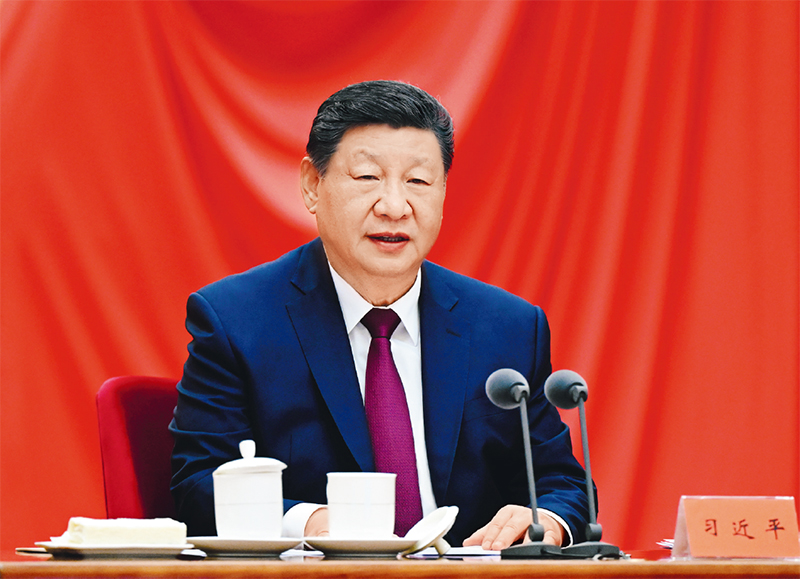
2026年1月12日,中共中央总书记、国家主席、中央军委主席习近平在中国共产党第二十届中央纪律检查委员会第五次全体会议上发表重要讲话。 新华社记者 谢环驰/摄
一、更加坚决有力地贯彻落实党中央重大决策部署
贯彻落实党中央重大决策部署,是维护党中央权威和集中统一领导的根本要求,也是党和人民事业不断发展进步的重要历史经验。中国共产党因理想而生,为使命而战。正是在党中央坚强领导下,一代又一代共产党人不畏艰难接续奋斗,成功带领中国人民从半殖民地半封建社会一步步站起来、富起来、强起来,开辟了中国特色社会主义的人间正道。现在,我们到了基本实现社会主义现代化的关键时期,前进道路上必将面对风高浪急甚至惊涛骇浪的重大考验。只要心中有理想、胸中有家国、肩上有使命,就能站得高看得远,不断增强信心和力量;就能压倒一切困难、不为困难所压倒,形成全党一条心、全国一盘棋,切实把党中央重大决策部署贯彻落实好,凝心聚力征服一个个“娄山关”、“腊子口”。各级党组织和广大党员、干部要增强政治责任感、历史使命感,以党的初心为本心、以党的使命为生命,把全部智慧和力量凝聚到实现党的中心任务上来。各级领导干部要从实现党的使命任务出发,树立和践行正确政绩观,看自己的思想和行动有没有偏离共产主义远大理想和中国特色社会主义共同理想,有没有背离全心全意为人民服务根本宗旨,有没有游离党的路线方针政策和党中央重大决策部署,有没有脱离国情和本地区本部门实际,以功成不必在我、功成必定有我的精神境界,心无旁骛推进中国式现代化。
对贯彻落实党中央重大决策部署,我们党有健全的机制,总体上是顺畅、有力的。同时,从巡视巡察、审计、督查等了解的情况看,对党中央重大决策部署不落实、乱落实等问题仍然存在,有的方面还比较突出。必须明确,贯彻落实党中央重大决策部署是党的政治纪律和政治规矩的基本要求。我们强调“两个维护”、同党中央保持高度一致,必须体现到落实党中央重大决策部署的实际行动上,不能空喊口号,更不能说一套做一套。谁违反,谁就要受到追究,该批评的批评,该调整的调整,该处分的处分,不能轻描淡写、含含糊糊。要切实加强这方面的政治监督。
“十五五”时期,我国经济社会发展任务十分繁重。要紧紧围绕贯彻新发展理念、推动高质量发展、加快构建新发展格局等战略部署,聚焦建设现代化产业体系、因地制宜发展新质生产力、建设全国统一大市场、扩大高水平对外开放、扎实推进全体人民共同富裕、常态化防止返贫致贫、化解地方政府隐性债务、加强生态环境保护、统筹发展和安全等任务要求,加强具体化、精准化、常态化的监督,用好巡视成果、强化整改监督,保障党的二十届四中全会各项决策部署落到实处。今年开始地方将陆续换届,要防止临近换届等待观望不作为、换届后急功近利“翻烧饼”,确保一张蓝图绘到底。需要指出的是,坚决有力贯彻落实党中央重大决策部署与创造性开展工作并不矛盾。任何工作都要实事求是、从实际出发,切忌生搬硬套、上下一般粗。要在严格监督的同时,支持鼓励各地区各部门结合实际探索贯彻落实党中央重大决策部署的有效方法和途径,确保最终效果符合党中央决策意图、政策初衷。
贯彻落实好党中央重大决策部署,关键在人,必须警惕心怀二志、言行不一的“两面人”。“两面人”的表现形形色色。主要是有的口口声声讲政治忠诚、“两个维护”,对贯彻落实党中央重大决策部署表态很快、调门很高,实际上却阳奉阴违、我行我素,甚至有令不行、有禁不止,大搞“七个有之”。还有的思想上搞自由主义,信奉个人至上,对新时代中国特色社会主义思想合则用、不合则弃;有的政治上搞投机主义,巧言令色,见风使舵,哪里有利益就往哪里钻,随时准备“跳船”;有的组织上搞宗派主义,立山头、拉圈子,排斥异己,借集体之名行小团体之私;有的工作上搞本位主义,私心很重,眼里只有自己的“一亩三分地”,不惜为了局部损害全局、为了眼前牺牲长远;有的履责上搞好人主义,发现问题不制止、不纠正,任其蔓延泛滥,美其名曰维护团结,实则逃避担当。凡此种种,都违背党性原则,严重阻碍党中央重大决策部署贯彻落实,对党的事业、党的形象危害极大,要敢于揭露、果断清理。换届过程中务必擦亮眼睛,把真正忠诚可靠、表里如一、担当尽责的好干部用起来,决不让“两面人”、私字当头的人蒙混过关。
二、更加科学有效地把权力关进制度笼子
把权力关进制度笼子,是新时代全面从严治党的一项重要任务。党的十八大后,我们制定的第一部重要党内法规就是中央八项规定,之所以由此开局破题,是因为“四风”问题很多表面上是脱离群众、享乐奢靡,本质上则是结党营私、朋比为奸,掩盖的是权权交易、权钱交易、权色交易,严重损害党在群众心中的形象。我们从群众反映最强烈的问题入手,立铁规矩、强硬约束,咬定青山不放松,以钉钉子精神抓落实,刹住了不少过去认为不可能刹住的歪风,祛除了一些多年难以祛除的顽瘴痼疾,终结了“几百个文件管不住一张嘴”的乱象,以徙木立信之举推动党风政风焕然一新,为党和国家事业发展凝聚起强大正能量。去年在全党开展的学习教育,进一步统一思想、深化认识,总结经验、完善措施,表明把中央八项规定一抓到底的坚定决心。落实中央八项规定精神没有捷径,关键就在常、长二字,不经常抓容易出现反复,不长期抓难以形成自觉。要巩固拓展深入贯彻中央八项规定精神学习教育成果,不断完善经常性发现问题、解决问题机制,推进作风建设常态化长效化。
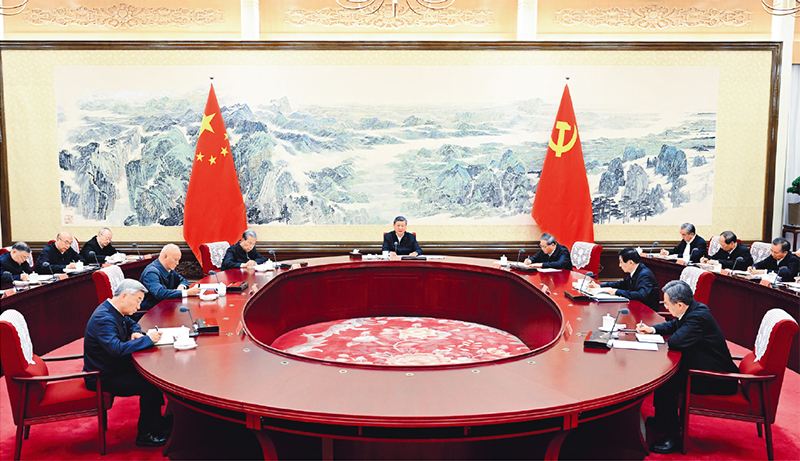
2025年12月25日至26日,中共中央政治局召开民主生活会,中共中央总书记习近平主持会议并发表重要讲话。 新华社记者 谢环驰/摄
深入贯彻中央八项规定精神的实践告诉我们,把权力关进制度笼子,既要完善制度规定,把笼子织密织牢,又要提高制度执行力,增强刚性约束。党的十八大以来,党中央高度重视法规制度建设,制定修订数量之多前所未有,目前已经形成比较完善的法规制度体系。同时要看到,一些法规制度规定过于原则笼统、针对性操作性不够强,不同法规制度之间衔接不够紧密、存在缝隙漏洞,针对新领域、新业态、新群体等的法规制度建设相对滞后。要不断完善法规制度,根据管党治党现实需要加强制度供给,空白缺位的抓紧建立,不全面、滞后的尽快修订补充,使制度密而不繁、有效管用,防止“牛栏关猫”。
这些年,我们在抓法规制度执行上也采取了一系列措施,但一些党组织制度空转的问题仍然存在,一些地方制度执行力层层递减,结果导致“纸笼禁虎”。明规矩不彰,潜规则必然盛行;潜规则大行其道,明规矩就会沦为摆设。为什么社会上活跃着那么多政治掮客、政治骗子?就是因为潜规则导致法规制度不起作用、产生破窗效应,有的干部靠人脉不靠组织,有的人信关系不信法纪。长此以往,“劣币驱逐良币”、“章子不如条子”,必然侵蚀政治生态、滋生腐败乱象。遏制潜规则,关键在于提升明规矩的执行力。要加强法规制度宣传教育,引导党员、干部懂法纪、明规矩、知敬畏,认识到法规制度既是“紧箍咒”、更是“护身符”。要进一步提高党务、政务等的透明度,真正让权力在阳光下运行,使潜规则失去市场。要坚持法规制度面前人人平等、遵守法规制度没有特权、执行法规制度没有例外,对“闯红灯”、“翻栅栏”的严肃查处,对其中负领导责任的坚决追究,确保制度规定真正成为带电的高压线。
一个地区、一个部门制度执行得好不好,关键在“一把手”。把权力关进制度笼子,要重点解决好“一把手”带头执行制度的问题。党中央关于加强对“一把手”和领导班子监督的意见,对贯彻执行民主集中制、完善“三重一大”决策监督机制等提出了明确要求,各级领导班子成员特别是“一把手”要以身作则、带头执行到位,相关监督也要到位。
三、更加清醒坚定地推进反腐败斗争
党的十八大以来,我们党深入推进自我革命,坚定不移反对腐败,成功走出一条在党中央集中统一领导下,标本兼治、一体推进不敢腐不能腐不想腐的中国特色反腐败之路。这条路要坚定走下去。
当前,腐败问题仍然易发多发。事实再次表明,党中央关于“反腐败斗争形势仍然严峻复杂,铲除腐败滋生土壤和条件任务仍然艰巨繁重”的判断是完全正确的,反腐败斗争永远在路上、永远是进行时,必须以愚公移山、精卫填海的精神一抓到底;再次警示我们,腐败是我们党面临的最大风险、最大威胁、最大挑战,是党和国家事业发展进程中的拦路虎、绊脚石,如果任其滋生蔓延,势必破坏经济发展环境,诱发各种风险隐患,动摇党的执政根基。实践再次启示我们,反腐败是一场输不起也决不能输的重大斗争,一刻不能停、半步不能退,“沉舟侧畔千帆过,病树前头万木春”,“病树”该拔就拔、该伐就伐。必须“宜将剩勇追穷寇”,保持战略定力和战斗韧性,继续起底清理,彻底正本清源。不管面对多大阻力、付出多大代价,都要把反腐败斗争进行到底!不管是谁、不管职位多高、不管贡献多大,只要搞腐败,就决不姑息!
必须保持高压态势不动摇。坚持有腐必反、有贪必肃、除恶务尽,让腐败分子没有藏身之地。要聚焦权力集中、资金密集、资源富集领域,紧盯政商勾连、权力为资本提供保护、资本向政治领域渗透等问题,加大对“一把手”、年轻干部等贪腐问题查处力度,着力清除不收敛不收手、肆意妄为的贪腐者,坚决查处明知故犯、一犯再犯的行贿人,深挖细查预期收益、约定代持、政商“旋转门”等新型腐败和隐性腐败,深入推进群众身边不正之风和腐败问题集中整治,加大跨境腐败治理和追逃追赃力度。发生重大腐败案件的地方和部门要认真肃清流毒,坚决彻底地把污染源清除干净。
必须不断提高反腐败穿透力。要把握腐败新动向新特点,创新手段方式,进一步及时发现、准确识别、有效治理各类腐败问题。要深化风腐同查同治,透过“风”的表象,揭开“腐”的本质,深挖不作为乱作为背后的以商养官、以官护商、官商一体,彻查违规吃喝背后的请托办事、利益输送,严惩结交政治掮客、政治骗子等行为。要强化科技赋能,注重运用大数据等手段提高监督执纪执法效能。当然,使用新技术手段要强化伦理规范、数据安全,严格依规依纪依法进行。要完善反腐败责任落实机制。各级党委(党组)要坚决扛起主体责任,书记要认真履行第一责任人责任,立场坚定、态度鲜明,带动各有关方面切实负起责任,不要以为反腐败只是纪委监委的事,真正做到知责、担责、履责。
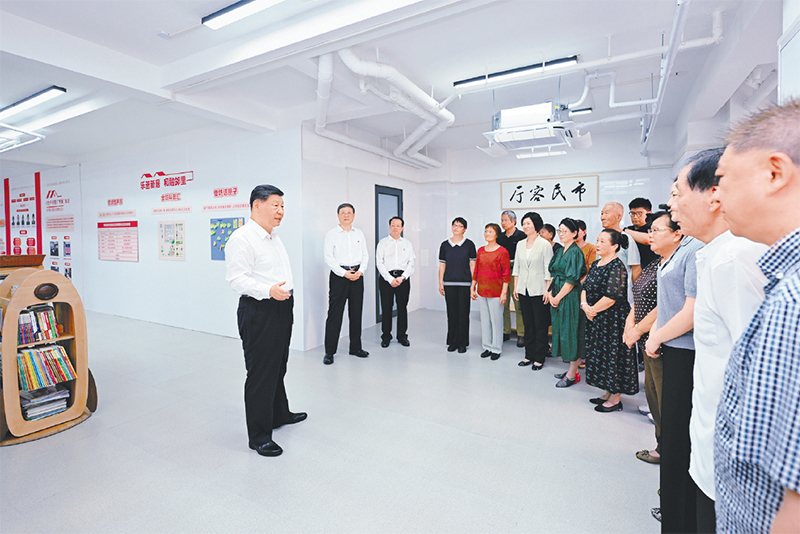
2026年7月15日,中共中央总书记、国家主席、中央军委主席习近平在上海考察。这是习近平在黄浦区半淞园路街道市民新村居民区考察时,在社区党群服务站同居民代表、街道干部、社区工作者等亲切交流。 新华社记者 谢环驰/摄
必须在一体推进上下更大功夫。一体推进不敢腐、不能腐、不想腐,重在“一体”,也难在“一体”,要强化系统观念,做到同时发力、同向发力、综合发力。实践中可以有所侧重,但不能割裂和偏废,防止阶段论、环节论影响反腐败实效。要进一步健全反腐败工作机制,在任务部署、资源配置、工作推进、成效考核上联动配合,把党组织日常监督、纪检监察监督和巡视、审计、信访、舆论等各方面监督贯通起来,统筹用好全面监督的“无影灯”和强力办案的“手术刀”,以全链条协作促进一体化治理。要抓实以案促改促治,剖析腐败成因,查找管理漏洞,利用典型案件开展警示教育,不能让老问题反复发生、让代价白付。要按照新时代好干部标准选人用人,构建积极健康的党内同志关系和亲清政商关系,持续净化政治生态。要加强新时代廉洁文化建设,提高廉洁教育的针对性和有效性,大力营造崇廉拒腐、尚俭戒奢的社会环境。
纪检监察机关在推进全面从严治党中责任重大、使命光荣,要始终牢记自己是干什么的,坚定维护党的团结统一,坚定捍卫党的先进性纯洁性。要持续加强纪检监察工作规范化法治化正规化建设,不断提高监督执纪执法质效。要坚持刀刃向内,坚决清除害群之马。要按照政治过硬、能力过硬、作风过硬、廉洁过硬的要求,持续加强队伍建设,着力锻造忠诚干净担当、敢于善于斗争的纪检监察铁军。
※这是习近平总书记2026年1月12日在二十届中央纪委五次全会上讲话的主要部分。
来源:《求是》2026/20 作者:《求是》杂志编辑部 2026-10-15 15:00:04
把习近平党建思想贯彻到从严管党治党实践中
《求是》杂志编辑部
管党治党、兴党强党,一刻也离不开思想的引领。党的十八大以来,以习近平同志为核心的党中央坚持党要管党、全面从严治党,围绕建设什么样的长期执政的马克思主义政党、怎样建设长期执政的马克思主义政党这个重大时代课题,提出一系列新理念新思想新战略,形成习近平党建思想,为加强新时代党的建设提供了根本遵循。
全面从严治党永远在路上。2026年1月12日,习近平总书记在二十届中央纪委五次全会上发表重要讲话,《以更高标准、更实举措推进全面从严治党》一文是讲话的主要部分。在这篇重要文章中,习近平总书记强调要“持之以恒推进全面从严治党”,并深刻阐述了更加坚决有力地贯彻落实党中央重大决策部署、更加科学有效地把权力关进制度笼子、更加清醒坚定地推进反腐败斗争三个重大问题,这对于进一步抓紧抓实党的建设各项工作,不断把我们党治理好、建设强,具有重要指导意义。要结合学习习近平总书记这篇重要文章,深入领会习近平党建思想的核心要义和实践要求,以更高标准、更实举措落实党中央关于全面从严治党的决策部署,不断开创管党治党、兴党强党新局面。
充分认识习近平党建思想重大而深远的指导意义
一种思想的力量,往往要经过实践的淬炼、历史的检验,才能愈发展现其真理光芒。
党的十八大之前的一个时期,党的建设新的伟大工程取得显著成效,同时一系列长期积累及新出现的突出矛盾和问题亟待解决,当时党内和社会上不少人对党和国家前途忧心忡忡。面对这样的形势,习近平总书记在十八届中央政治局常委同中外记者见面时掷地有声地宣示:“坚持党要管党、从严治党,切实解决自身存在的突出问题”。
言出必行,说到做到。自那时起,从中央政治局做起、从领导干部严起,管党治党的螺丝越拧越紧,党风政风和社会风气持续向好。曾经,“几百个文件管不住一张嘴”,公款吃喝、铺张浪费屡禁不止;如今,中央八项规定精神深入人心,“舌尖上的浪费”、“会所中的歪风”、“车轮上的腐败”得到有力遏制,群众身边的“四风”问题少了。曾经,一些地方政治生态污浊,买官卖官、拉票贿选时有发生,形形色色的潜规则让干部寒心、群众揪心;如今,选人用人风气明显好转,政治生态日渐清朗,越来越多的干部把心思用在干事上,凭实干赢得群众信任。曾经,一些基层党组织软弱涣散,群众办事找不到门、找不到人,惠民政策卡在“最后一公里”;如今,基层党组织作用得到更好发挥,群众办事有人管、困难有人帮,党的旗帜在基层一线高高飘扬。曾经,有的地方和部门发生系统性塌方式腐败,不少人对反腐败能否深入持久心存疑虑;如今,“打虎”、“拍蝇”、“猎狐”多管齐下,不敢腐、不能腐、不想腐一体推进的成效日益显现,人民群众对党风廉政建设和反腐败工作的信心和满意度持续提升。
党的十八大以来的这14年,在历史长河中不过一瞬;对中国共产党来说,这14年间却在革命性锻造中发生了有目共睹的深刻变化。靠的是什么?根本就在于以习近平同志为核心的党中央领航掌舵,在于习近平新时代中国特色社会主义思想科学指引。作为习近平新时代中国特色社会主义思想的党建篇,习近平党建思想为破解新时代党的建设重大理论和实践问题,以“中国共产党之治”引领保障“中国之治”,提供了有力武器和行动指南。
实践是理论的源头活水。新时代全面从严治党之所以能够取得历史性、开创性成就,很重要的一点就在于我们党立足波澜壮阔的管党治党实践,边总结、边思考、边升华,及时把成功经验和有效做法上升为规律性认识,又反过来指导新的实践。从制定和落实中央八项规定开局破题,到明确新时代党的建设总要求;从把党的政治建设摆在党的建设统领位置,到坚持思想建党和制度治党同向发力;从健全上下贯通、执行有力的组织体系,到锻造忠诚干净担当的高素质干部队伍;从持之以恒正风肃纪,到以零容忍态度反腐惩恶……一系列重大举措接续发力、逐步深化,有力推动管党治党从宽松软走向严紧硬,实现了从实践探索到理论升华的质的飞跃。可以说,习近平党建思想是在回应时代之问、在实践与认识的互促共进中形成的,饱含着百年大党对自身和国家前途命运的深沉忧思,是对新时代全面从严治党实践经验的系统总结和理论升华。
“每个原理都有其出现的世纪。”从马克思主义政党建设的历史长河,从当代世界政党制度发展的时代大背景下来认识,可以更加深刻领会习近平党建思想的时代价值和重大意义。马克思主义经典作家基于特定历史条件,没有也不可能系统回答无产阶级政党夺取政权后如何实现长期执政的问题。对这一重大课题的回答,历史地落在了中国共产党人肩上。习近平党建思想立足新时代党执政新的历史方位,把马克思主义基本原理同中国具体实际相结合、同中华优秀传统文化相结合,围绕长期执政条件下党的建设构建起一套完整的理论体系。这一思想既坚守马克思主义建党学说最基本、最核心的内容,又总结继承我们党的建设成就和理论成果,在研究新情况解决新问题中守正创新、推陈出新,以一系列富有时代性、原创性的思想成果丰富和发展了马克思主义建党学说。真理的力量是超越国界的。习近平党建思想放眼世界政党制度发展历程,深入分析世界政党兴衰成败,深刻总结和镜鉴马克思主义政党经验教训,为世界范围内马克思主义政党建设提供了有益借鉴。许多国际人士评价,习近平党建思想不仅为“世界第一大党”迈向“世界最强大政党”提供了指引,也打破了一些人对西方政党制度和理论的迷思,为世界政治文明发展进步贡献了中国智慧。
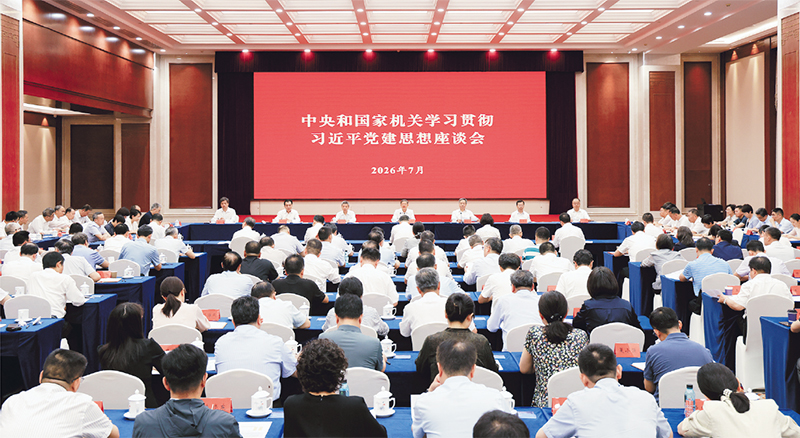
中央和国家机关是践行“两个维护”的第一方阵和贯彻落实党中央决策部署的“最初一公里”,要在学习贯彻习近平党建思想上发挥表率示范作用。图为2026年7月29日,中央和国家机关学习贯彻习近平党建思想座谈会在京召开,对持续推动学习贯彻习近平党建思想走深走实作出部署。 中央和国家机关工委供图
习近平党建思想是在新时代强党强国伟大历史进程中形成的,对管党治党、兴党强党和强国复兴具有重大现实意义和长远指导意义。当前,基本实现社会主义现代化进入夯实基础、全面发力的关键时期,战略机遇和风险挑战并存、不确定难预料因素增多。向外看,世界百年变局加速演进,单边主义、保护主义加剧,外部环境的复杂性、严峻性、不确定性上升。向内看,改革发展稳定面临不少深层次矛盾躲不开、绕不过,干部队伍能力素质和精神状态与现代化建设要求仍有差距。从党自身看,党面临的“四大考验”、“四种危险”长期存在,“四风”问题树倒根存,反腐败斗争形势仍然严峻复杂,铲除腐败滋生土壤和条件任务仍然艰巨繁重。这些都使管党治党的长期性、艰巨性、复杂性更加凸显。习近平党建思想把握世情国情党情的深刻变化,既立足当前解决突出问题,又着眼长远作出系统谋划和部署,必将指引全党以更高标准、更实举措把新时代全面从严治党宝贵经验坚持好、运用好,把党的建设面临的突出问题整治好、解决好,把管党治党形成的良好政治局面巩固好、发展好,为强国建设、民族复兴提供坚强政治保证。
深入领会习近平党建思想的丰富内涵和实践要求
翻开《习近平党建文选》第一卷、第二卷,可以看到包括《以更高标准、更实举措推进全面从严治党》这篇重要文章在内的102篇著作,这些著作生动记录了习近平党建思想形成发展的历史脉络,全景展现了习近平党建思想的丰富内涵。
习近平党建思想这座理论大厦的“四梁八柱”是什么?就是“十四个坚持”。这“十四个坚持”言简意赅、饱含深意。“坚持党的领导是中国特色社会主义最本质的特征”居于首位,充分彰显党的领导对于中国特色社会主义的本质规定性,明确了新时代坚持和发展中国特色社会主义的根本政治保证。“坚持党中央集中统一领导”是党的领导的最高原则,把握这一条,就要深刻领悟“两个确立”的决定性意义,坚决做到“两个维护”。“坚持全面从严治党”是新时代党的建设的战略方针,必须把严的基调、严的措施、严的氛围长期坚持下去。“坚持不忘初心、牢记使命”是党的宗旨立场和价值取向,要牢记江山就是人民、人民就是江山,把为民造福作为最大政绩。党的政治建设决定党的建设方向和效果,“坚持以党的政治建设为统领”明确了新时代党的建设的根本要求。“坚持用党的创新理论凝心铸魂”是党的思想建设的根本任务,必须加强理论创新和理论武装,自觉做习近平新时代中国特色社会主义思想的坚定信仰者和忠实实践者。“坚持锤炼坚强党性”是党员、干部的终身课题,每名党员、干部都要牢记自己的第一身份是共产党员,对党忠诚、为党分忧、为党担责、为党尽责。党的力量来自组织,“坚持健全上下贯通、执行有力的组织体系”是党的优势所在、力量所在,要增强党组织政治功能和组织功能,推动基层党组织全面进步、全面过硬。“坚持建设堪当民族复兴重任的高素质干部队伍”是关系党和国家事业的关键性问题,必须贯彻新时代好干部标准,统筹做好选育管用工作,造就一支忠诚干净担当的高素质干部队伍。“坚持推进作风建设常态化长效化”是保持党同人民群众血肉联系的有效途径,要锲而不舍落实中央八项规定精神,常抓不懈、久久为功。纪律是管党治党的戒尺,“坚持用严明的纪律管全党治全党”是全面从严治党的治本之策,必须把纪律挺在前面,使纪律真正成为带电的高压线。腐败是我们党面临的最大风险、最大威胁、最大挑战,“坚持一体推进不敢腐不能腐不想腐”是全面从严治党的重要方略和反腐败斗争的基本方针,必须坚决打好反腐败斗争攻坚战持久战总体战。“坚持制度治党、依规治党”是全面从严治党的长远和根本之策,要健全党内法规制度体系,不断提高管党治党科学化、制度化、规范化水平。“坚持落实管党治党政治责任”是全面从严治党需要牢牢牵住的“牛鼻子”,要健全各负其责、统一协调的管党治党责任格局,切实把党建工作抓实、抓细、抓到位。
“十四个坚持”内在联系、相互支撑,构成了一个逻辑严密、系统完备的科学体系。从主题看,每一个“坚持”都紧扣建设什么样的长期执政的马克思主义政党、怎样建设长期执政的马克思主义政党这一重大时代课题,从不同方面和角度展开阐述,“十四个坚持”同答一题,一条主线贯穿始终。从结构看,前四个“坚持”是总论,深刻阐明党的建设的最高原则、战略方针和价值追求;中间九个“坚持”是分论,依次阐述党的政治建设、思想建设、组织建设、作风建设、纪律建设、反腐败斗争、制度建设等,明确了新时代党的建设工作布局和分领域的重点任务;最后一个“坚持”管落实,是推动全面从严治党各项任务落地见效的有力保障。总论举旗定向,分论系统铺展,末条压实责任,“十四个坚持”层次分明、纲举目张。从旨归看,这一体系深刻揭示了管党治党、兴党强党和强国复兴的内在联系,把党的建设置于强国复兴全局中谋划和推进。主题一以贯之,结构各居其位,旨归同向一处,“十四个坚持”连成一体,科学体系的大厦坚固牢靠。
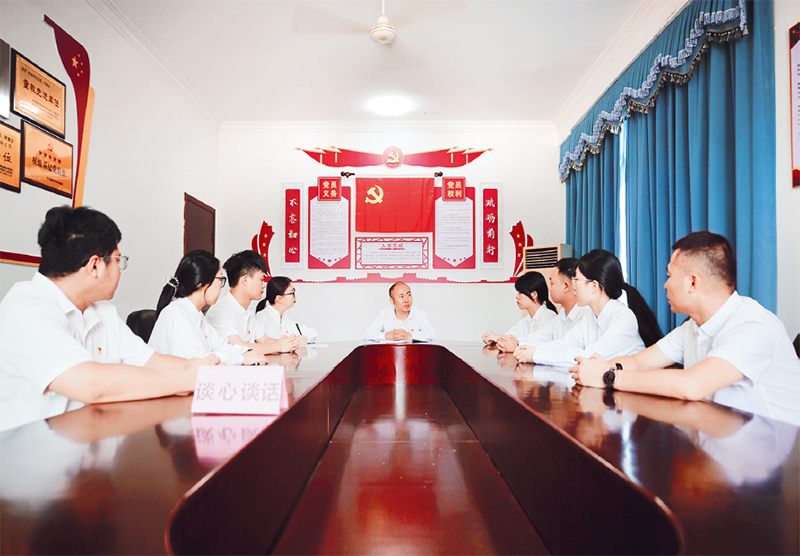
党的十八大以来,管党治党政治责任不断压紧压实,推动全面从严治党持续向纵深发展。图为2026年9月16日,福建省福安市纪委监委对年轻党员、干部开展谈心谈话,坦诚交流思想、检视存在问题。 福安市纪委监委组织和宣传部 蔡晓敏/摄
把握精髓要义,既要读懂科学内涵,还要体悟理论品格。习近平党建思想深刻阐明了中国共产党是什么、要干什么这个根本问题,彰显了马克思主义的真理力量,饱含着习近平总书记的政治智慧、思想光芒和人格魅力,具有独特而富有感召力的理论品格。坚定的理想信念,给我们把准方向、明辨是非、矢志奋斗的强大动力;高度的历史主动,让我们永葆“赶考”的清醒和坚定;鲜明的问题导向,推动盯住突出问题靶向施治、动真碰硬;强烈的使命担当,彰显伟大工程对伟大斗争、伟大事业、伟大梦想的决定性作用;深厚的为民情怀,把一切工作落到人民对美好生活的向往;科学的思想方法,指引我们前瞻性思考、全局性谋划、整体性推进党的建设。把这些品格学深悟透,就能更好把握习近平党建思想的精神实质,从中汲取真理力量、精神力量和人格力量。
科学理论的价值,最终要体现在回答实践问题、引领实践发展上。习近平党建思想具有明体达用、体用贯通的鲜明特征。明体,就是深刻揭示马克思主义执政党建设的根本方向、重大原则和内在规律;达用,就是把规律性认识转化为管党治党、兴党强党的实践要求、制度机制和工作方法;贯通,就是体与用内在统一,根本道理立起来,实践要求落下去。“十四个坚持”之中,每一个“坚持”都有大量的理论阐述和明确的实践要求,既讲怎么看,又讲怎么办,既部署“过河”的任务,又指导解决“桥或船”的方法问题。体立得正,为的是用行得远;体用贯通,贯通的关键也在用。无论是党的政治建设、思想建设、组织建设、作风建设、纪律建设、反腐败斗争、制度建设,还是落实责任,全面从严治党每一项工作都应从这个科学体系里找遵循、找方法,对标对表、校准偏差。习近平党建思想是管党治党、兴党强党的强大思想武器,其中的道理正在于此。
把习近平党建思想贯彻到党的建设全过程各方面
学习贯彻习近平党建思想,是一个由知到信再到行的过程。学习是起点,也是前提和基础。学习,既要坚持读原著、学原文、悟原理,联系实际学,更要在系统深入上下功夫,着力于整个体系的全面贯通、完成从零散化理解向体系化把握提升,着力于对立场观点方法的透彻掌握、推动从表层化认知向规律性认识深化,着力于思想自觉和价值认同、实现从理论认知向信念信仰的升华。经由这样一步一步的深学细悟,才能把这一重要思想的精髓要义学到手、学到家,进而把学习成效转化为全面从严治党的生动实践。
行是最终的落脚点。习近平党建思想明确了管党治党的“路线图”和“任务书”,只有坚持用这一重要思想谋划和推进党的各方面建设,将其贯彻落实到党的建设全过程各方面,方能充分彰显其实践伟力。要紧密联系正在做的事情,聚焦重点领域,找准工作切入点、着力点,做好结合的文章。管党治党是全党共同的任务,但不同层级、不同领域、不同行业情况千差万别,要抓的重点工作、采取的方式方法也应有各自不同的特点。脱离实际、忽视差异,上下一般粗、笼而统之作部署提要求,不仅无助于推动工作,反而容易造成责任悬空、落实弱化。要坚持实事求是、因地制宜,把党中央统一的部署要求,细化为贴合自身实际的具体举措。比如,机关单位要聚焦加强党的政治建设、作风建设与履职效能等,强化大局意识、严明纪律规矩,同时加强对重点岗位、关键权力的监督约束,充分发挥示范引领作用;城乡基层要突出服务群众和提升治理效能,建强战斗堡垒,妥善化解各类矛盾问题,维护群众切身利益;各类企事业单位、“两新”组织等,需紧密结合各自行业、领域的属性特点,推动党建工作深度融入中心工作,实现管党治党与事业发展互促互进。只有坚持分类施策、精准发力,才能推动习近平党建思想落地生根,转化为实实在在的效果。
贯彻落实党中央重大决策部署,是学习贯彻习近平党建思想的重要着力点,也是检验学习贯彻成效的重要标准。习近平总书记在这篇重要文章中鲜明指出,贯彻落实党中央重大决策部署,是维护党中央权威和集中统一领导的根本要求,也是党的政治纪律和政治规矩的基本要求,强调在贯彻落实上要更加坚决有力。对此,要从政治高度上深化认识,真正把“两个维护”体现到实际行动上,不能空喊口号,更不能说一套做一套。要切实加强政治监督,硬起手腕,谁违反就追究谁,决不轻描淡写、含含糊糊。同时也要看到,坚决有力贯彻落实党中央重大决策部署与创造性开展工作并不矛盾,各地区各部门要结合实际探索贯彻落实的有效方法和途径,确保最终效果符合党中央决策意图、政策初衷。贯彻落实好党中央重大决策部署,关键在人。总书记强调必须警惕心怀二志、言行不一的“两面人”,点明了现实中阻碍党中央重大决策部署贯彻落实的突出因素。为此,必须把好选人用人关,把真正忠诚可靠、表里如一、担当尽责的好干部用起来,决不让“两面人”、私字当头的人蒙混过关。
新时代全面从严治党取得伟大成就,但党内存在的思想不纯、组织不纯、作风不纯等突出问题尚未得到根本解决,而且新情况新问题也不断出现。贯彻落实习近平党建思想,必须在研究解决管党治党突出问题上持续发力。在这些问题中,如何坚持制度治党、依规治党,更加科学有效地把权力关进制度笼子,是一个带有根本性、全局性的问题。习近平总书记在这篇重要文章中强调,把权力关进制度笼子,既要完善制度规定,把笼子织密织牢,又要提高制度执行力,增强刚性约束。这一重要论述,从制度供给、制度执行等方面深入回答了制度笼子如何才能真正扎紧、带电、有效等关键问题,揭示了制度治权的基本方法论。实践中,要将科学制度供给与刚性制度执行紧密结合,融入权力行使全过程,确保权力始终在制度的轨道上运行,实现规范用权、有效治权。腐败的本质是权力滥用。当前,腐败问题仍然易发多发,必须更加清醒坚定地推进反腐败斗争,为新征程上党和国家事业发展清除绊脚石、拦路虎。“不管面对多大阻力、付出多大代价,都要把反腐败斗争进行到底”,“不管是谁、不管职位多高、不管贡献多大,只要搞腐败,就决不姑息!”总书记斩钉截铁的话语、不容置疑的态度,鲜明传递出党中央坚定不移推进反腐败斗争的强大决心意志。这不仅是向全党发出的严厉警示,更是向历史、向人民作出的庄严承诺。要保持高压态势不动摇,不断提高反腐败穿透力,在一体推进不敢腐、不能腐、不想腐上下更大功夫。强化系统观念,注重统筹联动,既要严惩腐败、让不敢腐的震慑充分彰显,又要堵塞制度漏洞、扎紧不能腐的笼子,还要筑牢思想堤坝、增强不想腐的自觉,做到三者同时发力、同向发力、综合发力。
再过几天,党的二十届五中全会将在北京召开,对持之以恒推进全面从严治党作出战略部署。这对于我们党坚持以习近平党建思想为指引、深入推进新时代党的建设新的伟大工程,具有重大现实意义和长远指导意义。各级党组织和全体党员、干部要切实增强管党治党责任意识,把责任牢牢抓在手上、坚定扛在肩上,持续巩固发展全党动手一起抓的良好局面,把我们这个百年大党建设得更加坚强有力。


No comments:
Post a Comment