
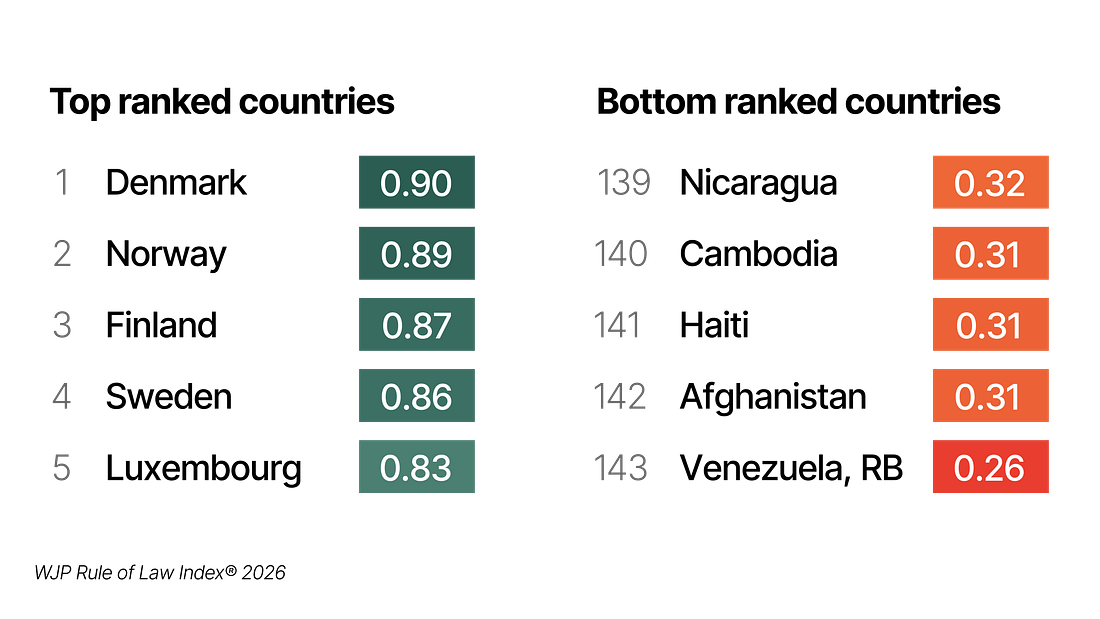
The World Justice Project (WJP) Rule of Law Index® 2026 is the latest report in an annual series measuring people’s perceptions and experiences of the rule of law around the world. The Index is the world’s leading source for original, independent data on the rule of law, and it is WJP’s hope that this diagnostic tool will help identify strengths and weaknesses, encourage policy choices, guide program development, and inform research to strengthen the rule of law. The following pages contain a selection of key insights and data trends from 2026. In contrast with previous versions of the report, WJP has migrated portions of the Index—including country profiles, the methodology, and supplemental data visualizations—online. These and other resources, such as our questionnaires and variable map, are available for download on our website: worldjusticeproject.org/index. (here)
Explore the full Index dataView the 2026 Rankings
Dive into the Insights
Download the Complete WJP Index 2026 Report
Access Detailed Country Profiles, now with a redesigned layout!
Pro Tip: Remember, you can download all of our historical data from the top-right “Download” button on the Index website for comprehensive trend analysis.
Key takeaways-Authoritarianism is no longer an emerging trend – it has become entrenched.
-Government interference is compromising the justice system.
-Improvements in access to justice are emerging.
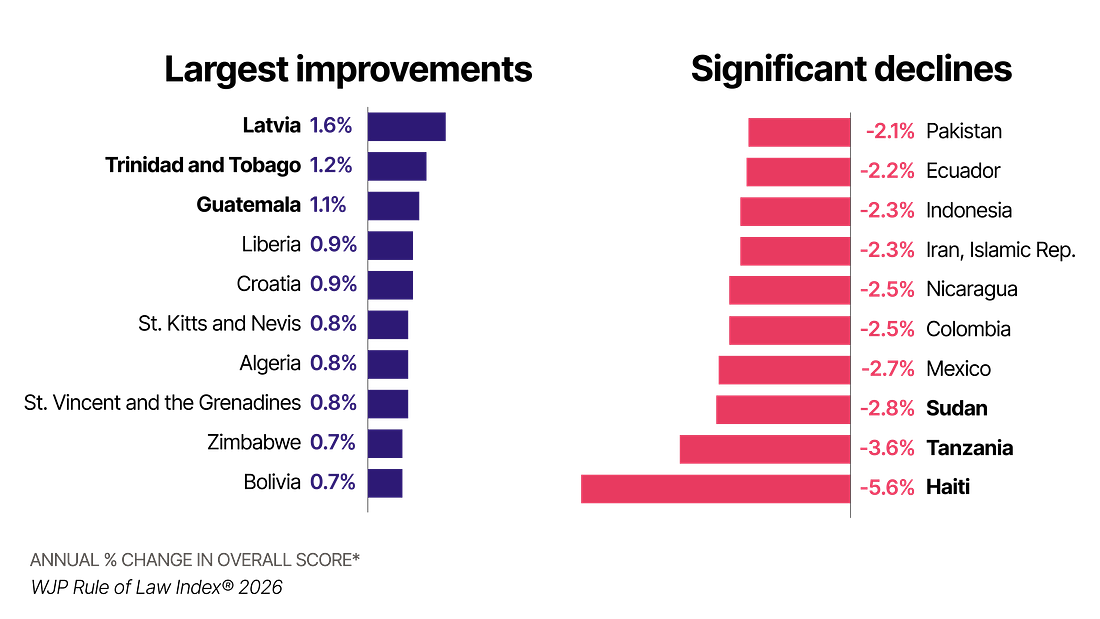
-Progress is possible: Poland and Brazil recorded the world’s two largest improvements over the past three years, demonstrating that institutional momentum can shift.
-Where the rule of law is stronger, prices are stable and risk is lower.
Staff Shorts: from the U.S. results to this year’s cover. Get behind the scenes and let our staff walk you through their research and designs.The art behind this year’s cover
Sovereign risk & the rule of law
Are courts losing power?
The erosion of the rule of law in the U.S.
Economic benefits of the rule of law
Improvements in access to justice
Did you miss the launch? Watch to get the 2026 WJP Rule of Law Index’s key data and expert analysis on rule of law and the economy.
 |
| Pix credit here |
The WJP Rule of Law Index 2026 Report may be accessed HERE.
As in prior years, all of this makes for quite useful ad fascinating reading. For me, though, the most fascinating part s its semiotics. Analytics has an ideology, ideology has a metric, and metric engages ideology at the operational level, both fixing meaning and being fixed by it. In a sense, metrics around ideals that manifest ideological expectations or yearnings---produces a sort of inter-subjectivity that is both recursive and dialectic.


 |
| Pix Credit WJP Methodology HERE |
Methodology
The WJP Rule of Law Index represents the first attempt to
systematically and comprehensively quantify the rule of law
around the world and remains unique in its operationalization
of rule of law dimensions into concrete questions.
The WJP Rule of Law Index 2026 report presents information
on eight composite factors that are further disaggregated
into 44 specific sub-factors (see page 17). Factor 9: Informal
Justice is included in the conceptual framework but has been
excluded from the aggregated scores and rankings in order to
provide meaningful cross-country comparisons.
The country scores and rankings presented in this report
are built from more than 550 variables drawn from the
assessments of over 215,000 households and 3,400 surveys
from legal practitioners and experts in 143 countries and
jurisdictions, making it the most accurate portrayal of the
factors that contribute to shaping the rule of law in a country.
Data Sources
To present an image that accurately captures the rule of law
as it is experienced in practice, each score of the Index is
calculated using a large number of questions drawn from two
original data sources collected by the World Justice Project
in each country: a General Population Poll (GPP) and a series
of Qualified Respondents’ Questionnaires (QRQs). These
sources collect up-to-date firsthand information that is not
otherwise available at the global level, constituting the world’s
most comprehensive dataset of its kind. Each survey captures
people-centered data based on the lived experiences of
ordinary people and in-country professionals concerning the
performance of the state and its agents in terms of the actual
operation of the legal framework in their country.
Through the GPP, WJP collects primary data on the public’s
interactions with a range of pertinent rule of law mechanisms.
These topics include people’s dealings with the government,
the ease of interacting with state bureaucracy, the extent of
bribery and corruption, the availability of dispute resolution
systems, and the prevalence of common crimes to which they
are exposed.
The GPP survey instrument includes 127 perception-based
questions and 213 experience-based questions, along
with socio-demographic information on all respondents.1
The questionnaire is translated into local languages,
adapted to common expressions, and administered by
leading local polling companies using a probability sample
of 1,000 respondents. In previous editions of the Index,
the poll was conducted in the three largest cities of each
country. However, the World Justice Project has updated
this methodology to include nationally representative polls.
Towards this end, nationally representative polls have thus far
been administered in 98 countries and jurisdictions covered in
the 2026 WJP Rule of Law Index. The remaining countries will
be updated with nationally representative polling data in future
1. Due to small populations or obstacles to data collection in certain countries and jurisdictions, the sampling plan may be adjusted in some cases. For more information on specific countries and jurisdictions and sample sizes, see pages 10-17.
WJP RULE OF LAW INDEX 2026-4Methodology
editions of the Index. Depending on the polling conditions of
each country, one of three different methodologies is used:
face-to-face, online, or telephone. The GPP has been carried
out in each country every few years. The polling data used
in this year’s report was collected during spring 2024 (for 28
countries), summer 2023 (for two countries), fall 2021 through
summer 2022 (for 21 countries), fall 2020 through summer
2021 (for 16 countries), fall 2019 (for five countries), fall 2018
(for 56 countries), fall 2017 (for 42 countries), fall 2016 (for
four countries), fall 2014 (for three countries), fall 2012 (for one
country), and fall 2011 (for two countries). Detailed information
regarding the country coverage (cities surveyed or nationally
representative), the polling companies contracted to
administer the questionnaire, and the polling methodology
employed in each of the 143 countries and jurisdictions is
presented on page 10.
The QRQs complement the household data with assessments
from in-country practitioners and academics with expertise
in civil and commercial law; constitutional law, civil liberties,
and criminal law; labor law; and public health. These
questionnaires gather timely input on a range of topics from
practitioners who frequently interact with state institutions.
Such topics include information on the efficacy of courts,
the strength of regulatory enforcement, the accessibility of
public health resources, and the reliability of accountability
mechanisms.
The questionnaires contain closed-ended perception
questions and several hypothetical scenarios with highly
detailed factual assumptions aimed at ensuring comparability
across countries. The QRQ surveys are conducted annually,
and the questionnaires are completed by respondents
selected from directories of law firms, universities and
colleges, research organizations, and non-governmental
organizations (NGOs), as well as through referrals from the
WJP global network of practitioners. All qualified respondents
are vetted by WJP staff based on their expertise. The expert
surveys are administered in seven languages: Arabic, English,
French, Portuguese, Russian, Spanish, and Thai. In order
to improve the accuracy of the QRQ results and reduce
respondent burden, proactive dependent interviewing
techniques are used to remind returning respondents who
participated in the previous year’s survey of their responses
from the year prior. The QRQ data for this report includes
more than 3,400 surveys, which represents an average of
about 24 responses per country. This data was collected from
February 2026 through August 2026.
Data Cleaning and Score Computation
Once collected, the data is carefully processed to arrive at
country-level scores. As a first step, the respondent level data
is edited to exclude partially completed surveys, suspicious
data, and outliers (which are detected using the Z-score
method). Individual answers are then mapped onto the 44
sub-factors of the Index (or onto the intermediate categories
that make up each sub-factor), codified so that all values
fall between 0 (weakest adherence to the rule of law) and 1
(strongest adherence to the rule of law), and aggregated into
WJP RULE OF LAW INDEX 2026-5Methodology
question level indicators at the country level using the simple
(or unweighted) average of all respondents.
To allow for an easier comparison across previous years of
Index data, the resulting 2026 scores are normalized using the
Min-Max method with a base year of 2015. These normalized
scores are then successively aggregated from the variable
level all the way up to the factor level to produce the final
country scores, rounded to two decimal points, and rankings.
In most cases, the GPP and QRQ questions are equally
weighted in the calculation of the scores of the intermediate
categories (sub-factors and sub-sub-factors).
For a full picture of how questions are mapped onto indicators
and how they are weighted, WJP’s Variable Map is available
for download on the WJP Rule of Law Index web page at
https://worldjusticeproject.org/rule-of-law-index/downloads/
ROLIndex2026_Table_of_Variables.pdf.
Data Validation
As a final step, data is validated and cross-checked against
third-party sources to provide an additional layer of analysis
and to identify possible mistakes or inconsistencies within the
data. During this step, WJP references over 90 quantitative data
sources and a broad range of qualitative resources, including
reports and analyses from renowned international civil society
and non-governmental organizations as well as numerous
international and local news sources for each country. Many
of the third-party data sources used to cross-check the Index
scores are described in Botero and Ponce (2011).2
Methodological Changes to this Year’s Report
Every year, the WJP reviews the methods of data collection
to ensure that the information produced is valid, useful, and
continues to capture the status of the rule of law around the
world. To maintain consistency with previous editions and to
facilitate tracking changes over time, this year’s questionnaires
and data maps are closely aligned with those administered in
the past.This year, no new questions or indicators were added
to the Index. Overall, 100 percent of questions remained the
same between the 2025 and 2026 editions of the Index. A
description of the variables is available at worldjusticeproject.
org.
Using the WJP Rule of Law Index
The WJP Rule of Law Index is designed to offer a reliable and
independent data source for policy makers, businesses, non-
governmental organizations (NGOs), and other stakeholders to
assess a country’s adherence to the rule of law as perceived
and experienced by the average person, identify a country’s
strengths and weaknesses in comparison to similarly situated
countries, and track changes over time. With unique features
such as its wide-ranging coverage of rule of law topics and
comparability over time, the Index distinguishes itself as a
valuable resource that can inform policy debates both within
and across countries.
Among its strengths is the inclusion of expert and household
surveys to ensure that the findings reflect the conditions
experienced by the population. By triangulating information
2. Botero, J. and Ponce, A. (2011) “Measuring the Rule of Law”: WJP Working Paper No. 1, available at worldjusticeproject.org/publications.
Methodology
WJP RULE OF LAW INDEX 2026-6Methodology
across data sources and types of questions, the Index’s
measurement approach not only accounts for different
perspectives on the rule of law but also reduces possible bias
that might be introduced by any other data collection method.
Additionally, the Index relies on statistical testing to determine
the significance of the changes in the factor scores over the
last year. In the Econometrics and Applied Statistics Unit of
the European Commission’s Joint Research Centre’s most
recent statistical audit of the Index’s methodology, authors
Matija Kovacic and Giulio Caperna conclude that “the ROLI is
a reliable tool, and that the framework has a good statistical
coherence and a robust structure.”3
The Index’s findings must also be interpreted considering
certain inherent limitations. Policymaking related to the rule
of law should take into account a combination of sources,
instruments, and methods, and requires careful consideration
of all relevant and country-specific variables. As such, the
Index is generally intended to be used in tandem with other
quantitative and qualitative instruments. Just as in the areas of
health or economics, no single index conveys a full picture of a
country’s situation. The WJP Rule of Law Index is not intended
to establish causation or ascertain the complex relationship
among different rule of law dimensions in various countries.
The scores and rankings of the Index provide an overview of
rule of law dimensions that appear relatively strong or weak,
but it is necessary to use the Index alongside other analytical
tools to provide a full picture of causes and possible solutions
for a country’s rule of law issues.
Indices and indicators are subject to potential abuse
and misinterpretation. Once released to the public, the
data is openly accessible and can be used for purposes
unanticipated by the researchers. If data is taken out of
context, it can lead to unintended or erroneous policy
decisions. Rule of law concepts measured by the Index
may have different meanings across countries, so users
are encouraged to consult the specific definitions of the
variables employed in the construction of the Index. These are
discussed in greater detail in the methodology section of the
WJP Rule of Law Index website.
Safeguards Against Measurement Error
The Index’s scores and rankings are the product of a rigorous
data collection and aggregation methodology. Nonetheless,
as with all measurements, they are subject to measurement
error. To safeguard against the potential for error, WJP has
examined limitations associated with its data collection
methods and taken measures to reduce such errors.
In previous editions of the Index, General Population Poll
(GPP) data was only gathered from three major urban
areas in each of the indexed countries. The World Justice
Project has changed this methodology to include nationally
representative polls, currently reflected in 97 of the indexed
countries and jurisdictions, and the remaining countries will be
updated in future editions of the Index. Additionally, Qualified
Respondents’ Questionnaire (QRQ) data may be subject to
problems in measurement error due to the limited number of
experts in some countries, resulting in less precise estimates.
3. Kovacic, M. and Caperna, G. (2022) “Joint Research Centre Statistical Analysis of the World Justice Project Rule of Law Index 2021 (ROLI)", available at https://publications.jrc.ec.europa.eu/repository/
handle/JRC131884
WJP RULE OF LAW INDEX 2026-7Methodology
To address this, the WJP works constantly to expand its
network of in-country academic and practitioner experts who
contribute their time and expertise to this endeavor. Given
the uncertainty associated with picking a particular sample
of respondents, standard errors have been calculated using
bootstrapping methods to test whether the annual changes in
the factor scores are statistically significant.
Due to the fact that changes to the rule of law can occur
rapidly, scores for certain countries may be sensitive to the
specific period during which data was collected. To address
this, the WJP is piloting test methods of moving averages to
account for short-term fluctuations. However, it is possible
that this test may not detect small changes in a country’s
situation over time due to the limited number of experts in
some countries (which implies higher standard errors) and
the fact that general population polls are administered in
each country every few years (which implies that, for some
countries, certain variables do not change from one year to
another).
Pursuant to the sensitivity analysis of the Index data
conducted in collaboration with the Econometrics and
Applied Statistics Unit of the European Commission’s Joint
Research Centre, confidence intervals have been calculated
for all figures included in the WJP Rule of Law Index. These
confidence intervals and other relevant considerations
regarding measurement error are reported in Kovacic and
Caperna (2022) and Botero and Ponce (2011).
Additional Methodological Resources
A detailed presentation of the methodology, a table and
description of the 550+ variables used to construct the Index
scores, and the questionnaires used to collect the data are
available at: https://worldjusticeproject.org/rule-of-law-index/
about. To learn more about the development of the Index,
please refer to Botero, J. and Ponce, A. (2011) “Measuring the
Rule of Law”: WJP Working Paper No.1, available at: https://
worldjusticeproject.org/rule-of-law-index/about.
The following pages (10-17) list the coverage and polling
methodology for the GPP in the 143 indexed countries and
jurisdictions.


No comments:
Post a Comment