Thursday, September 24, 2020

The Penn State CSR Lab 2020 Report No. 1: Creating a Ratings System for Business Compliance with the OHCHR Accountability and Remedy (ARP) III Project--Description of the Project


In a prior post I mentioned the start of an extra credit project undertaken by my class on Corporate Social Responsibility (CSR) Law at Penn State Law (Creating a Ratings System for Business Compliance with the OHCHR Accountability and Remedy (ARP) III Project--The Penn State CSR Lab 2020).

By the completion of the project, Penn State’s CSR Lab 2020 will (1) develop a concept paper touching on the need for, construction, methodology and use of an ARP III rating system for enterprises; (2) Produce a methodology justified by and through the great principles of the UNGP; (3) describe the way in which data warehouses will be managed and used; (4) apply the rating system to an initial group of enterprises; (5) produce a Report detailing the results of that first rating application along with recommendations for internal improvement and external responses to the rating; and (6) consider recommendations for strengthening the public and private law systems with respect to which the key factors that produce the ratings are based.

Started in 2018, Penn State's CSR Lab is an informally constituted collective of graduate students undertaking the study of corporate social responsibility. They include Law Students and graduates seeking the LL.M. degree at Penn State Law, and graduate students enrolled in the School of International Affairs working under the guidance of Larry Catá Backer and with the assistance of the Coalition for Peace & Ethics. The 2020 Project builds on the Report prodiced by the Penn State CSR Lab in 2018.  See Penn State CSR Lab: Report and Observations on Non-State Based Non-Judicial Mechanisms on the Ground (Prepared Feedback for the OHCHR Accountability and Remedy (ARP) III Report (including eight recommendations directed to the ARP III Team)).

The work of the Penn State CSR 2020 Lab, then, picks up where the 2018 left off.  Penn State's CSR Lab along with CPE is attempting to create a corporate rating system for compliance with the UN's Accountability and Remedy Project relating to non-state non-judicial grievance mechanisms. We will report on our progress as is members, students drawn from the Law School and the School of International Affairs work through the problem. The ultimate object is to enhance the capacity of even modestly funded organizations or groups to develop and apply their own accountability measures to relevant actors. The Penn State CSR Lab 2020 and CPE will provide brief updates of its progress. 

With this post the Penn State CSR Lab 2020 and CPE will provide brief updates of its progress. I will  report on our progress.  Report No. 1 starts with the project background and the search for standards against which it may be possible to construct useful measures. 


 Index of Reports

Report No. 1 (Description of the Project)

Report No. 2 (The The Basis of Measurement and the Challenge of Measurability)


Wednesday, September 23, 2020

Open Call for Input from the UN Working Group for Business and Human Rights: Next Decade 10+ "Business and human rights – towards a decade of global implementation"


In the West, humans, and their institutions, are sometimes obsessed with the magical quality of the passage of time.  Time, of course, IS magical, in the sense that it signals first a thrusting toward vigor that then progresses toward an inevitable rigidity and a decline preceding death and its re-incarnation as memory. Every life, every effort, every endeavor, within the realities constructed through this obsession, is both marked by time, and doomed to a cycle of initial vigor and eventual decline, irrelevance, and oblivion (more more delicately put, toward ascent to a more eternal space of memory or joinder with a higher power).  

Indeed, since in the West human life is sometimes understood to stand as the measure of all things, it is appropriate to gauge the passage of institutional time by the expected lifetime of the humans who are responsible for its formation. Though the lifespan of institutions (including states, enterprises, and other social structures) may exceed the span of a human life  many times over, it is the span of a human life that gives value to such long-lived expressions of the collective humanity from out of which it is spawned, nourished, and used. The same applies to ideas, and to principles on which human organizations are incarnated, and to all structures through which humans are trained to "see the world" they believe they make.

The rhythm of such measures, of course, are also creatures of the systems invented by humans to count such things.  Since the Enlightenment (and its more abrupt expression in the revolutionary transformations in France after 1789), the way that many humans count is based on systems of 10.  The English counted for a while based on systems of 12, and the Americans still do.  But there is an elegance (at least for those nourished on the principles of Enlightenment counting) to 10 that adds significance to measuring the passage of  times in blocks of 10, and in multiples of 10 (centuries, millennia, epochs, etc.).  That rhythm, then, also produces the temporal spaces within which it is possible to take the measure of a thing.

It is no surprise, then, that one has reached such a period of magical signification in the evolution of the life (vigor, decline, death, transfiguration into memory or progeny) of the United Nations Guiding Principles for Business and Human Rights. Aaaahh, but not exactly for the UNGP, rather signification attaches here not to the principles themselves but to a rhythm that is a function of the year in which the UNGP were endorsed by an authenticating body--the UN Human Rights Council. Not just that, of course, for the spawning also produced a living memory of the event--the Working Group for Business and Human Rights.

To mark that passage of time, and to enhance its signification certain rituals are necessary. Those are the means through which both the thing itself is celebrated, but also the means by which those who tend it assert their power over it (the role of a Nietzschean priesthood, e.g., here) and one can better prepare for the inevitable passage of the signification itself (young and expanding, middle aged and stable, old and in decline, preparing to make way for what comes next). The traditional ritual for such passages involve a collective celebration whose trajectories are well managed by those who have taken for themselves (or have been given) authority to care for  (in this case) the institution of the UNGP. 

And so it is that the 

UN Working Group on Business and Human Rights (UNWG) launched a new global project, ‘Business and human rights: towards a decade of global implementation.” Also known as “UNGPs 10+ / Next Decade BHR,” the project is centred around the upcoming tenth anniversary of the UN Guiding Principles on Business and Human Rights (UNGPs), the global authoritative framework on business and human rights that was unanimously endorsed by the UN Human Rights Council in June 2011. The project is taking stock of practice to date, identifying gaps and challenges, and developing a vision and roadmap for scaling up implementation of the UNGPs over the course of the next decade. (Working Group: Call for Input).

The Call for Input is thus an important marker for the measurement of the UNGP, and for its placement within its own life cycle.  One gets that sense, of course, from the way that the Call for Input is framed.  One might learn as much from the questions posed as from the answers to be harvested, and thus harvested, processed, packaged and refined for public consumption.  The guidance for inputs center on five key projects: (1) bettering UNGP implementation; (2) identifying (and avoiding) failures and the work left to be done; (3) identifying people and institutions (as well as narratives and ideas) that continue to stand in the way of preferred progress; (4) a barely concealed effort to reorient the UNGP from  centering economic activity in human rights to the of human rights as the language of (the currently best candidate for supplanting the UNGP) sustainability and climate change ; and (5) the evolution of data driven measures to which the enterprise might be reduced. From these, it is presumed, that the Working Group will seek to develop a 2nd Ten Year Plan for the UNGP. Let us hope it measures up.

The  Working Group: Call for Input (with links HERE) follows.  Please consider participating! Inputs will be received through  30 November 2020 through a conveniently provided form.  Brief summaries of materials the senders believe useful will be accepted through the end of February 2021.


Tuesday, September 22, 2020

Remarks by Mr Trump and Mr Xi to the 75th Session of the United Nations General Assembly-- Transcript and Brief Reactions


Pix Credit: U.S.-China Rift Worries World Leaders at the United Nations

As is customary at this event, a number of important (or self important) world leaders appear before the United Nations at the commencement of the United Nations General Assembly annual session.  This year marks the 75th such session.  It was most interesting (as these events tend to be) for what either the leaders of worrisome states, or those of flashpoints, have to say.  But almost always, the session speeches are most interesting for what the leaders of the hegemonic powers have to say.  This year the speeches were particularly interesting as people gauge the extent (or at least the public theatre) of the rift in relations between the great emerging imperial powers of the second quarter of the 21st century--the United States and China.
 
This year has not disappointed. The leaders of both empires delivered the sort f gesture calculated to set the tone for official (and we are unaware of the reality of back door relations)  between two powers once so very very close to an alignment which would have dominated the world and now sorting through a divorce (what is described as decoupling of economies--but not just economies) through which each empire will set claims to specific aspects or manifestations of global production (note here the reluctance to speak of this in 20th century terms tied to territory, a coupling that is itself obsolete). However, each empire will do more than that--each is now reconstituting its economic-political model on oral terms and reworking the manifestation of that moral system i their respective internal and external relations (see discussion: CPE EmpireSeries (42 essays). 
 
Despite their outward differences, the remarks of the two leaders are remarkably similar in tone and focus.  Each is necessarily self centered, in the sense that they focus on the experiences of the imperial center from which insights and lessons may be drawn of utility to the world.  That is, of course, the essence of the New Era in the historical development of the United States as a leader of the liberal democratic camp, as well as of China as the leader of the Marxist Leninist camp.  Both appear quite self conscious of the reality of the passing of the old eras of each--for China that of the era of Deng Xiaoping's Reform and Opening Up tied to the objectives of Socialist Modernization through the harnessing of markets.  For the United States, the transition away from the single minded sense that it was the example of the  power of a will to self overcoming (to invoke Nietzsche indirectly) by a which a state could become the world by disappearing within it and at the center of a complex web of cultural, migratory, economic, social and cultural globalization. This was the era of globalized multilateralism whose highest forms of manifestation were in evidence in the last years of the Obama Administration. (discussed e.g., here, here, here). In their place Mr. Xi and Mr. Trump offer the world a choice of empire--either that of America First or that of the Belt and Road Imitative.  n each case the structure is the same--the empire at the center with spokes extending outward from the center.  In both cases each offers a win win relationship, but one guided by the leadership of the center  In the Case of China that is a necessary extension of Leninism;  in the case of the United States it is a necessary projection of the universal values that the United States embodies (embraced in quite distinct ways by ts warring elites to be sure, but all the same for that). 

Each of the empires is quite aware, as well, of the power of the other.  The differences in the speeches may reflect, in that sense, a difference in rhetorical form inherent in the political-economic ideology from which each is situated.  Mr. Trump speaks the language of the common law--of property and of the harm principle (a principle that is embraced by both hard left and hard right, though with different emphasis--for the left the harm is to individuals and the basis human rights, for the hard right it is to property and the basis due process). It is in this sense that one can approach those (large) portions of the speech devoted to an indictment of China, a discursive approach already used by the President (e.g., J'Accuse: President Trump's Letter to WHO Threatening De-Funding). Mr. Xi speaks the language of vanguard leadership; he speaks of collective leadership.  His is the approach of democratic centralism under the leadership of China as a vanguard state, which itself is guided by a vanguard (Communist) Party. This is the language of collective work toward common goals that further economic, social, and cultural welfare as such may be determined through the vanguard. And indeed, the remarks serve as a means of China offering itself as the leading force of the global vanguard  exemplified by its triumph against pandemic. 

In the end, Mr. Trump would break the world, or at least break dramatically from the old era, to build the foundation of a new one, one which reverts to the state as the baseline. In its place he proposes a new era (with the United States at its center) reflecting the apotheosis of the market in which states are the principal stakeholders.
For decades, the same tired voices proposed the same failed solutions, pursuing global ambitions at the expense of their own people. But only when you take care of your own citizens will you find a true basis for cooperation. As President, I have rejected the failed approaches of the past, and I am proudly putting America first, just as you should be putting your countries first. That’s okay — that’s what you should be doing.
Mr Xi also offers a similar vision of the future.  But where Mr. Trump speaks of breaks, Mr. Xi speaks to scientific and rational progress--to an evolution that must be guided by the leading global (state) forces. It is not to the apotheosis of the market but rather to the  rational ordering of the world through vanguard guidance that the new era will emerge.  Mr. Xi speaks, then, to the apotheosis of his own state and of the leadership of its vanguard. 
The baton of history has been passed to our generation, and we must make the right choice, a choice worthy of the people's trust and of our times. Let us join hands to uphold the values of peace, development, equity, justice, democracy and freedom shared by all of us and build a new type of international relations and a community with a shared future for mankind. Together, we can make the world a better place for everyone.
In the end, and for the rest of the world, the messages appears remarkably aligned. It is not clear that that is a way back from this moment of transformation.  And the way forward appears quite murky indeed.
 
The Transcript of the Speeches follows below (also included is a transcript of the remarks of Mr. Trump keyed to the timing of its delivery, with thanks to Rev.com from which it is cross posted):


Monday, September 21, 2020

Brief Reflections on the OMFIF/Refinitv Report: The Role of Data in Sustainable Investment, Policy and Regulation (2020)


"Everybody wants comparable reliable, robust data, but no one quite knows how to get it, and people are very scared about the implications of what having that much data might mean on a societal level.’" (quoting Felicia Jackson in Report, below at p. 29)
 
The creeping triumph of compliance oriented accountability based data driven governance continues  unabated.  It is now high on the horizon of central banks and their macro economic planning related to non traditional risk--especially pandemics, and sustainability, including climate change related risk. To that end, central banks are increasingly sensitive to the need to manage macro-economic risk through data driven mechanisms.  Yet the management of that risk is increasingly challenged--at least for the banks--in a world in which data is incoherently harvested, warehoused, siloed, and used.  That is one of the fundamental insights of a report recently released by the Official Monetary and Financial Institutions Forum (OMFIF) and Refinitiv: Danae Kyriakopoulou (Chief Economist and Director of Research, OMFIF), Brandon Chye (Economist, OMFIF), Julia Walker (Global Head of Government and Industry Affairs, Sustainable Finance and Risk, Refinitiv), with support from Sherry Madera (Chief Industry and Government Affairs Officer, Refinitiv),  The Role of Data in Sustainable Investment, Policy and Regulation (2020)
The move towards sustainability is accelerating even as the global economy grapples with the consequences of Covid-19, an OMFIF-Refinitiv report shows. . . . Socioeconomic resilience in the face of risks such as the pandemic and climate change is moving to the forefront of agendas across the financial sector. Stakeholders are unanimous in the belief that clear and consistent environmental, social and governance data will be critical to realign the financial markets towards sustainable development and help achieve the sustainable development goals. While there has been significant progress in disclosure of information in relation to environmental and societal impacts over the past decade, this field is still young with unrealised potential. (Press Release)
But there is more.  Central banks do not want necessarily to bear the burdens of data harvesting (as important as that might be for creating the normative foundations for conduct to be managed).  Instead, the banks appear to envision a role like a sort of Google or Facebook--as a platform through which such information may be aggregated, dispersed, controlled, and directed.  
 
 
More than that, of course, central banks as information platforms would then serve potentially to shift the center of the regulatory power of data driven governance systems from data collectors (enterprises, NGOs, governments, financial institutions, and private information platforms)  to the central banks.  In effect, it could be surmised, the object of centralizing data aggregation through a bank platform, would be to shift the power to organize and direct that data gathering from its sources to the banks themselves. That is real power. 
 
The Report is an especially important read, if only for indicating the way in which the move toward data driven government--and its politics--is becoming a central objective of politics, and from politics, to the animating form of behavior control.  That control is increasingly oiled not by jurisprudence and its law, administrative regulations, and judges, but by markets, data, risk and expectations of key actors that in the aggregate constitute the great driers of economic, social, cultural, and political life. The Report may be accessed (pdf) HERE.
 
Brief reflections keyed to some of the more interesting aspects of the Report follow. 
 

Sunday, September 20, 2020

Xinjiang in the Crosshairs of the West: H&M and the Norwegian Pension Fund Global Add to the Pressure on Chinese Officials to Meet the Allegations of Human Rights Abuses


Pix Credit HERE

 Xinjiang has proven to be both a test of China's internal policies--and of the effectiveness of the implementation of the CPC Party Line in accordance with its spirit--but also of the consequences for global trade and finance where the ideological lens, principles, and expectations of  liberal democratic states appear incompatible with those of Chinese Marxist Leninism as applied in Xinjiang. For a discussion, see, The Emerging Business, Compliance, Human Rights, and Sanctions Nexus--the Case of the Management of Global Production and Chinese Uighurs.

Of course, the government of the United States has been at the forefront of  Western efforts to characterize Chinese policies in Xinjiang as incompatible with Western (and international) principles, not the least fo which are human rights principles. (see, e.g.,  Congressional-Executive Committee on China (CECC) Hearings: Forced Labor, Mass Internment, and Social Control in Xinjiang 17 October 2019). 

Now, it appears, others in the Western camp are beginning to align with American policy in the operation of their global production chains, especially, when they transact the Xinjiang region. There have been two principal vectors for Western financial pressure--both contemporary examples of societal 2nd Pillar exercises of corporate responsibility to respect human rights autonomous (though not unconnected with) of states.


The first had its genesis in the role of non-governmental organizations and their role of monitoring of enterprises (against the standards of human rights principles as they envision them) and transparency (in the form

of reporting to inform enterprise, consumer, and investor decision making in markets). In March 2020, the Australian Strategic Policy Institute (ASPI) identified 83 foreign and Chinese companies directly or indirectly benefiting from the use of Uighur workers outside Xinjiang through what they described as potentially abusive labor transfer programs (Vicky Xiuzhong Xu et al., Uyghurs for sale: ‘Re-education’, forced labour and surveillance beyond Xinjiang (The Australian Strategic Policy Institute Limited Policy Brief Report No. 26/2020. The Report suggested that

The Chinese government has facilitated the mass transfer of Uyghur and other ethnic minority1 citizens from the far west region of Xinjiang to factories across the country. Under conditions that strongly suggest forced labour, Uyghurs are working in factories that are in the supply chains of at least 83 well-known global brands in the technology, clothing and automotive sectors, including Apple, BMW, Gap, Huawei, Nike, Samsung, Sony and Volkswagen. (Ibid. PP 3).

Now the Swedish company Hennes & Mauritz AB (H&M) has issued a statement declaring that "it was halting transactions with a Chinese yarn producer that owns the factory where Uighurs are allegedly being forced to work. The company also said it will no longer procure cotton from China's Xinjiang Uygur Autonomous Region. " (H&M cuts ties with Chinese supplier). The actin was interesting in at least one respect:

A report by the Australian Strategic Policy Institute think tank, published in March, pointed to H&M as one of the beneficiaries of a forced labor transfer program through their relationship with the dyed yarn producer Huafu Fashion Co’s (華孚時尚) factory in Anhui Province. However, H&M said in a statement that it had never had a relationship with the factory in Anhui, nor Huafu’s operations in Xinjiang. H&M did concede that it has an “indirect business relationship with one mill” in Shangyu in Zhejiang Province, belonging to Huafu.“While there are no indications for forced labor in the Shangyu mill, we have decided to, until we get more clarity around allegations of forced labor, phase out our indirect business relationship with Huafu Fashion Co, regardless of unit and province, within the next 12 months,” H&M said. (H&M cuts ties with Chinese supplier).

While the effects may be slow, they are appearing to be gaining some momentum--something that ought to concern Chinese officials tasked with meeting these accusations, and western enterprises, responsible for mitigating human rights risk in the face of accusations such as these. This state of affairs if allowed to continue unresponded may well threaten China's objectives for its Bet & Road Initiative as well as push forward  and globalize the disentanglement strategy pursued by the US in which western enterprises are being guided to shift their production chains out of China.


The second touches on the role of state and state related financial institutions in furthering  international human rights objectives consonant with national policy applied through their commercial or financial activities in (in this case investment) markets. The Norwegian Pension Fund Global is an important international actor in this area.  The Pension Fund Global has turned its attention to enterprises which may contribute to the human rights violations of others, including states. The Pension Fund Global's action must be understood within a broader European context, one driven, to some extent, by the work of influential global NGOs.  These have targeted European companies  (see, e.g., Amnesty International, Out of Control: Failing EU Laws for Digital Surveillance Exports (2020) ("“Europe’s biometric surveillance industry is out of control. Our revelations of sales to Chinese security agencies and research institutions that support them are just the tip of the iceberg of a multi-billion Euro industry that is flourishing by selling its wares to human rights abusers, with few safeguards against end-use abuses,” said Merel Koning, Senior Policy Officer, Technology and Human Rights at Amnesty International.") Press Release).
 
The particular target in this case was Hikvision Digital Technology Company, a Chinese enterprises with global operations, one which generates ESG reports and other relevant documents. In a press release the Pension Fund Global announced

On 14 January 2020, the Council on Ethics recommended that Hangzhou Hikvision Digital Technology Co Ltd be excluded from investment by the Government Pension Fund Global due to an unacceptable risk that the company is contributing to serious human rights violations. The recommendation concerns Hikvision’s role in the mass surveillance of the population in the Xinjiang region of China. On 11 September 2020, the Council received a letter from Norges Bank stating that the Bank will not process the recommendation because the company is no longer in the Fund’s portfolio. The Council therefore decided to withdraw its recommendation on 15 September 2020. Please find the Council’s recommendation here:https://etikkradet.no/hangzhou-hikvision-digital-technology-co-ltd-2/

Unlike the direct relationship of alleged human rights harms within a supply chain, the Pension Fund Global targeted those who make that harm possible or contribute to its maintenance.  In this case, the Norwegian SWF examined the complicity of those who make state and private surveillance possible. The case is interesting not just in the narrow context of the situation in Xinjiang, but also with respect to the parameters within which western enterprises (and the states within which they operate) may also set up systems for the surveillance and data harvesting of individuals, institutions and others.  It is a pity that the Pension Fund Global will likely not venture too far in that direction.   
 
The notice and the action were odd, in the sense of representing a somewhat unusual chain of decisions.  The most critical aspect of that chain  appears to have been the the proactive elimination of the potentially offending company from the SWF's investment portfolio.  The decision, however, is still potentially useful as a warning.  Here that warning goes to the reception of Chinese companies outside of China in the context of allegations of human rights abuses within China.

Taken together, the actions suggest a two prong strategy, in the private (markets driven) management of human rights harms in the context of confronting systems whose own approach to human rights may be incompatible with those who would hold those actors to account by their own standards. The first targets outside (foreign) companies doing business in the territory and in the context in which harm is alleged internally.  The second is to make it more difficult for Chinese enterprises to access capital (or at leats to seek to raise the cost of capital) where Chinese companies seek investment outside of their home territory and financial institutions. In a sense the markets driven strategy provides a more effective means of surrounding China, and at less expense, than any traditional effort of political containment.  But one ought to be prepared for countermeasures as well. 

The Pension Fund Global's Ethic's Council Recommendation follows.
 

Thursday, September 17, 2020

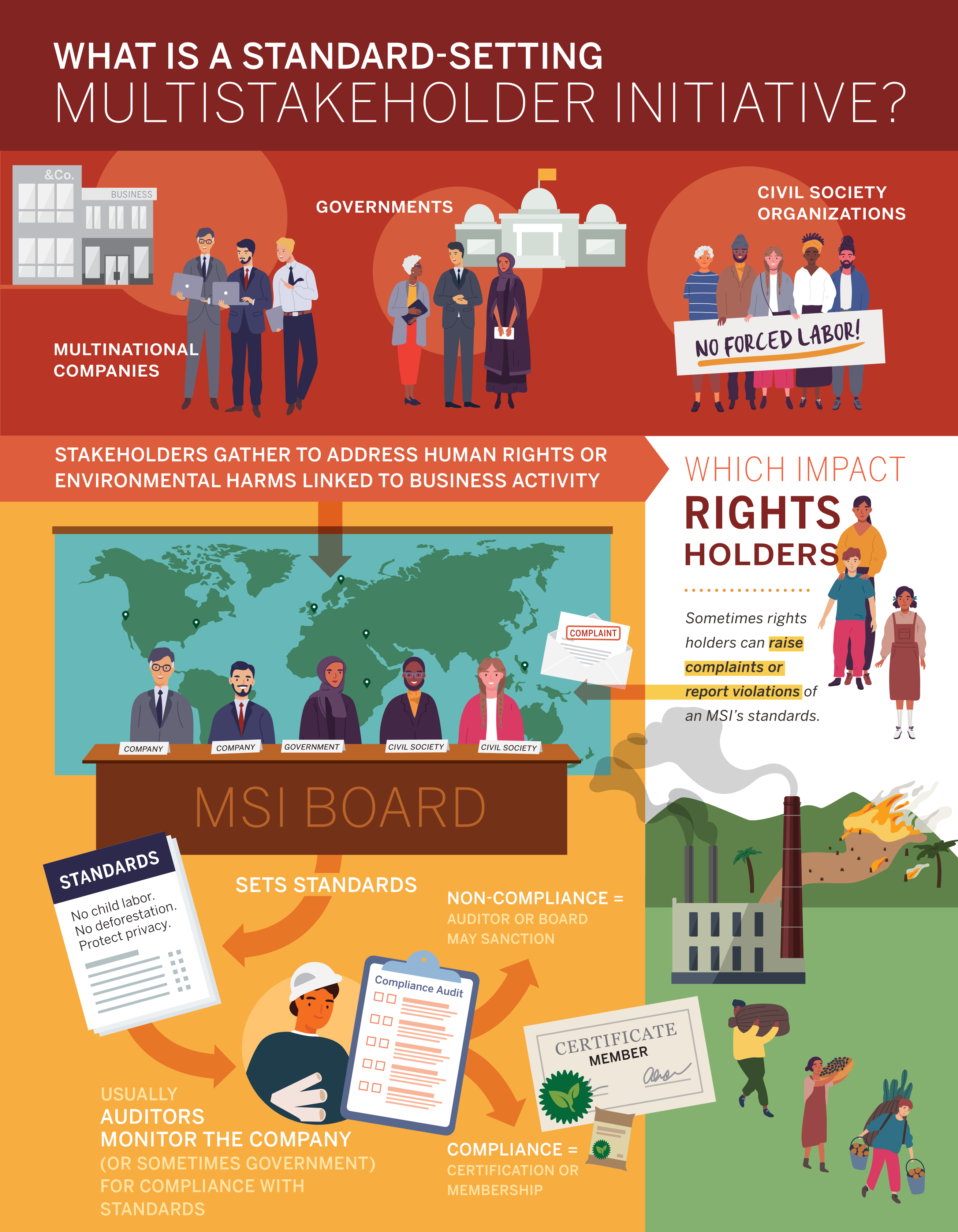
A Critical View of Multi-Stakeholder Initiatives: The MSIntegrity Report: "Not Fit for Purpose: The Grand Experiment of Multi-Stakeholder Initiatives in Corporate Accountability, Human Rights and Good Governance"


In July 2020, MSIntegrity Released its Report: Not Fit for Purpose: The Grand Experiment of Multi-Stakeholder Initiatives in Corporate Accountability, Human Rights and Good Governance. It described the thrust of the Report on its website:
Not Fit-For-Purpose reflects on a decade of research and analysis into international standard-setting MSIs. It concludes that this grand experiment has failed in its goal of providing effective protection against abuse. While MSIs can play important roles in building trust and generating dialogue, they are not fit-for-purpose to reliably detect abuses, hold corporations to account for harm, or provide access to remedy. Through an analysis of six key cross-cutting insights, the report invites readers to think critically about the limitations of voluntary regulation and to envision more effective strategies to protect human rights.
The Report is worth considering in two respects.  First on the specific critique of the forms and operation of Multi-Stakeholder Initiatives.  Much of its observations bear careful consideration.  Second, and perhaps more profoundly, is the development of the insight that the logic of institutions, even those created for the best reasons and most positive (normative) intentions inevitably become the prisoners of the logic of institutional forms. It then follows that the stronger the institutional form, the more precarious its relationship to the passion and normative thrust that brought it initially to life. 


Summary materials from the Report (the Six Key Insights) along with information about MSInsight follow.
 

Wednesday, September 16, 2020

中共中央办公厅印发《关于加强新时代民营经济统战工作的意见》The General Office of the CPC Central Committee issued the "Opinions on Strengthening the United Front Work of Private Economy in the New Era"


The Chinese United Front is a complicated apparatus that aligns several entities or organizations, some of them relatively autonomous, under the leadership of the Communist Party.  It has undergone a series of substantial transformations from the time of the early history of the Chinese Communist Party during its days as a small  collective, through the years of revolutionary activity, and then after the establishment of the People's Republic when the CPC was faced with the challenge of transforming itself from a revolutionary party to a party in power. 

Perhaps one of its most important aspects is the operation of the Chinese People’s Political Consultative Conference about which Flora Sapio has written perceptively for the Coalition for Peace & Ethics (see, Flora Sapio: "What Do We Still Ignore About Chinese Constitutionalism?: The United Front and the Chinese People’s Political Consultative Conference" Part 1 and Part 2). It along with a number of other organizations operate under the guidance of the CPC through the United Front Work Department of the Central Committee of the Communist Party of China (中共中央统一战线工作部).

The United Front has elicited strong suspicion in the West certainly since the 1950's (see declassified CIA Report from 1957 ACCESS HERE).  And it continues to do so, especially in those states which are experiencing more robustly confrontational relations with China. (e.g.,  Chinese Regime Steps Up United Front Efforts to Influence Western Democracies: Report; Putting Money in the Party’s Mouth: How China Mobilizes Funding for United Front Work).  Yet from a Chinese perspective, the role of the United Friont appears consistent with Leninist Principles of expanding the CPC's influence, and of ensuring cohesion and discipline among those subject to the CPC's leadership (see, e.g., The Expansion of the United Front Under Xi Jinping). Indeed, one might understand the United Front, in this sense as both nationalist in its orientate (a sort of China first analogue to the America First Movement under the Trump Administration in the US), and a means of expressing collective decision making under the overall guidance of the CPC in adherence to the party's Basic Line.

All of this is interesting. But more interesting still has  been the connection between United Front politics, the Belt and Road Initiative, and the management of the Chinese private sector within the constraints of the CPC Socialist Modernization Basic Line within the New Era Basic Contradiction "between the people's ever-growing needs for a better life and unbalanced and inadequate development." That the United Front might now be more intimately involved in the organization and operation of private sector business may in part be attributed to a New Era reshaping of the then controversial decision under the leadership of Jiang Zemin to open CPC membership to business people under the Sange Daibiao line (discussed in The Rule of Law, the Chinese Communist Party, and Ideological Campaigns: Sange Daibiao (the 'Three Represents'), Socialist Rule of Law, and Modern Chinese Constitutionalism).

This has two potentially substantial implications.  The first is the use of the United Front ads a means of more closely aligning political and economic decision making--that is of ensuring that all economic decision making is political in the sense that it advances both the CPC Line and is in conformity with Chinese policy and strategic (short and long term) objectives.  The second, is that--and certainly within Belt and Road relationships worldwide, the United Front's discipline of private sector enterprises might affect as well the way in which foreign relationships with non-Chinese businesses and governments are constructed, implemented, and advanced.  By placing the CPC art the center (an important element of New Era Leninist Theory) the Marxist character of economic (socialist) modernization might be better aligned to the CPC's political work and to advancement of Chinese interests in the world. This is not to suggest that the result is bad for China's partner, it is merely to suggest that its genesis is internal to Chins and intimately connected to the deepening of its ideological advancement of Leninist with Chinese and 21st century characteristics. 

The implications are made much clearer in a document recently circulated by the General Office of the CPC Central Committee issued the "Opinions on Strengthening the United Front Work of Private Economy in the New Era" 《关于加强新时代民营经济统战工作的意见》, and a crude English translation of which appears below along with the original Chinese version. 

As one reads through the text, it might be useful to focus on  Paragraph 6 on the importance of aligning business decision making, and the conduct of business with the `political positions, directions, principles, and trajectories of the CPC Central Committee. That was, of course, explicit in Sange Daibiao and has now been explicitly generalized for economic activity. Interesting as well is Paragraph 10 that while mentioning Hong Kong and Macao does not mention Taiwan.  That is notable, though its implications remain mysterious.

Tuesday, September 15, 2020

Short Reflections on the UN Working Group's July 2020 Report to the General Assembly: "Business, human rights and conflict-affected regions: towards heightened action"

Pix Credit HERE


One of the more challenging issues that confronted the process of drafting (and then applying) the UN Guiding Principles for Business and Human Rights, centered on the duty of states to protect--and more relevantly the responsibilities of companies to respect--human rights in conflict zones (as well as in weak governance zones) (discussed in Corporate Social Responsibility in Weak Governance Zones).

The problem of business operation in conflict (and weak governance) zones remains a key issue for framing the business, legal, political, economic, and societal risks of operating in the face of conflict or in the absence of the state.  It was therefore with great anticipation that I read the UN Working Group for Business and Human Rights Report to the UN General Assembly   "Business, human rights and conflict-affected regions: towards heightened action" A/75/212 (21 July 2020).

The Report's focus is quite specific and quite pragmatic:
In the present report, the Working Group on the issue of human rights and transnational corporations and other business enterprises clarifies the practical steps and outlines practical measures that States and business enterprises should take to prevent and address business-related human rights abuse in conflict and post-conflict contexts, focusing on heightened human rights due diligence and access to remedy.
This approach is laudable.  And the UN Working Group handled the task with great competence, considering the complexities of the issues and the severe space limitations for its report. For that they are to be congratulated. The Report provides a welcome framework for considering the issues, especially in the narrowly focused context of traditionally defined conflict zones.

This post includes the Recommendation potion of the Report (which may be accessed HERE) and some brief reflections.

Monday, September 14, 2020

Defending Traditional Markets Driven Capital Centering Economic-Political Models: Hester M. Peirce: "Markets, Morality, and Mobsters: Remarks at the 18th Annual Corporate Governance Conference"

Has Business Left Milton Friedman Behind?


Hester M. Peirce
In a remarkable address delivered 27 August 2020 at the University of Texas at Dallas Institute for Excellence  in Corporate Governance, Hester Peirce, appointed by President Donald J. Trump to the U.S. Securities and Exchange Commission and was sworn in on January 11, 2018, sought to take on the current movements to shift the fundamental regulatory narrative of corporations from an institutional/shareholder wealth maximizing model to a stakeholder/societal welfare maximizing one. In the process she sought to make a case against the Business Roundtable’s new Statement on the Purpose of a Corporation signed by over 180  CEO to great (and mostly positive) response by academic and administrative elites (e.g. here). 

The address, posted as  Markets, Morality, and Mobsters: Remarks at the 18th Annual Corporate Governance Conference, is well worth reading, especially by those inclined to reject its basic premises. It serves as a counter to the quite powerful recent push by influence leaders among the intelligentsia to bury the ghost of Milton Friedman, a task made infinitely easier by 40 years of absurd and strategic misreadings of his most influential (and short) work. Not that criticism was unwarranted; Milton Friedman was notable for an ambiguity that might be exploited by the unscrupulous--and yet there is both truth (and in the sense just suggested substantial irony in his key point respecting the social responsibility of business leaders, "That responsibility is to conduct the business in accordance with their desires, which generally will be to make as much money as possible while conforming to the basic rules of the society, both those embodied in law and those embodied in ethical custom." (A Friedman doctrine‐- The Social Responsibility Of Business Is to Increase Its Profits).  And, of course, to some extent it is dated--the assumption of the strict separation of public and private functions, of economics and politics, within a liberal democratic polity, reflects the unique self conception of an age long past.  Contemporary society now advances the increasing interlinking of public and private, of politics and economics, and of regulation and accountability in the everyday engagement of people and institutions within the social-political collective we understand as liberal democratic states. 

Peirce does not rely on these more directly obvious lines of response to the emerging stakeholder model (itself the subject of the sort of distortion that has been the fate of Friedman's perspective but from the other side).  Instead she attempts a more powerful defense--and one ironically with deep resonance to the emergence of the defense of the Chinese Marxist Leninist political-economic model now emerging. to do this she draws on the work of a 19th century Japanese (keen) observer of the emerging political-economic model of Anglo-European states and the insights he drew.  She uses these insights to make a case that what she calls capitalism (or perhaps better markets driven economic models) are in essence a moral system--an honorable way to enhance one's own economic position while at the same time enhancing the social state of society.  That assertion would draw strong objection today from the current cop of influencer elites, many of whom are in control of the mechanics of narrative production for our political economic model.  And yet she has a point. Like the Chinese political-economic model, markets drive capital centering models for organizing economic activity are at their core moral systems, systems of values, and systems of belief in the positive effects of those values. But it is also a system (like virtually all others) easily corrupted and thus made immoral.  But that corruption is not inherent in the moral system itself but in its strategic distortion by those who effectively undermine its moral (rather than economic) core.

Second, she emphasizes a perhaps unique moral understanding of fiduciary duty.  Here, ironically, she shares much with stakeholder advancing champions who see in fiduciary duty the means through which to hold multinational enterprises liable for harms where-ever it might occur within chains of production.  But that is at it should be--their views ought at some point to converge govern that both see the fundamental moral value of economic activity is to enhance collective welfare.   She makes as well an interesting case against certain forms of regulatory compliance.If the costs of compliance, including disclosure become  very great, then one effectively creates the very barriers to wealth creation by the poorer segments of society by denying them access to the benefits of organization in corporate form. The perverse consequences ought not to be lost on those who seek to open economic opportunity  at the bottom.  In effect, she suggests, and there is a point here worth considering, that well intentioned thick regulatory systems may in doing good (in some areas of human rights, environmental and sustainability goals) also cause substantial harm by denying economic opportunity (also an important SDG principle) to the most economically vulnerable groups.  In effect, doing good for stakeholders  contributes to the3 process of ensuring that only the rich will get richer.

And yet, like those championing a stakeholder model, Peirce may miss the fundamental problem of delivering value--and that is that under either model, the system of accounting tends to encourage a substantial amount of free riding.  It is not that shareholder versus stakeholder valuation is good or bad; rather it is that no one is yet willing (for quite different and ideologically compelling reasons, at least in their own minds) to actually and rigorously impose on financial accounting regimes  (and the systems like GAAP etc. that incarnates it) the full costs of economic activity  That in part represents an unwillingness to quantify certain costs (as inimical to its nature), or to accept that consumption of certain goods (laws, labor, air, water, space, etc.) must be embedded in the calculus of costs of goods  or other things of value produced fro sale. In any case, there is much here to agree or disagree with.  The perspective and the moral imperative are worth engaging seriously beyond the sound bite or the character limits of twitter.

And that, perhaps, is the fundamental problem with the debate.  It is a problem that will grind this generation's version that THAT debate into the ground as it has those of its predecessor. The current cop of those who would lead us will do so because, like their fore-bearers, they (e.g., the current crop of detractors and defenders) have yet to embrace accountability fully (noted e.g., here, in Unpacking Accountability in Business and Human Rights). Until there is a full embrace of costing production--in the economic, societal, and political spheres--until each of these collectives embrace the principle that each must fully disclose and account for their use of resources (including human, communal, ambient, and other resources), until that can be measured (a process resisted by absolutists on both sides of this debate), until then, we will (to the benefit of future generations of influence leaders looking for something to keep them busy) continue this sterile debate (for steps in the right direction, see, e.g., Impact-Weighted Accounts Project). To overcome it, a society committed to accountability must learn to measure, to assess, and to disclose.

The full text of the speech follows.

Brief Reflections on "Evaluation of the Dutch RBC Agreements 2014-2020"


In the context of its project ‘Putting Responsible Business Conduct (RBC) Measures in Perspective’ the Dutch Ministry of Foreign Affairs commissioned an evaluation of the Dutch Responsible Business Conduct (Corporate social responsibility (CSR)) to review its current RBC/CSR policy.

All of this was undertaken, in some significant respect with respect to Dutch (and more generally) European public movement toward the facilitation of private international multilateralism connected with or derived from or conformity with the OECD Guidelines for Multinational Enterprises (OECD Guidelines) and the United Nations Guiding Principles on Business and Human Rights (UNGPs) in Dutch ‘high-risk’ sectors.

The Report--Bitzer, Verena, Rob Kuijpers, Katrine Danielsen, Anne Rappoldt, Irene Visser and Helena Posthumus. 2020. Evaluation of the Dutch RBC Agreements 2014-2020:Are voluntary multi-stakeholder approaches to responsible business conduct effective? KIT Royal Tropical Institute: Amsterdam -- was released 8 July 2020.

The full Report may be accessed HERE (PDF).  Brief reflections and the Report's Management Summary follow.