Like public intellectuals everywhere, German public intellectuals enjoy the momentary limelight of the public intellectual (see here). It is a phenomenon made quite fashionable by the French about a generation ago (e.g., Pierre Bourdieu, 'The Corporatism of the Universal: The Role of Intellectuals in the Modern World,' Telos 81:99-110 (1989)); and also long embraced by academically conceptually cocooned academic intellectuals in Mitteleupropa as a means of grappling with ghosts on the right and rationalizing-avoiding the perditions of the left through the lens of a shifting fantasy center. But the itch has also long been scratched by the more programmatically minded and politically ambitious set in the Anglo-American world, whose reward is to be petted by those in power and the ability to pretend, if only for an an instant, that they are like their masters. In some respects, and again following the lead of French sociology, this appears to be the product of the marriage of a profound skepticism of the value of journalism to correctly curate public opinion in liberal democratic states (along with the recognition of their power to do just that; Pierre Bourdieu, 'Public Opinion Does not Exist' 1972), aligned with a sense that intellectuals must exploit that technology as a vanguard to appropriately guide the masses ("What must be invented today are forms of organization which permit the creation of a voice for a large collective of intellectuals, combining the talents of the ensemble of specific intellectuals" (Bourdieu supra 1989, 108). In the American context, of course, the trajectories of the public intellectual is almost pure bathos choking on its own populist elitism (Cf., "We are All Public Intellectuals Now").
The Russo-Ukrainian War has provided a grand opportunity for the sort of performance--in public--of the intellectual. It is one that has allowed them the appearance of a foray out from their well protected bubbles and into the world of flesh, of blood, of wealth, and of violence. But it is also one that permits the public intellectual to use these facts as avatars for the purpose of mobilizing public opinion in liberal democratic states and thus insert themselves, from a distance, into the political life of the nation. In this they may seek to mimic the great economic enterprises, the powerful non-governmental organizations, and the state security and propaganda organs of domestic and foreign governments, friendly or otherwise.
To that end, German intellectuals, academics and otherwise, sometimes use the mechanism of an "open letter" suitably published in some friendly or strategically interested press organ. Since the start of the Russo-Ukraine war, this modality of mobilization and narrative making has been used several times (see, here, and here) and then sometimes also by intellectuals from the center of the zone of combat and also circulated in German press organs (see, e.g., here). Many if these forays into discourse have taken a position that aligns with a position that advocates response of some kind against Russia and to aid Ukraine.Much of this is of course formulated and digested through the lens of the history of the last several centuries and its climax in the period 1914-1989.
It is thus with some interest that it may be work considering the recently posted open letter from a group of intellectuals seeking to mobilize opinion toward a different end--the choking off of the capacity of Ukraine to wage a defensive campaign against the Russian invasion. Berliner Zeitung: Offener Brief fordert von Scholz Stopp der Waffenlieferungen an die Ukraine (Berliner Zeitung: "Open letter calls for Scholz to stop arms deliveries to Ukraine").

That is urged in the hopes of minimizing the damage to the human and physical capital housed in Ukraine for the exploitation of however is ultimately (via negotiation apparently at the point of a barrel of a (Russian) gun) to be effectuated between two secondary imperial hubs--that centered in elite networks in Berlin and those centered somewhere between St Petersburg and Moscow. It is certainly an interesting perspective from the point of view of husbanding productive resources for the exploitation by someone; though in this case it appears anyone may do. Its imagery invoked by the reference to „unverteidigten Städten“ (roughly open cities) invokes Paris in 1940, or Manila in 1941, more than Odessa in 2022. And indeed, one might well have read a variation of this in French newspapers immediately after Dunkirk from from the South of France. Yet at its heart, what appears to be a central concern--mimicking
that of the Americans--is to keep German hands clean and avoid being
"dragged" into a war:
"Mit der Lieferung von Waffen
haben sich Deutschland und weitere NATO-Staaten de facto zur
Kriegspartei gemacht. Und somit ist die Ukraine auch zum Schlachtfeld
für den sich seit Jahren zuspitzenden Konflikt zwischen der NATO und
Russland über die Sicherheitsordnung in Europa geworden." ("By supplying
weapons, Germany and other NATO countries have de facto made themselves a
war party. And so Ukraine has also become the battlefield for the
conflict between NATO and Russia over the security order in Europe,
which has been escalating for years.") (Offener Brief)
More important, perhaps, is the practical calculus that then gives volume to the lofty principles meant to be furthered by the proposals embedded in the Offener Brief.
"Trotz zwischenzeitlicher Erfolgsmeldungen der ukrainischen Armee: Sie ist der russischen weit unterlegen und hat kaum eine Chance, diesen Krieg zu gewinnen. Der Preis eines längeren militärischen Widerstands wird ‒ unabhängig von einem möglichen Erfolg ‒ noch mehr zerstörte Städte und Dörfer und noch größere Opfer unter der ukrainischen Bevölkerung sein. Waffenlieferungen und militärische Unterstützung durch die NATO verlängern den Krieg und rücken eine diplomatische Lösung in weite Ferne." ("Despite reports of success from the Ukrainian army in the meantime: it is far inferior to the Russian one and has little chance of winning this war. The price of prolonged military resistance, regardless of possible success, will be more destroyed towns and villages and more casualties among the Ukrainian population. Deliveries of arms and military support from NATO prolong the war and make a diplomatic solution a long way off.") (Offener Brief)
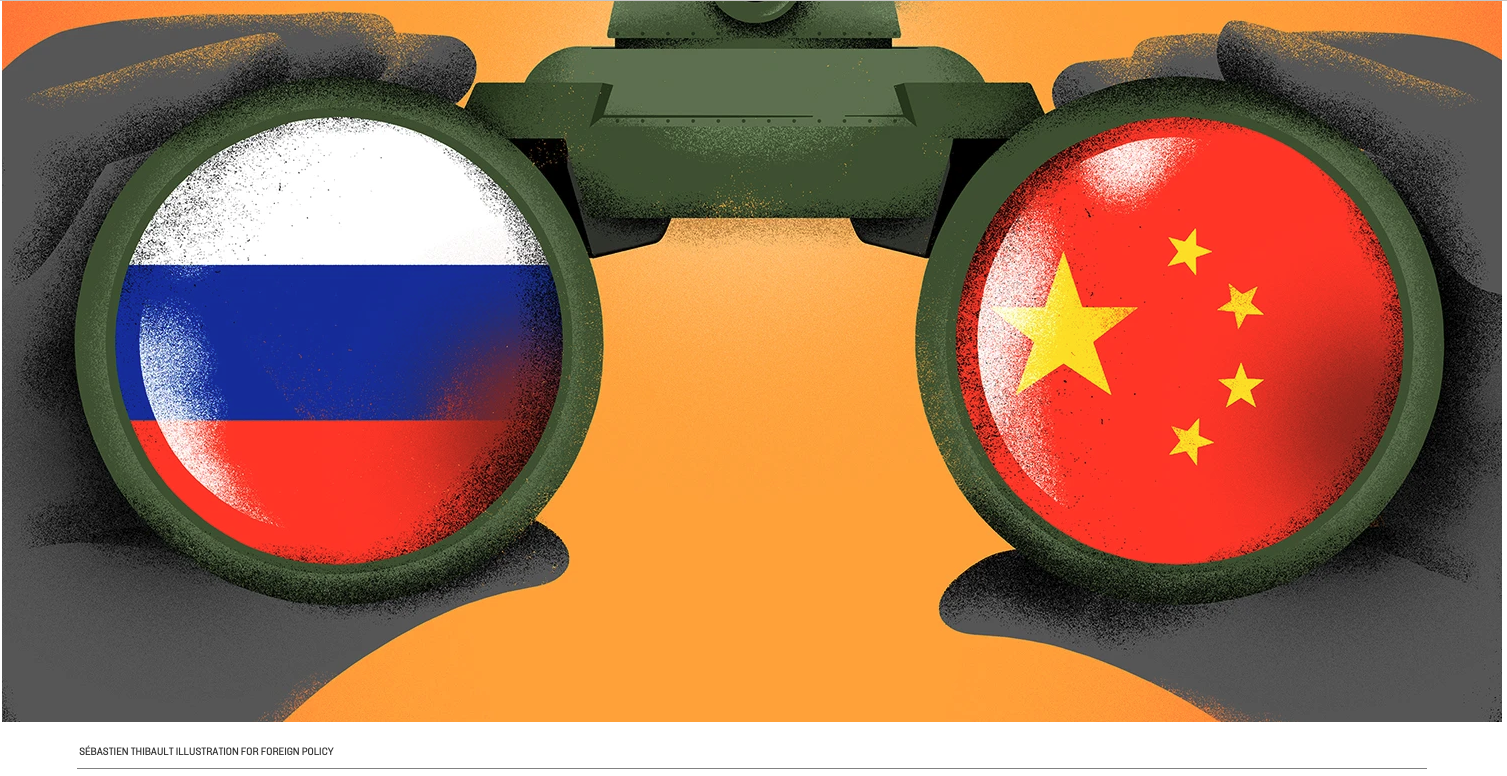
Why, indeed, through good money after bad if it will also incur the wrath of an antagonist that is in no danger of disappearing any time soon? There are all sorts of odd premises and miscalculation built into this, the heart of the argument: conceptions of the calculus of victory (how quickly the strategies of national liberation movements are forgotten); the valuation of arms supplies to hobble an antagonist second order state; and though treated as an afterthought, the calculus of the other side of the proxy war taking place in the Ukraine--if the Ukraine has the US-EU, Russia has China. China indeed is treated--in the usual European manner of certain intellectual circles, as an afterthought. These intellectuals continue to appear to believe that the Russian ox drives its Chinese master, a master who remains oblivious and shrouded in a mysterious unfathomable Asian mist that Europeans appear uincapable of penetrating (see
here).
It is also a particularly interesting position for the way it situates, not just violence, but also the way it theorizes negotiation. For a long time time, negotiation appears to have has been undergoing a sort of intellectual transformation, from an action with object, to a fetish and a performance. Indeed, the Letter clearly states the aims of a negotiation--a performance that will lead to a pre-negotiated result (probably the reason why some recoil at the theatre of the absurd that negotiation has morphed into):
"Die bereits von Präsident Selenskyi ins Gespräch gebrachten Angebote an Moskau ‒ mögliche Neutralität, Einigung über die Anerkennung der Krim und Referenden über den zukünftigen Status der Donbass-Republiken ‒ bieten dazu eine reelle Chance." ("The offers to Moscow already discussed by President Zelenskyi - possible neutrality, agreement on the recognition of Crimea and referendums on the future status of the Donbass republics - offer a real chance to do so.") (Offener Brief)
Negotiation here, then, is fetish: the legitimating performance of a done deal, one in which the object of this negotiation plays only a secondary role. But more than that, it is grounded on the asymmetries of rationality grounded in the strategic deployment of (in)security (see
here). Here Chinese conceptualization of the indivisible security premise is married to the valuation of security where the concept is framed from the baseline of paranoia.
But that does seem to be the way of Post-Global Empire. And yet it is, in the form of this letter, an act of intellectual lèse majesté--if one follows the rules of Empire in the post global--yet one that falls nicely within the patterns of intellectual cat fighting in the West. In that context, of course, German intellectuals would have to defer to the needs and inclinations of the superior authority, even within intellectual circles, of the apex authority and the core of leadership of the liberal democratic empire. And that center does does reside in Berlin, or Brussels--it resides (even if for the moment in challenging way for American dependencies) in Washington. Even intellectuals sometimes bend the knee to power. Now that would be a quite interesting topic for an Open Letter--the negotiation of an orthodox position for intellectuals in a first tier dependent territory. And it would being the logic of the Offener Brief home.
And yet, again, what is brought home, given the coverage of this Offener Brief, is the power of the insights of the public intellectual in the West. Taken as a whole, the Offener Brief does not amount to much in the course of the policy discussion of the political and economic vanguards who are running this conflict. And yet, as a device for the mobilization of public opinion--for its creation--and as amplified for that purpose by its coverage, the Offener Brief has managed to leverage itself into some prominence, at least of a nanosecond in German public life, and perhaps longer behind closed doors.
The text of the Berliner Zeitung: Offener Brief fordert von Scholz Stopp der Waffenlieferungen an die Ukraine (Berliner Zeitung: "Open letter calls for Scholz to stop arms deliveries to Ukraine") appears in the original German and in a crude translation that may not do full justice to the original text.