Friday, September 07, 2018

Recursos del constitucionalismo cubano/Cuban Constitutionalism Resources: Flora Sapio-"The Constitutional Debate in Cuba: The Irrelevant, the Good, and the Thoughtful" / Flora Sapio: "El debate constitucional en Cuba: lo irrelevante, lo bueno y lo reflexivo"


(Pix © Flora Sapio 2018)


The Coalition for Peace & Ethics has been looking at the data respecting public commentary on the draft Constitution since such comments were requested 13 August 2018 (e.g., Recursos del constitucionalismo cubano/Cuban Constitutionalism Resources: Primeros Commentarios del Pueblo/Initial Popular Commentaries). From that analysis we shared an Infographic that we thought might give readers a taste for the shape of constitutional discourse in Cuba in real time (Recursos del constitucionalismo cubano/Cuban Constitutionalism Resources: Infografía del Comentario Popular/Infographic on Popular Commentary).

We continue to analyze the data on popular commentary to the Cuban draft constitution.  We have not looked at the formal comments redacted by Cuban officials during the course of the many local meetings to be held all across the Republic to gather comments and to summarize debates.  It is those official transcripts of the tenor of debate and of the suggestions thought worthy enough for memorialization and delivery to the State and Party organs that will serve as the official basis for consideration of further revisions before a final text is approved  and put to a popular Referendum in 2019.  Those comments will no doubt serve a valuable purpose in the course of official engagement leading to the establishment of a revised constitutional order  under the leadership and subject to the direction of the Cuban Communist Party.  But there is also value  in gauging the temperature and trajectories of public opinions from the "informal sector."  These are comments that the state and Party have tolerated sufficiently to permit their posting onto social media but may reflect in much more direct ways popular opinion that may in some respects find their way into  the summaries of opinions and suggestions delivered to the National Assembly. 

Continuamos analizando los datos relacionados a los comentarios populares al borrador de la constitución cubana. No hemos visto los comentarios formales redactados por funcionarios cubanos durante el curso de las multiples reuniones locales que se celebrarán en toda la República cuyos objectivos requiere el reunir comentarios y resumir los debates. Son esas transcripciones oficiales del tenor del debate y de las sugerencias, los que se consideran suficientemente válidas para la conmemoración y la entrega al Estado y los órganos del Partido, que servirán como base oficial para la consideración de nuevas revisiones antes de que se apruebe un texto final para la aprobación popular mediante un Referéndum programado para 2019. Esos comentarios sin duda tendrán un propósito valioso en el curso del compromiso oficial que conduzca al establecimiento de un orden constitucional revisado bajo la dirección y bajo la dirección del Partido Comunista de Cuba. Pero hay valor en y vale la pena  medir la temperatura y las trayectorias de las opiniones públicas del "sector informal". Estos son comentarios que el Estado y la Parte han tolerado lo suficiente para permitir su publicación en las redes sociales, pero pueden reflejar de manera mucho más directa la opinión popular que solo en algunos aspectos quizas se encuentran en los resúmenes de opiniones y sugerencias entregadas a la Asamblea Nacional.

For this post CPE is happy to repost an essay of Flora Sapio, one of its members, who has been working on the analytics of popular opinion in the course of the Cuban Constitutional project.  Her essay--The Constitutional Debate in Cuba: The Irrelevant, the Good, and the Thoughtful--follows below.  It may also be accessed from the blog site, Forgotten Archipelagoes HERE.

Para este post, CPE se complace en volver a publicar un ensayo de Flora Sapio, uno de sus miembros, que ha estado trabajando en el análisis de la opinión popular en el curso del proyecto constitucional cubano. Su ensayo - El debate constitucional en Cuba: lo irrelevante, lo bueno y lo reflexivo - sigue a continuación. También se puede acceder desde el sitio del blog, Forgotten Archipelagoes AQUÍ.


Thursday, September 06, 2018

Annual Conference: European China Law Studies Association (欧洲中国法研究协会) Torino Italy--Tentative Program

(Pix © Larry Catá Backer 2018)


These are very dynamic times in China.  In the wake of the 19th Congress of the Chinese Communist Party in October 2017, China saw substantial and important changes in its Communist Party and its state organs. China has moved aggressively to advance its Belt and Road Initiative, expanding and complicating its relationship with developing states.  It has produced a vigorous alternative to the principles of global trade that have been substantially unchallenged for a generation. Relations with the United States, always tumultuous, has become more strained as the U.S., like China, roils out its own new version of a global trading order. China has moved as well to become a more significant player in the development of global norms in areas form human rights to the law of the sea. At the same time, China's projects of Yuan internationalization continues to move forward and its move into international development through the the Asia Infrastructure and Investment Bank poses a challenge to the hegemony of the World Bank and IMF.

It is in this context that a group of superb scholars will come together in Torino, Italy, to discuss these issues during the course of the 13th Annual Conference of the European China Law Studies Association (key topics for the 13th Annual Conference HERE; for the Conference last year in Leiden see HERE).  Since its founding in 2006, the European China Law Studies Association has become a major international venue for scholars and practitioners who are engaged in the study of Chinese law, from both comparative and interdisciplinary perspectives. The annual general conference provides an excellent forum for the exchange of information and ideas, as well as a platform for the development of research collaboration. Studies from disciplines other than law or interdisciplinary papers as well as submissions from young academics are expressly encouraged.

This Post includes the tentative program for the event.


Tuesday, September 04, 2018

From Mr. Woodward's "Fear" to Fear of America First: Initial Thoughts


The release of the much anticipated book by Bob Woodward about the administration of the presidency of Donald Trump, Fear: Trump in the White House (Simon & Schuster (September 11, 2018)) was met with substantial emotion from all quarters of the political spectrum. Mr. Woodward
paints a harrowing portrait of the Trump presidency, based on in-depth interviews with administration officials and other principals. Woodward writes that his book is drawn from hundreds of hours of interviews with firsthand participants and witnesses that were conducted on “deep background,” meaning the information could be used but he would not reveal who provided it. His account is also drawn from meeting notes, personal diaries and government documents. ( Philip Rucker and Robert Costa, "Bob Woodward’s new book reveals a ‘nervous breakdown’ of Trump’s presidency," The Washington Post (4 Sept. 2018))
It is no doubt a marvelous work of its kind. It is also likely to keep global elites quite busy as they ponder ways to draw maximum utility from the materials in the service of whatever agenda moves them. And yet Fear may yet serve a useful purpose beyond the utility of the gossip about the aristocracy that that book serves up in generous portions. That utility goes to illustrating the structures of power within enclosed and self reflexive  structures that sometimes mark powerful states. I have written about this from the perspective of the architecture that such states leave behind:
There is a certain trans-cultural element to architecture of a certain kind. There is certainly what appears to be a universal approach to an architecture to power. That architecture should serve as a lesson to those who tend to like to wield it. In a different age the architecture of power was expressed in the palace complex. For all their contextual quirks, the Forbidden City, the Topkapi Palace and Versailles all express the same complex set of symbols and gestures. And each reveals the same fatal weakness. (Forbidden Cities 2008)
Americans appear to have been intent on building their own palace complex within the White House. If so, and it is possible Mr. Woodward might agree, then the object, of course, translated into the language of American political culture, is to make the case for the illegitimacy of the office of the United States because, if one believes the gossip, then the President is no longer actually exercising his office.  Philip Rucker and Robert Costa, writing for the Washington Post puts it this way: "Woodward describes “an administrative coup d’etat” and a “nervous breakdown” of the executive branch, with senior aides conspiring to pluck official papers from the president’s desk so he couldn’t see or sign them." ( Philip Rucker and Robert Costa, "Bob Woodward’s new book reveals a ‘nervous breakdown’ of Trump’s presidency," The Washington Post (4 Sept. 2018)). More importantly, it may serve as an important tool in shaping mass opinion on the eave of elections in the United States that may shift the balance of power among some of the aggressively antagonistic leadership factions in the United States.The effect may be useful to those who have no love for the current administration-- to provide the performance that the population can then vote on  the way people submit their votes during one of the many television talent or reality TV dramas.  And, indeed, one might see Fear as a political version of "The Voice" or more likely "Survivor".

This post considers the other side of "Fear"--the fear that the state of the internal workings of the U.S: administration is reflected in the state of the workings of American foreign policy.  That is it considers the way that the "Fear" administration has developed a new architecture for U.S. engagement in a world, whose leaders read Mr. Woodward's Fear, with the same eager anticipation as many Americans. It is organized in the context of a conversation I recently had with a foreign colleague.  It draws no conclusions about either, but it does suggest a dissonance between analysis and passion in this age increasingly marked by "Fear" at every turn.

Sunday, September 02, 2018

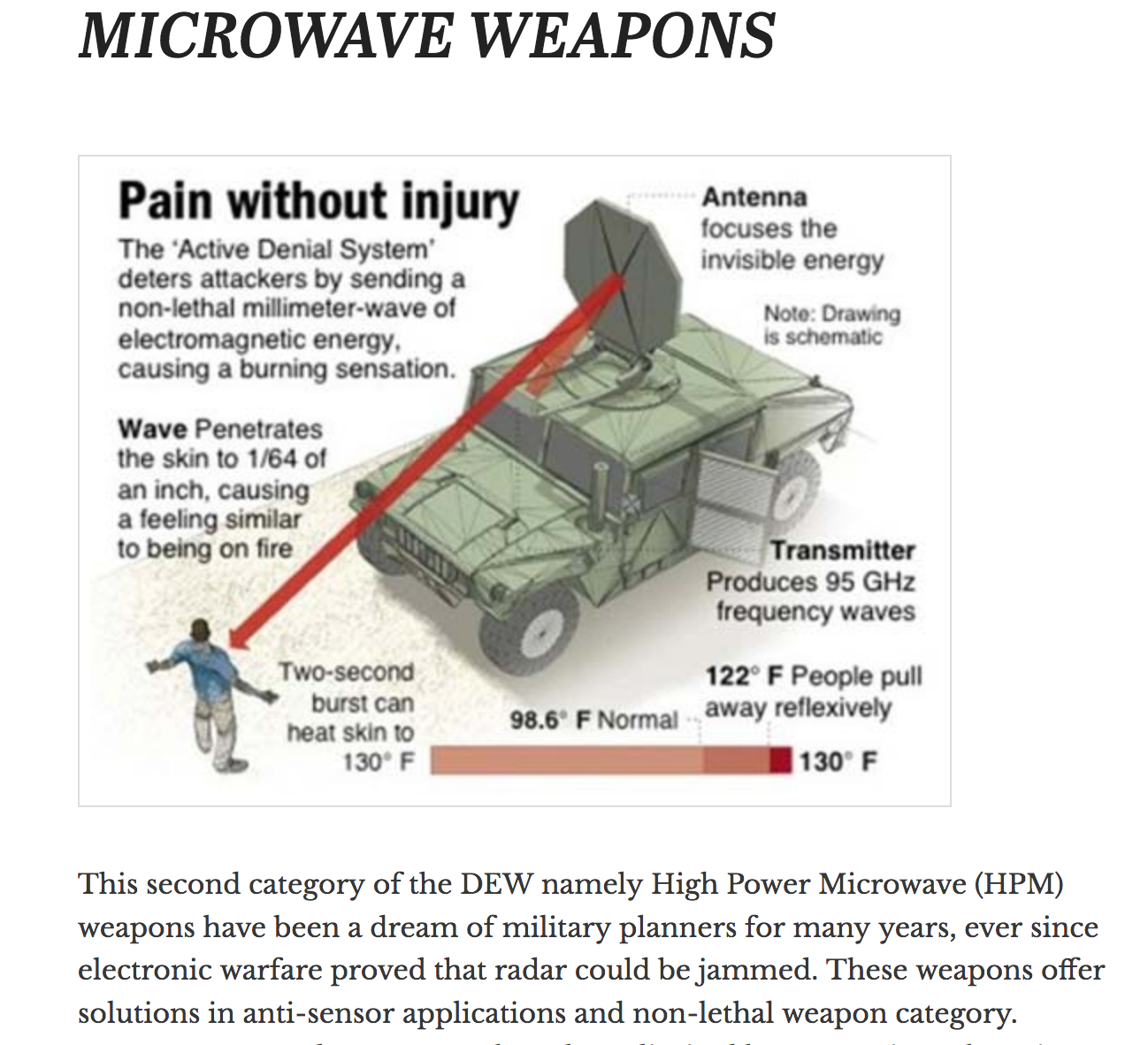
The Affair of the Sonic Weapons Attack: Management, Containment and Control--Microwave Weapons and the State Department Cuba Accountability Review Board Report

(Pix credit "Microwave Weapons" (11 Sept. 2015), Weapons and Warfare)


From the start, the Affair of the Sonic Weapons Attack has amounted to a series of curious turns. Each of these twists and turns has provided a measure if illumination in a small but significant corner of the world of contemporary conflict at the state to state and institution to institution level.  What had started as a well managed and quite genteel set of partial disclosures about the state of diplomat safety in Cuba has morphed into a story the limits of the ramifications of which remain largely unknown. Those ramifications touch on the state of modern warfare, perhaps in its 6th generation--the development of a set of weapons that can affect specific high value targets (an advance of the utility of drone killings but augmenting the spectrum of weaponry that can be used against specific targets), the erosion of the classical protections of diplomats, the increased blurring of the line between the techniques of war, those of business and those of statecraft.  Most importantly, perhaps, the Affair of the Sonic Weapons Attacks has substantially diffused the access of individuals and non state actors to the means and methods of warfare--nonlethal, technologically accessible and able to be used against individuals.

The Affair of the Sonic Weapons Attack has been used in the context of the substantial reshaping of normalization between the U.S. and Cuba.  It has seen some use in the quite aggressive battles between the U.S. and China over the shape of global trade going forward (a work still in progress).  it has helped shape, though on the periphery, the relations between the U.S., Russia and some of the former Central Asian Soviet satellites. And it has shaped a very new and different sensibility about the nature of risk and injury in conflicts that are yet to be defined, much less named. In the process it has exposed the use of a variety of techniques and technologies both within the United States and abroad by others. The Affair of the Sonic Weapons Attack has moved from the "he said-she said" stage through the reaction and grand gesture stage, through the solicitude for injury stages, through the scientific investigation and data gathering/analysis stage, to a new stage that may suggest the future course of events.   


Two recent events suggest the current contours of those efforts to manage, contain, and control information, and thus to shape the public environment within which pressure can be exerted to some ends or other. The first is the rather laconic report of the results of the State Department's Cuba Accountability Review Board Report made available on 30 August 2018. The second is the reporting of an interview given by the lead investigator  of the medical team that examined 21 affected diplomats from Cuba made no mention of microwaves in its detailed report published in JAMA in March, that microwave weaponry remains the chief suspect in the attacks widely reported on 1 September 2018 (here and here). This post includes brief commentary around those reports and suggestions, as well as an analysis of both.  

Wednesday, August 29, 2018

The Congressional-Executive Commission on China (CECC): Xinjiang, its Uyghurs, and the Potential Expansion of Global Magnitsky Sanctions to Chinese Officials


The Congressional-Executive Commission on China was created by the U.S. Congress in 2000 "with the legislative mandate to monitor human rights and the development of the rule of law in China, and to submit an annual report to the President and the Congress. The Commission consists of nine Senators, nine Members of the House of Representatives, and five senior Administration officials appointed by the President." (CECC About). The CECC FAQs provide useful information about the CECC. See CECC Frequently Asked Questions. They have developed positions on a number of issues (e.g., here).

CECC tends to serve as an excellent barometer of the thinking of political and academic elites in the United States about issues touching on China and the official American line developed in connection with those issues. CECC becomes an even more important barometer of coherence and fracture in policy approaches as the discipline of activities between the political parties and the President and Legislature fractures in new and dynamic ways. As such it is an important source of information about the way official and academic sectors think about China. As one can imagine many of the positions of the CECC are critical of current Chinese policies and institutions (see, e.g., (here, here, here, here, here, here, here, here, here, here, and here).

The CECC has recently turned its attention to a critical consideration of Chinese policies toward its autonomous regions, and its treatment of religion (in general) and religious minorities (specifically). That consideration is worthy in its own right, of course.  To that end, the CECC on July 7 published CECC ANALYSIS: Xinjiang Authorities Forcefully Suppress Demonstration, Restrict Free Flow of Information. In late July 2018, the CECC program-Surveillance, Suppression, and Mass Detention: Xinjiang’s Human Rights Crisis--looked specifically at Uyghurs and other primarily Muslim ethnic minorities in the Xinjiang Uyghur Autonomous Region.The trajectory of those events for U.S. policy is effectively summarized in the Written Statement of Ambassador Kelly Currie delivered during that program.

Now CECC has further augmented its focus on the issue of the Uyghurs and other primarily Muslim ethnic minorities in the Xinjiang Uyghur Autonomous Region in ways that may affect not just this issue but also indirectly the issue of the framework of U.S. China trade that is entering an important developmental stage. The reason for this is that as Congress moves more aggressively to abandon wholesale embargoes and trade sanctions as a means of statecraft in favor of quite targeted action against key figures in states through application of the Global Magnitsky Act, and its sanctions regimes.  The analysis was particularly useful to help understand the emerging state of U.S. Congressional politics. This is especially important in the context of the upcoming elections, as well as in the negotiations between the U.S. and China respecting trade and other matters. And, indeed, the most telling part of the discussion is the portion that targets China's Belt and Road Initiative ("We believe that targeted sanctions will have an impact.  At a time when the Chinese government is seeking to expand its influence through the Belt and Road Initiative, the last thing China’s leaders want is international condemnation of their poor and abusive treatment of ethnic and religious minorities." Letter to State and Treasury Secretaries). Here is the sort of pressure that, like several initiatives undertaken during the Obama administration, seeks to tie U.S. countermeasures against expanding Chinese trade networks to Chinese internal human rights. But under the Trump administration there is a difference. Where during the Obama administration these actions might have been coordinated, or at least undertaken in concert, during the Trump Administration, the President and Congress appear to play good cop /bad cop, a psychological negotiation tactic .

The CECC Press Release,  Chairs Lead Bipartisan Letter Urging Administration to Sanction Chinese Officials Complicit in Xinjiang Abuses, along with the letters to the Secretary's of State and Treasury follow below. The list of individuals and enterprises suggested for inclusion was omitted from the publicly available information. 


Saturday, August 25, 2018

Recursos del constitucionalismo cubano/Cuban Constitutionalism Resources: Infografía del Comentario Popular/Infographic on Popular Commentary


The Coalition for Peace & Ethics has been looking at the data respecting public commentary on the draft Constitution since such comments were requested 13 August 2018 (e.g., Recursos del constitucionalismo cubano/Cuban Constitutionalism Resources: Primeros Commentarios del Pueblo/Initial Popular Commentaries). From that analysis we have prepared an Infographic that we thought might give readers a taste for the shape of constitutional discourse in Cuba in real time. Though these are not official comments they are useful to give a good sense of the scope of public debate and the subjects of most interest within those confines.

La CPE ha estado estudiando los datos respetando los comentarios públicos sobre el borrador de la Constitución, ya que dichos comentarios fueron solicitados el 13 de agosto de 2018. A partir de ese análisis, hemos preparado una Infografía que pensamos podría dar gusto a los lectores sobre la forma del discurso constitucional en Cuba en tiempo real. Aunque estos no son comentarios oficiales, son útiles para dar una buena idea del alcance del debate público y temas de mayor interés dentro de esos límites.


The  Infographic on Popular Commentary on Cuban Internet Official Site to date/ Infografía del Comentario Popular en el sitio oficial cubano de Internet hasta la fecha follows.


Friday, August 24, 2018

The Affair of the Sonic Weapons Attack and its Perverse Consequences: Cuban Constitutionalism and U.S. Influence


It should come as no surprise that the Affair of the Sonic Weapons Attack has oscillated along a very narrow route between a specific form of politics (the politics of insinuation and bad behavior even when judged by the low standards expected of states in their relations with each other) and a specific form of scientific forensics (one that takes the discursive style the deconstructive hermeneutics of scholastic monks).  The former has seen use of the Affair of the Sonic Weapons Attack to justify a policy change in need of some form of public legitimacy.  The later has seen the Affair of the Sonic Weapons Attack as a marvelous terrain within which the forensic scientific community can engage in two of its favorite sports--disciplinary prestige and the attention of those with money and power--and usually for reasons of the highest morality and virtue, centering the search for truth.  
Claims that US diplomats suffered mysterious brain injuries after being targeted with a secret weapon in Cuba have been challenged by neurologists and other brain specialists. A medical report commissioned by the US government, published in March, found that staff at the US embassy in Havana suffered concussion-like brain damage after hearing strange noises in homes and hotels, but doctors from the US, the UK and Germany have contested the conclusions. In four separate letters to the Journal of the American Medical Association, which published the original medical study, groups of doctors specialising in neurology, neuropsychiatry and neuropsychology described what they believed were major flaws in the study. (Cuban 'acoustic attack' report on US diplomats flawed, say neurologists)
These contests become more complicated when they acquire an interdisciplinary character, as when scientists debate both the technical feasibility of the Sonic Attacks even as they argue about the way such injury might have been presented in victims (The Affair of the Sonic Weapons Attack: A Sonic Cocktail with a Kick--(Kevin Fu, Wenyuan Xu, and Chen Yan, “On Cuba, Diplomats, Ultrasound, and Intermodulation Distortion,” IEEE Spectrum (March 2018).). This keeps both stakeholders, the media and the audience which is in part the object of all of this activity, quite engaged in a process that can be managed for a long term to suit the needs of the principal players. It also complicates the narrative in ways that may be necessary given the potential multiple objectives pursued by states (The Affair of the Sonic Weapons Attack and the Weaponization of Noise; From the Front Lines in China, Cuba, the United States and Elsewhere).

By now, of course, these gyrations define the character of the "new normal" But they define not merely the state of relations between the two states but also the way in which each is now vulnerable and constrained in their internal and external choices at a point in time in which Cuba is to some extent vulnerable.

This post suggests that like every transition to new political equilibrium states (and especially during the period of such transition), the usually foreseen consequences of the courses of action that bring these changes eventually begin to emerge. It considers one of them--tied to the determination to substantially reduce U.S. diplomatic presence in Cuba at a very interesting point in Cuban history.More specially it considers the ways in which the current trajectory of Cuban constitutional reform can be understood within the context of the trajectories of the Affair of the Sonic Weapons Attack. The essay is  part of the Coalition for Peace & Ethics's Technical Assistance Project--Reforma de la Constitución del Estado cubano 2018/Reform of the Cuban State Constitution 2018.

Tuesday, August 21, 2018

Recursos del constitucionalismo cubano/Cuban Constitutionalism Resources: Comentarios del Extranjero y de la Prensa Independiente/Commentaries from Abroad and the Independent Press


The leaders of the Cuban State, like many other leading groups around the world, have announced its commitment to encourage popular review and commentary of its project of constitutional revision for the Cuban Republic. Such review and commentary broadly encouraged not just from Cuban living within Cuba but also those resident abroad (e.g., here), will precede a general referendum the object of which is to obtain popular approval of the constitution as finalized.  


It is with that in mind that I am posting, from time to time, commentary submitted during the the time public commentary and debate is permitted in Cuba (and elsewhere among Cubans abroad) respecting the 2018 draft Constitution. This is part of the Coalition for Peace & Ethics's Technical Assistance Project--Reforma de la Constitución del Estado cubano 2018/Reform of the Cuban State Constitution 2018.


This post makes available two principal essay-commentaries.  The first, Jorge Sanguinetty, Oportunidades del debate constitucional en Cuba, was first published in Diario de Cuba on 9 August 2018, provides a window into thinking from high levels of the Cuban community abroad. The second, Rene Gómez Manzano, Una vez publicada la “nueva” Constitución castrista…, was first published in Cubanet 6 Augist 2018, and represents a view from the Cuban independent press. Both essays appear below (in the original Spanish). Links to related additional commentary are also provided after each commentary. This is part of the Coalition for Peace & Ethics's Technical Assistance Project--Reforma de la Constitución del Estado cubano 2018/Reform of the Cuban State Constitution 2018.

Friday, August 17, 2018

孙晓义评许章润:我们当下的恐惧与期待/ Flora Sapio, Thoughts on Xu Zhangrun: Our current fears and expectations


Very recently, Professor Xu Zhangrun (许章润) Professor of Jurisprudence and Constitutional Law at Tsinghua University, posted an essay, "Our current fears and expectations" (我们当下的恐惧与期待).   The essay appeared on the website of the Unirule Institute of Economics (天则经济研究所), an independent think tank in Beijing (and below).  It was thereafter translated into English by Geremie R. Barmé, Editor, China Heritage  on 1 August 2018 and posted to its website with an elegant and thoughtful introduction by the translator (Imminent Fears, Immediate Hopes — A Beijing Jeremiad).  The essay is important and worthy of reflection, even for those inclined to reject its claims, in whole or part.   

Flora Sapio (Naples) and I have  each written reflections on the many important ideas, and provocations, in Professor Xu's essay. My reflection,  白轲评许章润:我们当下的恐惧与期待/ Larry Catá Backer, Thoughts on Xu Zhangrun: Our current fears and expectations was recently posted. Professor Xu's essay may be accessed at the end of each of our reflections.

This post includes Flora Sapio's response to Professor Xu's Essay, 孙晓义评强 许章润:我们当下的恐惧与期待/ Flora Sapio, Thoughts on Xu Zhangrun: "Our current fears and expectations," appears below.  It may also be accessed at Professor Sapio's blog: The Forgotten Archipelago.

 The essay may be downloaded HERE.


Thursday, August 16, 2018

白轲评 许章润:我们当下的恐惧与期待/ Larry Catá Backer, Thoughts on Xu Zhangrun: Our current fears and expectations


Very recently, Professor Xu Zhangrun (许章润) Professor of Jurisprudence and Constitutional Law at Tsinghua University, posted an essay, "Our current fears and expectations" (我们当下的恐惧与期待).   The essay appeared on the website of the Unirule Institute of Economics (天则经济研究所), an independent think tank in Beijing;(and below).  It was then translated into English by Geremie R. Barmé, Editor, China Heritage  on 1 August 2018 and posted to its website with an elegant and thoughtful introduction by the translator (Imminent Fears, Immediate Hopes — A Beijing Jeremiad).  The essay is important and worthy of reflection, even for those inclined to reject its claims, in whole or part.   

Flora Sapio and I have  each written reflections on the many important ideas, and provocations, in Professor Xu's essay. Flora Sapio's reflection, 孙晓义评 许章润:我们当下的恐惧与期待/ Flora Sapio, Thoughts on Xu Zhangrun: Our current fears and expectations, appears here (and may also be accessed HERE).

My reflection,  白轲评 许章润:我们当下的恐惧与期待/ Larry Catá Backer, Thoughts on Xu Zhangrun: Our current fears and expectations appears below. Professor Xu's essay may be accessed at the end of each of our reflections.

The essay may be downloaded HERE.